The sentence beneath Rosie's name made my hands go numb.
The property owners agree to maintain permanent accessible occupancy for Jenna Rowe and her daughter, Rosie Rowe, for the duration of the daughter's documented accessibility needs.
I read it once.
Then again.
Then a third time.
Below the paragraph was another sentence.
The accessible entrance shall not be removed, obstructed, or substantially altered without providing an equivalent accessible alternative.
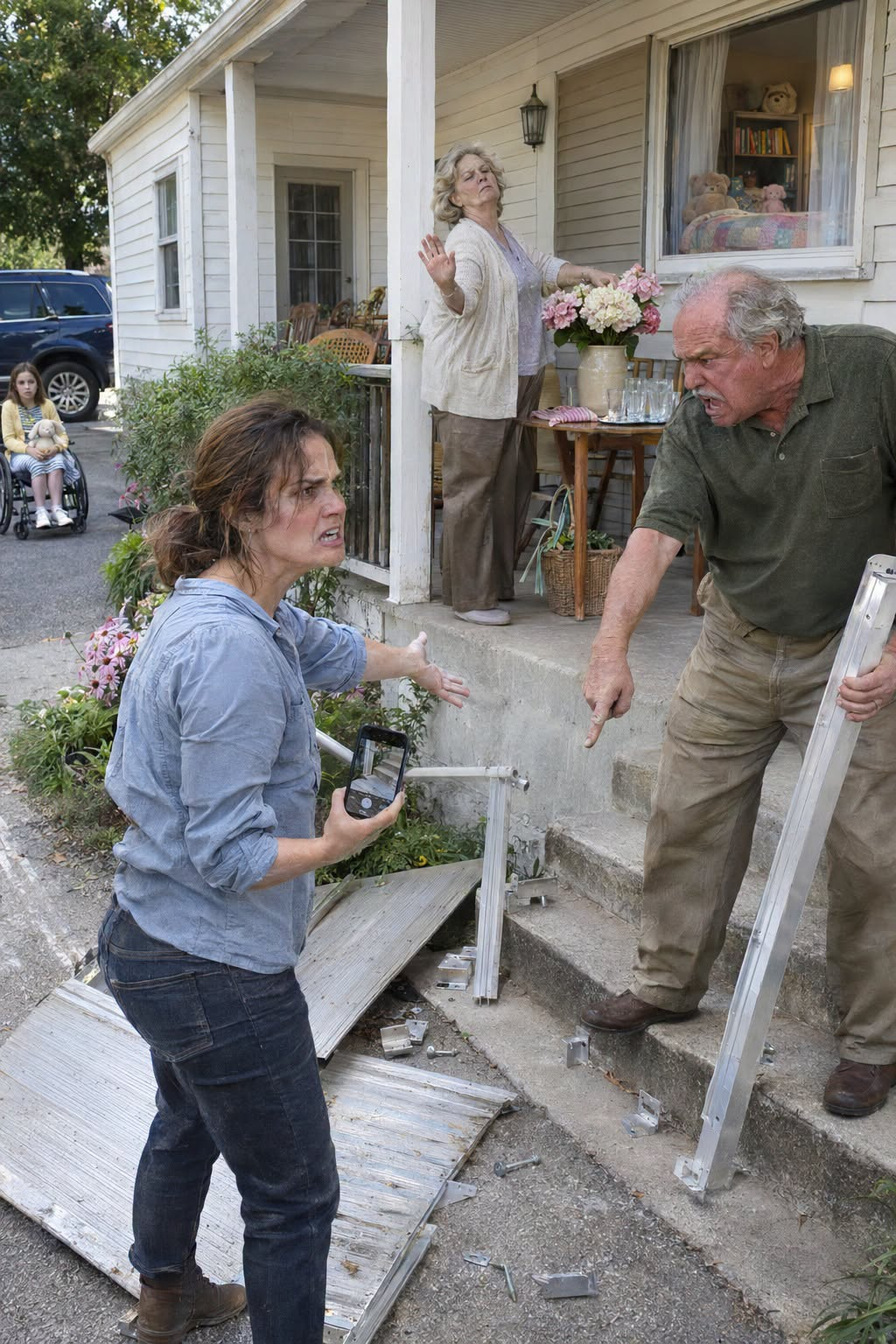
I looked at the photograph of the destroyed wheelchair ramp sitting in the dumpster.
My father had signed this agreement.
My mother had signed it too.
And six years later, they had ordered the ramp dismantled because it made their garden look less attractive.
I scrolled farther.
The document contained several pages of conditions, signatures, and references to a residential accessibility assistance program.
There was a financial figure on the second page.
$38,500.
I stared at it.
My parents had received $38,500 to convert their old garage into an accessible apartment.
The money had been provided specifically to create a permanent accessible living arrangement for a family member with mobility needs.
My daughter's name appeared repeatedly.
Rosie Rowe.
Not as an inconvenience.
Not as a temporary guest.
Not as someone who could be carried up four steps whenever the flowers needed rearranging.
She was the person the entire agreement had been designed to protect.
I felt something tighten inside my chest.
For six years, my parents had allowed me to believe they were simply doing us a favor.
They had never told me about the financial assistance.
They had never shown me the agreement.
And they had never explained that the apartment had been created under conditions specifically intended to protect Rosie's access.
I picked up my phone and called Thomas Avery.
He answered almost immediately.
"Jenna?"
"This is Jenna Rowe. I received your document."
"I figured you would."
"Can you explain what I'm looking at?"
There was a brief silence.
"Before I do, I need to ask you something. Have your parents removed the ramp?"
I closed my eyes.
"Yes."
"Recently?"
"Thursday."
He exhaled sharply.
"Then we have a serious problem."
I looked at the document again.
"Thomas, what exactly did my parents agree to?"
He took a breath.
"They agreed that the apartment would remain available to you and Rosie as an accessible family residence. The ramp was part of the approved accessibility plan. The agreement also required them to maintain an equivalent accessible entrance if the original installation ever needed to be replaced."
"So they couldn't just remove it?"
"Not without addressing the accessibility requirement and following the applicable approval process."
I felt my throat tighten.
"And the money?"
"That was part of the conversion assistance. The program helped cover the construction costs."
"Did my parents receive the money?"
"Yes. They were the property owners, so the assistance was issued through them."
I stared at the figure.
"Thirty-eight thousand five hundred dollars?"
"That's what the agreement shows."
I swallowed.
"Did they tell the program that Rosie would live there?"
"Absolutely. Her circumstances were central to the application."
I couldn't speak for several seconds.
Thomas continued.
"Jenna, I was involved in the original inspection. Your father told us he wanted to make sure his granddaughter had a permanent place where she could live independently."
I almost laughed.
Not because anything was funny.
Because the contrast was unbearable.
The man who had once promised my daughter an accessible home had watched her ask how she was supposed to climb four concrete steps.
And he had told her that her mother would figure something out.
"Thomas, why didn't I know about this agreement?"
"I can't answer that."
"Was I supposed to sign it?"
"Not necessarily. Your parents were the property owners and applicants. But your name appears in the occupancy section because the arrangement specifically identified you as Rosie's parent and tenant."
I looked at the final page.
My father's signature.
My mother's signature.
And a witness signature belonging to someone named Margaret Ellis.
"Who is Margaret Ellis?"
"She was the program coordinator at the time."
"Is she still there?"
"I don't know. I retired from the inspection office two years ago."
"Why did you contact me?"
Thomas hesitated.
"Because I saw the property listing."
I sat upright.
"You saw it?"
"Yes. A colleague sent it to me because he recognized the address. He remembered the accessibility conversion."
"And?"
"And the listing described the apartment as vacant guest accommodation."
I looked at the screen.
"That's what they're telling the buyers."
"I know."
He paused.
"Jenna, the original agreement was not supposed to be treated as a temporary arrangement."
I looked toward the hallway.
Rosie was asleep.
Her wheelchair was parked beside the guest bed.
I whispered, "Thank you for telling me."
Thomas gave me his email address and promised to send the remaining pages of the agreement, along with the original inspection records he still possessed.
Before ending the call, he said something that stayed with me.
"Your father was very proud of that apartment when it was completed. He told everyone he had built something special for his granddaughter."
I looked at the document.
"Apparently, he forgot."
The next morning, I took the agreement to Rebecca.
She read every page.
She examined the signatures.
She compared the dates with the lease and the property records.
Then she looked at me.
"Jenna, this changes the picture."
I leaned forward.
"How?"
"The agreement creates obligations that we need to investigate before anyone assumes your parents can simply remove the accessibility features and deliver the apartment as vacant."
"Can they sell the property?"
"They may be able to sell it, but the sale doesn't necessarily eliminate existing obligations. We need to verify the program requirements and determine whether they run with the property or bind the original applicants."
I nodded.
"What about the ramp?"
"That is an immediate concern. The agreement specifically addresses accessible entry."
She pointed to the second page.
"Your parents agreed to maintain access or provide an equivalent alternative. According to the photographs and your account, they removed the ramp without replacing it."
"Yes."
"And they represented the apartment as vacant before you had given notice."
"Yes."
Rebecca closed the document.
"I want to contact the program administrator and obtain the official records."
"Can they investigate?"
"If the agreement was part of a funded accessibility program, there may be reporting and compliance procedures. We'll need to confirm the exact terms."
I felt my heart beating faster.
"Could my parents lose the assistance?"
"Possibly, depending on the program conditions and what the investigation establishes. But our priority is protecting your tenancy and Rosie's access."
I nodded.
Then I remembered something.
"Rebecca, there's another document."
I showed her my father's old email.
The one mentioning that he'd handled the paperwork with an attorney before I signed the lease.
She read it carefully.
"Do you remember ever receiving a copy of the accessibility agreement?"
"No."
"Did your parents ever tell you that the apartment had been created under a special program?"
"No."
"Did you pay rent?"
"Every month."
"Do you have proof?"
I opened my banking application and showed her the recurring transfers.
She nodded.
"Keep those records."
Then she asked a question I hadn't considered.
"Did your parents ever tell you the rent was supposed to be reduced because of the accessibility funding?"
I shook my head.
"No. They chose the amount. I paid what they asked."
Rebecca wrote something down.
"That's worth reviewing."
I stared at her.
"Do you think they used the money to build the apartment and then charged me rent for living in it?"
"I think we need to examine the funding terms, construction expenses, and rental arrangement before drawing conclusions."
She was careful.
But I could see that she was taking the situation seriously.
Before I left, she prepared a formal notice disputing the forged termination agreement.
She also sent a request that my parents preserve all records relating to the apartment, the ramp removal, and the pending sale.
For the first time, I felt that someone was putting boundaries around the chaos.
When I returned to Marcy's house, Rosie was sitting at the dining table.
She was drawing a new picture.
This time, she had included three people standing in front of a yellow door.
Me.
Herself.
And Marcy.
I smiled.
"Who's that?"
"Marcy."
"Why is she in our new house?"
Rosie looked at me as though the answer were obvious.
"Because she helped us."
Marcy, standing near the sink, turned away quickly.
I kissed Rosie's forehead.
"That's very thoughtful."
Rosie added a sunflower beside the door.
Then she looked up.
"Mommy, did you find out why Grandpa took my ramp?"
I pulled out a chair.
"I found something that might explain it."
"What?"
"Your grandparents signed an agreement a long time ago saying you should have a safe, accessible place to live."
She stared at me.
"They did?"
"Yes."
"Does that mean they have to give me my ramp back?"
I hesitated.
"It means they made a promise that they were supposed to honor."
Rosie thought about that.
Then she looked down at her drawing.
"Why didn't they?"
I couldn't answer.
Not honestly.
Not without making excuses.
And I was finished making excuses for people who had hurt her.
"I don't know, sweetheart."
She nodded.
Then she asked, "Did they forget?"
I reached for her hand.
"I don't think they forgot."
She looked at me.
For a moment, neither of us spoke.
Then she quietly returned to her drawing.
At two thirty, my father arrived at Marcy's house.
I saw his truck through the front window.
My stomach tightened.
Marcy looked at me.
"Do you want me to answer?"
I shook my head.
"I'll speak to him."
She moved toward the living room.
"I'll stay nearby."
I stepped outside and closed the door behind me.
My father stood beside his truck.
He wore a navy polo shirt and khaki shorts.
His hair was neatly combed.
He looked exactly as he had on the afternoon the ramp was destroyed.
Calm.
Well-dressed.
Completely convinced that the world should accommodate him.
"Jenna."
"Dad."
He glanced toward the house.
"Can we talk?"
"What about?"
He looked irritated.
"Your attorney sent a ridiculous letter."
"It's not ridiculous."
"You've involved lawyers, the police, and a real estate agency. What exactly are you trying to accomplish?"
I stared at him.
"Why did you sign an agreement promising Rosie permanent accessible occupancy?"
His expression changed.
Only for a moment.
But I saw it.
"Where did you get that?"
"That's not an answer."
He looked toward the street.
"Thomas Avery contacted you."
I didn't respond.
He shook his head.
"I should have known."
"So you remember the agreement."
"Of course I remember it."
"Then why did you remove the ramp?"
He sighed.
"That agreement was made years ago."
"Six years."
"Things change."
"Does Rosie's disability change?"
His jaw tightened.
"Don't twist my words."
"You promised her an accessible home."
"I provided her with one."
"Until Thursday."
He stepped closer.
"Your mother wanted the entrance cleaned up for the sale. The ramp was old. We were going to deal with it."
"How?"
"That's not your concern."
I looked at him.
"Actually, it is."
He lowered his voice.
"Jenna, we have a buyer. The offer is good. Your mother and I need this sale to happen."
"Then why did you tell them the apartment was vacant?"
"Because we believed you were leaving."
"Before I told you?"
He didn't answer.
I felt my pulse quicken.
"You submitted that termination agreement Thursday morning."
His eyes narrowed.
"Who told you that?"
"Does it matter?"
"You have no idea what you're talking about."
I stared at him.
"I know I didn't sign it."
He looked away.
For a moment, the only sound was traffic moving along the street.
Then he said, "Your mother handled the paperwork."
I felt a chill.
"Did she copy my signature?"
He looked back at me.
"Don't accuse your mother of something you can't prove."
I took a breath.
"Then help me understand why my name is on a document I never signed."
My father rubbed his forehead.
"Jenna, we were trying to protect the family."
"From what?"
He looked toward the house again.
Then he said something that made my stomach drop.
"From the consequences of that agreement."
I stared at him.
"What consequences?"
He didn't answer.
Instead, he stepped toward his truck.
"Tell Rebecca Shaw to stop digging into the property records."
I remained still.
"Why?"
He opened the driver's door.
"Because she doesn't understand what she's getting involved in."
"Then explain it to me."
He stopped.
For several seconds, he stood with one hand on the door.
Then he turned.
"Your mother and I didn't have a choice."
I felt my heart pound.
"What does that mean?"
He climbed into the truck.
Before closing the door, he looked at me.
"Ask Thomas what happened to the original inspection."
Then he drove away.
I stood in the driveway for several minutes.
My father's last sentence kept repeating in my head.
Ask Thomas what happened to the original inspection.
I went inside.
Marcy was waiting near the kitchen.
"How did it go?"
"He admitted he remembered the agreement."
"And?"
"He said they were trying to protect the family."
Marcy frowned.
"From what?"
"I don't know."
I pulled out my phone and called Thomas.
He answered after several rings.
"Jenna?"
"My father just told me to ask you what happened to the original inspection."
There was a long silence.
Then Thomas said, "He said that?"
"Yes."
"Did he explain why?"
"No."
I heard him moving something in the background.
Then he said, "I need to find my old records."
"Can you tell me what you're looking for?"
"The original inspection report."
"Why is it important?"
"Because the final approval was conditional."
My heart started beating faster.
"Conditional on what?"
He didn't answer immediately.
"Jenna, the apartment passed the physical inspection. The ramp passed too. But there was one issue involving the original property documentation."
"What issue?"
"The program required the owners to disclose all existing financial interests and obligations connected to the property."
I frowned.
"Why?"
"Because the accessibility assistance was public funding. The administrators needed to know whether the property could be sold, transferred, or used in a way that undermined the purpose of the grant."
I swallowed.
"Did my parents disclose everything?"
Thomas was silent.
Then he said, "That's the part I need to verify."
I gripped my phone.
"What do you mean?"
"I remember a question being raised during the final review. Your father insisted the property was free of any conflicting obligations."
"And?"
"And I remember the reviewer asking for additional documentation."
I felt cold.
"Did he provide it?"
"I don't know. The original inspection file should show that."
"Can you find it?"
"I'll try."
I thanked him and ended the call.
I turned toward Marcy.
"Something else was going on with the property."
She looked concerned.
"What?"
"I don't know yet."
That evening, Rebecca sent me an email.
She had contacted the accessibility program administrator and requested the official agreement and compliance history.
The administrator confirmed that the property had received funding under a family accessibility housing initiative.
However, the office needed additional time to retrieve the original application and supporting records.
Rebecca also attached a preliminary title search.
I opened it.
The first pages showed the property ownership and mortgage information.
Then I reached a section titled:
RECORDED FINANCIAL INTERESTS AND PRIOR LIENS.
There was an entry dated two months before my parents received the accessibility assistance.
A private loan.
$112,000.
The lender was a company I'd never heard of.
I read the description.
Then I noticed another entry.
A security interest had been recorded against the property.
And beneath it was a reference to an additional agreement involving the attached apartment.
My father's name appeared as the signing party.
My mother's name appeared beside it.
I forwarded the document to Rebecca.
Then I called her.
"Did you see the private loan?"
"Yes."
"Is that why my father said they were protecting the family?"
"Possibly, but we need the underlying loan documents."
"Could the buyers know about it?"
"The title search should disclose recorded interests, but I can't tell you what the buyers were told."
I stared at the page.
"Rebecca, what happens if my parents promised the apartment to someone else before they received the accessibility funding?"
She paused.
"That would be a significant issue. We need to determine exactly what the earlier agreement says."
I looked toward the living room.
Rosie was watching a cartoon with Marcy.
Her laughter drifted down the hallway.
I lowered my voice.
"Could the apartment have been promised to someone before we moved in?"
"It's possible."
I felt my stomach tighten.
"Who?"
"We don't know yet."
At nine fifteen, Thomas called.
He sounded different.
More serious.
"Jenna, I found the original inspection file."
I sat upright.
"Did you find the report?"
"Yes."
"And?"
There was a pause.
"There's a document attached to the original application that I had forgotten about."
"What document?"
"A prior occupancy agreement."
I stopped breathing.
"Whose names are on it?"
"Your parents' names."
"Who else?"
Thomas hesitated.
Then he said, "A third party."
I closed my eyes.
"Who?"
"I don't want to guess from the scanned copy. But there's something else."
"What?"
"The agreement predates your move by almost two years."
I looked at the date on the loan record.
The timing matched.
Thomas continued.
"Your father told the inspection office that the earlier agreement had been terminated before the accessibility application was submitted."
"Was it?"
"I don't know. That's what the missing documentation was supposed to establish."
My hands began to tremble.
"Thomas, what was the third party entitled to?"
He took a breath.
"That's what I'm trying to understand."
Then I heard papers moving.
"Jenna, I found the original inspection note."
"What does it say?"
He was silent for several seconds.
Then he read the final handwritten line.
Approval must not proceed until the previous beneficiary's occupancy rights are formally released.
I stared at the wall.
"Previous beneficiary?"
Thomas didn't answer.
Instead, he said, "Jenna, I think your parents may have had another agreement involving this apartment before they promised it to Rosie."
My phone buzzed.
An email had arrived from Rebecca.
Subject: URGENT — ADDITIONAL PROPERTY RECORD.
I opened it.
There was a scanned document attached.
The first page contained the same private loan reference.
The second page listed the previous beneficiary.
I scrolled down.
And the name printed beneath the words ORIGINAL OCCUPANCY BENEFICIARY was—






Comments 0