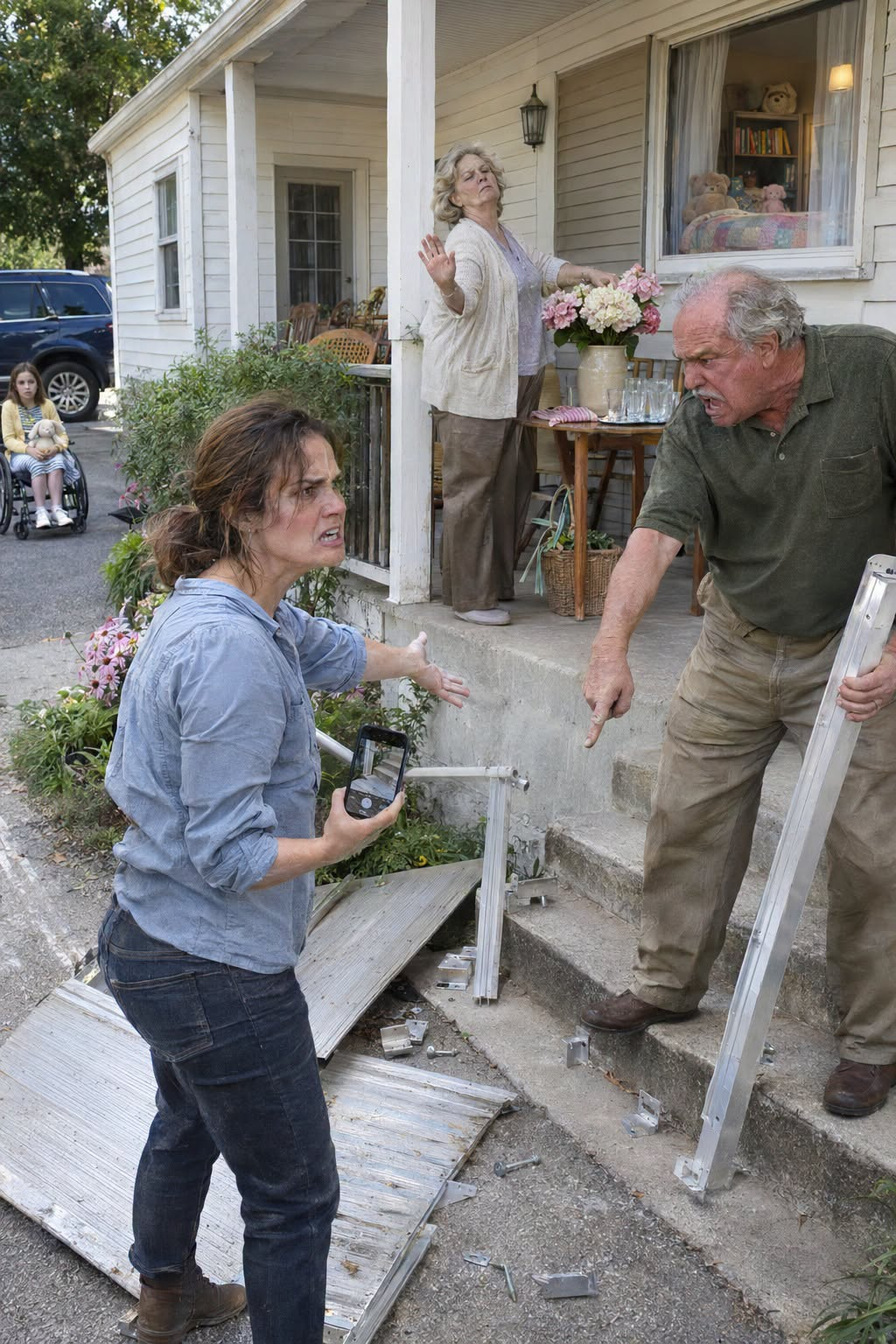
"Grandpa, where's my ramp?" Rosie called from her wheelchair.
My father, Gordon Rowe, stood on the concrete steps holding a piece of the aluminum railing I'd paid $4,800 to have installed.
A small yellow sunflower sticker was still attached to the metal.
Rosie had put it there herself.
My father looked at the sticker, then at my daughter, and said something that changed our family forever.
"Your mother can carry you."
I didn't scream.
I didn't cry.
I didn't even move for several seconds.
Because sometimes the worst things people do to you are so unbelievable that your brain refuses to accept them immediately.
Four hours earlier, Rosie had been laughing in the waiting room of the children's rehabilitation clinic.
She'd spent twenty minutes explaining to another little girl why her wheelchair had purple spokes.
"Because regular wheels are boring," she'd said with the confidence only a nine-year-old could possess.
The appointment had gone well.
Her physical therapist was pleased with her upper-body strength, and Rosie had proudly demonstrated how she could transfer from her wheelchair onto an examination table with minimal assistance.
For a child born with spina bifida, every new skill represented months of practice.
Every bit of independence mattered.
That was why I'd bought the ramp.
And that was why seeing it destroyed felt like watching someone deliberately tear apart a piece of my daughter's future.
Our apartment was attached to my parents' house in a quiet Ohio suburb.
It wasn't luxurious.
The kitchen cabinets were old, the bathroom sink leaked occasionally, and the furnace made a clicking sound every November.
But it was home.
Rosie had her own bedroom.
She had friends on the street.
She knew exactly how to maneuver her wheelchair through the hallway, around the kitchen table, and out the front entrance.
Most importantly, she could get inside without asking anyone to carry her.
Until that Thursday.
I had pulled into the driveway shortly after three in the afternoon.
The first thing I noticed was the lawn.
My father had always been particular about appearances, but the yard looked unusually perfect.
The grass was freshly cut.
The hedges had been trimmed into neat rectangles.
White flowers lined the walkway.
Two enormous ceramic planters stood beside the porch.
And the ramp was gone.
At first, I thought the landscaping crew had temporarily moved it.
Maybe they needed access to the foundation.
Maybe they were repairing something.
I searched the driveway for a replacement.
There wasn't one.
Then I noticed the dumpster.
A bent aluminum railing protruded from the top.
Yellow nonslip tape hung from its edge.
I recognized that tape immediately.
I'd installed it myself after Rosie nearly slipped during an icy winter morning.
"Mom?"
I turned toward the back seat.
Rosie was wearing her mustard-yellow sweatshirt, dark teal leggings, and white sneakers.
Her copper-red hair had escaped its ponytail during the drive.
She was holding the stuffed rabbit she'd carried to medical appointments since kindergarten.
"Why aren't we going inside?"
"Just a minute, sweetheart."
I stepped out of the SUV.
My father was standing near a landscaping truck, talking to a worker holding a clipboard.
He wore a navy golf shirt and khaki shorts.
He looked relaxed.
Almost cheerful.
I walked straight toward the dumpster.
There were three aluminum ramp sections inside.
One had been bent almost in half.
Another was missing its railing.
Loose bolts and mounting brackets lay scattered on the ground.
I recognized every piece.
I'd spent months saving for that ramp.
I'd worked overtime.
I'd canceled a vacation.
I'd postponed replacing my aging SUV.
And I'd paid a professional accessibility contractor to install it correctly.
My father had signed the installation agreement because he owned the property.
He'd stood beside me while the contractor explained how the ramp would be secured.
He'd even said it looked sturdy.
Now he watched me examine the wreckage without the slightest sign of embarrassment.
"Dad."
He glanced over.
"What happened to Rosie's ramp?"
"We had it removed."
I waited.
He looked back toward the landscaper.
"Make sure those shrubs are here by Friday. Vivian wants everything finished before the party."
"Dad."
He sighed.
"What?"
"Why did you remove the ramp?"
"Because it looked terrible, Jenna."
For a moment, I thought I'd misheard him.
"What?"
"Your mother's hosting twenty-six people Saturday. That thing made the entrance look like a loading dock."
I looked at the broken metal.
Then at him.
"Rosie uses that ramp every day."
"I know that."
"She can't get inside without it."
He shrugged.
"Then help her."
"Help her how?"
He gave me the irritated look I remembered from childhood.
The one that meant he believed I was being deliberately difficult.
"You're her mother. Pick her up and carry her."
I stared at him.
"She's nine years old."
"And?"
"She shouldn't have to be carried into her own home."
He folded his arms.
"Don't start."
Those two words brought back years of memories.
Don't start.
He'd said them when I questioned his decisions.
When I disagreed with his opinions.
When I tried to explain why something he'd said had hurt me.
To my father, any disagreement was disrespect.
Any boundary was rebellion.
And any problem that inconvenienced him was somebody else's responsibility.
But this wasn't about me.
This was about Rosie.
"Dad, that ramp cost forty-eight hundred dollars."
"I know what it cost."
"I paid for it."
"And it's my property."
The landscaper stopped writing.
I noticed him glance toward the SUV.
Rosie was watching us through the window.
My father noticed too.
His voice dropped.
"This is family business."
The worker looked uncomfortable.
He quietly stepped away.
That was when my mother appeared on the porch.
Vivian Rowe was carrying a ceramic vase filled with hydrangeas.
Her chestnut-brown hair had been carefully styled, and she wore a lavender linen blouse with olive trousers.
She looked as though she were preparing for a photograph.
"What's all this noise?"
I turned toward her.
"Mom, did you know Dad was removing Rosie's ramp?"
"Of course."
She said it as casually as if I'd asked whether she'd ordered groceries.
"We've been discussing the entrance for months."
"You've been discussing removing the only accessible entrance to our apartment?"
She adjusted a flower.
"Jenna, please don't be dramatic."
I felt something tighten in my chest.
"Rosie can't climb stairs."
"We know that."
"Then how is she supposed to get home?"
My mother looked at the steps.
Then at me.
"It's only four steps."
Four steps.
She said it like a measurement.
Like four steps were an inconvenience rather than a barrier.
I imagined asking her to sit in Rosie's wheelchair and climb them.
I imagined explaining how many times Rosie had cried during physical therapy because she wanted to do something her body couldn't safely do.
I imagined listing every doctor, therapist, and specialist who had helped my daughter build confidence.
But I didn't say any of it.
Because Rosie was calling me.
"Mommy?"
I walked back to the SUV.
She was looking toward the empty space beside the porch.
"Where's my ramp?"
I opened her door.
"Come here, sweetheart."
I helped her transfer into her wheelchair.
She did most of the work herself.
Her arms were strong.
Her movements were practiced.
She positioned her hands on the wheels and rolled forward.
Then she stopped.
Her eyes had found the dumpster.
"Mom."
Her voice changed.
"Is that my ramp?"
I crouched beside her.
"Yes."
She looked at the twisted aluminum.
"Did it break?"
"No, honey."
"Then why is it like that?"
I swallowed.
"Grandpa had it taken down."
She stared at me.
"Why?"
Before I could answer, my father approached.
"We're making the yard look nice for Grandma's party."
Rosie looked up at him.
"But how do I get inside?"
He gestured toward me.
"Your mother will help you."
Rosie turned toward the steps.
She studied them for several seconds.
Then she looked down at her wheelchair.
"But I can get inside by myself with my ramp."
My father said nothing.
My mother stepped closer, still holding her flowers.
"Don't look so upset, sweetheart. It's only four steps."
Rosie lowered her eyes.
I saw her fingers tighten around the rubber grips of her wheels.
Then she asked a question I will remember for the rest of my life.
"Did I do something wrong?"
Nobody answered immediately.
My father looked annoyed.
My mother looked embarrassed.
I felt as though someone had reached into my chest and squeezed my heart.
I knelt in front of Rosie.
"No."
She looked at me.
"Absolutely not."
"Then why did they throw my ramp away?"
I couldn't answer without telling her something a child should never have to hear.
That sometimes adults care more about appearances than people.
That sometimes the people who say they love you will make choices that hurt you because your needs inconvenience them.
That sometimes cruelty arrives dressed as practicality.
Instead, I held her hand.
"Rosie, we're not going inside today."
Her eyes widened.
"Where are we going?"
"Somewhere you can get through the front door."
My father stepped forward.
"Oh, for heaven's sake."
I stood.
"Don't make a spectacle of this, Jenna."
I took out my smartphone.
He frowned.
"What are you doing?"
I opened the camera.
I photographed the steps.
The exposed concrete anchors.
The broken aluminum panels.
The scattered mounting brackets.
The dumpster.
The landscaping company's name.
I walked slowly from the driveway toward the entrance, recording a short video.
There was no alternate ramp.
No temporary platform.
No accessible entrance.
Just four concrete steps.
My mother raised her voice.
"Are you seriously photographing your own parents?"
"Yes."
"Put that phone away."
I took another photograph.
My father moved closer.
"You're embarrassing yourself."
I looked at him.
"No, Dad."
He stopped.
"You removed my daughter's way into her home."
His face reddened.
"I own this house."
"I know."
"And I'll decide what belongs on it."
I nodded.
Then I turned toward Rosie.
"Sweetheart, let's go."
My father stared at me.
"You're leaving?"
"Yes."
"Over a ramp?"
I didn't answer.
I helped Rosie back into the SUV.
I folded her wheelchair and loaded it into the cargo area.
As I fastened her seat belt, she looked toward the porch.
My mother was already rearranging her hydrangeas.
My father had returned to the landscaper.
Neither of them came over to say goodbye.
Neither apologized.
Neither asked where we would sleep.
I started the engine.
We were halfway down the street when Rosie spoke.
"Mommy?"
"Yes, baby?"
"Did Grandma take my ramp away because she doesn't want me there anymore?"
I gripped the steering wheel.
I wanted to tell her no.
I wanted to tell her that her grandparents loved her exactly as she was.
But I'd just watched them destroy something essential to her independence because it offended their sense of beauty.
I couldn't lie.
"I don't know what Grandma was thinking."
Rosie was quiet.
"But I know you didn't do anything wrong."
She looked out the window.
"That's not what I asked."
I nearly pulled over.
Because she was right.
And because I didn't have an answer that wouldn't break her heart.
At the next red light, I called my friend Marcy Bell.
Marcy lived twenty minutes away in a ranch-style house with a level entrance.
She answered on the third ring.
"Hey, Jenna."
"Marcy, I need a favor."
Something in my voice made her serious.
"What happened?"
I told her.
Not everything.
Just enough.
When I finished, she was silent for a moment.
Then she said, "I'll put fresh sheets on the guest bed."
I closed my eyes.
"Thank you."
"Does Rosie want pepperoni or cheese pizza?"
From the back seat, Rosie called, "Both!"
Marcy laughed.
And for the first time that afternoon, my daughter smiled.
I thought that was the worst thing my parents could possibly do.
I thought destroying the ramp had been one selfish decision.
I thought we would spend a few nights at Marcy's house, find a lawyer, and figure out what came next.
I had no idea that my parents had been making plans behind my back for weeks.
And I certainly didn't know that the broken ramp was only the beginning.
That evening, after Rosie had fallen asleep in Marcy's guest room, I sat at the kitchen table reviewing the photographs on my phone.
One picture showed the dumpster from the side.
Another showed the broken ramp.
Then I enlarged the photograph of the concrete steps.
Something near the front door caught my attention.
A small white rectangular sign had been placed behind one of my mother's ceramic planters.
Most of it was hidden.
But I could read three printed words.
PROPERTY SHOWING NOTICE.
I stared at the screen.
Then I zoomed in farther.
There was a date printed beneath the words.
Saturday.
The day of my mother's garden party.
And beneath that was the name of a real estate agency I'd never heard of.
I reached for my laptop.
The agency's website loaded.
I entered my parents' street address into the search bar.
A property listing appeared.
I clicked it.
And the first photograph showed—






Comments 0