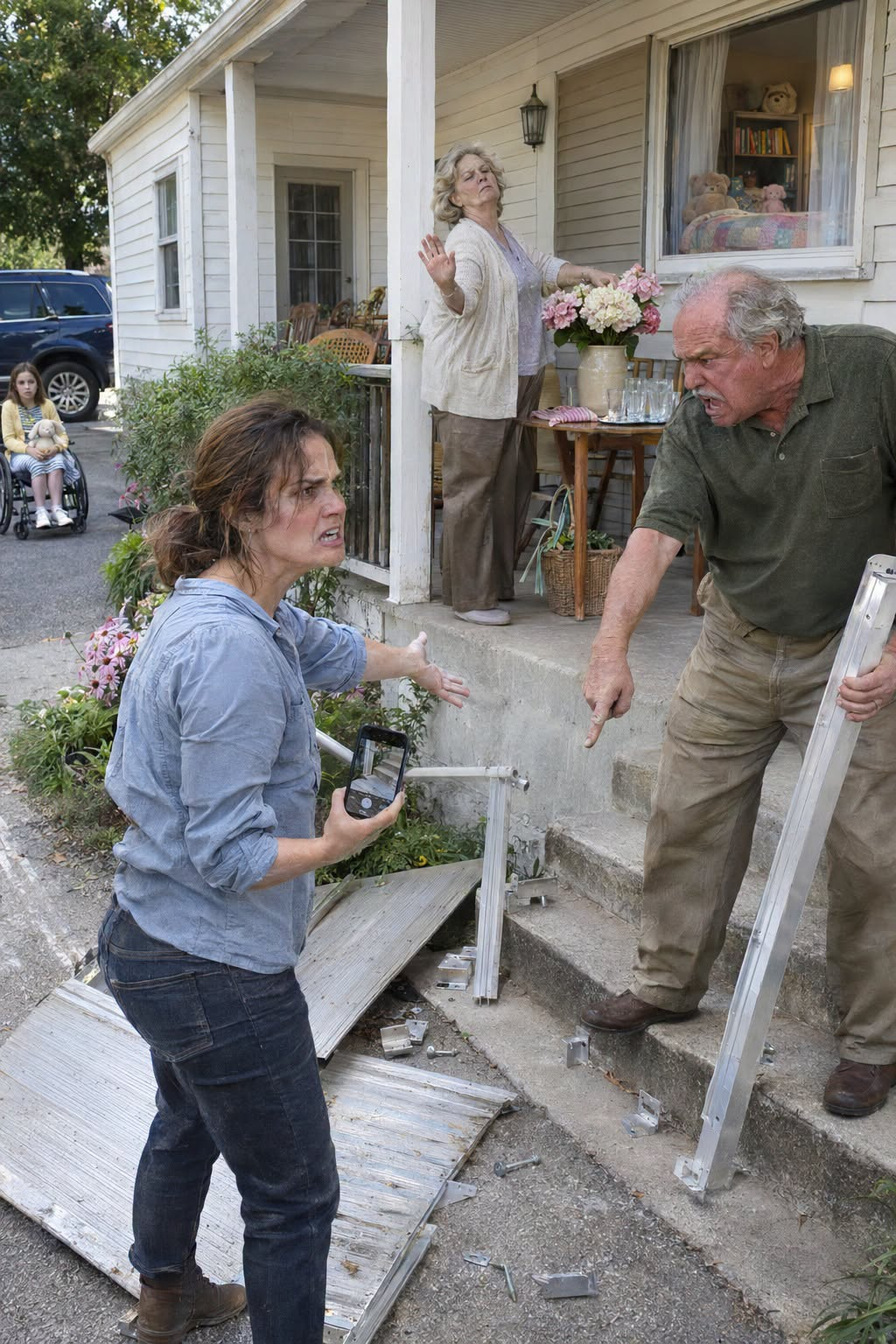
The woman standing inside my daughter's bedroom was my mother.
Vivian Rowe.
She was holding Rosie's purple memory box.
The little wooden box Rosie had decorated with sunflower stickers when she was seven.
I recognized the chipped corner and the crooked yellow flower painted on its lid.
My mother had no reason to be touching it.
And she certainly had no right to be carrying it around for a real estate photographer.
I enlarged the photograph until the image became grainy.
Behind my mother, Rosie's bookshelf was almost empty. Her favorite stuffed animals had disappeared from the bed. The framed photograph of Rosie and me at the county fair was missing from the dresser.
But what frightened me most wasn't what had been removed.
It was the expression on my mother's face.
She was smiling.
Not an uncomfortable smile.
Not the expression of someone who knew she was doing something questionable.
She looked pleased.
As though clearing out my daughter's belongings was simply another task on her garden-party checklist.
"Jenna?"
Marcy was standing beside me.
I hadn't realized I'd stopped breathing.
"That's my mother," I whispered.
Marcy leaned toward the screen.
"She's holding Rosie's box."
"I know."
"The one with her hospital bracelets?"
I nodded.
Rosie kept important things in that box.
Her first hospital identification bracelet.
A photograph of the physical therapist who had taught her to transfer independently.
A small silver charm from her eighth birthday.
A folded letter she'd written to herself after learning to navigate the ramp without assistance.
She called it her brave box.
And my mother was holding it like a decoration that needed to be moved out of the way.
Marcy looked at me.
"Call the police."
I already had my phone in my hand.
But before I dialed, I looked toward the living room.
Rosie was sitting at the coffee table, carefully coloring the windows of the imaginary house she'd drawn.
She was humming to herself.
For the first time in two days, she seemed peaceful.
I couldn't let her hear me panic.
"Marcy, can you stay with her?"
"Of course."
"Don't tell her what's happening yet."
Marcy nodded.
I stepped onto the back patio and called the local police department's non-emergency number.
My voice sounded strangely calm as I explained that I was a tenant, that my landlords were my parents, and that I had received photographs showing someone inside my apartment moving my belongings without permission.
The dispatcher asked whether anyone was in immediate danger.
"No."
"Are you currently at the property?"
"No. My daughter uses a wheelchair, and the accessible ramp was destroyed Thursday. We're staying with a friend."
There was a brief pause.
"Did you say the wheelchair ramp was destroyed?"
"Yes."
"By whom?"
"The property owners."
She asked for the address.
Then she asked whether I had a lease.
"Yes."
"Do you still have keys?"
"Yes."
"Have you formally moved out?"
"No."
She told me an officer could meet me at the property to document the situation, although disputes involving tenancy and access sometimes involved civil legal questions.
I understood.
I wasn't expecting someone to solve everything with one phone call.
I needed a record.
And I needed to know whether my daughter's belongings were still there.
Forty minutes later, I parked across the street from my parents' house.
I hadn't brought Rosie.
Marcy had promised to make grilled cheese sandwiches and watch a movie with her.
As I turned off the engine, I looked toward the porch.
The garden party was still going.
Several guests stood near the flower beds holding glasses.
A woman in a wide-brimmed hat admired the landscaping.
Someone laughed.
Soft music drifted through the open windows.
Everything looked normal.
That was the part I found almost unbearable.
My parents had destroyed a child's wheelchair ramp, entered our rented apartment, and apparently started clearing out our belongings.
Yet from the street, the house looked like the setting for a pleasant summer afternoon.
I took a photograph.
Then another.
A few minutes later, a police cruiser pulled up behind me.
Officer Daniel Price stepped out.
He looked to be in his early forties, with a calm expression and the tired patience of someone who had spent years listening to people argue.
"Ms. Rowe?"
"Yes."
He introduced himself and asked me to explain what had happened.
I showed him the lease.
The photographs of the destroyed ramp.
The installation invoice.
The real estate listing.
And finally, the image of my mother holding Rosie's memory box.
He studied everything without interrupting.
"You're saying you didn't authorize anyone to enter?"
"Correct."
"And you haven't surrendered possession of the apartment?"
"No."
"Do your parents have a key?"
"Yes. They own the property."
He nodded.
"All right. Let's speak with them."
My stomach tightened.
I had spent my entire childhood dreading confrontations with my father.
Even as an adult, some part of me still expected punishment whenever I challenged him.
But I wasn't a child anymore.
And this time, I wasn't asking him to be fair.
I was documenting what he had done.
My mother saw us first.
She was standing beside the porch table, arranging napkins.
Her expression changed when she noticed the police cruiser.
Then she saw me.
"Jenna?"
Several guests turned.
My father emerged from the house carrying a glass of iced tea.
He stopped when he saw Officer Price.
"What is this?"
The officer introduced himself.
"We're here regarding a report about the attached apartment."
My father looked at me.
"You called the police?"
I said nothing.
His face reddened.
"On your own parents?"
Officer Price spoke before I could answer.
"Sir, I'd like to ask a few questions."
My father straightened.
"About what?"
"Ms. Rowe reports that she rents the attached apartment and that someone entered and moved belongings without her permission."
My mother laughed nervously.
"Oh, goodness. Is that what this is about?"
She turned toward the guests.
"Please excuse us. Just a little family misunderstanding."
Nobody moved.
My father stepped down from the porch.
"Officer, my daughter is having an emotional episode because we removed an old ramp from our property."
I felt my jaw tighten.
Officer Price looked at him.
"Was the ramp being used?"
My father hesitated.
"It was an eyesore."
"That wasn't my question."
For the first time, my father seemed uncertain.
He glanced toward my mother.
Then back at the officer.
"My granddaughter uses a wheelchair."
"And the ramp provided access to the apartment?"
"Yes, but—"
"Was there another accessible entrance?"
My father looked toward the house.
"No."
The officer wrote something in his notebook.
My mother stepped forward.
"Rosie can be carried up the steps. Jenna is making this much more complicated than necessary."
Officer Price didn't respond to that.
Instead, he asked, "Has Ms. Rowe moved out?"
My father folded his arms.
"She told us she was leaving."
"Did she return her keys?"
"No."
"Did she remove her belongings?"
"Not all of them."
"Did she give written notice?"
My father's expression hardened.
"This is my house."
The officer nodded.
"I understand that you own the property. I'm asking about the tenancy."
My mother looked increasingly uncomfortable.
One of her guests quietly moved toward the driveway.
Another pretended to examine a flower arrangement.
My father noticed.
His voice dropped.
"Can we discuss this privately?"
Officer Price looked at me.
"Ms. Rowe, would you like to inspect the apartment?"
"Yes."
My father immediately said, "That's unnecessary."
I turned toward him.
"Why?"
He didn't answer.
I took my keys from my pocket.
"Because my daughter lives there."
The entrance to our apartment was beside the porch.
Four concrete steps separated it from the driveway.
Without the ramp, I could climb them.
Rosie couldn't.
That difference had never seemed more important.
I walked up the steps with Officer Price beside me.
My father followed.
My mother stayed on the porch.
I unlocked the apartment door.
The first thing I noticed was the smell.
Furniture polish.
My mother loved furniture polish.
She used so much of it that the main house sometimes smelled like a department store display.
Our apartment had never smelled that way.
I stepped inside.
The living room was almost unrecognizable.
The couch had been moved against the opposite wall.
The bookshelf was empty.
The family photographs were gone.
The small table beside the window had disappeared.
I looked toward the kitchen.
My red coffee maker was missing.
So was Rosie's painted fruit bowl.
I walked down the hallway.
The wooden chest was gone.
The framed pictures had been removed from the walls.
I stopped outside Rosie's bedroom.
For a moment, I couldn't make myself enter.
Then I pushed the door open.
Her bed was still there.
The lavender curtains were still hanging.
But the room looked wrong.
Too clean.
Too empty.
The stuffed animals were gone.
Her books were gone.
Her art supplies were gone.
And the purple memory box was nowhere to be seen.
I turned toward my father.
"Where are her things?"
He looked irritated.
"Your mother was organizing."
"Where are they?"
"In storage."
"What storage?"
"The garage."
I stared at him.
"You moved my daughter's belongings into the garage?"
"We needed the apartment presentable."
"For whom?"
He looked away.
Officer Price stepped forward.
"Mr. Rowe, did you enter this apartment today?"
"My wife did."
"With permission from the tenant?"
My father sighed.
"She's my daughter."
The officer waited.
My father finally said, "No."
I looked around Rosie's room.
There was an empty space beside the dresser where her transfer board normally stood.
"Where's her medical equipment?"
My father frowned.
"What equipment?"
"The board she uses to transfer from her wheelchair."
"I don't know."
I walked into the hallway.
I checked the closet.
Nothing.
I returned to the bedroom.
"Where is it?"
My father raised his voice.
"Jenna, I don't know where every little thing is!"
I turned toward him.
"That isn't a little thing."
Officer Price lifted one hand.
"Let's keep this calm."
I took a breath.
Then I asked my father to show me the garage.
My mother was waiting outside.
She looked furious.
"Are you finished humiliating us?"
I walked past her.
"Where did you put Rosie's things?"
She followed me.
"In the garage."
"All of them?"
"Most of them."
"Why?"
"Because we were preparing the apartment for visitors."
"What visitors?"
She stopped.
I turned.
"Mom?"
Her expression changed.
For a second, I thought she might finally tell me the truth.
Instead, she said, "Your father handles the financial arrangements."
I stared at her.
"What financial arrangements?"
She looked toward the driveway.
"Jenna, not now."
Officer Price asked whether the garage was accessible.
My father reluctantly opened it.
Inside were several cardboard boxes.
Some had labels.
KITCHEN.
BOOKS.
BEDROOM.
One box had Rosie's name written across the top.
I walked toward it.
The cardboard was damp along one edge.
I opened the flaps.
Inside were her stuffed animals.
Her school photographs.
Her favorite books.
And the purple memory box.
I picked it up.
The lid was scratched.
One sunflower sticker had peeled away.
I opened it.
The hospital bracelets were still inside.
The silver charm was there.
But the folded letter was missing.
I searched through the box.
Nothing.
My father stood behind me.
"Are we done?"
I looked up.
"Where's the letter?"
"What letter?"
"The one Rosie kept in here."
He shrugged.
"How would I know?"
I wanted to shout.
I wanted to ask how two people could be so careless with things that mattered so much to a child.
Instead, I closed the box.
Officer Price asked whether I wanted to make an inventory of the items.
"Yes."
I photographed every box.
Every label.
Every piece of furniture stacked against the garage wall.
Then I found Rosie's transfer board leaning behind an old lawn mower.
I picked it up.
There was a fresh scratch across the surface.
My hands trembled.
I looked at my parents.
Neither apologized.
Neither seemed concerned.
My father simply checked his watch.
"We have guests waiting."
Officer Price explained that he would document the report and that questions about unlawful entry, damaged property, and tenancy rights might require further investigation or civil legal action.
He advised me to keep copies of my evidence and speak with an attorney.
I thanked him.
Before leaving, he asked my parents not to move or dispose of any additional belongings while the dispute was unresolved.
My father nodded stiffly.
My mother looked as though she'd swallowed something unpleasant.
When the officer returned to his cruiser, I stayed beside my SUV.
My father approached.
"You've made your point."
I looked at him.
"What point?"
"That you're willing to embarrass your family."
I stared at him.
"Rosie asked me if Grandma took away her ramp because she wasn't wanted anymore."
For the first time, his expression shifted.
Only slightly.
But I saw it.
Then he looked away.
"Children misunderstand things."
"She understood exactly what happened."
He folded his arms.
"You're filling her head with nonsense."
I shook my head.
"No, Dad. I'm trying to help her understand why the people who claim to love her destroyed something she needed."
His face hardened.
"Watch your tone."
I almost laughed.
There it was again.
The old command.
The same one he'd used when I was twelve.
When I was seventeen.
When I was twenty-five.
But I was forty-one now.
And I had a daughter who needed me to be stronger than the fear I'd carried since childhood.
"I need you to stop entering our apartment," I said.
He stared at me.
"I need our belongings left alone. And I need you to communicate with me in writing."
"You don't get to dictate terms."
"I'm not asking permission."
His jaw tightened.
For a moment, I thought he might shout.
Instead, he stepped closer.
"You have no idea what you're interfering with."
I held his gaze.
"Then tell me."
He said nothing.
"Are you selling the house?"
His eyes narrowed.
"That's none of your business."
"It is when my daughter and I live there."
He looked toward the porch.
My mother was watching us.
Then he lowered his voice.
"Your mother and I have financial obligations you wouldn't understand."
I stared at him.
"What obligations?"
He stepped back.
"Go home, Jenna."
I looked at the house.
Then at the empty space where Rosie's ramp had stood.
"That's what I've been trying to do."
I returned to Marcy's house with Rosie's memory box, transfer board, and two bags of essential belongings.
I didn't tell Rosie everything.
Not yet.
I showed her the box.
Her face lit up.
"My brave box!"
She opened it immediately.
Then her smile faded.
"Where's my letter?"
I sat beside her.
"I couldn't find it."
She searched again.
Her fingers moved carefully through the hospital bracelets and photographs.
"It was right here."
"I know."
She looked at me.
"Did Grandma throw it away?"
"I don't know."
Rosie closed the lid.
For a moment, she looked very small.
Then she said, "I wrote that letter when I learned to use my ramp."
I nodded.
"I remember."
"I said I wasn't scared anymore."
My throat tightened.
She looked toward her wheelchair.
"Maybe Grandma thought it was just paper."
I put my arm around her.
"Maybe."
She leaned against me.
Then she whispered, "But it was important to me."
"I know, sweetheart."
And I did.
More than anyone.
That night, I reviewed everything again.
The photographs.
The lease.
The messages.
The real estate listing.
The police report number.
The installation contract.
My father's statements.
My mother's messages.
I arranged the documents chronologically.
Then I noticed something.
The listing photographs taken before the ramp was removed showed the apartment fully furnished.
The updated photographs showed it nearly empty.
The seller's disclosure claimed we were voluntarily vacating.
And my mother had asked whether I'd removed our things before the garden party.
It wasn't random.
The ramp removal.
The photographs.
The boxes.
The party.
Everything seemed connected to the sale.
I opened the real estate listing again.
The asking price was still $489,000.
But a new line had appeared beneath it.
STATUS: PENDING.
I stared at the screen.
Pending.
Someone had apparently made an offer.
And my parents had accepted it.
I checked the date.
Saturday.
The same day as the garden party.
My phone buzzed.
Caroline Hayes.
"Ms. Rowe, I'm sorry to contact you so late. I wanted you to know that the property status has changed."
I replied immediately.
"I saw."
Another message appeared.
"The buyers have requested confirmation that the attached apartment will be vacant at closing."
I felt my stomach drop.
I typed, "It won't be vacant unless my tenancy is lawfully resolved."
Caroline responded.
"I understand. I've informed my supervising broker of the dispute."
Then another message arrived.
"There is something else. The buyers received a document this afternoon that I had not previously seen."
I sat upright.
"What document?"
A photograph appeared.
It showed a single sheet of paper.
At the top were the words:
VOLUNTARY TENANCY TERMINATION AGREEMENT.
Below them was my full name.
Jenna Rowe.
And at the bottom of the page—
there was a signature.
My signature.
Except I had never signed it.
I enlarged the image.
The handwriting looked almost perfect.
Someone had copied the way I formed the J.
The long curve of the R.
Even the little line I always put beneath my last name.
I stared at it.
Then I noticed the date beside the signature.
Thursday.
The day my parents destroyed Rosie's ramp.
My phone rang.
Caroline.
I answered.
"Jenna," she said quietly, "there's something you need to know about who submitted that agreement."
I gripped the phone.
"Who?"
She hesitated.
Then she said, "The document didn't come directly from your father."
I stopped breathing.
"It came from someone who claimed to be acting on your behalf."
A new email appeared on my laptop.
Caroline had forwarded the submission record.
I opened it.
There was a name in the sender field.
I clicked to reveal the full address.
And the person who had submitted the forged agreement was—






Comments 0