I stared at the title of the document.
CONFIDENTIAL FAMILY PROPERTY TRANSFER — JENNA ROWE AND ROSIE ROWE.
For several seconds, I couldn't bring myself to open the remaining pages.
Rebecca sat across from me, watching my expression.
"Take your time."
I clicked the attachment.
The first page contained the property address, the names of my parents, and a description of the apartment that Rosie and I had occupied for six years.
The second page contained a proposed transfer arrangement.
My parents had apparently agreed to transfer a portion of the property's residential interest to me, with specific provisions protecting Rosie's accessible occupancy.
I read the paragraph twice.
There was no mention of selling the apartment.
No mention of removing the ramp.
No mention of making us leave.
Instead, the agreement described a future arrangement under which I would become responsible for maintaining the apartment as a permanent accessible residence for Rosie.
I looked at Rebecca.
"Why would they prepare something like this if they intended to sell the house?"
"That's what we're trying to establish."
I continued reading.
The document had been prepared six years earlier, shortly before Rosie and I moved into the apartment.
There were references to an independent property assessment, a transfer of residential interest, and a separate financial settlement.
Then I reached the final page.
My father's signature appeared first.
My mother's appeared beneath it.
The third signature belonged to Margaret Ellis.
And the fourth line was blank.
INTENDED RECIPIENT: JENNA ROWE.
There was no signature.
I looked at Rebecca.
"I never received this."
"Did your parents ever discuss transferring part of the property to you?"
"No."
"Did they ever tell you that you would eventually own the apartment?"
"No."
Rebecca closed the document.
"Then we need to determine whether this was an unsigned proposal, an executed agreement with a missing page, or something else."
I leaned back.
For six years, I'd believed I was simply renting an apartment from my parents.
Now I was discovering that there had been several arrangements involving my name, Rosie's needs, and the property.
Some were incomplete.
Some appeared to contain unauthorized signatures.
And others seemed to have been hidden from everyone involved.
"Rebecca, why would my mother sign an agreement promising us part of the property and then use our occupancy rights as security for a loan?"
Rebecca didn't pretend to know.
"Money may have been involved. But we need the financial records before reaching a conclusion."
I looked at the date.
June 8.
Four days before the loan authorization.
Six years earlier.
Then I noticed a handwritten note in the margin.
Transfer to be completed once outstanding financing is cleared.
I pointed to it.
"Does that mean they intended to give us the apartment after the loan was paid?"
"That's one possible interpretation."
"Then why didn't they?"
Rebecca looked at me.
"Perhaps the financing was never cleared. Or perhaps the parties changed their intentions. We need the complete transaction history."
I stared at the blank signature line.
For the first time, I wondered whether my parents had once intended to give Rosie a permanent home.
And whether something had happened that made them abandon that promise.
On the drive back to Marcy's house, I called Eleanor.
She answered immediately.
"Did you see the document?"
"Yes."
"Was my name on it?"
"No. Your name appeared in the original agreement, but this one was prepared for me and Rosie."
Eleanor sighed.
"That sounds like Gordon."
"What do you mean?"
"He always liked having several plans at once."
I frowned.
"Several plans?"
"When the apartment was being constructed, your father told me he wanted to keep it available for family members who needed accessibility accommodations. He said it would be an investment in the family's future."
"Did he ever mention transferring ownership?"
"Not to me."
I looked through the pages Rebecca had sent.
"Aunt Eleanor, did you know my parents were planning to give us part of the property?"
"No."
"Did you know about the private loan?"
"Yes."
"Did you know they used the accessibility funds to purchase another property?"
There was a long silence.
"No, Jenna. I didn't."
I believed her.
Her voice sounded genuinely shocked.
Then she asked, "Have you spoken to Margaret?"
I stopped walking.
"Margaret Ellis?"
"Yes."
"No. Why?"
"Because she knew about the original agreement. She was there when your father promised me the apartment."
I looked at the witness signature.
"She also witnessed the documents claiming you and I signed releases."
Eleanor became quiet.
"Then you need to speak to her."
"Rebecca says we shouldn't contact anyone involved until we understand the records."
"She's probably right."
Eleanor paused.
"But there's something I want you to know."
"What?"
"Margaret wasn't always Vivian's friend."
I frowned.
"What does that mean?"
"They became close after your father started having financial problems."
I waited.
"Before that, Margaret was the person who helped me navigate the accessibility program. She knew my medical needs, my housing requirements, and the original plans for the apartment."
"Why would she help my mother?"
"I don't know."
Eleanor sighed.
"But I remember something she told me during the final inspection."
"What?"
"She said the apartment was supposed to protect the person who needed it most, not the person who owned the house."
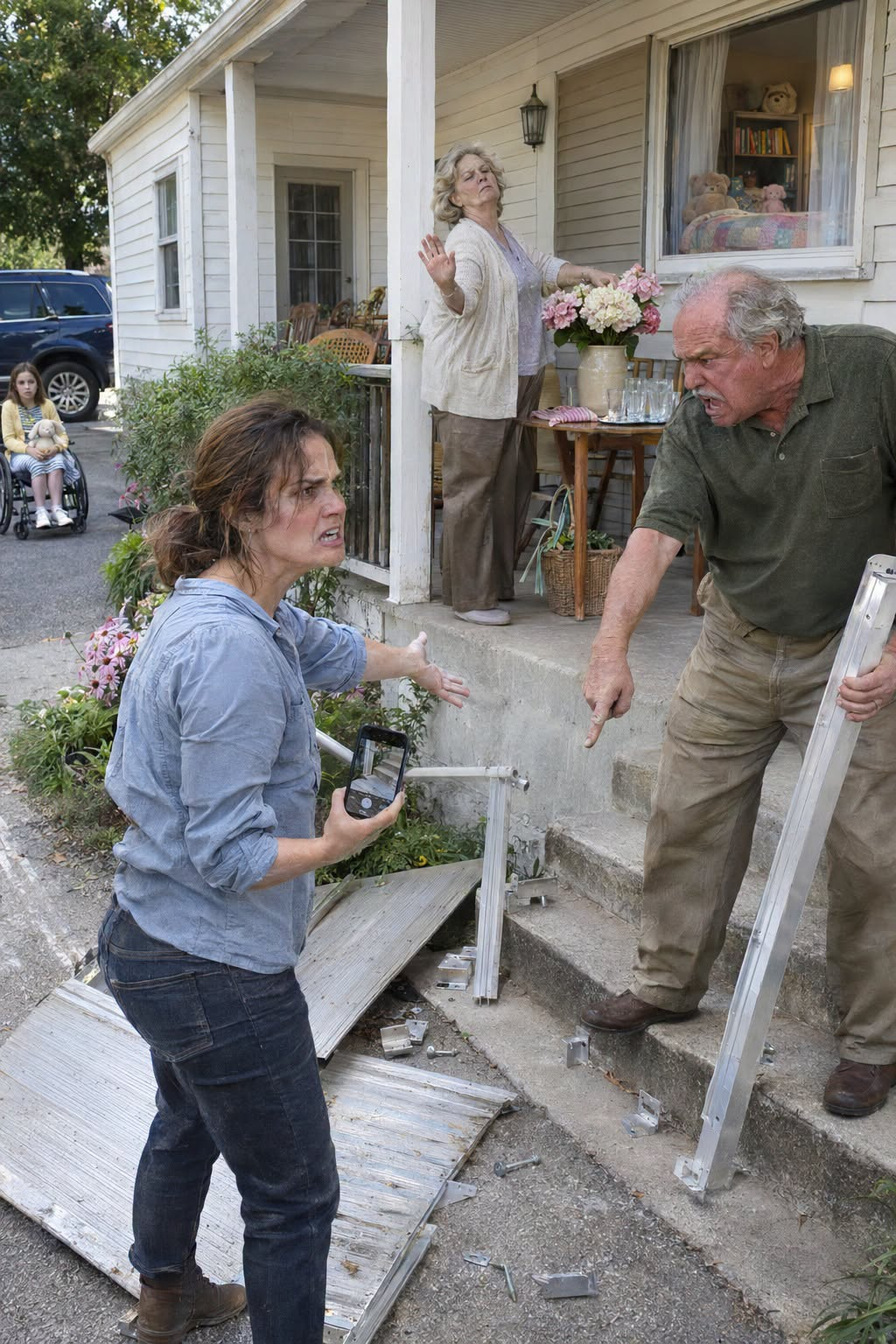
I looked at the photographs of the broken ramp.
Those words stayed with me.
That evening, Rosie asked whether we could call Great-Aunt Eleanor again.
I smiled.
"Of course."
She climbed onto the couch beside me, holding her favorite stuffed rabbit.
Eleanor answered on the second ring.
"Hello, sweetheart."
"Hi!"
"How was your day?"
"Good. I drew another house."
"Did you put the sunflowers outside?"
"Yes. And I made the ramp wider."
Eleanor laughed.
"That's very important."
Rosie showed her the drawing through the camera.
Eleanor leaned closer.
"That's beautiful."
Then Rosie asked, "Can I come see your house?"
"Whenever your mother says it's all right."
"Does your ramp have lights?"
"It does."
"Are they yellow?"
"No. They're white."
Rosie considered that.
"I think yellow would look prettier."
"I agree."
They continued talking about flowers and wheelchair ramps.
I watched them.
For the first time since discovering the original agreement, I felt something other than anger.
My daughter was connecting with someone who understood her experience.
Someone who didn't see her wheelchair as a problem.
Someone who didn't expect her to apologize for needing an accessible entrance.
When the call ended, Rosie turned toward me.
"I think Great-Aunt Eleanor is nice."
"She is."
"Why didn't we visit her before?"
I brushed a strand of hair away from her face.
"Sometimes grown-ups make decisions that aren't fair to other people."
Rosie nodded.
"Like Grandma?"
I didn't answer immediately.
Then I said, "Yes. Like Grandma."
The following morning, Rebecca called.
She had received an update from the lender.
The original $112,000 loan had been divided into two payments.
The first had gone to the construction company.
The second had been transferred into Rowe Property Holdings.
But the company had not used the entire amount to purchase the commercial property.
There had been another transfer.
$27,000.
It had gone to an account belonging to Vivian Rowe.
I stared at the figure.
"An account in my mother's name?"
"That's what the records indicate."
"What did she do with it?"
"We haven't established that."
I looked at the document.
"Could it have been used for personal expenses?"
"Possibly. We need the bank statements."
I felt my stomach tighten.
"Rebecca, does this mean the accessibility money was used for something other than the apartment?"
"The records raise that question. But the exact source and legal classification of the funds need to be confirmed."
I nodded.
Then she said something else.
"The lender also provided a copy of the original collateral schedule."
"What is that?"
"A list of assets and interests associated with the loan."
I closed my eyes.
"Is Rosie's occupancy arrangement on it?"
"Yes."
I felt sick.
"Anything else?"
Rebecca hesitated.
"Your parents also listed a future residential transfer agreement."
"The document I saw yesterday?"
"Apparently."
I looked at the blank signature line.
"Can they use an unsigned agreement as collateral?"
"That depends on the transaction and applicable law. But I want you to see the full schedule."
She sent it.
I opened the attachment.
The list contained the house, the attached apartment, the commercial property, and several financial interests.
At the bottom was a reference to an insurance policy.
It was held in Rosie's name.
I read the line again.
CHILD BENEFICIARY POLICY — ESTIMATED VALUE: $50,000.
I felt my hands go cold.
"Rebecca?"
"Yes?"
"Why is Rosie's insurance policy on this list?"
Rebecca was silent for several seconds.
"Jenna, I don't think that should have been included without proper authorization. We'll need to investigate immediately."
I stared at the screen.
The policy had been established when Rosie was born.
My parents had contributed some money to it during her first year.
I had forgotten about it.
I'd assumed the policy was simply a small financial safeguard for her future.
Now it appeared in the collateral schedule for a loan I had never approved.
"Can they access that money?"
"We need to contact the insurer and determine the policy ownership, beneficiary designation, and whether any assignment or borrowing provision was executed."
I swallowed.
"Please do that."
"I will."
After the call, I searched through my old files.
I found the insurance folder in a storage box.
The original policy was there.
I opened it.
The owner was listed as Jenna Rowe.
The insured person was Rosie Rowe.
The beneficiary was listed as a trust established for her benefit.
But there was a later amendment.
Dated six years earlier.
The amendment changed the ownership arrangement.
I looked at the signature.
My name appeared beneath the words:
AUTHORIZED POLICY ASSIGNMENT.
I felt my stomach turn.
I had never signed it.
I took the document to Rebecca that afternoon.
She examined it carefully.
"Did you recognize the form?"
"No."
"Did you receive a notice from the insurer?"
"No."
"Did you ever agree to assign the policy?"
"Never."
Rebecca placed it beside the loan authorization.
The signatures looked similar.
Not identical.
But similar enough to make my skin crawl.
"Jenna, we'll need a document examiner."
"Do you think they're forged?"
"I think they require independent examination."
She scanned both pages.
Then she asked me to provide an example of my signature from the same period.
I gave her an old employment contract.
She compared the documents.
"Your signature has a distinctive final stroke," she said.
I looked at the page.
"What's different?"
"The authorization has a slightly different formation in the last two letters."
I leaned closer.
I could see it now.
The signature looked convincing from a distance.
But the final stroke was wrong.
I felt my throat tighten.
"Someone copied it."
"We'll let the examiner determine that."
I nodded.
Then Rebecca opened the policy's amendment history.
There was another page.
This one contained a witness declaration.
Margaret Ellis.
Again.
I stared at the name.
"She's everywhere."
Rebecca nodded.
"Her name appears on the accessibility release, the loan authorization, and now the insurance amendment."
"Why?"
"That's one of the questions we need answered."
I leaned back.
"Can we contact her?"
"We can send a formal request for information. I would prefer not to have you approach her personally."
I agreed.
Before leaving, Rebecca made copies of everything.
She also advised me to contact the insurer through the formal process and request that no further changes be made to the policy until the disputed authorization was investigated.
I followed her instructions.
That night, my father called.
I almost ignored it.
But I decided to answer.
"Hello, Dad."
"Jenna."
His voice sounded unusually controlled.
"We need to talk."
"About what?"
"Your mother tells me you've been contacting the bank."
I looked toward Rosie.
She was watching television with headphones.
"Yes."
"Why?"
"Because there are documents with my signature that I never signed."
He exhaled.
"Your mother explained everything."
"Then explain it to me."
"You're misunderstanding the paperwork."
"Which paperwork?"
"All of it."
I closed my eyes.
"Dad, why is Rosie's insurance policy listed as collateral for your loan?"
Silence.
Then he said, "That policy was part of a family arrangement."
"Did I authorize it?"
"We discussed it."
"No, we didn't."
"You were young. You didn't understand the financial structure."
I felt my hands tighten.
"I was a mother. I understood perfectly well that Rosie's money and insurance belonged to her."
"Jenna, don't start."
"Did you use her policy to secure the loan?"
He didn't answer.
"Did you?"
Finally, he said, "We were trying to keep the property."
I stared at the wall.
"Why?"
"Because we had obligations."
"What obligations?"
He sighed.
"Your mother and I had invested in something. It didn't work out."
"What did you invest in?"
"That's not important."
"It became important when you used my daughter's property and savings."
He raised his voice.
"Nobody took anything from Rosie!"
I looked at the bank statement.
Then at the insurance amendment.
Then at the destroyed ramp photograph.
"You removed her access to her own home."
"That was temporary."
"You listed the apartment as vacant."
"We thought you were leaving."
"You used her savings."
"We intended to repay it."
"And you pledged her occupancy arrangement."
He became silent.
For the first time, I heard uncertainty in his breathing.
Then he said, "Jenna, your mother and I were trying to protect you."
"From what?"
He didn't answer.
I waited.
Finally, he said, "From the lender."
I felt my stomach tighten.
"What lender?"
He seemed to realize what he'd said.
"Forget it."
"Dad, what lender?"
"I shouldn't have called."
He hung up.
I stared at the phone.
The lender.
Not the buyers.
Not the accessibility program.
The lender.
My parents weren't simply trying to sell the property because they wanted a better financial arrangement.
They were trying to protect something from someone.
And that person had apparently been waiting for six years.
The next morning, Eleanor sent me another message.
She had found a handwritten note in her old correspondence.
It was dated shortly after the original accessibility inspection.
The note was from Margaret Ellis.
It read:
Eleanor, I hope you understand that the apartment was never intended to become a financial instrument. Gordon has been told that the accessibility funding cannot be redirected for private investment. Vivian believes she can resolve the matter before the final review, but I am not comfortable with the documents she has submitted.
I read it twice.
Then I called Eleanor.
"Did Margaret write this?"
"Yes."
"Why didn't you show it to me earlier?"
"I had forgotten it existed. I kept the letter because I thought it was unusual."
I swallowed.
"Did you ever respond?"
"No. By then, your father had stopped returning my calls."
I looked at the note.
Margaret had known about the redirected funds.
She had questioned the paperwork.
And yet her signature appeared on every document.
"Did you trust her?"
"At first."
"And later?"
Eleanor sighed.
"I wasn't sure what to believe."
I thanked her and forwarded the note to Rebecca.
Within minutes, Rebecca replied.
She wanted to speak to Eleanor directly and obtain the original letter.
I arranged a call for the following afternoon.
For the first time, there was a possibility that someone outside my family had documented the problems before Rosie and I ever moved into the apartment.
At three the next day, Rebecca called me.
"Jenna, we have a problem."
I stood up.
"What happened?"
"The lender has issued a formal demand."
"For what?"
"Repayment of the outstanding balance."
I felt my heart pound.
"How much?"
"Approximately $96,000, subject to the final accounting."
I stared at the kitchen wall.
"Are they demanding it from my parents?"
"From the borrowers and the parties identified in the guarantee documents."
"Am I included?"
"Your name appears in the disputed authorization, but we are challenging that. We need to ensure you are not treated as an authorized guarantor or collateral provider."
I swallowed.
"What happens if they don't pay?"
"The lender may pursue its remedies under the loan documents. That's why the property sale has become urgent."
Everything suddenly made sense.
The rushed closing.
The pressure to make the apartment appear vacant.
The removal of the ramp.
The attempt to keep Eleanor from asserting her rights.
My parents weren't simply trying to sell a house.
They were trying to complete a transaction before the lender could interfere.
"Rebecca, can they sell the property while the loan is outstanding?"
"That depends on the security documents and the lender's consent. We need to examine the recorded interests."
I looked at the closing date.
July 8.
Only a few weeks away.
"What's our next step?"
"I'm contacting the buyer's attorney and the lender. We also need to protect the insurance policy and Rosie's financial interests."
I nodded.
Then Rebecca added something.
"The lender has agreed to provide one more document."
"What document?"
"The original correspondence between your parents and the private lending company."
I felt my stomach tighten.
"Why is that important?"
"Because it may establish what your parents told the lender about the apartment, Eleanor, and your daughter's occupancy rights."
I waited.
Rebecca continued.
"And Jenna, the lender's representative says the original correspondence contains a separate agreement involving a third person."
"Who?"
"That's what we don't know yet."
At eight that evening, my mother called.
I answered because I wanted to hear what she would say.
"Jenna."
Her voice sounded strained.
"Mom."
"Your father tells me you've been asking questions about the loan."
"Yes."
"You need to stop."
I closed my eyes.
"Why?"
"Because you're making a difficult situation worse."
"Did you use Rosie's insurance policy as collateral?"
Silence.
Then she said, "We were trying to protect the family."
"That's what Dad said."
"Then you should understand."
"No. I don't."
She sighed.
"Jenna, there are things you don't know about the property."
"Then tell me."
"I can't."
"Why?"
"Because if you find out everything, you'll understand why we had to make those decisions."
I felt anger rising.
"Mom, you destroyed my daughter's ramp."
"It was temporary."
"You didn't provide another accessible entrance."
"We were going to."
"You listed our apartment as vacant."
"Because we thought you had moved."
"You forged my signature?"
"Don't use that word."
"Then explain why your name appears on a document claiming I signed something I never saw."
She became quiet.
I waited.
Finally, she whispered, "Margaret was supposed to handle that."
I felt cold.
"Handle what?"
But my mother had already realized what she'd said.
"Forget I mentioned her."
"Mom, what did Margaret do?"
"Nothing."
"Then why did you say she was supposed to handle it?"
She started crying.
Not loudly.
Just a few quiet breaths.
Then she said, "Your father promised me he would fix everything before anyone found out."
I stared at the phone.
"Found out what?"
She didn't answer.
Instead, she said, "Please, Jenna. Don't let this go any further."
I closed my eyes.
"You should have thought about that before Rosie lost her ramp."
My mother ended the call.
Ten minutes later, Rebecca sent me a message.
The lender has released the correspondence file. Please review the first page carefully before we speak tomorrow.
I opened the attachment.
The document was dated six years earlier.
It contained a letter from Gordon Rowe to the private lender.
The first paragraph described the property.
The second explained the accessibility conversion.
The third identified Eleanor as the original beneficiary.
Then came a statement about the proposed substitution.
My father's words were clear.
The original beneficiary's interests have been addressed privately, and the new beneficiary, Rosie Rowe, will occupy the apartment under the authority of her mother, Jenna Rowe.
I felt my breathing change.
The letter then described the additional collateral.
The apartment.
Rosie's occupancy rights.
My disputed signature.
And the insurance policy.
But the final paragraph contained something I had never seen before.
In the event that the property cannot be transferred or sold by the agreed date, the lender shall have the right to pursue the additional guarantor identified in Schedule C.
I opened Schedule C.
The first page listed my parents.
The second listed Margaret Ellis.
The third contained another name.
A name I recognized immediately.
My father's business partner.
The man who had attended Rosie's birthday party every year.
The man who had once carried her wheelchair up the front steps when the ramp was covered in snow.
His name was Daniel Mercer.
And beneath his name was a handwritten note:
Primary guarantor. Full repayment responsibility accepted.
I stared at the screen.
Then I noticed the date beside his signature.
It was written three days before the original loan was approved.
And at the bottom of the page, in my mother's handwriting, were six words:
He must never know about Rosie.
I read them again.
Then my phone rang.
The caller ID displayed Daniel Mercer's name.






Comments 0