My name was written on a document I had never seen before.
Beside it was a date.
Saturday, June 14.
The day of my mother's garden party.
Underneath, a box had been checked beside the words:
TENANT VOLUNTARILY VACATING PREMISES.
I stared at my phone until the letters began to blur.
It was Friday evening.
According to the document, I had already agreed to leave our apartment the following day.
I hadn't agreed to anything.
I hadn't even been told the house was for sale.
And yet someone had submitted paperwork claiming that Rosie and I were moving out voluntarily.
My hands felt cold.
I enlarged the photograph Caroline Hayes had sent me.
There was no signature in the section visible on the screen, only my printed name and a handwritten date.
But the handwriting looked familiar.
My father wrote his sevens with a sharp horizontal line through the middle. He had done it for as long as I could remember.
The seven in the date looked exactly like his.
I took a screenshot.
Then another.
Then I saved the original photograph.
My phone buzzed again.
"Ms. Rowe, are you available for a call?"
I typed back immediately.
"Yes."
The phone rang less than ten seconds later.
"Jenna Rowe?"
"This is Jenna."
"Caroline Hayes. Thank you for speaking with me."
Her voice was professional but cautious.
"I want to make sure I understand your situation correctly. You currently occupy the attached apartment at the property?"
"Yes. My nine-year-old daughter and I have lived there for almost six years."
"And you have a rental agreement?"
"A written lease. I pay rent every month."
There was a pause.
"Have you given notice that you intend to vacate?"
"No."
"Have you signed any agreement to terminate your tenancy?"
"No."
"Have you authorized anyone to remove your belongings?"
My stomach tightened.
"Absolutely not."
Caroline exhaled quietly.
"All right."
"Why are you asking me that?"
"Because the information provided to our office indicates that the apartment will be delivered vacant."
"By whom?"
"The sellers."
"My parents."
"Yes."
I pressed my fingers against my forehead.
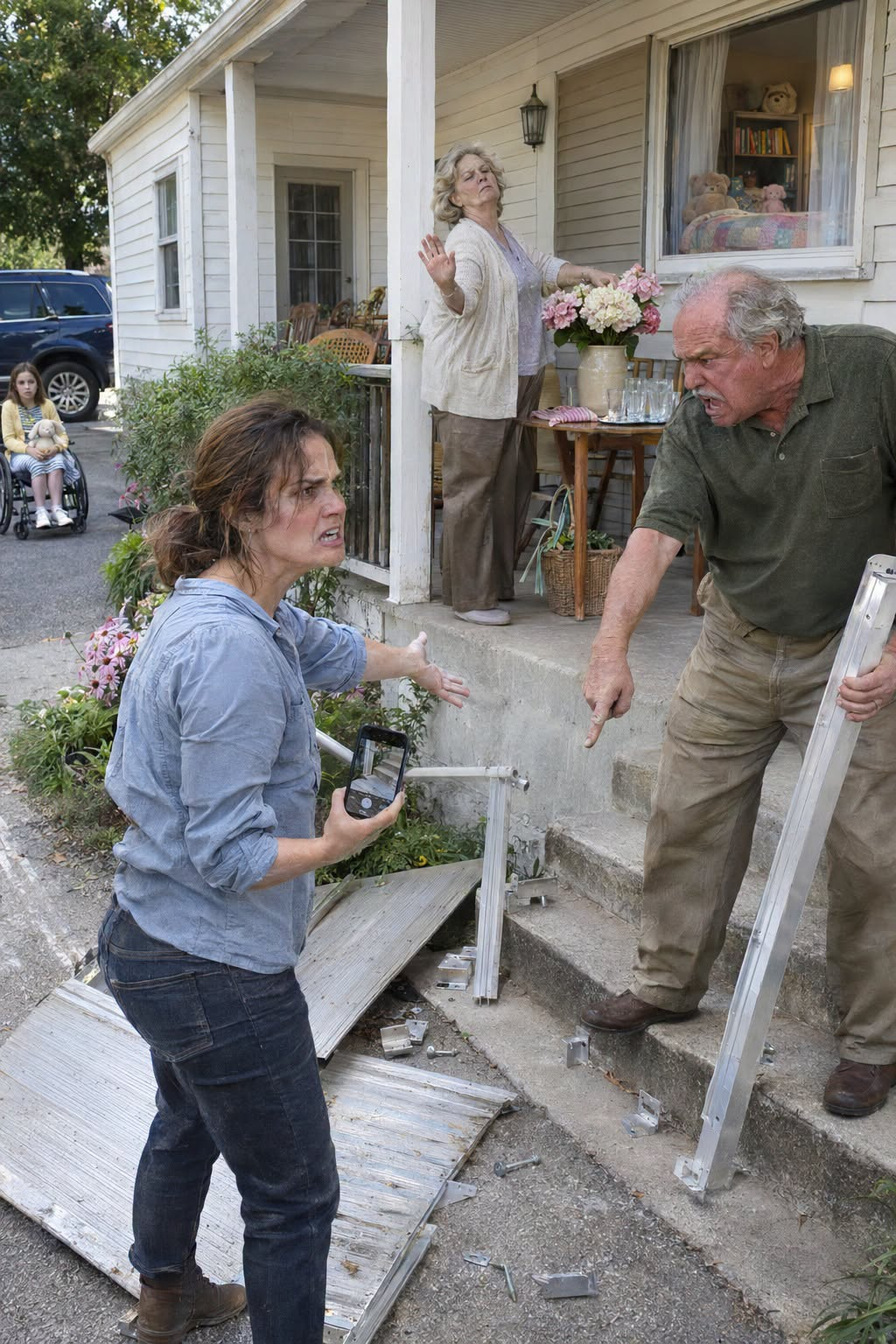
"Caroline, my parents destroyed my daughter's wheelchair ramp yesterday. We had to leave because she couldn't get into our home."
Silence.
Then Caroline asked, "Destroyed?"
"They had landscapers dismantle it and throw it into a dumpster. My daughter uses a wheelchair. There are four concrete steps to the entrance."
"Oh, my goodness."
Her reaction sounded genuine.
"I had no idea."
"Neither did the landscaping company, apparently. They were told the ramp wasn't being used."
Caroline was quiet for several seconds.
Then she said, "Ms. Rowe, I need to be careful about what I discuss because I'm representing the sellers. But I can tell you that the occupancy information you've described is inconsistent with what our office received."
"Can you send me the complete document?"
"I'll need to review what I can release. I also think you should speak with an attorney."
"Is my name on anything else?"
Another pause.
"I don't want to give you incomplete information."
That wasn't an answer.
And I think she knew it.
"Caroline, my daughter is nine. Her grandparents just destroyed the only ramp she could use to enter her home. Now I'm looking at a document saying I agreed to leave when I didn't. Please understand why I'm frightened."
Her voice softened.
"I do understand."
I heard papers moving.
"Here's what I can do. I'll notify my supervising broker that the occupancy information is disputed. I'll also ask that no representations about the apartment being vacant be made until the situation is reviewed."
"Thank you."
"And Ms. Rowe?"
"Yes?"
"Please keep your lease, payment records, and any communications about your tenancy."
"I already have them."
"Good."
Before hanging up, she added something that stayed with me.
"Don't assume that because someone owns a property, they can decide a tenant no longer exists."
I sat with the phone in my hand after the call ended.
For the first time since discovering the destroyed ramp, I felt something besides anger and grief.
I felt afraid.
Not because my father had shouted at me.
I'd heard him shout my entire life.
Not because my mother had dismissed Rosie's needs.
I'd spent years making excuses for that.
I was afraid because someone had started putting decisions about our lives into official-looking documents without telling us.
And I didn't know how far they intended to go.
Marcy found me sitting at the kitchen table twenty minutes later.
The laptop was open.
My lease was beside it.
The installation contract lay underneath a stack of printed photographs.
I had written the date and time of Caroline's call on a yellow legal pad.
Marcy took one look at me and stopped.
"What happened?"
I turned my phone toward her.
She read the document.
Then she read it again.
"Voluntarily vacating?"
I nodded.
"Saturday?"
"Tomorrow."
She looked toward the hallway.
"Jenna, that's insane."
"I know."
"You never told them you were leaving permanently."
"No."
"You told them you weren't going inside because Rosie couldn't get up the steps."
"Exactly."
Marcy sat down.
"Then how can they say you're moving out?"
"I don't know."
She studied the photograph.
"Did your father fill this out?"
"I can't prove that."
"But you think he did."
I looked at the date.
"I recognize the handwriting."
Marcy leaned back.
For a moment, neither of us spoke.
Then she said, "You need a lawyer."
"I called a tenant-rights organization this afternoon. I'm waiting for someone to return my message."
"Call again tomorrow."
"I will."
"And don't go over there alone."
I looked at her.
"I'm not planning to."
She reached across the table.
"Good."
Marcy had known my parents for almost twenty years.
She'd attended family barbecues, birthday parties, and Christmas dinners at their house.
She knew my mother could turn a simple disagreement into a lecture about gratitude.
She knew my father could make people feel guilty for asking perfectly reasonable questions.
But until Thursday, even Marcy had believed there were limits.
"I keep thinking about Rosie," she said quietly.
"So do I."
"She asked me something at the library today."
My stomach tightened.
"What?"
Marcy hesitated.
"She wanted to know whether people can stop loving someone because they're difficult."
I looked down at the table.
"She said that?"
"Yes."
I closed my eyes.
"God."
"I told her needing help doesn't make someone difficult."
"Thank you."
"Then she asked whether her grandparents thought she was too much work."
I couldn't speak.
Marcy squeezed my hand.
"Jenna, she needs to hear from you that none of this is her responsibility."
"I've told her."
"I know. But she might need to hear it a hundred times."
I nodded.
Because Marcy was right.
Children don't always believe reassurance the first time.
Especially when the people hurting them are the same people who are supposed to love them.
That night, Rosie couldn't sleep.
I found her sitting upright in bed with her stuffed rabbit tucked beneath one arm.
The guest room was softly lit by a small lamp.
Her wheelchair stood beside the bed, positioned exactly where she liked it.
"Hey, sweetheart."
She looked up.
"Can you stay for a minute?"
"Of course."
I sat beside her.
She pulled the blanket over her knees.
For a while, she didn't say anything.
Then she asked, "Are Grandma and Grandpa mad at me?"
"No."
"Are you sure?"
I hesitated.
"I'm sure you haven't done anything wrong."
She considered that answer.
Then she looked toward the window.
"Grandpa didn't even say goodbye."
My chest tightened.
"I know."
"He always says goodbye."
I remembered the way my father had turned back toward the landscaper while I loaded Rosie's wheelchair into the SUV.
He hadn't looked at her.
Not once.
"I think Grandpa was upset," I said.
"Because you took pictures?"
"Maybe."
"Why did you take pictures?"
"Because I needed a record of what happened."
She frowned.
"Like when the doctor takes pictures of my legs?"
"Something like that."
"So people can see?"
"Yes."
Rosie rubbed the rabbit's ear.
"Will the pictures make Grandpa put my ramp back?"
I looked at her.
"I don't know, honey."
She nodded slowly.
Then she asked the question I'd been dreading.
"Mommy, am I expensive?"
For a second, I couldn't breathe.
"What?"
"Am I expensive?"
"Why would you ask that?"
She stared at the blanket.
"Grandpa said the ramp cost too much. And Grandma said my chair makes things complicated. And you have to work extra hours sometimes."
I felt tears rising.
I forced myself to remain calm.
"Rosie, look at me."
She lifted her eyes.
"Your wheelchair is something you use. Your ramp is something you need. Neither one makes you a burden."
"But they cost money."
"Lots of things cost money."
"Not everybody needs a ramp."
"Not everybody needs glasses either. Or hearing aids. Or medicine. People need different things."
She was quiet.
I continued.
"I worked extra hours because I wanted you to have a safe way into our home. And I would make that choice again."
"Even if it cost forty-eight hundred dollars?"
"Even then."
She looked surprised.
"That's a lot."
"It is."
"More than my bicycle?"
I smiled despite everything.
"Much more than your bicycle."
She thought about that.
Then her expression changed.
"Would you still want me if I couldn't do anything by myself?"
I reached for her hand.
"Rosie."
She looked frightened.
"Would you?"
I moved closer.
"I wanted you before I knew what color your eyes would be. Before I knew whether you'd like drawing or soccer or purple dragons. Before I knew anything about the kind of help you might need."
Her lower lip trembled.
"You don't have to earn being wanted."
She stared at me.
"You don't have to walk. You don't have to be easy. You don't have to make other people comfortable."
I brushed a strand of copper-red hair from her forehead.
"You're my daughter. I love you because you're you."
She leaned into me.
I held her for a long time.
Then she whispered, "I thought Grandma wanted the flowers more than me."
That was when I finally cried.
Not loudly.
Not in a way that frightened her.
Just two tears that slipped down my cheeks before I could stop them.
Rosie noticed.
"Mommy?"
"I'm okay."
"You're crying."
"I know."
"Did I make you sad?"
"No, sweetheart."
I kissed the top of her head.
"You told me something important."
She wrapped her arms around my waist.
We stayed that way until her breathing slowed.
When she finally fell asleep, I sat beside her for another ten minutes.
I watched the small rise and fall of her chest.
I looked at the wheelchair beside her bed.
And I made myself a promise.
Whatever happened with my parents, Rosie would never again have to wonder whether she deserved a place in her own home.
The following morning, Saturday, my mother called at eight seventeen.
I was sitting at Marcy's kitchen counter with a cup of coffee.
I watched the screen until the call went to voicemail.
Thirty seconds later, she called again.
Then she sent a message.
"Jenna, please answer. We need to discuss today's arrangements."
I stared at the words.
Today's arrangements.
Not Rosie's ramp.
Not her feelings.
Not whether we had somewhere to sleep.
Arrangements.
I replied, "Please put anything you need to discuss in writing."
She answered almost immediately.
"Don't be childish."
I didn't respond.
A minute later, another message appeared.
"We have guests arriving at eleven. Your father wants to know whether you've removed your things from the apartment."
My coffee cup stopped halfway to my mouth.
I read the message again.
Removed your things.
I typed, "No. We have not moved out. Our belongings remain in our rented apartment."
Three dots appeared.
Then disappeared.
Then appeared again.
Finally, my mother replied.
"You told us you were leaving."
I felt my pulse quicken.
"I said we were leaving because Rosie could not enter the house without her ramp. I did not terminate our tenancy."
Her next message came quickly.
"Your father understood otherwise."
I stared at the screen.
There it was.
The explanation they intended to use.
They were going to claim I'd moved out voluntarily.
I typed carefully.
"We have a written lease. I have not surrendered possession of the apartment. Do not enter or remove our belongings without proper authorization."
My mother didn't answer.
Instead, my father called.
I let it ring.
He called again.
Then a voicemail appeared.
I played it on speaker.
"Jenna, this nonsense has gone far enough. Your mother has important people coming over, and you're not going to ruin another day with your attitude. You said you were leaving. We took you at your word. Now stop making threats and call me."
The message ended.
Marcy stood beside the refrigerator, listening.
When the recording stopped, she shook her head.
"He just admitted they interpreted your leaving as moving out."
"I know."
"Save that."
"I already did."
She looked at me.
"You're getting very good at documenting things."
I didn't smile.
"I wish I didn't have to."
At ten thirty, I received a callback from the tenant-rights organization.
The woman introduced herself as Elena Brooks.
She listened while I explained the ramp removal, the lease, the real estate listing, and the disputed occupancy document.
She asked whether Rosie and I had formally surrendered the apartment.
"No."
"Have you returned your keys?"
"No."
"Have you signed anything agreeing to move?"
"No."
"Have you received a court order requiring you to leave?"
"No."
Elena's voice became firmer.
"Then don't assume your parents can simply declare the apartment vacant."
I wrote down her words.
She explained that the exact legal issues would depend on the lease, the property's configuration, and applicable law.
She couldn't give me a definitive answer without reviewing the documents.
But she strongly recommended that I preserve everything and avoid signing anything without legal advice.
"What about the ramp?" I asked.
"That raises separate questions about property damage and accessibility. You'll want the installation agreement, proof of payment, photographs, and any communications about its removal."
"I have those."
"Good."
"And the real estate listing?"
"Preserve that too."
I looked at the laptop.
"Someone entered our apartment and photographed my daughter's bedroom."
"Make a written timeline of when you were away and when you first discovered the photographs. Don't assume you know who entered until you have evidence."
I nodded.
"Okay."
"One more thing," Elena said.
"Yes?"
"If you believe someone may remove your belongings, make an inventory of important items. Medical equipment, documents, medication, school records. Anything your daughter depends on."
I felt a fresh wave of fear.
"Do you think they'll do that?"
"I don't know. But preparation is better than discovering something missing afterward."
When the call ended, I immediately started a list.
Rosie's spare wheelchair cushion.
Her transfer board.
Her medical supplies.
Her school laptop.
Her favorite books.
The folder containing her medical records.
Her birth certificate.
My tax documents.
Our clothing.
Furniture.
Photographs.
Everything that made our apartment a home.
The list grew longer.
And with every item, I became more aware of how much we had left behind.
At noon, Marcy suggested we take Rosie to a nearby park with accessible pathways.
I agreed.
Rosie needed a normal afternoon.
She needed sunshine, fresh air, and something to think about besides her grandparents.
We packed sandwiches and drove to a park she loved.
For almost two hours, she seemed like herself again.
She raced Marcy along the paved path.
She laughed when a squirrel stole a piece of bread from a picnic table.
She insisted on drawing a picture of the lake.
Then, while we sat beneath a tree, she asked whether she could invite her friend Lily over when we went home.
I hesitated.
"We'll have to see."
"Because of the steps?"
"Yes."
She looked toward the water.
"Maybe we could get a different house."
I turned toward her.
"What kind of house?"
"One without stairs."
I smiled.
"That sounds nice."
"And a big kitchen."
"Why a big kitchen?"
"So you don't bump your knees on my wheels."
I laughed.
She grinned.
"And a front door I can open myself."
My smile faded.
She didn't notice.
She was already describing a bedroom with purple curtains and a desk big enough for all her art supplies.
I listened to every word.
Because for the first time since Thursday, she was imagining a future instead of questioning whether she belonged.
We returned to Marcy's house shortly after three.
My phone showed six missed calls from my mother.
Two from my father.
And one from an unfamiliar number.
There was also a new voicemail.
I played it.
"Hello, Ms. Rowe. This is Caroline Hayes. I wanted to follow up on our conversation. I've spoken with my supervising broker, and there are several issues we need to clarify before proceeding with the property listing. Please call me when you're available."
I saved the message.
Then I checked my email.
Caroline had sent a short written acknowledgment that I disputed the representation that the apartment was vacant.
She had also confirmed that the matter had been referred to her supervising broker.
I felt a small measure of relief.
At least someone outside my family was taking the situation seriously.
Then I opened a message from my mother.
It contained a photograph.
The picture showed the front porch.
The flowers were arranged.
The ceramic planters stood beside the steps.
Several unfamiliar people were gathered near the entrance, holding drinks.
My mother had written:
"See? Everything looks beautiful now. You made such an unnecessary fuss."
I stared at the photograph.
The ramp was gone.
The steps were clean.
The broken aluminum had been removed from view.
To anyone attending the party, the house probably looked perfect.
But I knew what had been sacrificed to create that picture.
I was about to close the message when I noticed something in the background.
Through the open front door, I could see a woman holding a folder.
She wasn't dressed like a guest attending a garden party.
She wore a dark business suit.
Beside her stood a man examining the doorway.
I enlarged the image.
The folder had a familiar logo.
The same real estate agency that had listed the property.
My mother's garden party wasn't simply a party.
At least some of the guests appeared to be connected to the sale.
I sent the photograph to Caroline.
"Are these people from your office?"
She didn't answer immediately.
I put the phone down.
Then Rosie called from the living room.
"Mommy, can you help me with my drawing?"
I went to her.
For twenty minutes, we worked on a picture of a house.
She drew a wide front entrance.
A long ramp.
A purple door.
And a small garden filled with sunflowers.
When she finished, she held it up.
"This is our new house."
I studied the drawing.
"Where's your room?"
She pointed to a window.
"Right there."
"And mine?"
"Next to mine."
I smiled.
"Perfect."
Then she added, "Grandma can visit if she says sorry."
I looked at her.
She was completely serious.
"And Grandpa?"
Rosie thought about it.
"He has to say sorry too."
I nodded.
"That sounds fair."
She returned to coloring.
I watched her for a moment.
My daughter still believed apologies could fix things.
Maybe sometimes they could.
But I was beginning to understand that my parents had done much more than make one cruel decision.
And I didn't know whether they intended to stop.
At five forty-six, Caroline finally replied.
"Yes. The woman in the photograph is associated with our office. The gentleman appears to be a prospective buyer."
I read the message twice.
Then another arrived.
"Ms. Rowe, I need to ask you something important. Have you authorized anyone to access your apartment today?"
My stomach dropped.
I typed, "No. Why?"
The reply came almost immediately.
"Because I have just received updated photographs from the property."
I sat upright.
"What photographs?"
There was a pause.
Then Caroline sent an attachment.
I opened it.
The first image showed our living room.
But the furniture was different.
The couch had been moved.
The bookshelf was empty.
The framed family photographs were gone.
I swiped to the next image.
Our kitchen.
The counters were completely bare.
Then the hallway.
The small wooden chest was missing.
My hands began to shake.
I swiped again.
Rosie's bedroom.
Her bed was still there.
But the stuffed animals were gone.
The bookshelf was empty.
And her wheelchair transfer board, which I'd left beside the dresser, was nowhere to be seen.
I stood so quickly that my chair scraped across the floor.
"Marcy!"
She appeared in the doorway.
"What?"
I held out the phone.
"Someone's been inside our apartment."
She took one look at the photographs.
Her expression changed.
"Jenna, call the police."
I was already reaching for my keys.
Then my phone buzzed again.
A final message from Caroline.
"There's one more photograph. I wasn't sure whether to send it."
I stared at the screen.
Another attachment appeared.
The thumbnail showed Rosie's bedroom doorway.
Someone was standing inside.
I tapped the image.
It began to enlarge.
And the person standing beside my daughter's empty bookshelf was—






Comments 0