The email address belonged to my mother.
Not her personal account.
Not the address she used to send birthday invitations or complain about neighborhood parking.
It was an address I had never seen before.
I read it three times.
Then I looked at the attachment Caroline Hayes had forwarded.
The forged tenancy termination agreement had been submitted from that address at 9:42 on Thursday morning.
At 9:42, Rosie and I had been sitting in the waiting room at the children's rehabilitation clinic.
My daughter had been showing another little girl the purple spokes on her wheelchair.
And my mother had apparently been sending a document claiming I had agreed to leave our home.
I checked the time again.
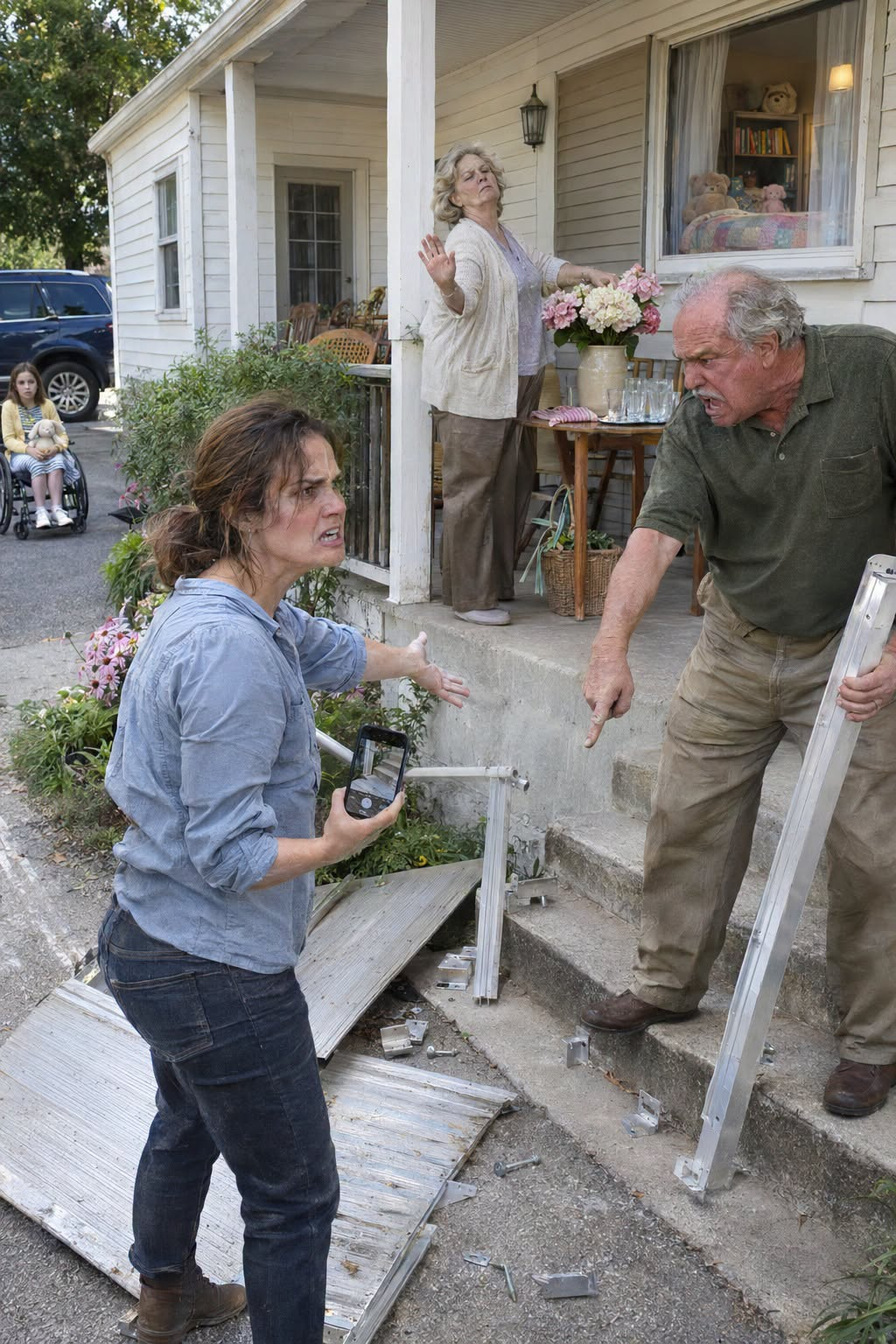
The ramp had already been scheduled for removal before Rosie and I returned that afternoon.
The false agreement had been sent before I'd discovered what my parents had done.
Before I'd photographed the broken aluminum.
Before I'd told them we were leaving.
My father couldn't possibly have misunderstood my words.
He hadn't heard them yet.
I sat perfectly still.
For four days, I'd been trying to understand whether my parents had made one terrible decision and then attempted to cover it up.
Now I was looking at evidence that they had planned for us to be gone before the confrontation even happened.
"Jenna?"
Marcy stood in the kitchen doorway.
I turned the laptop toward her.
She read the sender's address.
Then she looked at the timestamp.
"Oh, my God."
I nodded.
"Thursday morning."
"Before you got home?"
"Hours before."
Marcy pulled out a chair.
"Then they didn't decide you were moving out because you drove away."
"No."
"They were already telling people you were leaving."
I looked at the photograph of Rosie's bedroom on the screen.
Her empty bookshelf.
Her missing stuffed animals.
The space beside her dresser where her transfer board should have been.
"They wanted us out," I whispered.
Marcy didn't answer.
She didn't need to.
I called Caroline immediately.
She answered on the second ring.
"Ms. Rowe?"
"That email address belongs to my mother."
There was a pause.
"Are you certain?"
"It contains her name. And I recognize the way she labels things. She uses 'properties' whenever she talks about managing the house."
"All right."
"Caroline, the agreement was submitted Thursday morning."
"Yes."
"I didn't tell my parents we were leaving until Thursday afternoon."
Caroline was quiet.
Then she said, "I understand why that timing concerns you."
"That isn't a misunderstanding, is it?"
"I can't determine who created the document or whether a signature was forged. But you've formally disputed it, and I've referred the matter to our supervising broker."
"Does the buyer know?"
"The buyer's representative has been notified that the occupancy information is disputed."
I pressed my fingers against my forehead.
"Can my parents still sell the house?"
"A property can sometimes be sold with an existing tenant. The problem here is the representation that the apartment will be vacant."
"And they're saying I agreed to leave."
"Yes."
"With a signature I didn't write."
"That's what you've reported."
I appreciated her careful wording, even though part of me wanted her to sound as outraged as I felt.
She wasn't my attorney.
She represented the sellers.
And she had already told me more than I expected.
"Caroline, why would my parents need the apartment empty?"
She hesitated.
"The buyers have expressed interest in using the entire property."
"For what?"
"I don't have authorization to discuss their plans."
I looked at the listing.
$489,000.
Pending.
My parents had accepted an offer while their granddaughter slept in someone else's guest room because they had destroyed her ramp.
"One more question," I said.
"Of course."
"Who took the photographs of our apartment?"
"Our office arranged professional photography."
"Did the photographer know anyone lived there?"
"I'll need to confirm what information was provided."
"Please do."
After we hung up, I saved the email with its full headers and attachments.
Then I printed another copy.
I had begun to develop a strange habit.
Whenever something frightened me, I documented it.
Not because paperwork made the fear disappear.
Because it gave me something solid to hold when my parents tried to convince me that what I had seen wasn't real.
The following morning, Sunday, Rosie asked for pancakes.
Not ordinary pancakes.
Purple pancakes.
Marcy had bought blueberry pancake mix, and Rosie insisted that the batter looked purple enough to qualify.
I sat beside her at the kitchen table while she carefully poured syrup over a stack.
"Mommy?"
"Yes?"
"Are we staying here forever?"
I looked at Marcy.
She was standing by the stove, pretending not to listen.
"No, sweetheart. We're figuring out where we'll live."
Rosie considered that.
"Can we get a house with a ramp?"
"That's what I'm hoping."
"Could it have a yellow door?"
"Why yellow?"
"Because yellow looks happy."
I smiled.
"Then we'll look for a yellow door."
She cut a pancake into four pieces.
"Grandma doesn't like yellow."
I felt my stomach tighten.
"Why do you say that?"
"She said my sunflower stickers looked cheap."
I stared at her.
"When?"
Rosie shrugged.
"When she came into my room."
I set down my coffee.
"Grandma came into your room?"
"Yeah."
"When?"
She thought for a moment.
"The day before we went to the doctor."
Wednesday.
The day before the ramp was destroyed.
"What did she do?"
Rosie pushed a piece of pancake through the syrup.
"She looked at my shelves."
"Did she move anything?"
"She picked up my brave box."
My pulse quickened.
"What did she say?"
"She asked why I kept old hospital stuff."
I waited.
Rosie continued.
"I told her it was important. She said I should throw away things that reminded people I was sick."
Marcy turned off the stove.
I felt heat rise behind my eyes.
My daughter wasn't sick in the way my mother meant.
Spina bifida was part of Rosie's life, but it wasn't a shameful secret to hide.
Her hospital bracelets weren't evidence of failure.
They were reminders of what she'd survived.
"What did you say?" I asked.
Rosie looked down.
"I told her I liked my box."
"And?"
"She said the room would look nicer without all my things."
I couldn't speak.
Rosie looked up.
"Was she mad because I said no?"
I reached across the table.
"No, baby. You were allowed to say no."
She nodded.
Then she asked something that made my heart ache.
"Do grown-ups have to listen when kids say something belongs to them?"
I thought about the broken ramp.
The missing letter.
The boxes in the garage.
"They should respect your belongings," I said. "And when they don't, it's my job to help protect them."
Rosie smiled faintly.
"Even my dragon drawings?"
"Especially your dragon drawings."
She returned to her pancakes.
But I couldn't stop thinking about Wednesday.
My mother had entered Rosie's bedroom before the ramp was removed.
She had examined her belongings.
She had criticized the things that made the room hers.
And less than twenty-four hours later, she'd submitted a document claiming we were leaving.
At eleven, I called the tenant-rights organization again.
Elena Brooks answered.
I explained the new evidence.
She listened carefully.
"Do you have the original email?"
"I have a forwarded copy with the sender information and the attachment."
"Keep it."
"I also have the date and time."
"Good."
"Elena, my mother submitted that agreement before I ever said we were leaving."
"That timing may be important."
"What should I do?"
"First, don't sign anything. Second, preserve your communications. Third, you need legal advice about the disputed signature and the attempted termination of your tenancy."
I wrote everything down.
"Can my parents force us out because they're selling?"
"Not simply by declaring the apartment vacant. The specific procedures depend on your lease and Ohio law. A sale doesn't automatically erase every tenant right."
I felt a small measure of relief.
"But they own the house."
"Ownership doesn't mean they can ignore applicable landlord-tenant requirements."
I looked toward the hallway.
Rosie was watching cartoons.
"Can I ask you something else?"
"Of course."
"If they destroyed the ramp because they wanted the property to look better for buyers, does that matter?"
Elena paused.
"It could. The facts surrounding the removal, the ownership of the ramp, and the effect on access may all be relevant. You'll want an attorney to review the documents."
I swallowed.
"I feel like I'm losing my mind."
"Why?"
"Because my parents keep acting as though this is normal."
Elena's voice softened.
"You're describing several serious concerns. You don't have to decide what every piece of evidence means today. Focus on preserving it and getting qualified help."
After the call, she emailed me contact information for two local attorneys who handled housing disputes.
I called both offices.
One was closed.
The other had an answering service.
I left messages.
Then I sat at Marcy's kitchen table and waited.
Around one, my father sent a text.
"Your mother is very upset. You need to stop involving outsiders in family matters."
I read it without responding.
A second message arrived.
"We have done more for you and Rosie than anyone else ever will."
Then another.
"You are making a terrible mistake."
I saved all three.
Five minutes later, my mother called.
I let it go to voicemail.
Her message began with a sigh.
"Jenna, I don't understand why you're behaving this way. We were only trying to make the property presentable. Your father has been under tremendous stress, and you're making everything harder."
She paused.
Then her voice sharpened.
"And I would appreciate it if you stopped telling strangers that we mistreated Rosie. That's a very ugly accusation."
I listened to the message twice.
Not once did she ask how Rosie was doing.
Not once did she mention the missing ramp.
Not once did she apologize for entering our apartment.
Everything was about appearances.
The property.
The guests.
The embarrassment.
The accusation.
I thought about Rosie asking whether she was expensive.
Then I deleted the draft response I'd started typing.
I wasn't going to argue with my mother about whether my daughter's independence mattered.
That conversation should never have been necessary.
That afternoon, I opened every photograph Caroline had sent.
I arranged them beside older pictures of our apartment.
At first, I was simply trying to identify missing belongings.
Then I noticed something strange.
In the original listing photograph of Rosie's bedroom, her white bookshelf was full.
The stuffed animals were arranged on the bed.
Her purple memory box sat on the dresser.
But the wheelchair wasn't visible.
That made sense.
Rosie had been using it when the photograph was taken.
I studied the image more carefully.
The camera angle was unusual.
The photographer had stood near the doorway, but the picture seemed deliberately cropped to exclude the lower part of the room.
I opened the full-resolution file.
Then I compared it with a photograph I'd taken on Rosie's birthday.
Her wheelchair transfer board normally rested against the dresser.
In the listing photograph, it had been moved behind the bed.
I could see one corner.
Why would anyone hide a transfer board?
It wasn't unattractive.
It wasn't clutter.
It was medical equipment my daughter used every day.
I moved to the living room photograph.
The framed picture of Rosie in her wheelchair at the county fair was missing.
So was the photograph of her receiving an award at school.
I checked the kitchen.
Her painted fruit bowl had disappeared.
Her colorful artwork was gone from the refrigerator.
Every visible sign that a child with a disability lived in the apartment had been removed or concealed.
I sat back.
My parents weren't merely staging the rooms.
They were erasing Rosie from the photographs.
I wanted to believe there was another explanation.
Maybe the photographer had asked for personal pictures to be removed.
Maybe my mother had simply followed ordinary staging advice.
But then I remembered what Rosie had told me.
The room would look nicer without all my things.
And I remembered the landscaping company's work order.
Unused temporary structure.
I opened a new document and wrote down the similarities.
The ramp described as unused.
The apartment described as vacant.
The belongings moved into storage.
The medical equipment hidden.
The photographs arranged to make the space appear unoccupied.
I didn't know what conclusion an attorney would reach.
But I knew I wasn't imagining the pattern.
At four thirty, Marcy came into the kitchen carrying a basket of laundry.
"Still working?"
I nodded.
She looked at the photographs.
"What's that?"
"Rosie's room."
She leaned closer.
"Why are you comparing pictures?"
"Look at the dresser."
Marcy studied the images.
"Her transfer board is missing."
"Not missing. Hidden."
I pointed to the corner visible behind the bed.
Marcy frowned.
"Why would they do that?"
"I don't know."
She looked at the other photographs.
Then she said, "Jenna, did you notice the picture on the refrigerator?"
"What picture?"
"The one Rosie drew of your family."
I opened the kitchen photograph.
Marcy pointed.
"That was hanging there last month."
I remembered it.
Rosie had drawn herself in her wheelchair between me and my parents.
Above us, she'd written:
MY FAMILY.
I had put it on the refrigerator with a sunflower magnet.
Now both the drawing and the magnet were gone.
I stared at the empty refrigerator door.
Something inside me seemed to settle.
I had spent days wondering whether my parents understood how much they'd hurt Rosie.
But maybe understanding wasn't the problem.
Maybe they had understood perfectly.
Maybe they simply believed their plans mattered more.
At six, my phone rang.
An unfamiliar number.
I answered.
"Jenna Rowe?"
"Speaking."
"My name is Rebecca Shaw. I'm an attorney with Shaw and Mercer Legal Services. You left a message about a housing dispute."
I sat upright.
"Yes. Thank you for calling."
"I've reviewed the brief summary you provided. Do you have a few minutes?"
"Absolutely."
She asked about the lease, the rent payments, the ramp, and the real estate listing.
I explained everything as clearly as I could.
When I reached the forged termination agreement, she stopped me.
"Did you sign that document?"
"No."
"Did you authorize anyone to sign it?"
"No."
"Do you have a copy?"
"Yes."
"Send it to my office."
I wrote down her email address.
She continued.
"Do not confront anyone about the signature until we've reviewed the document and the circumstances."
"Okay."
"Do you have evidence that your parents entered the apartment?"
"Photographs. A police report. My father admitted his wife entered."
"Good."
"And they moved my daughter's belongings into the garage."
"Document the condition of anything damaged or missing."
I took a breath.
"Can you help us?"
"I can schedule a consultation tomorrow morning. We'll need to review the lease and determine what immediate steps are appropriate."
I felt my shoulders relax slightly.
For the first time, I had someone who might be able to help me understand what my rights actually were.
Before ending the call, Rebecca asked one final question.
"Ms. Rowe, did your parents ever tell you why they decided to sell?"
I hesitated.
"My father mentioned financial obligations."
"What kind?"
"He wouldn't say."
"Do you know whether the property has a mortgage?"
"I assume so."
"Any recent refinancing?"
"I don't know."
She paused.
"Bring whatever information you have. Sometimes the timing of a sale helps explain the urgency."
After we hung up, I sent her the documents.
Then I opened my laptop again.
My father had always presented himself as financially comfortable.
He talked about investments.
Retirement accounts.
Property values.
He criticized people who borrowed money.
He once told me that debt was a sign of poor discipline.
But recently, I'd noticed things.
He'd sold his boat.
My mother had canceled a vacation.
They'd stopped hosting their usual holiday dinners.
I'd assumed they were simply cutting expenses.
Now I wondered whether something else was happening.
That evening, Rosie asked if we could look at houses online.
I hesitated.
Then I agreed.
We sat together on Marcy's couch with my laptop.
I searched for small accessible homes in the area.
Most were too expensive.
Some had narrow doorways.
Others had steps at every entrance.
But Rosie wasn't discouraged.
She pointed at kitchens.
Bedrooms.
Backyards.
She rejected one house because the bathroom was painted orange.
"Too much orange," she declared.
I laughed.
Then she found a small ranch-style home with a level entrance.
The front door was white.
But the porch had enough space for flowerpots.
"Mommy, could we paint the door yellow?"
"Maybe."
She grinned.
"And put sunflowers beside it?"
"Definitely."
She leaned against me.
For a few minutes, I let myself imagine it.
A home where nobody could decide my daughter was inconvenient.
A home where her wheelchair wasn't something to hide.
A home where she could enter without asking permission.
Then my phone buzzed.
Caroline Hayes.
"Ms. Rowe, I wanted to let you know that the buyers have requested additional information about the apartment."
I replied, "What information?"
"They want confirmation of when the current occupants will leave."
I looked at Rosie.
She was still examining houses.
I typed, "We have not agreed to leave."
Caroline answered.
"I understand. I've communicated that the occupancy status is disputed."
Then another message appeared.
"There's something else you should know."
My pulse quickened.
"What?"
"The buyers were shown photographs that weren't included in the public listing."
I sat upright.
"What photographs?"
"Additional interior images."
"Of our apartment?"
"Yes."
I looked at the laptop.
Rosie had found a house with a bright blue kitchen.
She was laughing.
I typed, "Can you send them?"
Caroline hesitated.
"I need to confirm what I'm authorized to share."
A minute passed.
Then two.
Finally, she replied.
"I've received permission to send one image for identification purposes."
An attachment appeared.
I opened it.
The photograph showed Rosie's bedroom.
But it wasn't taken from the doorway.
It had been taken from inside the room, facing the closet.
The closet door was open.
Someone had pulled several boxes onto the floor.
And on the wall behind the boxes was something I hadn't seen in years.
A small rectangular access panel.
My father had once told me it covered old plumbing.
He'd insisted nobody should open it.
In the photograph, the panel was hanging loose.
I enlarged the image.
Something dark was visible inside the opening.
At first, I thought it was a shadow.
Then I noticed a corner of white paper.
A folder.
I stared at the screen.
The folder had a label.
I zoomed in.
The letters were blurry, but I could make out two words.
ROW E FAMILY.
No.
ROWE FAMILY.
I felt a chill.
Why would a family folder be hidden behind an access panel in my daughter's bedroom?
I looked closer.
There was a date written beneath the label.
Six years earlier.
The year Rosie and I had moved into the apartment.
My phone buzzed again.
Caroline.
"Ms. Rowe, the photographer says your mother became very upset when she realized this image had been taken."
I stared at the folder.
Then another message arrived.
"She demanded that the photograph be deleted."
I looked toward Rosie.
She was still sitting beside me, unaware that I was staring at a picture of her bedroom.
I closed the image.
"Mommy?"
I turned.
"Yes, sweetheart?"
"Did you find a house you like?"
I looked at her.
Then at the phone in my hand.
"Maybe," I whispered.
But my mind was somewhere else.
Behind a loose panel.
Inside a room my daughter had slept in for six years.
And inside a folder my parents apparently didn't want anyone to see.
A final message appeared from Caroline.
"The photographer kept the original file. There's another photograph taken seconds later."
I opened the attachment.
The second image showed the folder pulled halfway out of the wall.
Its cover was open.
And on the first page, beneath my daughter's full name, was a handwritten instruction that began—






Comments 0