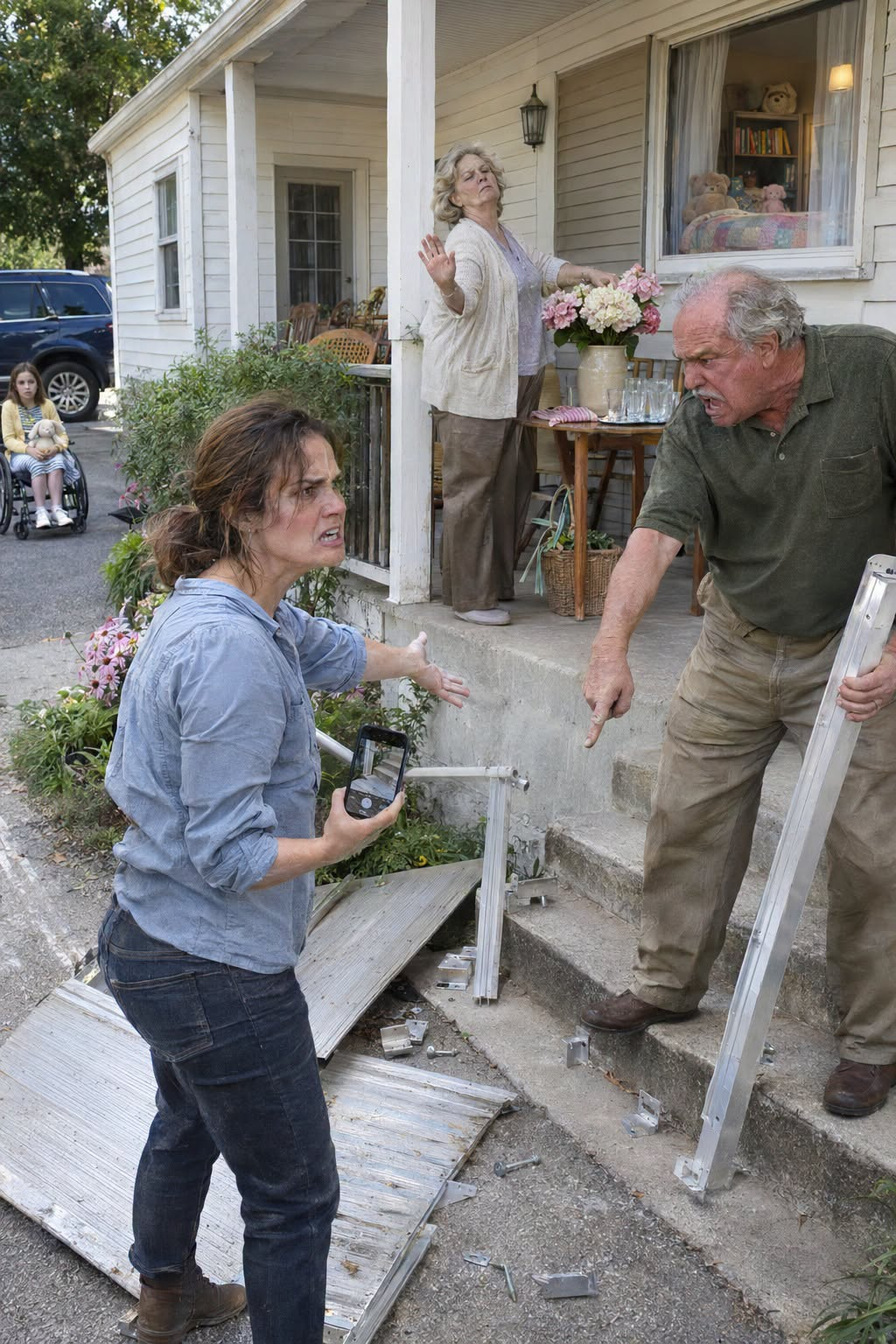
My mother was standing behind the locked front door of Rosie's house when I arrived the following morning.
She looked smaller than I remembered.
Her blond hair was untidy, her white blouse was wrinkled, and she held a set of keys in one trembling hand. Beside her stood Margaret Ellis, carrying a leather folder.
Rebecca had insisted that I wait until Robert and the property manager arrived before approaching the house. So I stayed beside my car, watching the woman who had helped destroy our first home stand inside the second one.
For the first time, I understood that my mother hadn't simply been hiding something from me.
She had been hiding something from herself.
When Robert finally arrived, he walked directly toward the entrance.
"Vivian, we need to talk."
My mother turned.
"Robert, please. Just give me a few minutes."
"You've had six years."
She looked at me.
"Jenna, I can explain."
I stepped out of the car.
"Then explain why you've been living in my daughter's house."
My mother lowered her eyes.
"I didn't know where else to go."
I stared at her.
"You had your own house."
"Your father and I were having problems."
"And Rosie?"
My mother looked toward the doorway.
"I never wanted her to lose anything."
I felt my throat tighten.
"Then why did she lose her ramp?"
She didn't answer.
Robert handed Rebecca a copy of the property deed.
"The ownership is clear. The residence belongs to the trust established for Rosie. Vivian has no independent ownership rights."
My mother began crying.
"I know."
Those two words surprised me more than anything else.
She knew.
She had known the entire time.
We entered the house together.
It was beautiful.
Not extravagant, but thoughtfully designed. The entrance was level with the walkway, the hallways were wide, and every doorway could accommodate Rosie's wheelchair.
The kitchen had lowered counters.
The bathroom had accessible fixtures.
There was even a small therapy room with enough space for exercise equipment.
Sunlight filled the living room through enormous windows overlooking a garden.
I stood in the middle of the room, unable to speak.
My grandfather had designed this place for Rosie.
Not as a favor.
Not as temporary accommodation.
As her home.
I noticed a framed photograph on the fireplace.
My grandfather was standing beside a younger Margaret.
My mother was there too.
They were holding a folder between them.
On the back of the photograph was the date Robert had mentioned.
Six years earlier.
I turned toward Margaret.
"Why did you sign the documents that used my name?"
Margaret looked exhausted.
"I made a serious mistake."
"That's not an answer."
She nodded.
"Your mother told me Gordon was facing a financial crisis. She said the family needed time to settle the debts, and she promised that the money would be returned before the trust was reviewed."
"Did you know the documents contained false information?"
"I knew some of them were inaccurate."
I stared at her.
"Some?"
Margaret looked down.
"I was told that you had agreed to the arrangement. I should have contacted you directly. I didn't."
"Why not?"
"Because I trusted Vivian. And because I was afraid of losing my position."
Robert interrupted.
"Margaret, you will have an opportunity to provide a complete statement. But none of that changes the ownership records or the responsibility for the unauthorized transactions."
She nodded.
"I understand."
I looked at my mother.
"Did you know Rosie owned this house?"
My mother wiped her cheeks.
"Yes."
"When did you know?"
"From the beginning."
"Then why did you let me believe we had nowhere to go?"
She looked toward the garden.
"Because I was afraid."
"Of what?"
"Your father."
I waited.
She finally explained.
Gordon had invested heavily in several commercial properties. When the investments failed, he borrowed money to cover the losses. He believed another successful purchase would restore everything.
My grandfather had refused to let him use Rosie's trust.
After his death, Gordon began pressuring my mother to help him obtain money through the apartment arrangement.
At first, she believed the transfers would be temporary.
Then the debts grew.
The private lender demanded repayment.
Daniel's guarantee became part of the loan file.
And Margaret helped prepare documents that made the financial arrangements appear legitimate.
My mother knew the second property existed, but Gordon convinced her that selling the original house would allow them to repay the money and restore Rosie's trust.
When the sale became urgent, he ordered the ramp removed to make the entrance more attractive to buyers.
My mother had agreed.
I listened without interrupting.
When she finished, I asked one question.
"Did you ever think about Rosie?"
My mother began crying again.
"Every day."
"Then you should have protected her."
She covered her face.
I walked away.
There was nothing left to discuss in that room.
The legal proceedings took several weeks.
Rebecca coordinated everything with the trustee, the lender, Daniel's attorney, and the buyer's legal team.
The attempted sale of my parents' house was stopped before closing.
The buyer was informed that the apartment's occupancy claims and the disputed collateral documents had not been properly resolved. The buyer withdrew from the transaction rather than inherit the uncertainty.
Daniel formally challenged the guarantee.
An independent examination found significant discrepancies between his original authorization and the lender's amended version.
The disputed signatures were also examined.
The examiner identified irregularities in the documents bearing my name, including the loan authorization and insurance assignment.
The bank confirmed that Rosie's savings withdrawal had been processed using an authorization that I had never approved.
The insurer placed restrictions on the disputed policy assignment while the matter was investigated.
Most importantly, the trustee secured Rosie's remaining inheritance.
The approximately $62,000 transferred without valid authorization became the subject of a recovery claim. Additional funds were traced through Rowe Property Holdings, including money used for the commercial investment and the private debt settlement.
The financial investigation established that my parents had not simply borrowed money to improve their family property.
They had used assets and rights belonging to other people to support their private investments.
The consequences were serious.
Gordon and Vivian were required to account for the unauthorized transfers and participate in the recovery process.
Margaret provided a formal statement about the documents she had prepared and witnessed. Her cooperation helped establish how the original agreements had been altered, although it did not erase her responsibility.
Daniel was eventually released from the disputed guarantee after the evidence showed that the expanded obligation had never been properly authorized by him.
He called me when he received the final confirmation.
"I wanted to apologize again," he said.
"You don't need to."
"I should have questioned Gordon earlier."
"Maybe. But you didn't know about Rosie."
He paused.
"How is she?"
"She's doing well."
"Good. That's what matters."
Before we ended the call, Daniel promised to contribute to the restoration of the original apartment's accessibility features if the property arrangement allowed it.
I thanked him.
For the first time in months, I felt that the people who had been harmed were finally being heard.
The trust's final accounting took longer.
Robert explained that the money would not be restored overnight. Some assets had lost value, and some transfers required additional recovery proceedings.
But the remaining trust funds were protected.
The separate housing trust was also confirmed.
Rosie's ownership of the Willow Creek residence was recorded through the appropriate legal structure, with independent administration until she became old enough to assume responsibility.
I was appointed to manage her day-to-day residential needs without gaining the right to use her assets for my own purposes.
The distinction mattered.
My grandfather had wanted Rosie to have independence, not simply another adult making decisions for her.
The trustee also confirmed that the house would remain available for her lifetime under the terms of the trust.
No family member could sell it to settle personal debts.
No one could pledge it as collateral.
And no one could remove its accessibility features without proper authorization.
When Rebecca explained everything, I felt a weight leave my shoulders.
"Does that mean Rosie can move in?"
"Yes," she said. "The property is ready."
I looked at the photographs of the house.
The yellow front door.
The level entrance.
The sunflower garden.
"Then I think it's time."
We moved in on a Saturday morning.
Marcy brought boxes, Eleanor brought homemade sandwiches, and Daniel arrived with a small potted sunflower.
Rosie sat in her wheelchair at the end of the driveway.
She stared at the house.
"Is this really ours?"
I knelt beside her.
"Yes, sweetheart."
"Forever?"
"As long as you want it to be your home."
She looked toward the entrance.
There were no steps.
No temporary wooden boards.
No metal ramp that someone could remove because they disliked how it looked.
Just a smooth path leading directly to the yellow front door.
Rosie moved forward slowly.
Her hands rested on the wheels.
She approached the entrance without anyone lifting her.
Without anyone carrying her.
Without asking permission.
When she reached the door, I unlocked it.
She rolled inside.
Then she stopped.
Her eyes widened.
The living room was bright, with large windows overlooking the garden.
There was a little reading corner beside the fireplace.
A wide hallway led toward the bedrooms.
And on the wall near the entrance was a framed photograph of my grandfather holding her as a newborn.
Rosie looked at it.
"Mommy, that's Great-Grandpa."
"Yes."
"Did he make this house for me?"
I knelt beside her.
"He wanted to make sure you always had somewhere you could call home."
Rosie studied the photograph.
Then she whispered, "Thank you, Great-Grandpa."
I wrapped my arms around her.
For a moment, neither of us spoke.
Then she pointed toward the garden.
"Can we plant sunflowers?"
I smiled.
"Of course."
My mother came to visit three weeks later.
She had asked through Rebecca whether she could see Rosie.
I had thought about refusing.
Part of me wanted to protect my daughter from ever experiencing that kind of disappointment again.
But Rosie deserved to have a say in the relationships she maintained, provided she remained safe.
So I asked her.
"Would you like Grandma to visit?"
Rosie thought about it.
"Will she be nice?"
"She needs to be respectful."
"Will she have to use the ramp?"
I smiled faintly.
"Yes."
Rosie considered that.
"Then she can come."
When Vivian arrived, she stood outside the yellow door for several seconds.
She looked at the smooth entrance.
Then at the sunflower garden.
Her eyes filled with tears.
"Jenna, it's beautiful."
I stepped aside.
"Come in."
She entered quietly.
Rosie was sitting at the kitchen table, coloring.
"Hello, Grandma."
My mother approached her carefully.
"Hello, sweetheart."
She looked at the wheelchair.
Then at the wide doorway.
"I should never have taken your ramp away."
Rosie stopped coloring.
"Why did you?"
My mother lowered herself into the chair opposite her.
"Because I was thinking about the wrong things. I wanted the house to look pretty for visitors, and I didn't think enough about what you needed."
Rosie looked at her for a long moment.
"That made Mommy sad."
My mother nodded.
"I know."
"And it made me sad too."
Vivian began crying.
"I'm sorry."
Rosie returned to her drawing.
After a moment, she said, "I like my new house."
My mother nodded.
"I can see that."
She did not ask Rosie to forgive her.
She did not demand another chance.
For once, she simply listened.
The visit lasted twenty minutes.
When she left, I walked her to the door.
"Mom, things won't go back to how they were."
"I understand."
"There will be boundaries."
"I understand."
"And Rosie's money will remain protected."
My mother nodded.
"That's how it should have been from the beginning."
I watched her walk down the garden path.
I didn't know whether our relationship would ever become close again.
But I no longer felt responsible for repairing what she had broken.
That responsibility belonged to her.
Four months later, on Rosie's tenth birthday, we opened my grandfather's final letter.
Robert had delivered the original envelope himself.
Eleanor sat beside Rosie at the kitchen table.
Marcy brought a birthday cake decorated with yellow flowers.
Daniel sent a gift.
My parents were not there.
That was a decision I had made after discussing the matter with Rosie.
The envelope contained a photograph and a handwritten message.
Rosie carefully unfolded the letter.
I read it aloud.
My dearest Rosie,
If you're hearing these words, I hope you're old enough to understand how much I loved you.
I wanted you to grow up knowing that needing a little extra help never made you less independent, less capable, or less deserving of a beautiful life.
I wanted you to have a home where you could enter through the front door without waiting for somebody to carry you.
I wanted you to have choices.
Most importantly, I wanted you to understand that your worth has never depended on what your body can or cannot do.
I stopped reading.
Rosie was crying quietly.
So was Eleanor.
I continued.
You don't owe anyone gratitude for making room for you. The world should make room for everyone.
Grow your sunflowers. Read your books. Make friends. Be stubborn when something matters. And never let anybody convince you that you are a burden.
All my love,
Grandpa Richard.
Rosie hugged the letter against her chest.
Then she looked toward the garden.
"Mommy?"
"Yes?"
"Can we put the photograph outside?"
"Where?"
"Near the sunflowers."
I smiled.
"I think he'd like that."
A year later, the sunflower garden had grown taller than Rosie.
She had started a new school with an accessible entrance and a supportive teacher who encouraged her to participate in every activity she wanted to try.
Her rehabilitation continued.
Some days were difficult.
Some days she needed more help than others.
But she no longer worried about whether she was welcome in her own home.
The trust remained independently managed.
The recovered funds were returned where possible, and the remaining financial claims were handled through the legal process.
My parents faced the consequences of their actions. Their financial situation changed dramatically, and they were no longer able to use Rosie's property or assets to support their business arrangements.
Margaret's involvement was formally documented, and she was removed from any role involving Rosie's trusts.
Eleanor became a regular visitor.
Daniel remained a friend.
And Marcy never stopped reminding me that our temporary stay had turned into one of the most meaningful chapters of our lives.
One Saturday afternoon, Rosie and I sat on the front porch.
She was holding a small envelope.
Inside was the photograph of my grandfather.
She looked at it, then at me.
"Mommy, do you think Great-Grandpa knew everything would happen like this?"
I considered the question.
"I think he knew that life could be difficult. And he wanted to make sure you had somewhere safe to begin again."
Rosie smiled.
Then she pointed toward the entrance.
"Look."
A delivery driver was approaching with a package.
He stopped at the garden gate.
"Delivery for Rosie Rowe?"
Rosie raised her hand.
"That's me!"
He smiled and placed the package beside her chair.
She opened it.
Inside was a sunflower-shaped wind chime from Eleanor.
Rosie laughed as the little metal petals moved in the breeze.
I watched her.
The same little girl who had once stared helplessly at four concrete steps was now sitting outside a home designed around her independence.
She had a safe entrance.
A room of her own.
A future protected by the people who had truly understood what she needed.
And most importantly, she had stopped asking whether she had done something wrong.
That evening, we planted another row of sunflowers.
Rosie insisted on choosing the spots herself.
When we finished, she rolled toward the yellow front door.
I followed her inside.
She looked back at me and smiled.
"Mommy, I love our home."
I kissed her forehead.
"I love it too, sweetheart."
And for the first time in a very long time, I knew that nobody would ever be able to take that feeling away from her.






Comments 0