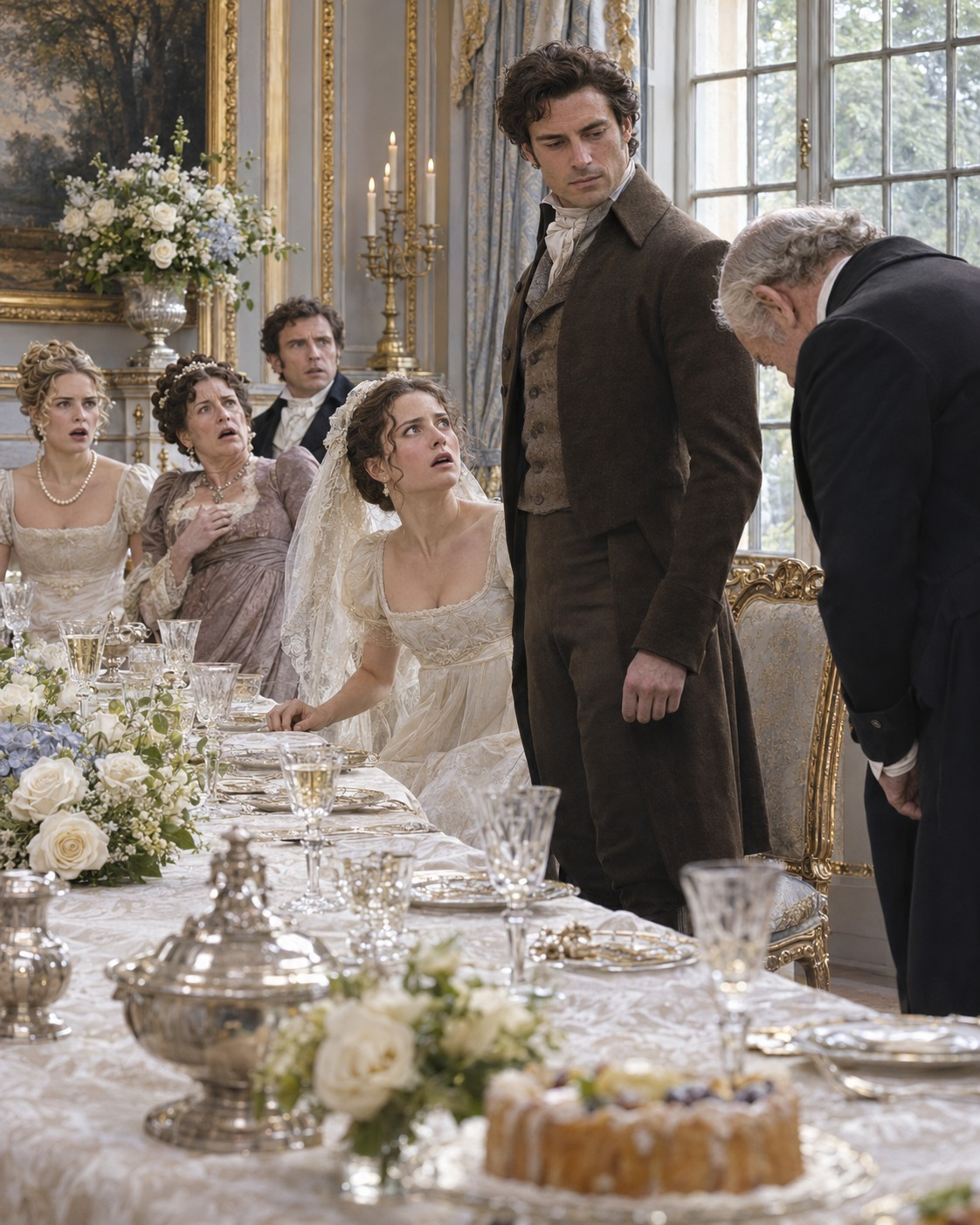
"Stop the wedding!" I cried, pulling my hand away from the stranger standing beside me.
The man my stepmother had chosen as my husband was holding a folded marriage document.
At the bottom, beside my name, someone had written a date three weeks earlier.
That was when I realized the wedding had been arranged before I had ever agreed to it.
And Lord Fenwick had never been intended for me.
Five minutes earlier, I had believed I was about to marry the man my family had promised me.
Now I was standing before an altar, wearing a veil that did not belong to me, looking into the dark gray eyes of a man I had spoken to perhaps four times in my life.
Edmund Hale.
The Duke of Ravensmoor's land steward.
A man without a title, without an independent fortune, and, according to my stepmother, without any prospects beyond a modest cottage on someone else's estate.
And somehow, he was about to become my husband.
"Clara."
My stepmother's voice reached me through the lace.
Lady Beatrice Ashton had a remarkable talent for making threats sound like affectionate advice.
"Do not embarrass this family."
I turned toward her.
"You told me I was marrying Lord Fenwick."
Her smile did not move.
"Plans change."
"Not at the altar."
Her fingers closed around my elbow.
"You will marry Mr. Hale, Clara. Your sister is taking Lord Fenwick. And if you make a scene, you will regret it for the rest of your life."
I stared at her.
For a moment, I thought I must have misunderstood.
Then I looked across the altar.
My stepsister Georgiana stood beside Lord Fenwick, wearing a wedding gown almost identical to mine.
Her veil was raised just enough for me to see her face.
She was smiling.
Not nervously.
Not apologetically.
Triumphantly.
Around her neck hung my mother's pearls.
The necklace my mother had promised me when I was a little girl.
The necklace I had searched for that morning, only to be told it had been misplaced.
Georgiana touched the pearls with two fingers.
Then she smiled wider.
I felt something inside me go terribly still.
This had not happened by accident.
The identical gowns.
The heavy veils.
The insistence that both brides enter the chapel with their faces covered.
The sudden changes to the seating arrangements.
The way my stepmother had refused to let me speak privately with Lord Fenwick during the previous week.
Every small humiliation had been part of something much larger.
"You planned this," I whispered.
Beatrice leaned closer.
"Lower your voice."
"You planned all of it."
"Your sister is better suited to Lord Fenwick's position."
"Then why did you tell me he had asked for my hand?"
"Because you would have made yourself difficult."
I looked at Edmund.
He stood beside me in a plain dark green coat, his expression controlled.
He was taller than Lord Fenwick, broader through the shoulders, and far less polished in his appearance.
There was nothing remarkable about his clothing.
His cravat was neatly tied but simple.
His boots were well maintained but not new.
He looked exactly like what everyone believed him to be.
A respectable employee of a wealthy household.
"Did you know?" I asked him.
His eyes met mine.
"Yes."
The word struck me harder than anything my stepmother had said.
"You knew they were going to do this?"
"Yes."
"And you agreed?"
He hesitated.
Then he said, "I did."
My throat tightened.
"Why?"
For the first time, something shifted in his face.
Regret.
Not embarrassment.
Not shame.
Something deeper.
"I cannot explain that here."
A bitter laugh escaped me.
"How convenient."
"Miss Ashton—"
"Do not call me that as though you have done nothing wrong."
He lowered his eyes briefly.
"You are right."
That surprised me.
No one in my family had admitted I was right about anything in years.
But the admission changed nothing.
I turned toward the chapel doors.
I could leave.
I could walk away from all of them.
For one extraordinary moment, I imagined myself doing exactly that.
I imagined throwing aside the veil, walking down the aisle, and stepping into the afternoon sunlight while every guest watched in horror.
Then reality returned.
I had no independent fortune.
My father had died two years earlier, leaving Hatherleigh Hall and its income under the administration of his widow until the terms of his will were fulfilled.
Those terms placed my marriage arrangements under Beatrice's authority until my twenty-fifth birthday.
I was twenty-four.
My father had believed he was protecting me.
He had never imagined that the woman he married would use his trust as a weapon.
If I walked out, I would have no home.
No allowance.
No respectable position.
No family willing to receive me.
Beatrice had spent years ensuring that every relative who might have helped me believed I was difficult, ungrateful, and emotionally unstable.
She had even dismissed my mother's old companions from the household.
The last one, Mrs. Whitcomb, had been sent away after telling me that my mother would never have approved of certain changes at Hatherleigh.
I had not seen her since.
"Clara," Beatrice whispered, "you are holding up the ceremony."
I looked toward the congregation.
Every pew was occupied.
Women in silk gowns watched from beneath elaborate bonnets.
Gentlemen shifted uncomfortably.
A few guests whispered behind gloved hands.
Nobody stood.
Nobody intervened.
I thought of my mother.
She had been buried beneath the stone floor of the family chapel nine years earlier.
I had been fifteen when she died.
I remembered her hands more clearly than her face.
Warm hands.
Gentle hands.
Hands that had held mine when I was frightened.
She had once told me that courage did not always mean fighting.
Sometimes it meant surviving long enough to find another way.
I had hated that advice when I was young.
Now I understood how much pain might have taught it to her.
Edmund extended his hand.
He did not reach for me.
He did not try to force my fingers into his.
He simply waited.
"You may refuse," he said quietly.
Beatrice's fingers tightened on my arm.
I looked between them.
"Can I?"
Edmund's jaw moved slightly.
"Yes."
"And where would I go?"
He did not answer.
That silence told me everything.
I placed my trembling hand in his.
The vicar resumed the ceremony.
I heard almost none of it.
I remembered saying the vows.
I remembered Edmund's voice, low and steady.
I remembered the ring sliding onto my finger.
And I remembered Georgiana's delighted laugh when Lord Fenwick kissed her hand.
By the time the ceremony ended, I was Mrs. Edmund Hale.
The unwanted daughter.
The discarded bride.
The woman everyone believed had married beneath her station.
I thought that was the worst humiliation I would ever endure.
I was wrong.
The wedding breakfast at Hatherleigh Hall began two hours later.
I had grown up in that dining room.
I knew every portrait on the walls, every scratch beneath the polished dining table, and every place where the afternoon sunlight touched the gilded moldings.
My mother had chosen the pale blue curtains.
She had selected the white roses that grew along the south garden.
She had commissioned the silver serving dishes that now glittered beneath the candlelight.
And yet, sitting there in my wedding gown, I felt like a stranger in my own home.
Georgiana occupied the place of honor beside Lord Fenwick.
Beatrice sat nearby, receiving congratulations as though she had arranged the most brilliant marriages in Hampshire.
I sat at the far end of the table beside Edmund.
No one asked whether I was happy.
No one asked why I had looked so distressed in the chapel.
People seemed determined to pretend that everything had happened exactly as intended.
I wondered how many of them knew the truth.
"Would you care for some wine?"
Edmund's voice interrupted my thoughts.
I shook my head.
"No, thank you."
He set down the bottle.
"You have eaten nothing."
"I am not hungry."
"You should try."
I turned toward him.
"Do you intend to begin giving me orders already, Mr. Hale?"
His expression changed.
"No."
"Then please allow me to decide whether I wish to eat."
"Of course."
He withdrew his hand.
I felt a brief stab of guilt.
He had deceived me, but he had not been unkind.
That distinction mattered, even if I was not ready to forgive him.
Across the table, Georgiana laughed.
"Oh, Clara, do try to look cheerful."
I kept my eyes on my plate.
"You have had such an eventful morning," she continued.
Several guests smiled.
Lord Fenwick lifted his wineglass.
Georgiana leaned forward.
"I hear Mr. Hale has a charming little cottage."
Edmund said nothing.
"Three rooms, isn't it?"
"Four," he replied mildly.
Laughter moved along the table.
Georgiana pressed a hand to her chest.
"Four! How extravagant."
I felt my face burn.
"Georgiana," I said quietly.
"What?"
"That is enough."
Her smile sharpened.
"My dear sister, I am only trying to make you feel welcome in your new circumstances."
"By humiliating me?"
The laughter stopped.
Beatrice looked up.
"Clara."
I ignored her.
"Have you not taken enough from me today?"
Georgiana's eyes narrowed.
"Taken?"
Her fingers moved to my mother's pearls.
"Oh, Clara. You cannot possibly mean Lord Fenwick."
I looked at the necklace.
"Those pearls belonged to my mother."
Georgiana glanced down.
"Yes, and they look lovely with my gown."
"They were promised to me."
"Promises are such delicate things."
Beatrice set down her fork.
"Clara, you will not discuss family property at the wedding table."
"Then perhaps Georgiana should stop displaying it as a trophy."
A few guests exchanged uncomfortable glances.
For the first time that morning, Georgiana looked genuinely annoyed.
"You have always been jealous of me."
I stared at her.
"Jealous?"
"Because Father loved me as much as he loved you."
"My father was kind to you."
"He was my father too, in every way that mattered."
I felt the familiar pain of that statement.
My father had tried to love Georgiana.
He had welcomed her into our home when he married Beatrice.
He had provided for her education, her gowns, and her future.
But kindness had never satisfied either of them.
They had wanted everything.
Including what belonged to my mother.
Georgiana leaned closer.
"You should be grateful anyone agreed to marry you."
The words were delivered sweetly.
Almost playfully.
But the cruelty beneath them was unmistakable.
I looked down.
I refused to cry.
Not in front of her.
Not in front of Beatrice.
Not in front of a room full of people who had watched me lose everything and called it a wedding.
Beside me, Edmund set down his glass.
The sound was small.
Yet something about it made me look at him.
His eyes were fixed on Georgiana.
There was no anger in his expression.
That was what frightened me.
His face had become completely still.
"Mrs. Fenwick," he said.
Georgiana blinked.
It was the first time anyone had addressed her by her married name.
"Yes?"
"I would advise you to speak more carefully about my wife."
The room went quiet.
Georgiana stared at him.
Then she laughed.
"Your wife?"
"Yes."
"How very gallant."
Edmund did not smile.
"Courtesy costs nothing."
Lord Fenwick shifted in his chair.
"I think we have had enough unpleasantness."
"Then perhaps," Edmund replied, "you should ask your wife to stop creating it."
I looked at him in astonishment.
No one spoke to Lord Fenwick that way.
Not a steward.
Not a servant.
Not anyone who depended upon aristocratic goodwill for employment.
Lord Fenwick's face hardened.
"Mr. Hale, I would remind you—"
A sound came from the dining-room doors.
Three sharp knocks.
The butler entered.
His name was Mr. Pritchard, and he had served my father for nearly twenty years.
I had never seen him look so pale.
"Madam," he said.
Beatrice frowned.
"What is it?"
"A carriage has arrived."
"Then have the visitors announced."
Mr. Pritchard swallowed.
"It bears the Ravensmoor arms."
The room fell silent.
Lord Fenwick straightened.
Beatrice rose halfway from her chair.
"The Duke?"
"Six outriders, madam."
Georgiana adjusted her veil.
Beatrice looked suddenly delighted.
"Well, why was I not informed that His Grace intended to honor us?"
Mr. Pritchard's expression grew even more uncomfortable.
"I believe, madam, that His Grace's representative has come on particular business."
"Then show him in."
I looked toward Edmund.
He was watching the doors.
Not with surprise.
With expectation.
A strange uneasiness moved through me.
"Did you know someone was coming?" I whispered.
"Yes."
I turned fully toward him.
"Who?"
Before he could answer, the doors opened.
An elderly gentleman entered the dining room.
He was tall, though age had bent his shoulders slightly.
His silver hair was neatly combed.
His severe dark coat was beautifully tailored, without any unnecessary ornament.
I recognized him immediately.
Mr. Purvis.
The Duke of Ravensmoor's confidential man of business.
I had seen him twice before, both times when he had visited my father on estate matters.
He was known throughout Hampshire as a man who rarely wasted words.
Beatrice moved toward him.
"Mr. Purvis! What an unexpected pleasure."
He bowed politely.
"Lady Ashton."
"Is His Grace with you?"
"No, madam."
Her smile faltered.
"I see."
"But I have come on His Grace's instructions."
Georgiana leaned forward.
Lord Fenwick rose.
Every eye in the room followed Mr. Purvis as he walked past Beatrice.
He did not stop beside Lord Fenwick.
He did not approach Georgiana.
He walked the entire length of the dining table.
Toward me.
Or rather—
Toward my husband.
Edmund rose.
Mr. Purvis stopped before him.
Then the elderly gentleman bowed so deeply that every conversation in the room died at once.
"Your Grace," he said. "Her Grace's carriage is waiting. I have brought the documents you requested."
I stared.
For a moment, I could not make sense of the words.
Your Grace.
I looked toward the doorway, expecting someone else to appear.
No one did.
Mr. Purvis remained bowed before Edmund.
My husband.
The man I had married only hours earlier.
The man Georgiana had mocked for owning a four-room cottage.
"Your Grace?" I whispered.
Edmund turned toward me.
His expression was gentle.
But there was something different about him now.
He stood straighter.
His quietness no longer looked like submission.
It looked like authority.
"My full name," he said, "is Edmund Hale Ashton."
I felt my heart stop.
"Fourth Duke of Ravensmoor."
Somewhere across the table, a glass struck porcelain.
Georgiana had dropped her champagne glass.
Beatrice gripped the back of her chair.
Lord Fenwick stared at Edmund as though he had seen a dead man rise.
"No," Beatrice whispered.
Edmund looked toward her.
"Yes, Lady Ashton."
"That is impossible."
"Is it?"
"The Duke of Ravensmoor is—"
"A man you have never met in his official capacity," Edmund finished.
Mr. Purvis straightened.
"His Grace inherited the title three years ago. His decision to manage portions of the estate under his second given name was entirely his own."
I could barely breathe.
Edmund Hale.
Edmund Hale Ashton.
The name had been there all along.
Hidden in plain sight.
"But you are a steward," Georgiana said.
Her voice sounded strangely high.
Edmund turned toward her.
"I have managed my own estates as one."
"Why?"
"I wished to understand how people behaved when they believed I possessed neither title nor fortune."
Nobody spoke.
His eyes moved toward Beatrice.
"I have learned a great deal."
Georgiana's face had turned scarlet.
Lord Fenwick looked down at the table.
Beatrice opened her mouth, then closed it.
I stared at Edmund.
The man beside me was a duke.
Not merely wealthy.
Not merely respectable.
A duke.
And I was his wife.
The woman everyone had laughed at was now the highest-ranking married woman in the room.
Yet I felt no triumph.
Only a terrible confusion.
"You knew," I whispered.
Edmund turned back to me.
"Clara—"
"You knew they were deceiving me."
"Yes."
"You knew who you were."
"Yes."
"And you let me believe I had been thrown away."
His expression tightened.
"I know."
"Why?"
He looked at me for a long moment.
Then he said, "Because there is something you must understand first."
I felt tears burning behind my eyes.
"Everyone seems to have something I must understand after they have already decided my life for me."
He accepted the accusation without protest.
"You are right."
I shook my head.
"I do not want another explanation designed to make me grateful."
"Then I will give you the truth."
He reached inside his coat.
Mr. Purvis stepped slightly aside.
Edmund withdrew a folded letter.
The paper was yellowed with age.
Its edges were worn.
There was a small stain near the bottom, and the folds had softened from repeated handling.
I stared at it.
Something about the handwriting on the outside made my chest tighten.
I knew those letters.
The graceful curve of the C.
The unusual way the writer crossed the final stroke of an H.
I had not seen that handwriting in nine years.
"Where did you get that?" I whispered.
Edmund's face changed.
For the first time, I saw pain beneath his composure.
"Your mother gave it to me."
The room seemed to tilt.
"My mother?"
"Nine years ago."
I shook my head.
"That is impossible."
"She asked me to make her a promise."
I looked at him.
"Why would my mother know you?"
Edmund hesitated.
Then he said, "Because my father was one of the few people she trusted."
I stared at the letter.
My mother's name was written on the back.
Eleanor Ashton.
I reached for it.
My fingers were shaking so badly that I nearly dropped it.
Edmund did not try to steady my hands.
He let me hold it myself.
I unfolded the paper.
The first sentence was unmistakable.
Edmund, you are the only one I can trust.
My throat closed.
I read the next line.
My husband's new wife is not who she claims to be.
I stopped breathing.
My husband's new wife?
My father had married Beatrice after my mother died.
I had been told that my mother's illness had lasted only a few weeks.
That she had died peacefully.
That my father had been inconsolable.
Then why had my mother written about his new wife?
I read the sentence again.
The words did not change.
My hands began to tremble violently.
Across the table, Beatrice made a sound.
Not a gasp.
Not an expression of surprise.
A small, strangled noise.
I looked up.
Her face was white.
She was staring at the letter.
Not with confusion.
With recognition.
And terror.
"Where did you get that?" she demanded.
Edmund said nothing.
Beatrice took a step forward.
"That document belongs to the Ashton family."
"No," Edmund replied.
"It is private correspondence."
"It was entrusted to my family."
"You have no right—"
"I have every right to return a mother's letter to her daughter."
Beatrice's eyes darted toward me.
"Clara, give me that paper."
I held it closer.
"No."
"Immediately."
I rose from my chair.
The movement surprised everyone.
Perhaps it surprised me most of all.
For years, I had obeyed that voice.
I had lowered my eyes when Beatrice entered a room.
I had apologized for mistakes I had not made.
I had surrendered my mother's jewelry, her bedroom, her portraits, and eventually even my place in the household.
But something had changed.
I was holding a letter written by a woman who had loved me.
A woman who had apparently feared Beatrice long before I had understood why.
And for the first time, my stepmother looked frightened of me.
"No," I repeated.
Beatrice's expression hardened.
"You foolish girl. You do not understand what you are holding."
"Then explain it."
Her mouth tightened.
"That letter is a fabrication."
Edmund spoke quietly.
"Be careful, Lady Ashton."
She turned toward him.
"Are you threatening me?"
"No."
He looked at the letter.
"I am giving you an opportunity to stop lying."
The silence that followed was so complete I could hear the faint crackle of candle flames.
Lord Fenwick moved toward Georgiana.
She had gone pale.
Mr. Purvis remained beside Edmund, his expression grave.
I looked down at the letter again.
Beneath the first two sentences, my mother had written several more lines.
Some were faded.
Others had been pressed so deeply into the paper that the ink had bled through.
I could see my name.
I could see the word danger.
And beneath it—
A name I did not recognize.
Beatrice moved suddenly.
"Clara!"
I stepped back.
She reached toward the letter.
Edmund moved between us.
He did not touch her.
He simply stood in her path.
"Enough," he said.
His voice was quiet.
But Beatrice stopped immediately.
I looked at him.
For the first time since the ceremony, I understood something about the man I had married.
He had not been waiting for permission to defend me.
He had been waiting for the right moment to reveal what he knew.
But that raised an even more frightening question.
How much did he know?
And why had he allowed me to suffer through the wedding before telling me?
I turned the letter over.
There was another page.
A smaller sheet folded inside the first.
It had been hidden so carefully that I had nearly missed it.
The paper was thinner.
Older.
And across the top, in my mother's handwriting, were four words.
If I am murdered.
My stomach dropped.
I stared at them.
For nine years, I had believed my mother died of fever.
For nine years, I had visited her grave.
For nine years, I had accepted the explanation that she had simply grown ill and never recovered.
But my mother had written those words before her death.
If I am murdered.
I looked toward Beatrice.
She had stopped moving.
Her eyes were fixed on the second sheet.
I heard Georgiana whisper something to Lord Fenwick.
I did not understand the words.
I barely heard them.
My entire world had narrowed to the paper in my hands.
I unfolded the smaller sheet.
At the bottom was a signature.
Not my mother's.
Someone else's.
Someone who had witnessed whatever she feared.
And beside the signature was a date.
The date was two days before my mother died.
I began to read the name.
Then a chair scraped violently against the floor.
Beatrice lunged forward.
"DO NOT READ THAT!"
Edmund caught her wrist before she could seize the letter.
The entire room froze.
My stepmother stared at him.
Then at me.
And suddenly, her expression changed.
She was no longer afraid of losing her position.
She was afraid of what I was about to discover.
I looked down at the signature again.
The first name was clear.
The surname had been written beneath a dark smear of ink.
I moved the paper closer to the window.
The daylight revealed an indentation beneath the stain.
A second line of writing.
A message pressed into the page by a hand that had been trembling.
I tilted the letter.
And there, beneath the hidden signature, I saw six words that made my blood run cold.
Ask who was buried instead.
I stopped breathing.
My mother had been buried nine years ago.
I had watched the coffin lowered into the family vault.
I had placed white roses on her grave every year.
But the letter was telling me something impossible.
Something no one had ever dared suggest.
I slowly raised my eyes toward Edmund.
He was watching me with an expression I could not understand.
"Edmund," I whispered, "whose body is in my mother's grave?"
He did not answer.
Mr. Purvis looked toward the dining-room doors.
His face changed.
Someone had appeared beyond the threshold.
Someone carrying a small wooden box tied with a faded blue ribbon.
Mr. Purvis whispered a name.
And Edmund turned so sharply that I knew, before the stranger even stepped into the room, that the next secret was one he had never expected me to discover.






Comments 0