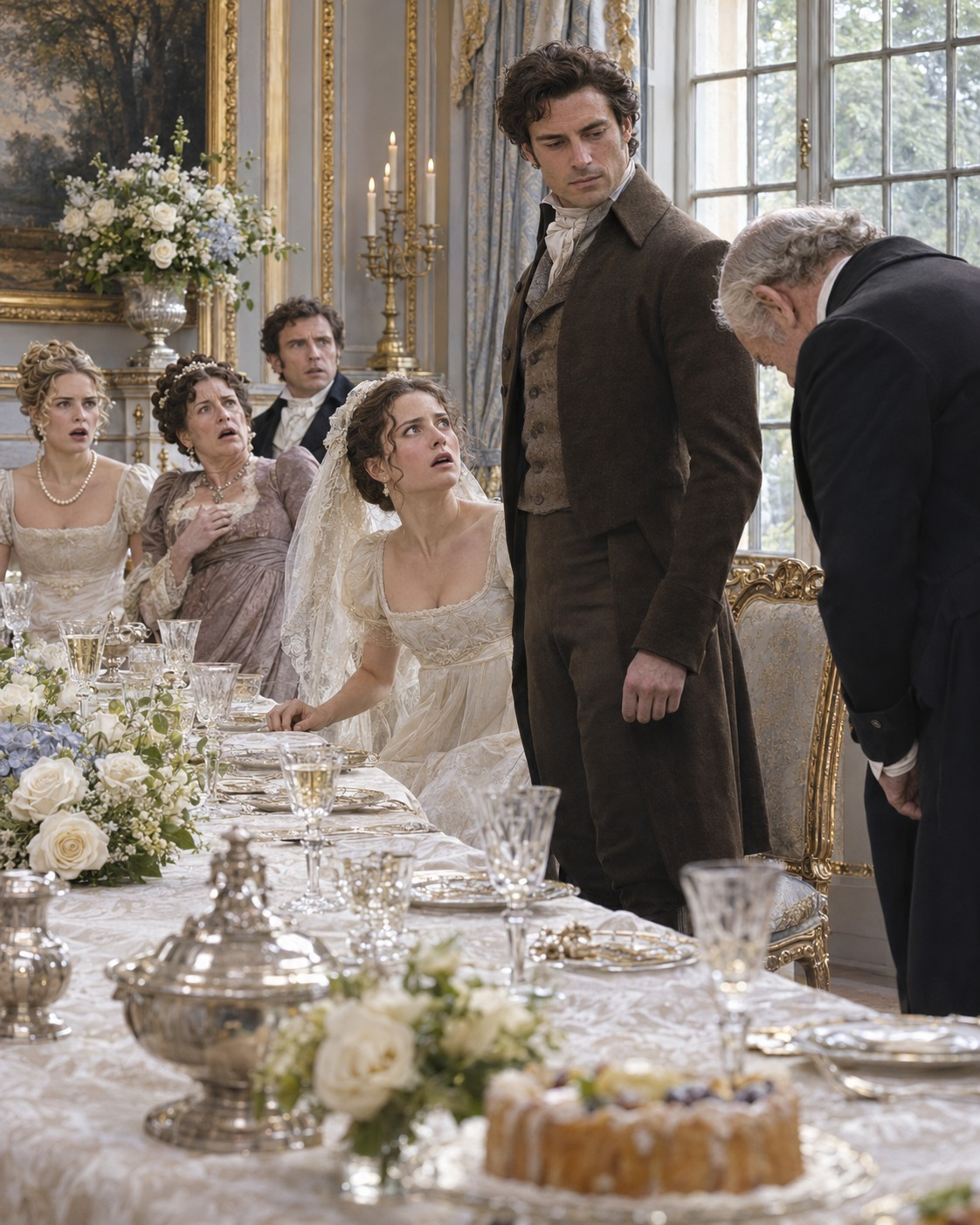
“And that daughter is standing in this chapel right now.”
The stranger's words echoed through the family vault.
For several seconds, nobody moved.
I stared at the entrance, where a tall man stood beneath the stone archway. He wore a weather-stained traveling coat, and his boots were covered with mud. A narrow leather satchel hung from one shoulder.
His face was unfamiliar.
But his eyes were fixed on me.
I felt Edmund's hand tighten around my arm.
“What did you say?” I whispered.
The stranger descended the first step.
“Lady Eleanor Ashton has been waiting for her daughter.”
“I am her daughter.”
He looked at me with an expression I could not understand.
“Yes, Your Grace.”
“Then why did you say she believed her daughter was dead?”
The man swallowed.
“Because that is what she was told.”
A cold sensation spread through my chest.
“Who told her?”
He glanced toward the open coffin.
Then toward Edmund.
“Sir Alistair Pembroke.”
I closed my eyes.
Of course.
Every road led back to Pembroke.
Every forged document.
Every stolen identity.
Every threat.
But this lie was different.
For nine years, I had believed my mother was dead.
And somewhere, perhaps not very far away, my mother had been made to believe the same thing about me.
I opened my eyes.
“Who are you?”
The stranger removed his hat.
“My name is Samuel Reed.”
The name struck me.
Reed.
Thomas Reed.
The accountant Margaret Bellamy had said was murdered after discovering the stolen trust funds.
I looked at Edmund.
He had noticed too.
“Are you related to Thomas Reed?” he asked.
The stranger's expression tightened.
“He was my father.”
Silence.
I stared at him.
“Your father was murdered.”
Samuel nodded.
“Yes.”
“And you came from Blackthorn House?”
“Yes.”
“Then tell me where my mother is.”
He looked toward the chapel entrance.
“Not here.”
I felt anger rise.
“Everyone keeps saying that.”
Samuel turned back.
“Your Grace, I understand—”
“No, you do not.”
My voice shook.
“You have no idea what it is like to spend nine years grieving someone who may have been alive all along.”
His expression changed.
For a moment, I saw something like pity.
Then he said quietly, “I spent twelve years believing my father abandoned us. I learned only recently that he was murdered.”
The words silenced me.
He looked down at the coffin.
“I know something about stolen years.”
I swallowed.
Then I nodded.
“Tell me what you know.”
Samuel reached into his satchel.
Edmund moved immediately.
“Slowly.”
The stranger stopped.
Then he withdrew a folded paper.
Not a weapon.
A letter.
He held it toward me.
“The woman at Blackthorn House gave me this.”
My heart began to pound.
I stepped forward.
The envelope was old.
Its edges were worn.
Across the front, in handwriting I knew better than my own, were two words.
My Clara.
I took it.
My fingers trembled.
I wanted to open it immediately.
But fear held me still.
What if it was another forgery?
Another carefully prepared lie?
Another trap designed to make me believe my mother was alive?
Edmund seemed to understand.
“May I examine the seal?” he asked.
I nodded.
He studied the envelope.
Then handed it back.
“The wax is old. The paper appears genuine.”
I looked at him.
“That doesn't prove who wrote it.”
“No.”
He met my eyes.
“But we can read it together.”
I broke the seal.
Inside was a single sheet.
The handwriting was uneven.
Some letters had been formed with difficulty.
I began to read.
My darling girl,
They tell me you are gone.
My breath caught.
They say you died during the winter fever, and that your father buried you beside the chapel.
Tears blurred my vision.
I forced myself to continue.
I have asked to see your grave. They refuse.
My hands began to shake.
I have asked to see your father. They tell me he has forgotten us both.
A sob escaped me.
Edmund stepped closer.
I barely noticed.
If this letter ever reaches you, then one of two things must be true. Either God has granted a miracle, or the people who imprisoned me have lied.
I pressed a hand over my mouth.
The next sentence was written in darker ink.
I have never stopped being your mother.
I could not read any further.
I bent forward, clutching the paper.
For nine years, I had imagined my mother in the grave.
Cold.
Silent.
Gone forever.
But she had been alive.
Writing letters to a daughter she believed was dead.
Praying for a miracle.
Waiting for someone to tell her the truth.
Edmund caught me before my knees gave way.
I leaned against him.
For once, I did not care who saw.
I cried.
And he held me.
Samuel waited until I could speak.
Then he told us how he had found my mother.
Three months earlier, he had taken employment at Blackthorn House under a false name.
He had been searching for evidence concerning his father's death.
“My father kept copies of every account he examined,” Samuel explained as we gathered in the chapel vestry. “Before he disappeared, he wrote to my mother saying he had discovered a scheme involving charitable trusts, forged marriage settlements, and a concealed inheritance.”
I sat beside Edmund.
Mr. Purvis stood near the table, taking notes.
Samuel continued.
“My father believed the people involved were using false identities to move money between estates.”
“Pembroke,” I said.
Samuel nodded.
“And Arthur Bellamy.”
I looked at him.
“Is Arthur still alive?”
Samuel hesitated.
“I believe so.”
My stomach tightened.
“Where?”
“I don't know.”
Edmund leaned forward.
“Did you see him at Blackthorn?”
“No. But I heard his name.”
“From whom?”
Samuel looked toward me.
“Lady Eleanor.”
My heart hammered.
“My mother?”
“Yes.”
I gripped the edge of the chair.
“What did she say?”
Samuel swallowed.
“She said Arthur Bellamy was the man who arranged her imprisonment.”
I closed my eyes.
The same name.
Again and again.
Arthur Bellamy.
The man who had married my mother's sister.
The man who had worked with Beatrice Vane.
The man who had stolen money, forged documents, and helped destroy my family.
I opened my eyes.
“Why didn't she escape?”
Samuel's expression darkened.
“Because she was never allowed to leave the east wing.”
I stared.
“Was she chained?”
“Not when I saw her.”
“Then why couldn't she leave?”
“Because they controlled her medicine.”
I felt cold.
“What medicine?”
“Drops given every evening. They made her weak and confused.”
I thought of Dr. Vale.
The physician who had signed the false death certificate.
The man who had been threatened into silence.
“Who gave her the medicine?”
Samuel looked down.
“A woman called Mrs. Harrow.”
Edmund's expression changed.
I turned toward him.
“You know her?”
He shook his head.
“No. But I have seen the name in my father's papers.”
Mr. Purvis looked up.
“Mrs. Harrow was employed at Blackthorn House shortly before the third duke died.”
I stared.
“Then she was there when Edmund's father visited.”
Samuel nodded.
“Yes.”
“Did my mother see him?”
The stranger hesitated.
Then he said, “She told me a gentleman came to the house and promised to take her home.”
My heart began to race.
“Edward Ravensmoor?”
“I believe so.”
I looked at Edmund.
His face had gone pale.
Samuel continued.
“She said the gentleman was kind. He brought her books. He told her he had found evidence against Pembroke.”
I swallowed.
“Then why didn't he bring her home?”
Samuel's expression darkened.
“Because he became ill.”
Edmund closed his eyes.
I knew what he was remembering.
His father returning from Blackthorn House.
His sudden illness.
His death three days later.
I reached for his hand.
He looked at me.
For a moment, neither of us spoke.
Then I whispered, “He tried.”
Edmund's jaw tightened.
“Yes.”
“Your father tried to save her.”
He looked away.
“I wish he had succeeded.”
I squeezed his hand.
“So do I.”
Samuel opened his satchel again.
“This is not all I brought.”
He withdrew a small notebook.
The leather cover was worn.
A name had been stamped into it.
Thomas Reed.
I stared.
“Your father's book.”
Samuel nodded.
“I found it hidden beneath a loose floorboard in the servants' quarters at Blackthorn.”
He placed it on the table.
Mr. Purvis leaned closer.
The pages were filled with numbers.
Dates.
Names.
Payments.
Some entries were crossed out.
Others had been marked with small red symbols.
Samuel turned to a page near the middle.
“My father recorded payments made to people who agreed to disappear.”
I felt a chill.
“Disappear?”
“Yes.”
“Witnesses?”
He nodded.
“Servants. Clerks. Anyone who discovered too much.”
Edmund examined the page.
“Some were paid to leave the country.”
“Others were threatened.”
Samuel turned another page.
“And some were reported dead.”
My stomach tightened.
“Like Dr. Vale.”
“Yes.”
“Like Mrs. Whitcomb.”
“Yes.”
I looked down at the notebook.
Then I saw a name.
Silas Crowe.
The undertaker who had prepared my mother's coffin.
The man who had disappeared three days after the funeral.
I pointed.
“Crowe.”
Samuel nodded.
“He was paid five hundred pounds.”
“For what?”
Samuel looked at me.
“To prepare a burial without asking questions.”
I felt sick.
“Did he know whose body was in the coffin?”
Samuel hesitated.
“I believe he did.”
I looked toward the open vault.
The remains of the unknown woman lay inside.
My mother's ribbon.
The silver locket.
The portrait of Pembroke.
And a letter whose final line had been torn away.
I turned back.
“Where is Silas Crowe now?”
Samuel looked at me.
“He's alive.”
My heart hammered.
“Where?”
Samuel hesitated.
Then he said, “I brought him with me.”
I stared.
“What?”
“He is waiting outside the village.”
Edmund stood.
“Why didn't you bring him here?”
Samuel's expression darkened.
“Because he believes someone at Hatherleigh will kill him if he enters the house.”
I felt cold.
“Who?”
Samuel looked toward the chapel door.
Then he whispered, “He wouldn't say.”
We left for the village before noon.
Edmund insisted on taking two trusted men from Ravensmoor.
I did not object.
After the attack in the hidden passage, I had no desire to walk into another trap unprepared.
Samuel rode ahead.
Mr. Purvis accompanied us in the carriage.
The road wound through fields and wooded hills.
The sky was gray.
Rain threatened.
I sat beside Edmund, holding my mother's letter.
For a long time, neither of us spoke.
Then I asked, “Did you ever think you would find her?”
He looked at me.
“Yes.”
I stared.
“Even after nine years?”
“Yes.”
“Why?”
He hesitated.
Then said, “Because my father never stopped searching.”
I looked down.
“Did he tell you about her?”
“Often.”
“What did he say?”
Edmund's expression softened.
“He said Eleanor Ashton was the bravest woman he knew.”
I swallowed.
“Brave?”
“Yes.”
I almost laughed.
“I remember her as gentle.”
“She was gentle.”
He looked toward the window.
“But gentleness and courage are not opposites.”
I thought of my mother.
The woman who taught me to be kind.
The woman who hid letters behind portraits.
The woman who tried to expose a conspiracy while protecting her daughter.
Perhaps I had known only part of her.
Perhaps all children knew only part of their parents.
I looked at Edmund.
“What else did your father say?”
He smiled faintly.
“That she was impossible to intimidate.”
I laughed softly.
“That sounds familiar.”
He looked at me.
“Yes.”
For a moment, his eyes held mine.
Something warm moved between us.
Then the carriage jolted over a rut.
The moment passed.
I looked down at my wedding ring.
It still felt strange.
But less strange than it had the day before.
“Edmund?”
“Yes?”
“Did you ever want to marry someone else?”
He looked startled.
“No.”
“Never?”
He shook his head.
“I was expected to make a suitable match.”
“With whom?”
“Several young ladies were suggested.”
I felt an unexpected sting.
“Were any of them beautiful?”
He gave a small smile.
“Most were considered so.”
I looked away.
“I see.”
He leaned closer.
“Clara.”
I kept my eyes on the window.
“What?”
“I never asked any of them to marry me.”
I turned.
“Why?”
His expression grew serious.
“Because I had already met someone I wanted to know better.”
My heart gave a strange movement.
“Who?”
He looked directly at me.
“You.”
I stared.
For a moment, I forgot the road.
The carriage.
The danger.
Everything.
Then I whispered, “You hardly spoke to me.”
“I was pretending to be a steward. I could hardly announce my intentions over tea.”
Despite myself, I smiled.
He smiled too.
Then his expression softened.
“I know I have given you many reasons to distrust me.”
I looked down.
“Yes.”
“But I hope, someday, you will believe that my affection for you was never part of the deception.”
I did not answer immediately.
Then I said, “I hope so too.”
We found Silas Crowe in a small cottage beyond the village.
He was older than I expected.
Thin.
Stooped.
With trembling hands and a face deeply lined by years of fear.
He opened the door only after Samuel spoke through it.
When he saw Edmund, he stepped backward.
“Your Grace.”
Edmund inclined his head.
“Mr. Crowe.”
The undertaker looked at me.
His eyes widened.
“Lady Clara.”
I felt a chill.
He remembered me.
The fifteen-year-old girl standing beside her mother's coffin.
The girl who had cried while the earth was lowered.
I stepped inside.
“Mr. Crowe, I need to ask you about my mother's burial.”
His face crumpled.
“I knew this day would come.”
I stared.
“Then tell me the truth.”
He lowered himself into a chair.
His hands shook.
“I was paid to prepare a coffin.”
“By whom?”
“Lady Beatrice.”
I swallowed.
“Did you see the body?”
He nodded.
“Yes.”
“Was it my mother?”
He closed his eyes.
“No.”
The word struck me.
I had expected it.
But hearing it from the man who had buried her made it real.
I took a breath.
“Who was she?”
Crowe looked toward Samuel.
Then toward Edmund.
“I never knew her name.”
I felt disappointment.
“But you recognized her?”
He nodded.
“Not at first.”
I leaned forward.
“What do you mean?”
He swallowed.
“She had been badly injured.”
My stomach tightened.
“Injured how?”
He looked down.
“There was a wound near her temple. And bruising around her wrists.”
I felt sick.
“She had been restrained?”
“I believe so.”
I looked at Edmund.
His expression was grim.
Crowe continued.
“I was told she had died after falling down the stairs.”
“By Beatrice?”
“Yes.”
“And you believed her?”
He shook his head.
“No.”
“Then why did you bury her?”
His eyes filled.
“Because they threatened my wife.”
I closed my eyes.
Again.
Another family.
Another threat.
Another person forced into silence.
I opened my eyes.
“Did you see the woman's face clearly?”
Crowe nodded.
“Yes.”
“Could you identify her?”
He hesitated.
“Perhaps.”
I took out the portrait miniature found in the coffin.
The young man with the scar beside his ear.
Sir Alistair Pembroke.
Crowe stared at it.
His face changed.
“Where did you get that?”
“In the coffin.”
He swallowed.
“That belonged to her.”
I leaned forward.
“Who was she?”
Crowe looked at me.
Then whispered, “A woman called Marianne.”
My heart hammered.
“Marianne what?”
He shook his head.
“I never heard a surname.”
I felt cold.
“Was she connected to Pembroke?”
Crowe nodded.
“She wore his portrait.”
I stared.
“Did she love him?”
Crowe's expression changed.
Then he said, “She was his wife.”
Silence.
I looked at Edmund.
His face had gone still.
“Pembroke was married?”
Crowe nodded.
“Yes.”
“Then why is there no record?”
The undertaker swallowed.
“Because the marriage was secret.”
I felt a chill.
“Why?”
Crowe looked toward the window.
Then whispered, “Because Marianne was supposed to marry another man.”
“Who?”
He hesitated.
Then said, “Arthur Bellamy.”
I stared.
Another woman.
Another marriage.
Another identity.
The web seemed endless.
I looked at Crowe.
“Was Marianne killed because she discovered the conspiracy?”
He closed his eyes.
“I don't know.”
“Did she know my mother?”
“Yes.”
My heart hammered.
“How?”
Crowe looked at me.
“She was Lady Eleanor's maid.”
I froze.
“My mother's maid?”
He nodded.
“She served her for years.”
I stared.
I remembered a young woman.
Dark hair.
A quiet smile.
She had helped dress my mother.
She had brought me warm milk when I was ill.
I had forgotten her name.
Until now.
Marianne.
I felt tears burning.
“She was kind to me.”
Crowe looked at me.
His eyes filled.
“She tried to help your mother escape.”
I stopped breathing.
“What?”
He nodded.
“She discovered that Lady Eleanor was being taken away. She tried to stop them.”
My hands trembled.
“What happened?”
Crowe swallowed.
“They killed her.”
Silence.
The words seemed to hang in the room.
I looked down.
Marianne.
The woman who had cared for me.
The woman who had tried to save my mother.
The woman buried in my mother's grave.
I felt sick.
“Who killed her?”
Crowe looked toward the door.
Then whispered, “I heard an argument.”
“Between whom?”
He swallowed.
“Marianne and Lady Beatrice.”
My heart hammered.
“And?”
He closed his eyes.
“Then I heard a scream.”
I leaned forward.
“Did you see what happened?”
He shook his head.
“No.”
“Then how do you know Beatrice was involved?”
He looked at me.
“Because she came to me afterward.”
I felt cold.
“What did she say?”
Crowe's voice broke.
“She told me a woman had died and that I would be paid to make certain no one ever knew her name.”
I sat back.
My stepmother had arranged the burial.
My stepmother had concealed the body.
My stepmother had taken my mother's place.
And now I knew that a woman had died trying to stop her.
I looked at Edmund.
His expression was grim.
“We need Crowe's testimony,” he said.
Crowe shook his head.
“No.”
I turned.
“Mr. Crowe—”
“They will kill me.”
I looked at him.
“Who?”
He swallowed.
“Pembroke.”
I felt a chill.
“Has he threatened you?”
Crowe nodded.
“Many times.”
“Then we will protect you.”
He laughed bitterly.
“Your Grace, I have been hiding for nine years.”
I leaned forward.
“And I have been grieving my mother for nine years.”
He looked at me.
I held his gaze.
“You helped bury the truth. Now you have a chance to help bring it into the light.”
His eyes filled.
For a long moment, he said nothing.
Then he nodded.
“I will testify.”
We returned to Hatherleigh with Crowe under guard.
By then, the rain had begun.
The sky darkened.
The house looked almost black against the hills.
As we entered the hall, Mr. Pritchard hurried toward us.
His face was pale.
“Your Grace.”
Edmund stopped.
“What is it?”
The butler looked toward me.
“Lady Beatrice has left the house.”
My heart tightened.
“Left?”
“Yes.”
“When?”
“Shortly after you departed.”
I looked at Edmund.
“Where did she go?”
Mr. Pritchard shook his head.
“We don't know.”
“And Georgiana?”
“In the blue bedroom with Margaret.”
I felt relief.
At least my stepsister was safe.
Edmund turned toward Mr. Purvis.
“Send riders to the main roads. Beatrice must not reach Blackthorn House before us.”
Mr. Purvis nodded.
Then Mr. Pritchard spoke again.
“There is something else.”
I looked at him.
“What?”
He swallowed.
“Mrs. Whitcomb found a letter in Lady Beatrice's chamber.”
My heart began to race.
“Where is it?”
He held out an envelope.
The seal was broken.
I took it.
The paper smelled faintly of perfume.
Beatrice's perfume.
I unfolded it.
The handwriting was hurried.
Alistair,
The girl knows too much. She has found the journal, the portrait, and the hidden settlement.
My heart hammered.
Crowe may speak. Vale has already betrayed us.
I looked at Edmund.
He was reading over my shoulder.
I continued.
We must remove the last witness before Clara reaches Blackthorn.
I felt cold.
The last witness.
Who?
The final line was underlined.
If Eleanor is still alive, she must not be allowed to see her daughter.
I stopped breathing.
Edmund's expression darkened.
I looked at him.
“She's going to Blackthorn.”
He nodded.
“Yes.”
I folded the letter.
“Then we leave now.”
He hesitated.
“Clara, the roads are dangerous in this weather.”
I looked at him.
“My mother has waited nine years.”
He said nothing.
“I will not make her wait another night.”
For a moment, he studied me.
Then he nodded.
“Very well.”
We left before sunset.
Two carriages.
Four armed men.
Samuel Reed riding ahead.
Mr. Purvis accompanying Crowe in the second carriage.
Edmund and I traveled together.
The rain struck the windows.
The wheels sank into muddy ruts.
The horses struggled along the road.
I held my mother's letter in my lap.
For hours, I watched the darkness beyond the glass.
I imagined her at Blackthorn House.
Older.
Weaker.
Perhaps frightened.
Perhaps waiting beside a window.
I wondered whether she would recognize me.
I was no longer the girl she remembered.
I had grown.
Changed.
Suffered.
But I was still her daughter.
I touched the letter.
I have never stopped being your mother.
Tears filled my eyes.
Edmund noticed.
He reached across the carriage.
His hand rested beside mine.
Not touching.
Waiting.
I looked at him.
Then slowly, I placed my hand in his.
He closed his fingers around it.
Neither of us spoke.
We did not need to.
Blackthorn House appeared shortly after midnight.
It stood beyond a line of dark trees.
A large stone mansion overlooking the southern coast.
The windows were mostly dark.
Only one light burned in the east wing.
I stared at it.
Samuel rode back toward the carriage.
He spoke through the open window.
“Your Grace, something is wrong.”
Edmund leaned forward.
“What?”
“The gates are open.”
I felt cold.
“Is that unusual?”
Samuel nodded.
“They are always locked after sunset.”
Edmund's expression hardened.
“Stay alert.”
We approached slowly.
The front doors stood open.
A carriage waited near the stables.
Its wheels were muddy.
The horses were restless.
Someone had arrived recently.
Or was preparing to leave.
Edmund stepped down first.
Then he helped me from the carriage.
The air smelled of salt and rain.
I looked toward the east wing.
The light was still burning.
“She's there,” I whispered.
Edmund looked at me.
“We don't know that.”
I nodded.
But I felt it.
Something deep inside me insisted that my mother was close.
We entered the house.
The entrance hall was empty.
A clock ticked beside the staircase.
The air smelled of damp stone and extinguished candles.
Samuel led us toward the east wing.
We passed a long corridor.
Several doors stood open.
The rooms were empty.
Beds stripped.
Drawers pulled out.
Furniture overturned.
Someone had searched the house.
Or prepared it for abandonment.
I felt panic rising.
“Samuel.”
He stopped.
“Where was my mother kept?”
He pointed toward the end of the corridor.
“The last room.”
I began walking faster.
Edmund followed.
We reached the door.
It was locked.
Samuel took out a key.
His hands trembled.
He inserted it.
The lock turned.
I pushed the door open.
The room was small.
A bed stood beside the window.
A chair sat near the fireplace.
A little table held a water pitcher and a cup.
The bed was empty.
I stopped.
My heart seemed to collapse.
“No.”
I stepped inside.
The blankets were folded.
The pillow was cold.
The window stood open.
Rain blew across the floor.
I turned toward Samuel.
“Where is she?”
His face had gone pale.
“I don't know.”
I looked at Edmund.
He moved toward the window.
There were footprints in the mud outside.
Fresh.
Several sets.
One appeared to have been dragged.
My stomach tightened.
“They took her.”
Edmund looked at me.
“We don't know.”
I shook my head.
“They took her.”
I turned toward the bed.
Then I saw something beneath the pillow.
A small wooden box.
I recognized it immediately.
My tenth birthday gift.
The music box my mother had given me.
The one painted with tiny blue birds.
I stared.
For a moment, I could not move.
Then I reached for it.
My fingers trembled.
I lifted the lid.
The familiar melody began to play.
Soft.
Fragile.
Almost unbearably beautiful.
I began to cry.
My mother had kept it.
All these years.
She had kept the little music box that belonged to the daughter she believed was dead.
I pressed it against my chest.
Then I noticed a folded paper beneath the mechanism.
I lifted it carefully.
The handwriting was my mother's.
Clara,
If you are reading this, then Samuel has found you.
My heart hammered.
I cannot stay here. They know I have discovered the truth about the settlement.
I swallowed.
There is something you must understand before you trust the people who claim to protect you.
I looked toward Edmund.
He was watching me.
I continued.
The person who betrayed me was not Beatrice.
I froze.
Not Beatrice?
My hands began to shake.
She helped conceal the truth, but she was not the one who arranged my imprisonment.
I stared at the words.
The person responsible was someone I loved.
My breath caught.
I looked up.
Edmund's expression had changed.
I read the next line.
Someone who stood beside me when I married your father.
I stopped breathing.
A witness.
Someone at my parents' wedding.
Someone close to the family.
I looked at Edmund.
He was staring at the letter.
Then I heard footsteps outside the room.
Slow.
Deliberate.
Coming down the corridor.
Samuel turned sharply.
Edmund moved toward the door.
A woman's voice called from the darkness.
“Clara?”
I froze.
The voice was weak.
Older.
But unmistakable.
My mother's voice.
I dropped the letter.
“Mother?”
The footsteps stopped.
Then the voice came again.
“My darling girl?”
I ran toward the door.
Edmund reached for my arm.
“Clara, wait.”
But I pulled free.
I stepped into the corridor.
At the far end, a woman stood beneath a single candle.
Her hair was silver-streaked.
Her face was thin.
She wore a faded blue gown.
And around her wrist was the ribbon I remembered from childhood.
I stopped breathing.
She looked at me.
Her eyes filled with tears.
“Clara?”
I took one step.
Then another.
“Mother?”
She began to cry.
“Oh, my darling.”
I ran toward her.
But before I reached her, a man stepped out of the shadows.
He seized her arm.
A pistol appeared in his hand.
I froze.
The man looked at me.
Then at Edmund.
His face was familiar.
Too familiar.
I had seen him in portraits.
In family records.
In the memories my father had shared.
He smiled.
“Hello, Clara.”
My heart stopped.
The man standing beside my mother was someone I had believed dead for years.
And as he raised the pistol toward her head, he spoke the words that shattered everything I thought I knew.
“Ask your husband why his father ordered me to disappear.”






Comments 0