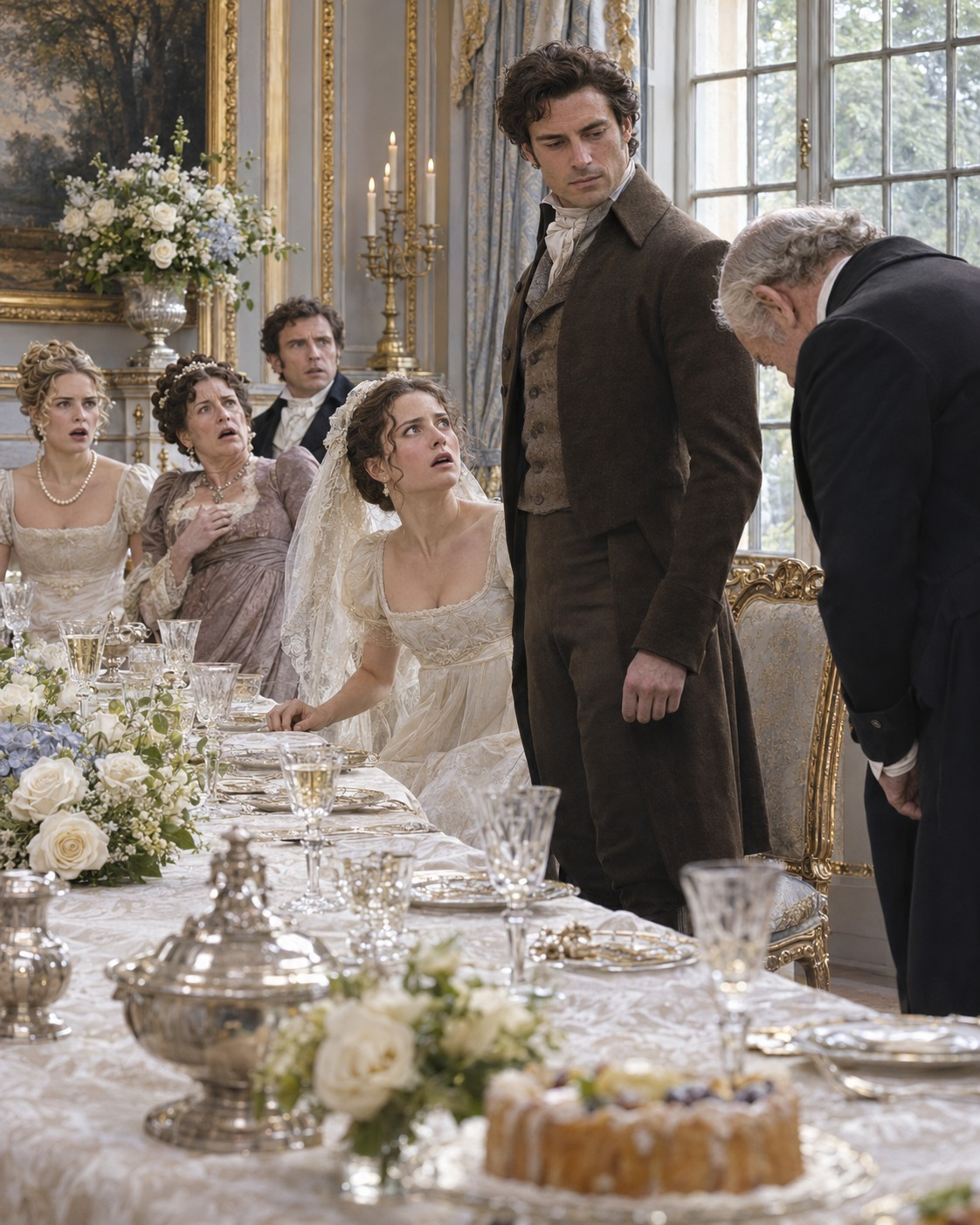
“Your mother should have burned that book when she had the chance.”
The woman stepped into the candlelight.
I felt the blood drain from my face.
“Georgiana?”
My stepsister stood beneath the chapel arch, still wearing the ivory silk gown she had worn at her wedding breakfast. My mother's pearls glittered around her throat.
But there was something different about her.
Her hair had fallen loose.
Her eyes were red.
And in her right hand, she held a small pistol.
Edmund moved in front of me.
“Put that down.”
Georgiana laughed.
It was a terrible sound.
“You really must stop giving orders, Your Grace. This is not Ravensmoor.”
I stared at her.
“Georgiana, what are you doing?”
She looked at the open box beside the memorial stone.
Then at the portrait miniature in my hand.
Her expression changed.
“You found it.”
I said nothing.
She took a step closer.
“Give it to me.”
“No.”
Her eyes narrowed.
“Clara.”
I stood.
For years, that single word had been enough to silence me.
Georgiana said my name the way Beatrice did.
As though I were an inconvenience.
As though my obedience were something she had purchased.
But the woman who had stood trembling at the altar that morning was gone.
“You will not take another thing that belongs to my mother.”
Georgiana's gaze dropped to the portrait.
Then she whispered, “It doesn't belong to her.”
I felt a chill.
“What?”
“The child in that picture.”
I looked down.
The miniature showed a dark-haired woman holding an infant.
The woman resembled my mother.
But the baby had been identified by a name written on the back.
A name I had barely managed to read before Georgiana entered.
Georgiana Margaret Bellamy.
My stepsister.
I looked up slowly.
“That's you.”
Georgiana's face hardened.
“Yes.”
I stared at her.
“Then why was your portrait hidden with my mother's documents?”
She swallowed.
“Because she stole something from me.”
I almost laughed.
“My mother?”
“Yes.”
“Georgiana, you have worn her jewelry, taken her place in this house, and helped your mother arrange my humiliation. What could she possibly have stolen from you?”
Georgiana's eyes filled with tears.
“My name.”
The words struck me.
I looked toward Edmund.
His expression was grave.
Georgiana raised the pistol slightly.
“Don't look at him. He doesn't know everything.”
“Then tell me.”
She stared at me.
For a moment, the anger in her face faltered.
I saw the frightened girl beneath it.
The girl who had spent years competing with me for affection.
The girl who believed every compliment given to me was something taken from her.
Then she whispered, “I was not born Georgiana Bellamy.”
I felt my heart hammer.
“What were you born?”
She looked down.
“Georgiana Ashton.”
Silence.
I stared at her.
“That isn't possible.”
She laughed bitterly.
“That's what I said when I found the papers.”
Edmund stepped forward.
“Georgiana, lower the weapon.”
She pointed it toward him.
“Stay where you are.”
He stopped.
I looked at her.
“Whose daughter are you?”
Her lips trembled.
She glanced toward the open box.
Then back at me.
“That's what I came here to find out.”
For a moment, none of us moved.
The chapel was silent except for the faint hiss of candle flames.
Moonlight fell across the marble floor.
The two kneeling angels seemed to watch us from their places beside the memorial.
Georgiana's hand trembled around the pistol.
I noticed it immediately.
She was frightened.
Not merely angry.
Frightened enough to bring a weapon into the chapel.
“Who gave you that pistol?” I asked.
She looked startled.
“What?”
“The pistol.”
Her fingers tightened.
“It's mine.”
“No, it isn't.”
She glared at me.
“How would you know?”
“Because you have always been afraid of firearms. You refused to accompany Father when he inspected the hunting grounds because you hated the sound of the guns.”
Her face changed.
I took a slow breath.
“Who gave it to you?”
She looked away.
“Lord Fenwick.”
My heart sank.
“Your husband?”
“Yes.”
“Does he know you're here?”
She hesitated.
Then she whispered, “He told me to come.”
Edmund's expression hardened.
“Why?”
Georgiana looked at him.
“He said Clara had found something that could ruin us.”
I felt cold.
“Ruin whom?”
She swallowed.
“Everyone.”
I looked at the pistol again.
“Did he tell you to shoot us?”
Her eyes widened.
“No!”
“Then put it down.”
She hesitated.
I stepped closer.
“Georgiana, you have spent years believing I wanted to take everything from you.”
Her expression twisted.
“Because you always had everything.”
I stared.
“Everything?”
“You had Father's love. You had the servants' affection. You had your mother's memory.”
Her voice broke.
“And I had a mother who only cared whether I married well.”
I felt something painful move inside me.
I had never considered that Georgiana might have been trapped by Beatrice too.
Not in the same way.
Not with the same cruelty.
But trapped nonetheless.
“Georgiana,” I said softly, “I never wanted to take anything from you.”
She looked at me.
For one brief moment, her face crumpled.
Then she lowered the pistol.
Edmund moved immediately.
He stepped forward and took the weapon from her hand.
She did not resist.
The moment it was gone, she began to cry.
Not the delicate tears she used when she wanted sympathy.
These were ugly, desperate sobs.
I stood still.
I did not know whether to comfort her.
I did not know whether I could.
Then she whispered, “I don't know who I am.”
And despite everything she had done to me, I understood.
Edmund led us into the small vestry beside the chapel.
Mr. Purvis had been summoned.
He arrived carrying a lamp and several documents from the library.
Georgiana sat near the fireplace, her hands clasped tightly in her lap.
I placed the portrait miniature on the table.
Then I opened the sealed envelope from my mother's hidden box.
The paper inside was thick.
Cream-colored.
The handwriting was unmistakable.
My dearest Clara,
If you have found this letter, then the secret surrounding Georgiana's birth has become too dangerous to conceal.
I stopped.
Georgiana looked up sharply.
“What does it say?”
I swallowed.
Then continued.
You must understand that the child has committed no wrong. Whatever her mother has done, Georgiana is innocent of the circumstances of her birth.
I looked at my stepsister.
Her eyes filled.
For the first time, I saw something other than resentment in her face.
Hope.
I read on.
The woman who calls herself Beatrice Vane has claimed Georgiana as her daughter. But the original baptismal record tells another story.
My heart hammered.
Georgiana was born to Margaret Bellamy, my younger sister.
Silence.
Georgiana stared at me.
“No.”
I looked up.
“Georgiana—”
“No.”
She stood so quickly that her chair scraped the floor.
“My mother is Beatrice.”
I swallowed.
“The woman who raised you is Beatrice.”
She shook her head.
“No.”
Her voice rose.
“No, that isn't true.”
Edmund stepped forward.
“Georgiana.”
She turned toward him.
“Tell her she's wrong.”
He looked at the letter.
Then at her.
“I cannot.”
She stared at him.
For one terrible moment, I thought she might collapse.
Then she whispered, “Margaret Bellamy?”
I nodded.
“The woman we found in the hidden chamber.”
Her face went white.
“The prisoner?”
“Yes.”
Georgiana covered her mouth.
I looked down at the letter.
My mother continued.
Margaret believed her daughter had died shortly after birth. Arthur Bellamy and Beatrice Vane told her the infant had not survived.
My hands trembled.
But the child was alive.
I looked at Georgiana.
She was shaking.
Beatrice took the baby and raised her under a false identity, using the child to strengthen her claim to Arthur Bellamy's property.
I felt sick.
A child stolen from her mother.
A woman told her baby had died.
Another woman raising that child as her own.
And years later, that child standing beside me at my wedding, laughing while I was humiliated.
I looked at Georgiana.
She had stopped crying.
Her expression was empty.
“Then she lied to me.”
I swallowed.
“Yes.”
“All my life.”
I said nothing.
She looked at the pearls around her throat.
Then she began to remove them.
Her fingers shook so badly that she could barely manage the clasp.
I stepped forward.
“Let me.”
She looked at me.
For a moment, I thought she would refuse.
Then she turned.
I loosened the necklace.
The pearls fell into my hand.
They were warm from her skin.
My mother's pearls.
The ones I had believed were gone forever.
Georgiana looked down.
“I thought she loved me.”
The words broke something inside me.
I wanted to tell her that Beatrice had loved her.
Perhaps in some twisted way, she had.
But I could not lie.
Not anymore.
So I said, “Margaret is alive.”
Georgiana looked up.
“Do you think she would want to see me?”
I stared at her.
Then I remembered the woman lying weakly in the blue bedroom.
The woman who had lost her child.
The woman who had spent years imprisoned while another woman raised her daughter.
“Yes,” I whispered.
“I think she has been waiting for you all her life.”
We returned to Hatherleigh Hall shortly before dawn.
The sky was beginning to pale beyond the trees.
The house looked peaceful from the outside.
Its windows glowed warmly.
The gardens lay beneath a thin veil of mist.
But I knew now that beauty could conceal terrible things.
Georgiana walked beside me in silence.
Edmund followed with Mr. Purvis.
As we reached the entrance hall, Mrs. Whitcomb appeared.
Her face changed when she saw Georgiana.
“Miss Georgiana?”
My stepsister swallowed.
“Where is Margaret?”
Mrs. Whitcomb looked toward me.
I nodded.
“She knows.”
The older woman pressed a hand against her chest.
“Oh, my dear.”
Georgiana's eyes filled.
“Please don't call me that.”
Mrs. Whitcomb looked startled.
“Why?”
“Because I don't know whether anyone has ever meant it.”
The words hung between us.
Mrs. Whitcomb's face softened.
Then she stepped forward.
She took Georgiana's hands.
“I have known you since you were a little girl.”
Georgiana looked away.
“And I have watched you grow up frightened of displeasing your mother.”
My stepsister's lips trembled.
“That does not excuse what you have done to Clara.”
Georgiana closed her eyes.
“But it does not mean you are beyond kindness.”
For a moment, nobody spoke.
Then Georgiana began crying again.
Mrs. Whitcomb held her.
I turned away.
I needed a moment.
Not because I envied the comfort.
Because I remembered how desperately I had wanted someone to hold me when my own mother disappeared.
And because I was beginning to understand that Beatrice had stolen more than one childhood.
Margaret was awake when we entered the blue bedroom.
She lay propped against pillows.
Her face was pale.
But her eyes were clear.
She looked toward me.
Then toward Georgiana.
For one impossible moment, she did not move.
Georgiana stood in the doorway.
Her hands were clasped tightly.
“Are you Margaret Bellamy?”
The older woman's lips parted.
“Yes.”
Georgiana swallowed.
“My name is Georgiana.”
Margaret's eyes widened.
She stared at the young woman before her.
Then her face changed.
Not with recognition.
With something deeper.
Something instinctive.
She lifted one trembling hand.
“Georgiana?”
My stepsister nodded.
Margaret began to cry.
“Oh, my darling girl.”
Georgiana stood frozen.
Margaret reached toward her.
“Come here.”
My stepsister looked at me.
I nodded.
She took one step.
Then another.
And suddenly she was beside the bed.
Margaret caught her hands.
For a moment, they simply stared at each other.
Then Georgiana whispered, “Did you know about me?”
Margaret shook her head.
“I was told you died.”
Georgiana's face crumpled.
“I was told you died too.”
Margaret pulled her close.
They embraced.
I stepped backward.
Edmund stood beside the door.
His expression was grave.
I looked at him.
For the first time, I understood why my mother had hidden the portrait.
It was not merely evidence.
It was a way to reunite a mother and daughter.
A truth that Beatrice had buried beneath years of lies.
And now, at last, one stolen life had been returned.
But my mother was still missing.
Later that morning, I found Edmund in the library.
He stood beside the window, reading a letter.
When I entered, he folded it.
I stopped.
“What is that?”
He looked at me.
“A message from Ravensmoor.”
I stared.
“About what?”
He hesitated.
I felt the familiar frustration.
“Edmund.”
He sighed.
“Lucy.”
My heart tightened.
“What about her?”
He unfolded the letter.
“Her grandmother has been missing for three weeks.”
I stared.
“Lady Margaret Ravensmoor?”
“Yes.”
“Where was she last seen?”
“Bath.”
“And Lucy?”
“She disappeared shortly afterward.”
I felt cold.
“Then Pembroke took them both.”
“Possibly.”
I stepped closer.
“Why?”
Edmund looked down.
“Because Lucy's father left a trust.”
I stared.
“Another trust?”
He nodded.
“Henry Ravensmoor died leaving a substantial estate for his daughter.”
“And Pembroke wants it.”
“Perhaps.”
I looked toward the letter.
“Is there something else?”
Edmund hesitated.
Then he said, “Henry's estate included a property called Blackthorn House.”
My heart stopped.
Blackthorn House.
The place Margaret said my mother had been taken.
I stared at him.
“Edmund.”
He looked up.
“Your cousin owned Blackthorn House?”
“Yes.”
“And you never told me?”
“I only learned the connection this morning.”
I wanted to believe him.
But the coincidence was too terrible.
My mother's disappearance.
The stolen trusts.
The hidden child.
The property near the southern coast.
Everything led to Blackthorn House.
I took a breath.
“We must go there.”
Edmund nodded.
“I agree.”
I stared.
“You do?”
“Yes.”
I felt a strange relief.
For once, we did not argue.
For once, he did not tell me to wait.
He stepped closer.
“I have already ordered the carriage prepared.”
I looked at him.
“Then we leave today.”
He nodded.
“As soon as the roads are passable.”
I turned toward the door.
But he caught my hand.
“Clara.”
I stopped.
He looked at me.
“There is something I need to tell you before we go.”
My heart tightened.
“What?”
He hesitated.
Then he said, “My father visited Blackthorn House shortly before he died.”
I stared.
“Why?”
“He believed Eleanor was being held there.”
I felt the blood drain from my face.
“Did he find her?”
Edmund looked away.
“I don't know.”
I stared at him.
“Then why didn't he tell anyone?”
He swallowed.
“Because he returned from that journey gravely ill.”
My heart hammered.
“What happened?”
Edmund looked at me.
“He died three days later.”
Silence.
I felt cold.
“Do you think he was poisoned?”
His expression darkened.
“I have wondered.”
I looked toward the window.
Blackthorn House.
The place where my mother might still be alive.
The place where the third Duke had gone before his death.
The place connected to Lucy's inheritance.
And perhaps the center of everything.
I turned toward Edmund.
“Then we go together.”
He nodded.
“Together.”
Before we could leave, Mr. Purvis arrived with troubling news.
The family vault had been disturbed again.
This time, the coffin had been moved.
And the undertaker who had been summoned to examine it had disappeared.
I stared at him.
“Disappeared?”
Mr. Purvis nodded.
“His assistant says he went into the chapel shortly before sunrise. He has not been seen since.”
Edmund's expression hardened.
“Was anyone with him?”
“The assistant heard voices.”
“What voices?”
Mr. Purvis hesitated.
“A man and a woman.”
I felt cold.
“Did he recognize them?”
“No.”
Edmund looked toward me.
“We should not delay our departure.”
I shook my head.
“No.”
He frowned.
“Clara—”
“My mother's grave has been opened twice. Someone is trying to remove evidence.”
“I know.”
“Then we must find out what.”
He studied me.
Then nodded.
“Very well.”
We returned to the chapel.
This time, several servants accompanied us.
The morning light revealed what darkness had concealed.
The family vault stood open.
The iron gate had been forced.
The stone floor was scratched.
And the coffin that had supposedly held my mother had been moved into the center of the chamber.
I stopped at the entrance.
For nine years, I had stood outside this vault believing my mother rested peacefully within it.
Now I knew that the woman buried there might have been someone else.
A woman whose life had been stolen.
A woman whose name had been erased.
And someone was still trying to conceal the truth.
Edmund stepped beside me.
“Are you certain you want to see this?”
I looked at him.
“Yes.”
We entered.
The air was cold.
The coffin was old.
Its wood had darkened with age.
The brass handles were tarnished.
The lid had been removed.
Inside lay the remains of a woman.
I turned away.
My stomach twisted.
Edmund placed a hand on my shoulder.
I took a breath.
Then looked again.
The bones were wrapped in remnants of pale fabric.
A small silver cross lay near the chest.
And beside the skull was a narrow blue ribbon.
My mother's ribbon.
I stared.
“Edmund.”
He followed my gaze.
I reached toward the ribbon.
But Mr. Purvis stopped me.
“Your Grace, allow me.”
He carefully lifted it with a cloth.
The fabric was faded.
But the knot was familiar.
My mother had tied ribbons exactly that way.
I felt tears burning behind my eyes.
“Why would they bury her ribbon with someone else?”
Edmund's expression darkened.
“To make the identification convincing.”
I looked down.
Then I noticed something else.
A small metal object lay beneath the fabric.
I pointed.
“What is that?”
Mr. Purvis leaned closer.
He lifted it carefully.
A silver locket.
Oval.
Plain.
With a tiny clasp.
I stared.
It was not my mother's locket.
Hers had been gold.
This one was silver.
Mr. Purvis opened it.
Inside was a miniature portrait.
A man's face.
I leaned closer.
The man was young.
Dark-haired.
With sharp features.
And a scar beside his left ear.
My heart stopped.
I knew that scar.
I had seen it only hours earlier.
Sir Alistair Pembroke.
I stared at the portrait.
“Why would Margaret Bellamy have his picture?”
Edmund's face tightened.
Mr. Purvis examined the locket.
Then he turned it over.
There was an inscription on the back.
Two initials.
A date.
And a single word.
Beloved.
I looked at Edmund.
“Was Pembroke married to Margaret?”
He shook his head.
“Not according to any record I have seen.”
I felt cold.
“Then perhaps she loved him.”
Mr. Purvis looked troubled.
“Or perhaps someone wanted us to believe she did.”
I stared at the locket.
Another false clue.
Another altered identity.
Another piece of evidence that might mean exactly the opposite of what it appeared to mean.
I felt exhausted.
Then one of the servants called from the far side of the vault.
“Your Grace!”
We turned.
The man stood beside a narrow recess in the stone wall.
He was holding a small wooden panel.
“There's something behind this.”
Edmund approached.
I followed.
The recess was shallow.
Inside lay a bundle wrapped in oilcloth.
Mr. Purvis carefully opened it.
Several papers fell onto the stone floor.
A folded map.
A small notebook.
And a letter.
I stared at the letter.
The handwriting was my mother's.
Across the front were three words.
For my daughter.
My hands began to shake.
I took it.
The paper was brittle.
The seal had already been broken.
Someone had opened it before us.
I unfolded the letter.
My dearest Clara,
If this letter is found in the grave, then the plan has failed.
I stopped breathing.
I read on.
The woman buried here was not meant to be forgotten. She agreed to help me expose the people who stole our lives.
My heart hammered.
But something went wrong.
I looked at Edmund.
His face was grave.
I continued.
The body in this coffin belongs to a woman who knew the truth about Arthur Bellamy.
I felt cold.
She was not my sister.
I froze.
Not her sister.
Then who?
I looked toward the coffin.
The remains.
The ribbon.
The silver locket.
The portrait of Pembroke.
I read the next line.
Her real name was—
The sentence ended abruptly.
The lower half of the page had been torn away.
I stared at the jagged edge.
Someone had removed the name.
Someone had wanted the truth hidden.
I looked toward Mr. Purvis.
“Was this opened recently?”
He examined the paper.
“The tear appears fresh.”
My heart hammered.
The undertaker.
The missing assistant.
The voices in the chapel.
Someone had found the letter before us.
Someone had torn away the name.
And someone might still be nearby.
I turned toward Edmund.
“We need to find the undertaker.”
He nodded.
“Immediately.”
We moved toward the vault entrance.
But before we reached it, a sound came from the chapel above.
Footsteps.
Slow.
Heavy.
Then a man's voice called down.
“Your Grace?”
Edmund stopped.
The voice was unfamiliar.
“Who is there?”
A pause.
Then the man answered.
“I have a message from Blackthorn House.”
My heart stopped.
Edmund moved toward the stairs.
“What message?”
The man hesitated.
Then said, “It concerns Lady Eleanor Ashton.”
I felt the blood drain from my face.
“Is she alive?” I cried.
Silence.
Then the man answered.
“She was alive when I left.”
I stumbled forward.
Edmund caught my arm.
The man continued.
“But there is something you must know before you come.”
My heart hammered.
“What?”
He lowered his voice.
“Lady Eleanor has been waiting for her daughter.”
I stared.
“For me?”
Another pause.
Then the man said something that made the entire vault fall silent.
“No, Your Grace.”
I stopped breathing.
“She has been waiting for the daughter everyone believes died twenty-six years ago.”
I stared at Edmund.
His face had gone white.
The stranger's footsteps approached the vault entrance.
Then he spoke again.
“And that daughter is standing in this chapel right now.”






Comments 0