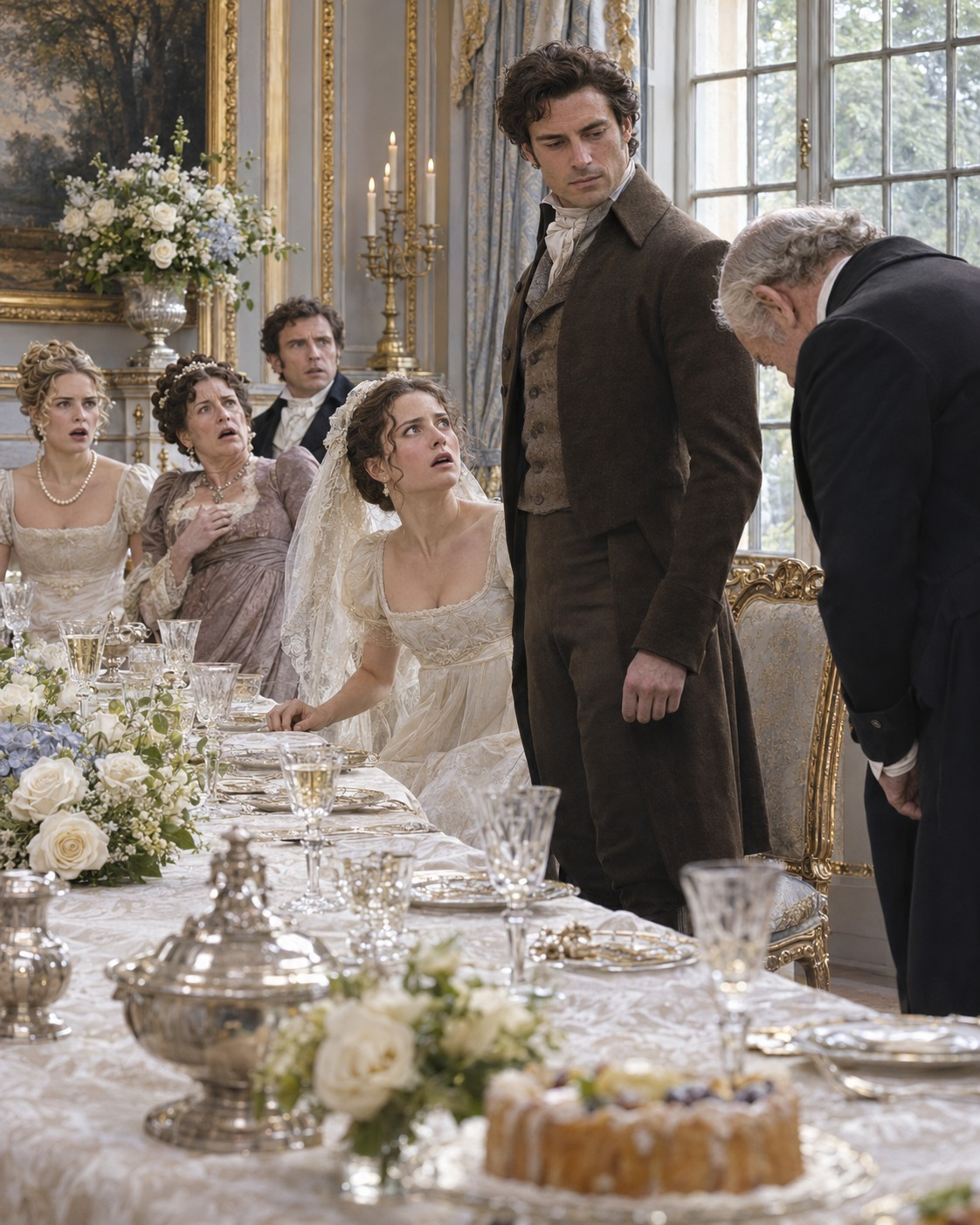
“Don't open that door!” the woman whispered, grabbing my wrist.
Edmund's voice came again from the corridor.
“Clara, I know who is in there. Step away from her.”
The woman who looked exactly like my dead mother pressed the sealed letter against my chest.
Then she said something that made my blood run cold.
“He knows what happened to your mother. But he doesn't know what his father did.”
I stared at her.
For a moment, I forgot the footsteps outside, the locked nursery, and the extraordinary fact that I had been married to a duke for less than a day.
All I could see was her face.
My mother's face.
The same gray-green eyes.
The same narrow nose.
The same delicate curve of her mouth.
Even the little crease between her eyebrows was familiar.
But something was different.
My mother had possessed a softness that this woman lacked. Her eyes had always seemed warm, even when she was frightened. The woman standing before me looked as though she had spent years expecting someone to come through a door and kill her.
“Who are you?” I whispered.
She swallowed.
“My name is Evelyn Bellamy.”
The name struck me.
Evelyn.
The name my mother had whispered during her final illness.
The name Mrs. Whitcomb had associated with a lost sister.
But the letters had already given me two different accounts of the women connected to Arthur Bellamy.
Nothing fitted together.
“Mrs. Whitcomb told me Evelyn was my mother's sister.”
The woman's expression changed.
“She believed what she was told.”
“Then who was my mother's sister?”
She looked toward the door.
“Clara, there isn't time.”
“There has never been time, apparently. Not for anyone to tell me the truth.”
I stepped away from her.
“You will answer me.”
Her eyes widened.
Perhaps she had expected a frightened girl.
Perhaps everyone in this house had grown accustomed to the Clara Ashton who lowered her eyes and accepted whatever explanation was offered.
That girl had stood at the altar that morning.
She was not standing in the nursery now.
“Your mother had a younger sister,” Evelyn said at last. “Her name was Margaret.”
I felt my stomach tighten.
“Margaret Bellamy?”
“Yes.”
“But my mother's letter says Beatrice's real name is Margaret Bellamy.”
“Because the woman you know as Beatrice stole Margaret's identity before she stole another.”
I stared at her.
“That makes no sense.”
“It will.”
“When?”
Her lips trembled.
“When you understand why your mother was taken away.”
I felt the room tilt.
“Taken?”
Evelyn closed her eyes.
Outside, Edmund tried the handle again.
“Clara.”
I turned toward the door.
“I'm safe.”
There was a pause.
“Then open it.”
“Not yet.”
“Clara, that woman has been missing for years. You don't know what she wants.”
I looked back at Evelyn.
She was watching the door with naked terror.
“Do you know my husband?” I asked her.
“Yes.”
“Does he know you?”
“Yes.”
“Then why is he afraid of you?”
Her expression became strangely sorrowful.
“Because I know what his family paid to keep hidden.”
The words settled between us.
I looked down at the letter.
The Ravensmoor seal had been pressed into dark blue wax. Beneath it was handwriting I recognized as my mother's.
But I no longer trusted handwriting alone.
I had already discovered that someone had altered the name on another letter.
“How do I know this is genuine?”
Evelyn looked startled.
Then, slowly, she nodded.
“You don't.”
It was the first answer anyone had given me that felt completely honest.
“Then I will read it with witnesses present.”
“No.”
“Why?”
“Because if the wrong person sees that name—”
“The wrong person has been making decisions for me for nine years.”
I moved toward the door.
Evelyn caught my sleeve.
“Clara, please.”
I stopped.
There was genuine desperation in her voice.
I looked at her.
“If you want me to trust you, stop asking me to be afraid of the truth.”
Her hand fell away.
I turned the key.
The door opened.
Edmund stood on the other side.
His face was pale.
Behind him were Mr. Purvis and two household servants carrying lamps.
Edmund looked past me.
His eyes found Evelyn.
For the first time since our wedding, I saw him lose his composure completely.
“Mrs. Bellamy.”
Evelyn lifted her chin.
“Your Grace.”
The title sounded like an accusation.
Edmund stepped into the nursery.
“I was told you had left England.”
“I was told you had abandoned your father's investigation.”
His jaw tightened.
“I never abandoned it.”
“Then you should have found her.”
Silence.
I looked between them.
“Found whom?”
Neither answered.
My anger rose.
“No.”
I stepped directly between them.
“You will not stand in front of me discussing my mother's disappearance as though I am a child who cannot understand.”
Edmund looked at me.
“Clara—”
“I want the truth. From both of you.”
Evelyn lowered her eyes.
Edmund took a slow breath.
Then he said, “Evelyn Bellamy was once employed as a confidential clerk by my father.”
I turned toward her.
“A clerk?”
She nodded.
“I copied legal correspondence and kept records of certain private transactions.”
“Why would my mother know you?”
“Because your mother was helping the third Duke investigate the theft of money from several estates.”
Edmund continued.
“Some of those funds were intended for widows, injured tenants, and families displaced from their homes.”
I stared at him.
“Charitable trusts?”
“Yes.”
“And someone stole the money?”
“Large sums.”
“How large?”
“Enough to ruin several families and purchase considerable influence.”
Evelyn looked toward the sealed letter.
“Your mother discovered that the theft was connected to a false marriage and a forged inheritance claim.”
My heart began to race.
“Beatrice.”
Evelyn nodded.
“But she was not acting alone.”
I looked at Edmund.
“Your father?”
His expression hardened.
“No.”
Evelyn gave a bitter laugh.
“That is what he believed too.”
Edmund turned toward her.
“Be careful.”
I stepped between them again.
“Stop.”
Both fell silent.
I held up the letter.
“This is what we are going to do. We will go downstairs. We will sit at a table. Every document will be examined. Every accusation will be spoken where everyone can hear it.”
Evelyn looked frightened.
Edmund looked thoughtful.
“And if someone lies,” I continued, “I will ask them to explain the evidence.”
I looked directly at my husband.
“I am finished accepting secrets as protection.”
For a long moment, nobody spoke.
Then Edmund inclined his head.
“As you wish, Your Grace.”
The words startled me.
Your Grace.
He had addressed me as a duchess.
Not as a frightened bride.
Not as a helpless girl.
As a woman whose decision mattered.
I looked at him.
“Then please begin by telling your servants that no one is to prevent Mrs. Bellamy from leaving if she chooses.”
Edmund hesitated.
“Clara—”
“She is a witness, not a prisoner.”
He studied me.
Then he turned toward the servants.
“See that Mrs. Bellamy is treated as an honored guest. She is free to leave whenever she wishes.”
Evelyn stared at me.
Something changed in her expression.
For the first time, she looked less afraid.
The library had always been my father's favorite room.
He used to sit beside the fireplace after dinner, reading aloud from newspapers while I pretended to embroider.
Sometimes he would interrupt himself to explain a political dispute or a strange legal decision.
He believed I should understand the world beyond Hatherleigh Hall.
Beatrice had considered that belief foolish.
“Too much knowledge makes a woman dissatisfied,” she once told me.
My father had laughed.
“Then perhaps the world should give women fewer reasons to be dissatisfied.”
I remembered those words as I entered the library with my mother's letters.
For years, I had believed my father failed to protect me because he did not understand Beatrice.
Now I wondered how much he had suspected before he died.
Edmund ordered a fire lit.
Mr. Purvis brought paper, ink, and a leather portfolio.
Mrs. Whitcomb joined us, her face changing when she saw Evelyn.
The two women stared at each other.
“Evelyn?” Mrs. Whitcomb whispered.
Evelyn's eyes filled.
“Hello, Agnes.”
Mrs. Whitcomb covered her mouth.
“I thought you were dead.”
“So did many people.”
I looked between them.
“You knew each other?”
Mrs. Whitcomb nodded.
“She came to Hatherleigh several times before your mother's illness.”
“Why did you tell me Evelyn was my mother's sister?”
The older woman's face flushed.
“Because that was the name Lady Eleanor used when she spoke of her missing sister. I believed the woman who visited under that name was the same person.”
Evelyn shook her head.
“Lady Eleanor's sister was Margaret. She used Evelyn as a private name in certain letters after leaving her family.”
I frowned.
“Why?”
“Because she was hiding from Arthur Bellamy.”
The name returned like a recurring nightmare.
Arthur Bellamy.
The man who had supposedly married Beatrice.
The man who had actually married my mother's sister.
The man whose death had never been proved.
I sat down.
“Start at the beginning.”
Evelyn took a chair opposite me.
She folded her hands.
“Your mother's sister, Margaret, married Arthur Bellamy against her family's wishes. He was charming, educated, and apparently prosperous.”
“Apparently?”
“He had debts. Serious debts. He also had a talent for persuading wealthy people to trust him.”
“Did my mother know?”
“Not at first.”
Evelyn continued.
“After the marriage, Margaret discovered that Arthur had been using her name to obtain loans. He forged her signature on documents. He sold jewelry that belonged to her family.”
I thought of Georgiana wearing my mother's pearls.
The resemblance was bitter.
“Did Margaret leave him?”
“She tried.”
“What happened?”
Evelyn looked down.
“She disappeared.”
I felt cold.
“Disappeared?”
“Arthur claimed she had run away with another man.”
“Was that true?”
“No.”
“How do you know?”
Evelyn lifted her eyes.
“Because Margaret wrote to your mother from a place where she was being held against her will.”
My hands tightened.
“Where?”
“A private residence near the coast.”
“Who held her there?”
Evelyn hesitated.
Then she said, “A woman named Beatrice Vane.”
I stared.
Beatrice Vane.
My stepmother's name before she married my father had supposedly been Beatrice Bellamy.
But perhaps neither name was hers.
“Who was Beatrice Vane?”
“A woman who worked with Arthur. Sometimes she presented herself as his sister. Sometimes as his wife.”
I felt sick.
“And Georgiana?”
Evelyn looked at me with pity.
“Georgiana was born during the years Arthur and Beatrice were traveling together.”
I stared at her.
“Then Georgiana may be Arthur's daughter.”
“Yes.”
“But Beatrice wasn't legally married to him.”
“Not if Margaret was still alive.”
The implications were enormous.
Beatrice's first marriage might have been fraudulent.
Her claim to widowhood might have been false.
And the documents through which she had entered my father's household might have been forged.
I looked toward Edmund.
“Did your father know?”
“He suspected.”
“Why didn't he stop them?”
“He was gathering evidence.”
“That seems to be a family habit.”
Edmund accepted the criticism without protest.
Evelyn continued.
“Your mother discovered that Margaret was alive. She began trying to arrange her escape.”
“What happened?”
“Arthur found out.”
My breath caught.
“He threatened your mother,” Evelyn said. “He told her that if she continued investigating, Clara would suffer.”
I stared at her.
“Me?”
“Yes.”
I remembered my mother's sudden anxiety during the final months of her life.
The way she insisted I never walk beyond the gardens alone.
The way she questioned servants about visitors.
The way she began locking her writing desk.
I had thought she was ill.
Perhaps she had been afraid.
“Did Arthur hurt her?”
Evelyn's face tightened.
“I don't know.”
“Did Beatrice?”
Silence.
Then Evelyn said, “I believe she arranged for Lady Eleanor to be removed from Hatherleigh.”
The words struck me.
“Removed?”
“Not killed. Removed.”
I stared at her.
“Then you believe my mother survived?”
Evelyn looked toward Edmund.
He did not answer for her.
She turned back to me.
“I believe she was alive after the date on her death certificate.”
I felt my chest tighten.
“How long after?”
Evelyn swallowed.
“Several weeks, at least.”
I closed my eyes.
Several weeks.
While I had been crying beside an empty grave, my mother might have been alive somewhere.
Waiting.
Frightened.
Perhaps calling for me.
The thought was almost unbearable.
I pressed my hands against my knees.
“Where was she taken?”
Evelyn looked down.
“That is the question I have spent nine years trying to answer.”
Mr. Purvis placed the letters on the table.
One by one, we examined them.
The first had been addressed to Edward, the third Duke of Ravensmoor, but someone had altered the name to Edmund.
The second had been hidden in the old nursery.
The third bore the Ravensmoor seal.
Evelyn watched as I broke it.
Inside was a single sheet.
I unfolded it.
The handwriting was my mother's.
At the top was a date.
Nine years earlier.
Three days before her supposed death.
Below it was a name.
Sir Alistair Pembroke.
I stared.
The name was unfamiliar.
“Who is he?”
Mr. Purvis stiffened.
Edmund's expression changed.
Evelyn closed her eyes.
I looked between them.
“Someone had better answer me.”
Mr. Purvis spoke first.
“Sir Alistair Pembroke was your father's solicitor.”
I felt a chill.
“My father's solicitor?”
“Yes.”
“He prepared the will?”
Mr. Purvis nodded.
“And the marriage settlements?”
“Yes.”
I looked at the name again.
The man who had helped arrange my father's estate.
The man whose documents placed my marriage under Beatrice's authority.
The man who had helped determine my future.
I turned toward Edmund.
“You knew him?”
“Yes.”
“Did you trust him?”
“No.”
The answer came immediately.
I stared.
“Then why did you allow him to prepare the settlement?”
“I did not. Your stepmother retained him before I knew of the arrangement.”
I looked down at the letter.
My mother had written:
Alistair Pembroke has been assisting Arthur Bellamy in the transfer of trust funds. He has altered legal documents and concealed the existence of Margaret Bellamy.
My hands trembled.
I continued.
Edward must be told that the evidence is hidden in the west wing of Hatherleigh Hall.
I stopped.
The west wing.
The nursery.
The hidden compartment.
I read the next line.
If anything happens to me, Clara must never be placed under Beatrice's guardianship.
I looked up.
My father had done exactly that.
After my mother's death, he married Beatrice.
After his own death, his will placed my future under her control.
Someone had ignored my mother's warning.
Or prevented it from reaching him.
I looked toward Mr. Purvis.
“Did Edward receive this letter?”
He shook his head.
“No, Your Grace.”
“Why not?”
“It was discovered among papers returned to the Ravensmoor estate after his death.”
“Who returned them?”
Mr. Purvis hesitated.
“Sir Alistair Pembroke.”
I felt cold.
The man named in the accusation had controlled the evidence.
I looked toward Edmund.
“And you kept it?”
“Yes.”
“Why?”
“Because I wanted to establish whether the allegations could be proved.”
“And could they?”
“Some of them.”
I leaned forward.
“Which ones?”
Edmund opened a ledger.
He pointed to several entries.
“Payments were made from charitable trusts into accounts controlled by companies that did not exist.”
I examined the numbers.
The amounts were enormous.
“Who authorized them?”
“Pembroke.”
“And Beatrice?”
“Her signature appears on several documents.”
I looked up.
“Then why has she not been arrested?”
“Because the signatures may have been forged, and the accounts were closed years ago. We need evidence linking the transactions to deliberate fraud.”
I stared at him.
“Then find it.”
His eyes met mine.
“That is what I have been trying to do.”
I shook my head.
“No. You have been investigating while keeping me ignorant.”
I stood.
“From now on, we investigate together.”
Edmund looked at me for a long moment.
Then he nodded.
“Together.”
I held his gaze.
“And I decide what happens to my mother's letters.”
“Yes.”
“And no one opens another room in this house without telling me.”
“Yes.”
“And if you discover something about my family, you tell me immediately.”
He hesitated.
I felt my anger rise.
“Edmund.”
He took a breath.
“Yes.”
I nodded.
“Good.”
For the first time, I felt something resembling control.
It was a small feeling.
Fragile.
But it was mine.
The confrontation with Beatrice took place an hour later.
I found her in the drawing room, seated beside Georgiana.
Lord Fenwick stood near the fireplace.
All three looked up when I entered.
Beatrice's expression hardened.
“Clara. I was beginning to wonder whether your husband intended to imprison us.”
I walked toward her.
“No one is imprisoned.”
“Then why are servants watching the doors?”
“Because someone entered the family vault and opened my mother's coffin.”
Georgiana gasped.
Lord Fenwick turned sharply.
Beatrice remained still.
Too still.
I watched her carefully.
“You don't seem surprised.”
Her eyes narrowed.
“Why should I be surprised by anything that happens in this house today?”
I placed the letters on the table.
“Because these concern you.”
Her gaze dropped.
For one brief moment, I saw recognition.
Then she looked away.
“I have no interest in whatever nonsense your husband has invented.”
“My mother wrote them.”
“Your mother was a confused woman.”
I felt something inside me harden.
“Do not speak about her that way.”
Beatrice laughed.
“Clara, you have been a duchess for less than a day. Do not imagine that a title makes you wiser.”
“No.”
I looked directly at her.
“But it does mean you can no longer threaten to throw me out of my home.”
Her smile vanished.
Georgiana shifted.
“Clara, please.”
I ignored her.
“Did you know Margaret Bellamy?”
Beatrice's face changed.
Only slightly.
But I saw it.
“No.”
“Did you know Arthur Bellamy?”
Her fingers tightened around her handkerchief.
“He was my husband.”
“Was he?”
Lord Fenwick looked toward her.
“Lady Ashton?”
I continued.
“Because I have documents suggesting he was legally married to another woman.”
Beatrice stood.
“That is a lie.”
“Then explain the marriage record.”
I placed a copied document on the table.
Mr. Purvis had found it among the papers.
Arthur Bellamy.
Margaret Ashton.
Married in a small parish church fourteen years before my wedding.
Beatrice stared at it.
Then she looked at me.
“You have no idea what you are doing.”
“Then explain it.”
She stepped closer.
“You think you can destroy me because you married a duke?”
“No.”
I held her gaze.
“I think you have spent nine years destroying everyone who might expose you.”
Her face twisted.
For one moment, I thought she might strike me.
But Edmund entered behind me.
Beatrice stopped.
He did not speak.
He simply stood beside the doorway.
I looked at her.
“Where is my mother?”
The question silenced the room.
Georgiana's face went pale.
Lord Fenwick stared at Beatrice.
My stepmother looked at me for a long moment.
Then she smiled.
It was the same smile she had worn at the altar.
Cold.
Controlled.
Cruel.
“Your mother is dead, Clara.”
“Then whose body was buried in her grave?”
Her smile faltered.
I stepped closer.
“Dr. Vale has admitted he never identified the body.”
Beatrice's eyes widened.
“Vale?”
“Yes.”
“He is here?”
“He was.”
Her expression changed.
For the first time, she looked genuinely afraid.
“Where is he now?”
“I don't know.”
She looked toward the door.
Then toward the windows.
I watched her.
“You're frightened of him.”
She said nothing.
“Why?”
Beatrice's lips trembled.
Then she whispered, “Because Nathaniel Vale was never supposed to return.”
I felt a chill.
“What did you do to him?”
Her expression hardened.
“Nothing.”
“Then why are you afraid?”
She looked at me.
And for one brief moment, I saw something beneath her cruelty.
Desperation.
Not remorse.
Not grief.
The terror of a woman whose carefully constructed life was beginning to collapse.
“You should leave this alone,” she said.
I shook my head.
“No.”
“Clara.”
“No.”
I stepped closer.
“You took my mother's room. You took her jewelry. You took her place beside my father. You controlled his estate after he died. You arranged my marriage without my consent.”
My voice remained steady.
“And now I am going to discover what happened to her.”
Beatrice stared at me.
Then she whispered, “You sound just like her.”
The words struck me.
For a moment, I could not speak.
Then I said, “Good.”
I turned and walked away.
Behind me, Georgiana called my name.
I did not stop.
Edmund followed me into the corridor.
“Clara.”
I kept walking.
“Clara, wait.”
I stopped near the staircase.
He approached carefully.
“You handled that well.”
I turned toward him.
“I did not do it for your approval.”
“I know.”
I looked away.
The house was quiet.
Somewhere below, servants were clearing the remains of the wedding breakfast.
It seemed impossible that the same day had begun with me standing at an altar, believing my life was over.
Now I was a duchess.
My stepmother was frightened.
My mother's letters were in my possession.
And I had begun to understand that the people who controlled my childhood had built their power on lies.
But I was exhausted.
My body felt heavy.
My thoughts would not settle.
Edmund noticed.
“You should rest.”
I laughed softly.
“Everyone keeps telling me what I should do.”
He gave a small, rueful smile.
“Then I will phrase it differently.”
I looked at him.
“Would you like to rest?”
The question was so simple that it almost hurt.
I had forgotten what it felt like to be asked.
Not ordered.
Not instructed.
Asked.
“Yes,” I whispered.
He nodded.
“I will have a room prepared.”
I hesitated.
“Our room?”
His expression changed.
“No.”
I stared at him.
He continued.
“You will have your own chamber. With a lock only you control.”
I felt a strange ache in my chest.
“And you?”
“I will remain in the adjoining suite.”
I looked down at my wedding ring.
“You understand that I did not choose this marriage.”
“Yes.”
“And that I do not know whether I can trust you.”
“Yes.”
“And that I may never forgive you for what happened at the altar.”
His jaw tightened.
“I understand.”
I looked up.
“Then why are you being kind?”
For a moment, he seemed unable to answer.
Then he said, “Because kindness should not require gratitude.”
The words settled between us.
I looked at him.
There was no triumph in his face.
No expectation.
Only a quiet sadness.
For the first time, I wondered whether he had been carrying a burden of his own.
But I was not ready to ask.
Not yet.
My new chamber overlooked the south gardens.
The servants had brought fresh linens, a fire, and a tray of tea.
Mrs. Whitcomb helped me remove my wedding gown.
As she loosened the ribbons, I caught sight of myself in the mirror.
I looked like a stranger.
My hair had fallen from its careful arrangement.
My eyes were red.
The pale fabric of my gown was creased.
The veil lay across the bed like something abandoned.
I touched the gold ring on my finger.
A duchess.
The title still felt unreal.
Mrs. Whitcomb folded the gown.
“Your mother would have been proud of you today.”
I looked at her.
“Would she?”
“Oh, yes.”
I swallowed.
“I was frightened.”
“Courage does not mean you weren't frightened.”
I gave a faint smile.
“She used to say that.”
Mrs. Whitcomb's eyes filled.
“I know.”
I sat beside the fire.
For a while, neither of us spoke.
Then I asked, “Do you believe she is alive?”
Mrs. Whitcomb looked toward the window.
“I don't know, my dear.”
“Do you hope?”
Her eyes returned to mine.
“Every day.”
I nodded.
That was enough.
Hope was dangerous.
But I could not abandon it.
Not yet.
Mrs. Whitcomb left shortly afterward.
I locked the door.
Then I took out the letters.
I spread them across the small writing desk.
The first letter.
The second.
The third.
And Dr. Vale's warning.
I examined the handwriting.
The dates.
The seals.
The names.
Something troubled me.
The first letter had been altered.
The second had been hidden in the nursery.
The third named Sir Alistair Pembroke.
But none explained why my mother had used the phrase my husband's new wife before Beatrice supposedly married my father.
I read the first letter again.
My husband's new wife is not who she claims to be.
The wording was wrong.
Unless—
I stopped.
Unless the letter had not been written to describe my father.
Unless it had been copied from another woman's correspondence.
Or unless someone had changed more than the name.
I lifted the paper toward the candle.
The ink shimmered faintly.
There were marks beneath the writing.
Older words.
Scraped away.
I stared.
Someone had altered the letter more extensively than I realized.
I reached for a blank sheet.
Carefully, I copied the visible words.
Then I held the original at an angle.
The indentations revealed fragments.
A different name.
A different date.
And a phrase that made my heart begin to race.
The child must never know.
I stared at it.
The child.
Which child?
Me?
Georgiana?
Someone else?
I examined the paper again.
Near the bottom, beneath the faded signature, I found a tiny mark.
Three letters.
E.V.B.
Evelyn Vane Bellamy.
I stopped breathing.
The woman from the nursery.
The woman who looked exactly like my mother.
The woman who had warned me not to let Edmund see the name.
I sat back.
The letter had not been written by my mother.
Or at least, not entirely.
Someone had copied her handwriting.
Someone had altered the names.
Someone had placed the document where Edmund would find it.
And someone wanted me to believe a particular version of the truth.
I looked toward the door.
My heart began to pound.
Was Evelyn helping me?
Or leading me toward another lie?
I stood.
I needed to speak to Edmund.
Immediately.
I gathered the letters.
Then I heard a sound outside my chamber.
A soft knock.
I froze.
“Who is it?”
No answer.
Another knock.
Three slow taps.
I moved toward the door.
“Edmund?”
Silence.
I looked through the narrow gap beneath the door.
A shadow stood on the other side.
Someone was waiting.
I reached for the handle.
Then a folded paper slid beneath the door.
It stopped against my shoe.
I stared at it.
The paper was old.
Yellowed.
Sealed with blue wax.
My mother's seal.
I picked it up.
Across the front, in handwriting I knew better than my own, were five words.
Clara, do not trust Evelyn.
My hands began to shake.
I looked toward the door.
The shadow had not moved.
Then a woman's voice whispered from the corridor.
“Open the door, darling.”
I stopped breathing.
The voice was my mother's.
Again.
But this time, it was closer.
And beneath the door, I saw something that made my blood run cold.
A small pool of blood was spreading across the floorboards.
Someone on the other side was injured.
Or dying.
I reached for the lock.
Then the voice whispered one final sentence.
“Clara, if you love me, don't let Edmund see my face.”
The handle turned slowly beneath my hand.
It was already unlocked from the outside.
And someone was waiting for me to open it.






Comments 0