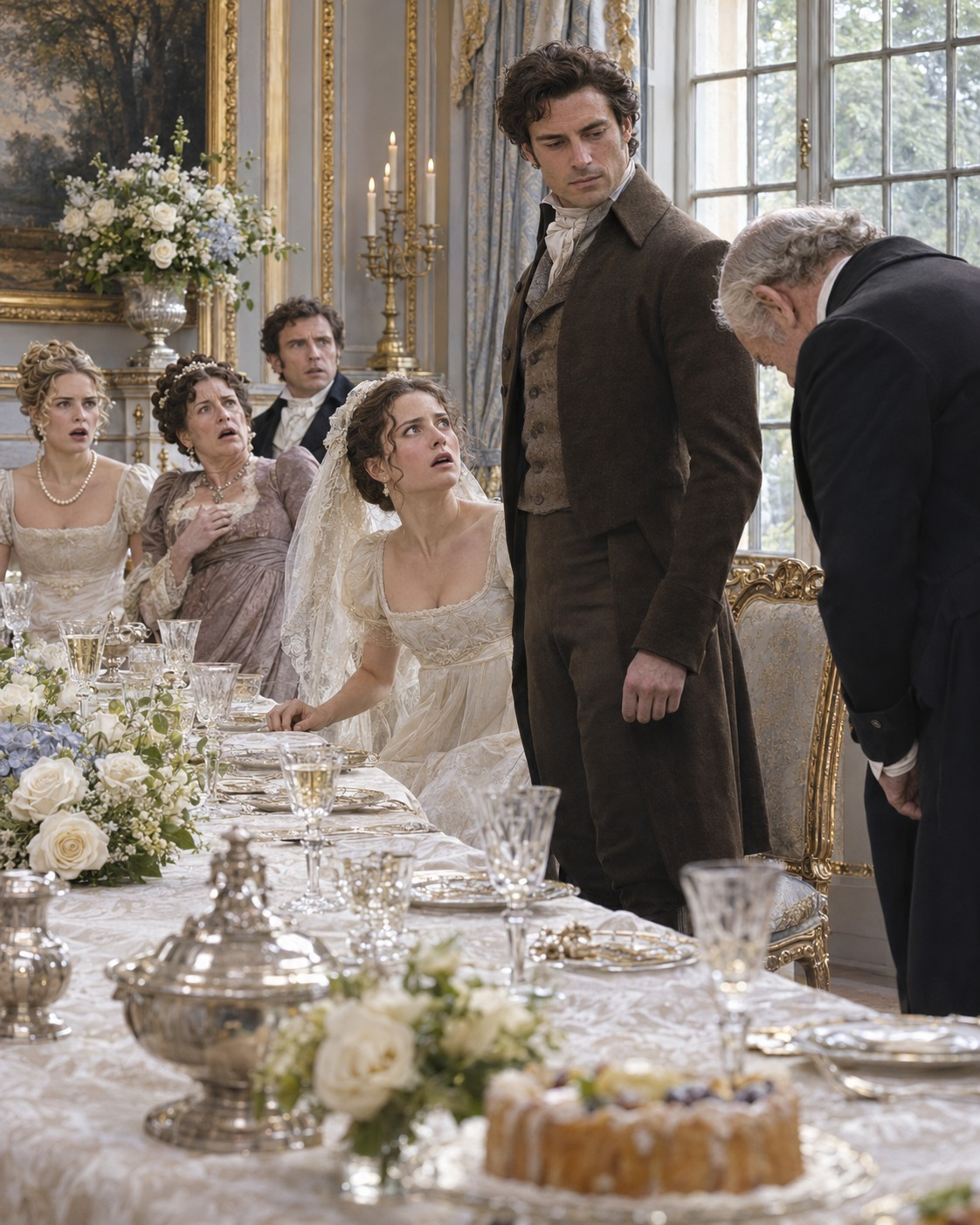
“Keep that woman away from the bride,” Edmund ordered.
His voice was quiet, but every person in the dining room obeyed it.
The stranger standing in the doorway held a small wooden box tied with a faded blue ribbon.
Mr. Purvis had gone pale.
And when the woman lifted her face, my stepmother whispered, “You were supposed to be dead.”
I looked from Beatrice to the stranger.
The woman was elderly, perhaps sixty-five, with silver hair tucked beneath a plain gray bonnet. Her traveling cloak was worn at the hem, and one of her gloved hands trembled around the wooden box.
There was nothing remarkable about her appearance.
Yet she had accomplished something I had never witnessed in all my years at Hatherleigh Hall.
She had frightened Beatrice Ashton into silence.
“Mrs. Whitcomb?” I whispered.
The woman looked at me.
For one terrible moment, her face crumpled.
“Oh, Miss Clara.”
I knew that voice.
I had heard it singing outside my bedroom when I was a child. I had heard it scolding the kitchen servants for bringing cold tea to my mother. I had heard it comforting me on the night my father announced he intended to marry Beatrice.
Mrs. Whitcomb.
My mother's former companion.
The woman who had disappeared from Hatherleigh Hall shortly after my mother's death.
I had been told she had accepted a position in Scotland.
Later, Beatrice claimed she had died of a fever.
But she was standing before me.
Alive.
Holding a box that appeared to have traveled through nine years of secrets.
“Come no closer,” Beatrice said.
Mrs. Whitcomb stopped.
Her eyes moved toward my stepmother.
“You have not changed, madam.”
Beatrice's mouth tightened.
“You have no business here.”
“I was invited.”
“By whom?”
“By the gentleman whose house you have spent three years pretending to understand.”
Edmund stepped forward.
“Mrs. Whitcomb is here at my request.”
I turned toward him.
“You knew she was alive?”
“Yes.”
“How long?”
He hesitated.
“Several months.”
Several months.
The words struck me with a strange, exhausted anger.
My wedding had become a procession of revelations, each one proving that everyone around me knew more about my life than I did.
My stepmother had arranged my marriage without telling me.
My husband had concealed his title.
My mother's companion had been alive while I mourned her.
And now there was a letter suggesting the woman buried beneath our family chapel might not have been my mother at all.
I looked down at the paper trembling in my hands.
Ask who was buried instead.
Those six words seemed to grow heavier every time I read them.
“Clara,” Edmund said softly.
I stepped away from him.
“Please do not tell me to be calm.”
“I wasn't going to.”
“Then tell me the truth.”
He looked at Mrs. Whitcomb.
She lowered her eyes.
Something passed between them.
An understanding.
A decision.
I hated it.
I hated watching people exchange silent messages about my life.
“Stop doing that,” I said.
Edmund turned back.
“Doing what?”
“Deciding what I am allowed to know.”
His expression changed.
I had expected defensiveness.
Perhaps even irritation.
Instead, he looked ashamed.
“You are right.”
“Then answer me.”
I held up the letter.
“Is my mother dead?”
The question fell into the room like a stone dropped into deep water.
No one moved.
Mrs. Whitcomb's eyes filled with tears.
Mr. Purvis looked down.
Beatrice gripped the back of her chair so tightly that her knuckles turned white.
Edmund remained still.
Finally, he said, “I do not know.”
I stared at him.
“You do not know?”
“No.”
“But you brought me this letter.”
“Yes.”
“You brought Mrs. Whitcomb here.”
“Yes.”
“You married me knowing my family had lied to me for years.”
His jaw tightened.
“Yes.”
“Then what exactly do you know?”
He took a slow breath.
“I know your mother feared someone inside Hatherleigh Hall. I know the account of her final illness contains serious contradictions. I know a woman whose name appears in the burial records cannot be found in any parish register before that year.”
My heart hammered.
“And I know,” he continued, “that someone has spent nine years making certain nobody asks questions.”
Behind him, Beatrice suddenly laughed.
It was a harsh, unpleasant sound.
“This is absurd.”
Nobody answered.
She turned toward the wedding guests.
“Surely you can all see what is happening. This man has deceived us about his identity, and now he intends to disgrace my family with some ridiculous story.”
Lord Fenwick cleared his throat.
“Lady Ashton, perhaps we should—”
“Be silent, Fenwick.”
His eyebrows rose.
Beatrice rarely lost control of her voice.
But she had lost it now.
She pointed at Mrs. Whitcomb.
“That woman was dismissed for stealing from my household.”
Mrs. Whitcomb's expression hardened.
“I was dismissed because I refused to sign a false statement.”
“Liar.”
“You know what happened in the blue bedroom.”
Beatrice went still.
I looked at her.
The blue bedroom.
My mother's room.
The room Beatrice had ordered locked after the funeral.
I had begged to enter it for years.
She always refused.
First, she said the memories were too painful.
Then she claimed the room needed repairs.
Eventually, she told me it had been emptied.
“What happened there?” I asked.
Neither woman answered.
I turned toward Mrs. Whitcomb.
“Please.”
The older woman's face softened.
“Oh, child.”
She looked toward Edmund.
He gave a small nod.
And once again, I felt that terrible sensation of being the last person in the room to learn something about myself.
Mrs. Whitcomb lifted the wooden box.
“Your mother asked me to keep this safe.”
I stared at it.
The blue ribbon was faded, but I recognized the knot.
My mother used to tie my birthday presents with that same double loop.
She had taught me how to make it when I was seven.
I stepped forward.
Beatrice moved at the same instant.
“Do not give her that.”
Edmund turned.
“Lady Ashton.”
“That box is stolen property.”
“Then you may present your complaint to the magistrate.”
“You arrogant—”
“Careful.”
One word.
Nothing more.
Yet Beatrice stopped.
I had never understood how much authority could exist in a quiet voice.
Edmund did not need to shout.
He did not need to threaten.
His rank had changed the way everyone listened to him.
But I wondered whether he understood that authority frightened me too.
I had spent years living under the power of people who believed their decisions mattered more than mine.
I did not want another master.
Even one who claimed to be protecting me.
Mrs. Whitcomb approached.
She held out the box.
“Your mother wanted you to have this when you were old enough to understand.”
“Understand what?”
Her eyes filled again.
“That she loved you more than anything in this world.”
My throat tightened.
I accepted the box.
It was surprisingly light.
The wood was dark walnut, scratched along one corner.
A small brass lock hung from the front.
I recognized it immediately.
“My mother's writing box.”
Mrs. Whitcomb nodded.
“She kept her private letters in it.”
“I thought Beatrice had burned it.”
“She tried.”
I looked toward my stepmother.
Her face had become unreadable.
That frightened me more than her anger.
I turned the box over.
There was a narrow groove beneath the base.
My mother had once shown me how to open it.
I had forgotten until that moment.
I pressed my thumb against the hidden catch.
A small compartment slid outward.
Inside lay a brass key.
And beneath it, a strip of folded paper.
I opened the paper.
Three words were written in my mother's hand.
Trust the promise.
I looked up.
“What promise?”
Mrs. Whitcomb's gaze moved toward Edmund.
His face tightened.
I understood immediately.
The promise he had mentioned.
The promise my mother had asked him to make nine years earlier.
I turned toward him.
“What did you promise her?”
He looked at me for a long moment.
Then he said, “That you would never be left without protection.”
A strange ache opened in my chest.
“Protection from whom?”
His eyes moved toward Beatrice.
He did not need to answer.
The wedding guests were dismissed shortly afterward.
Not by Beatrice.
By Edmund.
He spoke to Mr. Pritchard, who quietly instructed the servants to escort the guests toward the drawing room.
Some protested.
Others whispered.
Several ladies looked at me with an expression I had never received from them before.
Respect.
Or perhaps curiosity disguised as respect.
I did not care.
Georgiana remained seated beside Lord Fenwick.
Her hands were folded tightly in her lap.
The pearls at her throat seemed almost painfully bright.
“Clara,” she said as I passed.
I stopped.
She swallowed.
“I hope you understand that none of this was my idea.”
I stared at her.
The same woman who had laughed while I stood humiliated at the altar now looked frightened.
“You wore my mother's pearls.”
Her fingers flew to the necklace.
“I was told they were mine.”
“You knew they weren't.”
She looked away.
“Mother said—”
“Mother said many things.”
Her face hardened.
“You needn't become cruel simply because you've married a duke.”
I almost laughed.
Cruel.
She had stolen my promised husband, my mother's necklace, and my place at the wedding table.
Yet she believed my refusal to comfort her was cruelty.
“I haven't changed, Georgiana.”
“You certainly have.”
“No.”
I looked directly into her eyes.
“For the first time, I am simply refusing to pretend.”
Lord Fenwick shifted uncomfortably.
“Perhaps we should leave.”
Georgiana rose.
As she passed, she leaned toward me.
“You think you've won.”
I said nothing.
Her smile returned, but it was smaller now.
“You have no idea what kind of man you've married.”
I felt a chill.
“What does that mean?”
She glanced toward Edmund.
Then she walked away.
I watched her go.
There had been something in her voice.
Not merely jealousy.
Knowledge.
Or the pretense of it.
I could no longer tell which frightened me more.
By late afternoon, the dining room was empty except for Edmund, Mr. Purvis, Mrs. Whitcomb, and me.
The wedding flowers still covered the table.
Half-finished glasses stood beside untouched plates.
A small cake sat near the center, its icing beginning to soften.
It was an absurdly cheerful sight.
I had become a duchess that morning.
And I was sitting at my own wedding breakfast wondering whether my mother had been murdered.
Edmund pulled out a chair.
“Please sit.”
I remained standing.
He withdrew his hand.
“Or stand, if you prefer.”
I looked at him.
He seemed almost uncomfortable.
Good.
I wanted him uncomfortable.
“You have a great deal to explain.”
“I know.”
“Start with your name.”
He nodded.
“My father was the third Duke of Ravensmoor. His family name was Ashton, though the title passed through a different branch from your father's family.”
I frowned.
“We are related?”
“Distantly. The connection is several generations old.”
“And Hale?”
“My mother's family name.”
“Why use it?”
“Because few people connected it with Ravensmoor.”
I folded my arms.
“You spent three years pretending to be a steward.”
“I spent three years managing my estates while allowing most people to believe I was employed to do so.”
“That sounds remarkably like the same thing.”
A faint expression crossed his face.
Not quite a smile.
“You are correct.”
I did not return it.
“Why?”
He looked toward the window.
“When my father died, I inherited more than the title. I inherited debts that should not have existed, tenants who had been mistreated, and estate managers who had been stealing from families for years.”
“Surely you could have investigated as duke.”
“I could have.”
“Then why didn't you?”
“Because people behave differently when they believe you cannot punish them.”
I remembered Georgiana's laughter.
Beatrice's contempt.
Lord Fenwick's expression when Edmund had defended me.
I understood the principle.
I did not approve of its consequences.
“And I was part of your investigation?”
He looked at me sharply.
“No.”
“Then why marry me?”
He hesitated.
I felt my anger rise.
“Do not tell me you cannot explain.”
“I can.”
“Then do it.”
He rested one hand on the back of a chair.
“Your mother knew my father.”
I waited.
“They were close friends before either of them married.”
“Friends?”
“Yes.”
“My father never mentioned it.”
“Your father was not aware of everything.”
I felt a familiar tightening in my chest.
People spoke of my father as though his kindness had made him foolish.
Perhaps it had.
But I loved him.
And I was tired of hearing strangers suggest that he had failed me.
Edmund seemed to recognize the change in my expression.
“I do not mean to dishonor his memory.”
“Then be careful how you speak of him.”
“I will.”
I looked down at the ring on my finger.
It was a simple gold band.
Nothing about it suggested I had married a duke.
“Did my mother ask you to marry me?”
His eyes widened slightly.
“No.”
The answer came so quickly that I believed him.
“Then what did she ask?”
He looked toward Mrs. Whitcomb.
The older woman nodded.
Edmund turned back to me.
“She asked me to protect you if anything happened to her.”
I stared at him.
“You were twenty-seven when she died?”
“Twenty-seven.”
“And I was fifteen.”
“Yes.”
“Why would she ask a man she barely knew to protect her daughter?”
“Because she knew my father trusted me. And because I had helped him investigate irregularities involving several properties connected to Hatherleigh.”
“What irregularities?”
“Missing funds. Altered deeds. Payments made to people who could not be identified.”
My mouth went dry.
“Beatrice?”
“We suspected someone working with her.”
“Who?”
“That is what we were trying to discover.”
I stared at him.
“Then my mother died.”
“Yes.”
“And you did nothing?”
The words came out harsher than I intended.
Edmund accepted them.
“For years, I believed the matter had been settled.”
“Why?”
“Because the evidence disappeared. The physician who attended your mother left the county. The servants who questioned her illness were dismissed. Your father was told she had suffered a sudden fever.”
“And you believed that?”
“I was away when she died. By the time I returned, the burial had taken place.”
I looked at Mrs. Whitcomb.
She was staring at the floor.
“Were you there?”
Her lips trembled.
“Yes.”
“At the burial?”
“Yes.”
“Did you see my mother in the coffin?”
She closed her eyes.
“No.”
The word struck me with physical force.
I gripped the edge of the table.
“No?”
“The coffin was closed.”
“Why?”
“They said the illness had disfigured her.”
I remembered those words.
I had heard them myself.
I had begged to see my mother one final time.
Beatrice had refused.
She told me it would be too upsetting.
She said I should remember my mother as she had been.
I had believed her.
I had thanked her for protecting me.
A wave of nausea rose in my throat.
“Did anyone see the body?”
Mrs. Whitcomb hesitated.
“The physician.”
“Who else?”
“The undertaker.”
“Who else?”
Her silence was answer enough.
I looked toward Edmund.
“And now you think the body wasn't hers.”
“I think the burial records were altered.”
“That is not what I asked.”
He held my gaze.
“No,” he said. “I cannot yet prove whose body was buried.”
I sat down slowly.
For the first time that day, my legs would no longer hold me.
Mrs. Whitcomb opened the wooden box with the brass key.
Inside were several folded letters, a small portrait miniature, and a silver thimble.
I recognized the thimble immediately.
My mother had used it when sewing my dresses.
There was a tiny dent along one side where I had dropped it onto the nursery hearth.
I picked it up.
For a moment, I was fifteen again.
Sitting beside my mother.
Watching her mend a torn ribbon.
Listening to her tell me that beautiful things were not valuable because they were expensive.
They were valuable because someone had loved them enough to keep them.
I pressed the thimble into my palm.
Then I began to cry.
Not loudly.
Not dramatically.
The tears simply came.
I had held them back through the wedding.
Through Georgiana's insults.
Through Edmund's revelation.
Through the letter.
But that little silver thimble broke something inside me.
Mrs. Whitcomb knelt beside my chair.
“Oh, my dear girl.”
I shook my head.
“I thought everything was gone.”
She covered my hand with hers.
“Not everything.”
I looked at Edmund.
He had moved away from the table.
He stood near the window, giving me privacy.
For the first time, I wondered whether his restraint was not coldness but consideration.
The thought unsettled me.
I did not want to like him.
Not yet.
He had deceived me.
He had allowed me to stand at an altar believing I was being punished.
Whatever his reasons, that hurt remained.
Mrs. Whitcomb lifted the portrait miniature.
It showed my mother as a young woman.
Her hair was dark.
Her eyes were gray-green.
She wore a simple cream gown and a blue ribbon at her throat.
I remembered that ribbon.
I remembered her laughing when I tried to tie it around my own neck.
I touched the painted glass.
“Why did you keep these things hidden?”
Mrs. Whitcomb looked toward Edmund.
I raised my eyes.
“No.”
She stopped.
“No more looking at him before answering me.”
The older woman flushed.
“You are right, Miss Clara.”
“Then tell me.”
She took a breath.
“Because your stepmother searched my rooms the night your mother died.”
I went still.
“What was she looking for?”
“The letters.”
“Why?”
“Your mother had discovered something.”
“What?”
Mrs. Whitcomb hesitated.
“Something about Lady Beatrice's first husband.”
I stared at her.
“Georgiana's father?”
“Yes.”
“He died before Beatrice married my father.”
“That is what we were told.”
My skin prickled.
“What do you mean?”
Mrs. Whitcomb looked toward the doors.
Then she leaned closer.
“Your mother believed he was still alive.”
I felt the room shift around me.
Georgiana's father.
A man I had never met.
A man whose portrait Beatrice had never displayed.
A man whose name she rarely mentioned.
If he had been alive when Beatrice married my father—
I looked toward Edmund.
“Then her marriage may not have been lawful.”
He nodded.
“Depending on the facts.”
“And Georgiana?”
“Her position would be complicated.”
I thought of the estate.
The inheritance.
The marriage arrangements.
The years Beatrice had spent controlling every document that passed through my father's hands.
Suddenly, her cruelty seemed less like simple jealousy.
It looked like desperation.
“She needed my father to believe her first husband was dead.”
“Possibly,” Edmund said.
“And my mother discovered he wasn't.”
“That is one possibility.”
I looked down at the letters.
“Then why would she die?”
No one answered.
I knew why.
At least, I knew what I feared.
As evening approached, Mr. Purvis brought several documents into the room.
One was a copy of my father's will.
Another was a ledger from the Hatherleigh estate office.
The third was a marriage settlement.
I recognized my father's signature.
My heart tightened.
“What are these?”
“Documents that may explain why your stepmother was so determined to arrange your marriage,” Edmund said.
I looked at the settlement.
My name appeared near the top.
Clara Eleanor Ashton.
Below it was a clause I had never seen.
I read it once.
Then again.
Upon my lawful marriage, a portion of the estate income held in trust for me would become subject to administration by my husband until I reached twenty-five.
I looked up.
“She wanted control of my income.”
“Yes.”
“Through Edmund Hale.”
Mr. Purvis nodded.
“She believed Mr. Hale was financially dependent upon the Ravensmoor estate. She expected him to accept an arrangement that would allow her continued access to those funds.”
I stared at the paper.
“And Lord Fenwick?”
“His marriage settlement with Georgiana was structured separately.”
I looked toward Edmund.
“You knew this?”
“Yes.”
“And you agreed to marry me anyway.”
“Yes.”
“Why?”
He stepped closer.
“Because if you married the man your stepmother had originally selected for you, she would have controlled your fortune through him.”
“But she selected you.”
“She selected the man she believed she could control.”
I stared at him.
“Except you were never that man.”
“No.”
I looked down at the settlement again.
A terrible possibility occurred to me.
“Did you let her arrange the marriage because you knew she would choose you?”
Edmund did not answer immediately.
That was enough.
I stood.
“You did.”
“Clara—”
“You allowed her to believe she had found a helpless steward.”
“Yes.”
“You allowed her to humiliate me.”
His face tightened.
“I did not know she would switch the veils at the altar.”
“But you knew she intended to marry me to you.”
“Yes.”
“And you did not tell me.”
“No.”
I stared at him.
For a moment, I could not speak.
Then I said, “You may be a duke, Edmund, but that does not make what you did honorable.”
He looked as though I had struck him.
“I know.”
“Do you?”
“Yes.”
“Because I was terrified.”
His expression changed.
I continued.
“I stood in that chapel believing I had been abandoned by everyone. I thought I would spend the rest of my life dependent on a stranger who had agreed to marry me for reasons he would not explain.”
My voice trembled.
“I thought I had no choice.”
Edmund lowered his eyes.
“You should never have been made to feel that way.”
“But I was.”
“Yes.”
“And you helped make it happen.”
He looked at me.
“Yes.”
The admission silenced me.
I had expected excuses.
He offered none.
After a moment, he said, “I cannot undo this morning. But I can promise you that no decision concerning your future will be made without your consent again.”
I looked at him.
“Promises seem to be very popular in this family.”
He accepted that too.
“Then judge me by what I do.”
I wanted to answer.
I wanted to tell him that trust could not be repaired with a few well-chosen words.
But before I could speak, Mr. Purvis cleared his throat.
“Your Grace.”
Edmund turned.
“There is another matter.”
Mr. Purvis held up a narrow envelope.
It was sealed with dark red wax.
“Lady Eleanor's final instruction.”
I stared at it.
“My mother wrote that?”
“Yes, Your Grace,” Mr. Purvis replied. “It was held by your late father's solicitor, with instructions that it be opened only after Miss Ashton was safely married and beyond Lady Beatrice's legal control.”
I felt a strange mixture of relief and dread.
“Then open it.”
Edmund looked toward me.
“Are you certain?”
I almost laughed.
“After everything that has happened today, you are finally asking my permission?”
His expression softened.
“Yes.”
I held out my hand.
“Then give it to me.”
Mr. Purvis placed the envelope in my palm.
The wax seal bore my mother's initials.
E.A.
I broke it carefully.
Inside was a single sheet.
The handwriting was hers.
I recognized every curve.
Every flourish.
Every delicate stroke.
I began to read.
My dearest Clara,
If you are reading this, then I have failed to protect you myself.
My eyes filled.
I continued.
You must not blame your father. He has been deceived by people he believes he can trust.
I swallowed.
There are documents hidden in the blue bedroom. They prove that Beatrice entered this household under a false name.
My hand tightened.
But the documents are not the greatest danger.
I looked up.
Edmund was watching me.
I returned to the letter.
The woman who calls herself Beatrice has a connection to our family that your father does not know.
My heart began to race.
I discovered the truth shortly before my illness.
The next line was written more heavily.
If anything happens to me, do not trust the physician who attends me.
I stopped.
The physician.
The man who had declared my mother dead.
The man who had insisted the coffin remain closed.
I looked toward Mrs. Whitcomb.
“Who was he?”
Her face had gone pale.
“Dr. Nathaniel Vale.”
The name meant nothing to me.
But Edmund reacted.
His hand closed around the back of a chair.
I looked at him.
“You know him.”
“Yes.”
“Where is he?”
Edmund hesitated.
“Until six months ago, I believed he had died abroad.”
“And now?”
Mr. Purvis answered.
“We have reason to believe he returned to England.”
I stared at them.
“Where?”
Before either could respond, footsteps sounded in the corridor.
Mr. Pritchard appeared at the doorway.
His face was strained.
“Your Grace,” he said, “there is a gentleman asking to see Lady Clara.”
Edmund turned.
“His name?”
The butler swallowed.
“He refused to give it.”
“Then he may leave his card.”
“He says he has no card, Your Grace.”
I frowned.
“Then why has he come?”
Mr. Pritchard looked directly at me.
“He says he was present when your mother died.”
The room went silent.
My fingers tightened around the letter.
Edmund moved toward the doorway.
“Where is he?”
“In the entrance hall, Your Grace.”
“Did he say anything else?”
Mr. Pritchard hesitated.
Then he nodded.
“He said Lady Clara must come alone.”
Edmund's expression hardened.
“That will not happen.”
The butler looked relieved.
But I was already moving.
“Clara,” Edmund said.
I stopped.
He looked at me.
“You do not know who this man is.”
“No.”
“He may be dangerous.”
“Perhaps.”
“Then let me speak to him first.”
I thought of my mother's letter.
The closed coffin.
The physician who had disappeared.
The woman buried beneath the chapel.
And the years I had spent believing every lie I was told.
“No,” I said.
Edmund stared at me.
“I have spent my entire life waiting while other people decide what I am permitted to know.”
I walked toward the door.
“That ends tonight.”
He did not stop me.
Instead, he stepped beside me.
“Then you will not face him alone.”
I looked at him.
For the first time that day, I did not argue.
We walked through the corridor together.
The house was strangely quiet.
The wedding guests had departed.
The servants moved carefully, avoiding our eyes.
At the far end of the corridor, the entrance hall stood beneath the great staircase.
A single lamp burned beside the front doors.
And there, near the marble fireplace, stood a man in a dark traveling coat.
His back was turned.
He was tall.
His shoulders were narrow.
One hand rested on a walking stick.
I could see a silver ring on his little finger.
Something about him seemed familiar.
Not his face.
Not his clothing.
The way he stood.
The slight bend of his head.
A memory stirred.
A memory from childhood.
A man speaking quietly with my father in the library.
A man who had once brought me sugared almonds from London.
A man who had disappeared after my mother's funeral.
The stranger slowly turned.
I stopped breathing.
Edmund went rigid beside me.
The man looked directly at me.
Then he spoke.
“Miss Clara.”
His voice was older.
Rougher.
But I knew it.
I had heard it in my childhood.
I had heard it beside my mother's sickbed.
I had heard it on the morning they told me she was dead.
The man took one step forward.
“I am sorry to come without warning.”
His eyes moved toward Edmund.
Then back to me.
“But there is something you must know before they open the grave.”
I stared at him.
“Who are you?”
He removed his hat.
A pale scar crossed his forehead.
His eyes were filled with something that looked terribly like guilt.
“My name is Nathaniel Vale.”
The physician.
The man who had signed my mother's death certificate.
The man everyone believed had disappeared from England.
I felt the blood drain from my face.
“You told me my mother was dead.”
He closed his eyes.
“Yes.”
“You signed the certificate.”
“Yes.”
“You watched them bury her.”
His hands began to shake.
“Yes.”
I stepped toward him.
“Then tell me whose body is in that grave.”
He opened his mouth.
But before he could answer, the front doors burst open.
A servant stumbled inside.
His face was white.
“Your Grace! There has been an accident at the chapel!”
Edmund turned sharply.
“What accident?”
The servant struggled to breathe.
“The family vault, sir. Someone has broken the lock.”
I felt the floor shift beneath me.
The servant looked at Dr. Vale.
Then at me.
“And there is a coffin standing open.”
Silence.
Dr. Vale's walking stick slipped from his hand.
It struck the marble floor.
He stared toward the darkness beyond the doors.
“No,” he whispered.
Edmund seized his arm.
“What do you know?”
The physician's face twisted with terror.
“They weren't supposed to find it yet.”
I felt my heart stop.
“Find what?”
He looked at me.
And in his eyes, I saw the answer he was too frightened to speak.
Then he whispered, “There was something hidden inside your mother's coffin.”
I stepped closer.
“What?”
His lips trembled.
“A second letter.”
I stared at him.
“From my mother?”
He shook his head.
“No.”
The servant at the door made a small, frightened sound.
Dr. Vale turned toward him.
“What did they find?”
The servant swallowed.
Then he reached inside his coat.
He withdrew a folded piece of paper.
Its edges were stained with dark earth.
Across the front, in handwriting I recognized instantly, was my name.
Clara Eleanor Ashton.
My hands began to shake.
The servant held it out.
I reached for the paper.
But Dr. Vale suddenly seized my wrist.
“Do not open it here.”
I stared at him.
“Why?”
He looked toward the staircase.
His face had turned gray.
“Because the person who wrote that letter is still inside this house.”
At that moment, a door opened on the upper landing.
Slow footsteps crossed the floor.
And a woman's voice, one I had not heard in nine years, whispered from the darkness:
“Clara, darling. Please don't read it yet.”






Comments 0