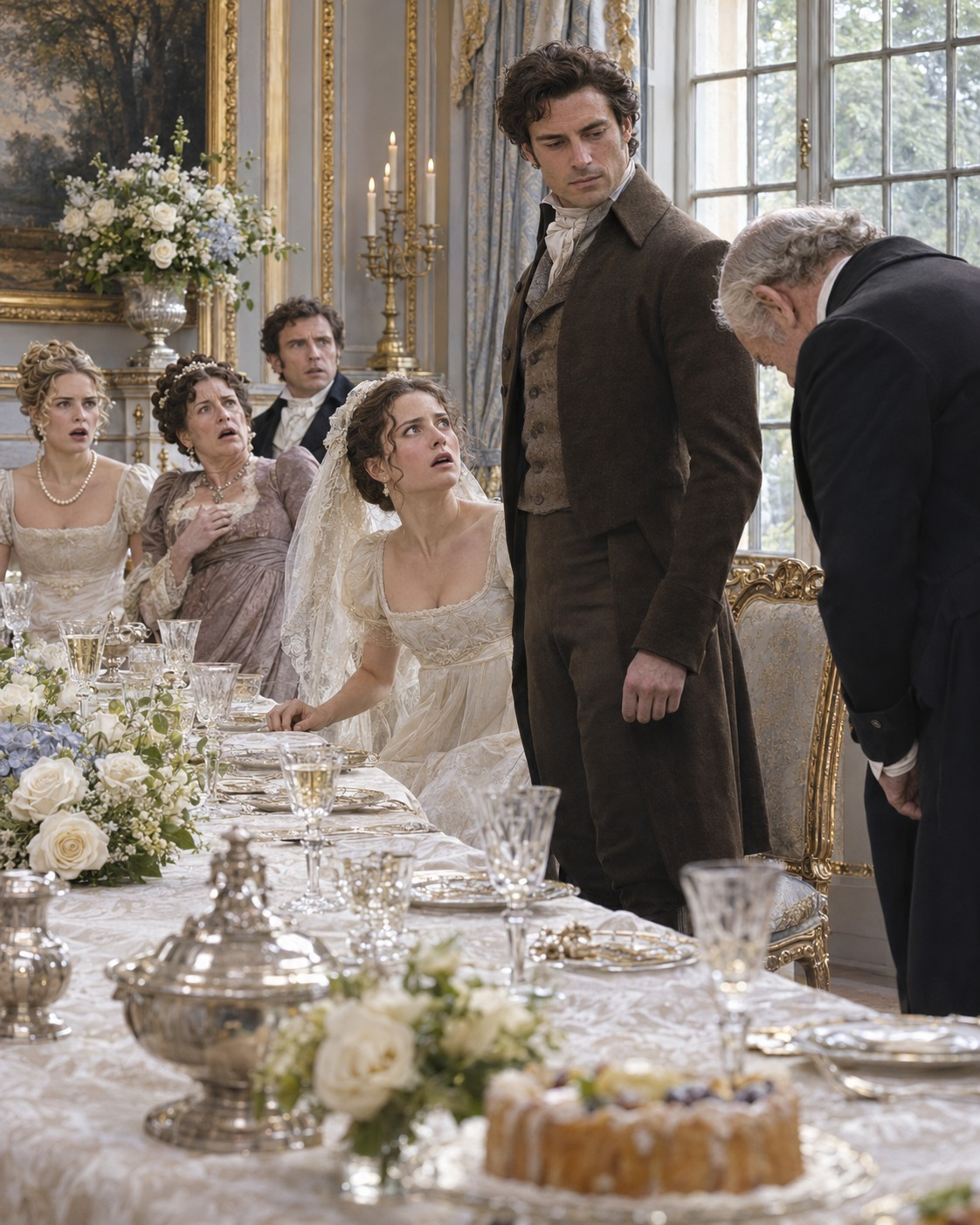
“Papa? Papa, is that you?”
The little girl's voice came from behind the locked chamber.
Edmund stopped breathing.
The stranger raised his pistol and smiled.
Then the child called again.
“Please, Papa. I heard you coming.”
I looked at my husband.
His face had turned white.
For one terrible second, I thought I understood everything.
The secret marriage.
The false identity.
The promises he had made.
The years he had spent investigating my mother's disappearance.
And now a child was calling him Papa from a room hidden beneath my family's house.
I stepped away from him.
“Edmund?”
He did not look at me.
His eyes remained fixed on the locked door.
The stranger laughed softly.
“Well, Your Grace? Aren't you going to answer your daughter?”
The word struck me harder than a slap.
Daughter.
I stared at Edmund.
“Is that true?”
His jaw tightened.
“No.”
The stranger's smile widened.
“Such a shame. The little thing has been waiting so patiently.”
Edmund moved forward.
The pistol rose.
“Another step,” the man warned, “and the duchess becomes a widow before her wedding night is over.”
I froze.
Mr. Purvis stood behind us, holding his lamp. Mrs. Whitcomb had pressed herself against the stone wall.
The stranger glanced toward the dark passage.
“Everyone seems terribly interested in the child. Perhaps we should introduce ourselves properly.”
He removed his hat.
He was perhaps fifty years old, with thinning brown hair, a narrow face, and eyes that seemed almost colorless in the lamplight.
There was a small scar beside his left ear.
Edmund recognized him.
I could see it in the way his shoulders stiffened.
“Alistair,” he said.
My heart lurched.
Sir Alistair Pembroke.
My father's solicitor.
The man named in my mother's letter.
The man who had helped arrange the transfer of charitable funds.
The man who had prepared the documents that placed my future under Beatrice's control.
He bowed.
“At your service, Your Grace.”
I stared at him.
“You helped destroy my family.”
Pembroke looked amused.
“My dear duchess, that is a rather serious accusation.”
“You forged documents.”
“Did I?”
“You stole money from the trusts.”
“Money has a remarkable habit of moving between accounts.”
“You helped my stepmother steal another woman's identity.”
His smile faded slightly.
“Careful.”
I stepped forward.
Edmund caught my hand.
“Clara.”
I pulled away.
“No. I have spent my entire life being told to be careful.”
I looked directly at Pembroke.
“Where is my mother?”
He studied me.
For the first time, his expression became genuinely interested.
“Your mother.”
“Yes.”
“Which one?”
The words made my blood run cold.
I stared at him.
“What did you say?”
He smiled again.
“Nothing you are prepared to understand.”
Edmund's voice hardened.
“Enough, Alistair.”
Pembroke turned toward him.
“Ah, there it is. The famous Ravensmoor temper.”
He gestured toward the locked chamber.
“Shall we begin with the child?”
From behind the door came a small sob.
“Papa?”
Edmund closed his eyes briefly.
Then he spoke.
“Lucy.”
The crying stopped.
I looked at him.
Lucy.
He knew her name.
My heart seemed to drop into my stomach.
The child answered immediately.
“Uncle Edmund?”
Silence.
Pembroke's smile vanished.
Edmund opened his eyes.
“Yes, Lucy. It's me.”
I stared at him.
Uncle.
Not father.
The girl began crying again.
“Please get me out.”
“I will.”
Pembroke's face tightened.
“You always did enjoy ruining a performance.”
Edmund looked at him.
“You made a mistake bringing her here.”
“Did I?”
“You thought she would call me Papa because you told her to.”
Pembroke said nothing.
Edmund continued.
“But you forgot that children remember the people who treat them kindly.”
The stranger's expression darkened.
I looked toward the door.
“Who is she?”
Edmund turned to me.
“Lucy is my cousin's daughter.”
I stared.
“Your cousin?”
“My cousin Henry.”
The name meant nothing to me.
Edmund saw my confusion.
“Henry Ravensmoor was my father's nephew. He died four years ago.”
“And Lucy?”
“His daughter. She should have been living with her grandmother in Bath.”
Pembroke laughed.
“Should have been.”
Edmund's eyes hardened.
“Where is Lady Margaret Ravensmoor?”
The stranger's smile returned.
“That depends on how cooperative you intend to be.”
I looked at the pistol.
Then at the locked door.
A child was trapped inside.
Whatever secrets surrounded her, they could wait.
“Let her out,” I said.
Pembroke looked at me.
“Excuse me?”
“Let the child out.”
He smiled.
“You are in no position to give orders.”
I took another step.
“Then shoot me.”
Edmund turned sharply.
“Clara!”
I ignored him.
I looked directly at Pembroke.
“You brought a child into a hidden chamber. You frightened her. You taught her to call a man Papa so that you could humiliate his wife.”
His expression hardened.
“You know nothing.”
“I know enough.”
I pointed toward the door.
“Open it.”
Pembroke's eyes narrowed.
“You have your mother's stubbornness.”
“Then perhaps you should have learned from what happened when you underestimated her.”
For a moment, nobody moved.
Then Pembroke smiled.
It was a terrible smile.
“Very well.”
He reached into his coat.
My heart hammered.
But instead of firing the pistol, he withdrew a small iron key.
He tossed it toward me.
It struck the stone floor.
“Open it yourself.”
I bent to retrieve it.
Edmund seized my arm.
“Wait.”
I looked at him.
He was staring at the key.
“What?”
His voice was low.
“Don't touch it.”
I froze.
Pembroke laughed.
“Still suspicious, Edmund?”
Edmund looked at him.
“Why give her the key?”
“Because she asked so politely.”
Edmund's jaw tightened.
He took a handkerchief from his pocket and used it to lift the key.
Then he examined the metal.
A faint dark substance coated the teeth.
I stared.
“What is that?”
Edmund looked at Pembroke.
“Poison?”
The stranger's expression changed.
Only slightly.
But enough.
I felt sick.
He had wanted me to pick up the key with my bare fingers.
He had wanted me to touch whatever substance covered it.
I stepped backward.
Pembroke raised the pistol.
“Enough games.”
Edmund moved in front of me.
“No,” I whispered.
He did not turn.
“Stay behind me.”
Pembroke's eyes moved between us.
“Your father would be disappointed, Edmund.”
“My father is dead.”
“Indeed.”
The stranger smiled.
“And yet he continues to cause so much trouble.”
Then he pulled the trigger.
The gunshot exploded through the passage.
I screamed.
Edmund seized me and threw us both against the wall.
The bullet struck the stone above Mr. Purvis's head.
Fragments scattered across the floor.
Mrs. Whitcomb cried out.
The lamp in Mr. Purvis's hand fell sideways.
Oil spilled.
Flame raced across the dusty stones.
For one horrifying moment, the entire passage seemed to catch fire.
Pembroke stumbled backward.
Edmund lunged.
The two men collided.
The pistol struck the wall.
A second shot thundered.
I dropped to my knees.
The bullet struck the ceiling.
Dust rained down.
Pembroke cursed.
Edmund drove his shoulder into the man's chest.
They fell against the locked door.
The wooden panels shook.
Inside, Lucy screamed.
“Uncle Edmund!”
I scrambled toward the fallen lamp.
Flames were spreading along the oil.
I grabbed the heavy blanket from the nearby chair and threw it over the fire.
Smoke rose around me.
My eyes burned.
I pressed the blanket against the stones until the flames weakened.
Behind me, the men struggled.
Pembroke struck Edmund across the face.
Edmund staggered.
The stranger raised the pistol again.
I seized the iron candlestick beside the wall.
And swung.
The metal struck Pembroke's wrist.
He cried out.
The pistol fell.
Mr. Purvis moved faster than I would have believed possible for a man of his age.
He kicked the weapon into the darkness.
Edmund caught Pembroke by the collar.
“Where is Eleanor?”
Pembroke laughed through bloody lips.
“You think she wants to be found?”
Edmund slammed him against the wall.
“Answer me.”
I stepped closer.
“Edmund.”
He did not seem to hear.
His face had changed.
The quiet man who had stood beside me at the altar was gone.
In his place was someone consumed by years of anger.
“Where is she?” he demanded.
Pembroke smiled.
“Ask your father.”
Edmund's grip tightened.
“My father is dead.”
“Then perhaps you should ask the woman who signed his final instructions.”
I felt a chill.
“What woman?”
Pembroke looked toward me.
His smile widened.
“Your mother, Duchess.”
I froze.
“My mother?”
He nodded.
“Eleanor Ashton.”
Edmund released him slightly.
The stranger took advantage of the movement.
He drove his knee into Edmund's stomach.
Edmund doubled over.
Pembroke twisted free and ran toward the far end of the passage.
Mr. Purvis shouted.
“Stop!”
But the man disappeared through a narrow doorway.
A heavy iron gate slammed behind him.
We heard a key turn.
Then silence.
Edmund straightened slowly.
Blood ran from a cut beside his eyebrow.
I hurried toward him.
“Are you hurt?”
He shook his head.
“Nothing serious.”
I touched his cheek.
He winced.
“You're bleeding.”
“So are you.”
I looked down.
A shallow cut marked my forearm.
I had not noticed it.
Edmund caught my wrist gently.
His expression changed.
“Clara.”
“It's only a scratch.”
He examined it.
Then he looked toward the locked chamber.
Lucy was crying.
I pulled my hand away.
“The child.”
He nodded.
We hurried to the door.
The lock was old.
Mr. Purvis examined it with the light of our remaining lamp.
“The key may be dangerous,” he said.
Edmund held up the handkerchief.
“We will not use it.”
I looked toward the door.
“Lucy?”
The crying stopped.
A small voice answered.
“Yes?”
“My name is Clara.”
Silence.
Then, “Are you Uncle Edmund's wife?”
I swallowed.
“Yes.”
There was a pause.
“Are you kind?”
The question nearly broke my heart.
I knelt beside the door.
“I hope so.”
“Will you send me away?”
“No.”
“Promise?”
I closed my eyes.
I had made so many promises to myself over the years.
Promises to be obedient.
To be quiet.
To survive.
But this promise felt different.
“I promise.”
The child sniffed.
“Then I like you.”
I pressed my hand against the wood.
“Lucy, can you see a window?”
“No.”
“Is there another door?”
“I don't think so.”
“Are you alone?”
A long pause.
Then she whispered, “No.”
My heart stopped.
“Who is with you?”
Another pause.
“A lady.”
I looked at Edmund.
His face had gone still.
“What lady?” I asked.
Lucy lowered her voice.
“She sleeps most of the time.”
I felt cold.
“Is she hurt?”
“I don't know.”
“Does she speak?”
“Sometimes.”
My heart hammered.
“What does she say?”
Lucy hesitated.
Then she whispered, “She keeps asking for Clara.”
I stopped breathing.
Edmund looked at me.
For one impossible moment, neither of us moved.
My mother.
Could it be?
I pressed my forehead against the door.
“Lucy, listen carefully. Is the lady awake now?”
“No.”
“Can you wake her?”
“I tried.”
“Does she have dark hair?”
“Yes.”
“Gray-green eyes?”
“I think so.”
My hands began to shake.
“Does she wear a little gold locket?”
Lucy was silent.
Then she said, “No.”
My heart sank.
But the child continued.
“She has a blue ribbon around her wrist.”
I froze.
A blue ribbon.
My mother had worn one for years.
It had belonged to her own mother.
I remembered watching her tie it around her wrist before church.
She said it reminded her that love did not disappear when someone died.
I looked at Edmund.
His eyes were filled with something like hope.
“Lucy,” I whispered, “we are going to open this door.”
“Please hurry.”
Mr. Purvis stepped forward.
“The hinges are old.”
Edmund nodded.
“Can you remove them?”
“With the right tool.”
I looked toward the narrow passage.
“The servants' staircase has a maintenance cupboard.”
Mr. Purvis turned.
“Where?”
“Behind the second alcove.”
He hurried away.
Edmund knelt beside me.
“Clara.”
I looked at him.
His face was serious.
“We don't know who is inside.”
“I know.”
“It may not be your mother.”
“I know.”
He studied me.
“Then why are you shaking?”
I swallowed.
“Because I have spent nine years trying to stop hoping.”
His expression softened.
I looked toward the door.
“And now I don't know how.”
He took my hand.
For once, I did not pull away.
Mr. Purvis returned with a hammer and iron chisel.
The first hinge resisted.
The second gave way.
The third required several blows.
Each strike echoed through the passage.
Lucy cried out whenever the metal rang.
I kept speaking to her.
Telling her about the gardens.
About the white roses near the chapel.
About the little pond where swans nested every spring.
I told her she could see them herself when she was safe.
She listened quietly.
Then she asked, “Will there be cake?”
I laughed despite everything.
“Yes.”
“What kind?”
“Whatever kind you like.”
“Strawberry?”
“Strawberry.”
“With cream?”
“As much cream as you want.”
Edmund looked at me.
Something softened in his expression.
For a moment, I could almost imagine an ordinary life.
A house without secrets.
A child laughing in the garden.
A husband who did not have to hide behind a false name.
Then the final hinge broke.
The door shifted.
Edmund and Mr. Purvis pulled it away from the frame.
Cold air rushed out.
I lifted the lamp.
The chamber was small.
A narrow bed stood against one wall.
A wooden chair sat beside it.
There was a basin, a pitcher of water, and a little table.
A child stood near the bed.
She was perhaps six years old.
Her dark curls were tangled.
Her pale dress was too large.
Her eyes were enormous.
She looked at Edmund.
Then she ran toward him.
“Uncle Edmund!”
He dropped to one knee.
She threw herself into his arms.
He held her tightly.
I turned toward the bed.
A woman lay beneath a gray blanket.
Her face was turned toward the wall.
Dark hair, streaked with silver, spread across the pillow.
A blue ribbon encircled her wrist.
My breath caught.
“Mother?”
The woman did not move.
I approached slowly.
My hands trembled.
I could hear my heartbeat.
I could hear Lucy crying against Edmund's shoulder.
I could hear Mr. Purvis moving behind me.
But all I could see was the woman on the bed.
I reached for her shoulder.
“Mother?”
She stirred.
Slowly, she turned her face toward me.
And my heart broke.
She looked like my mother.
But she was not.
Her face was thinner.
Her eyes were a darker shade of green.
There was a scar along her jaw.
And yet the resemblance was extraordinary.
The woman opened her eyes.
She stared at me.
Then tears filled them.
“Clara?”
I knelt beside the bed.
“Who are you?”
Her lips trembled.
She reached toward my face.
I caught her hand.
It was cold.
“Who are you?” I repeated.
She swallowed.
“My name is Margaret.”
I froze.
“Margaret Bellamy?”
She nodded.
My breath caught.
“But you were buried in my mother's coffin.”
Her eyes filled.
“No.”
I stared.
“Dr. Vale said—”
“Vale was told what to believe.”
She gripped my hand.
“Clara, listen to me.”
I leaned closer.
“Where is my mother?”
Her face twisted with pain.
“I tried to save her.”
My heart hammered.
“Where is she?”
Margaret looked toward Edmund.
Then back to me.
“She was taken to a place called Blackthorn House.”
I stared.
“Where is that?”
“Near the southern coast.”
“Is she alive?”
Margaret closed her eyes.
For a moment, I thought she would not answer.
Then she whispered, “She was alive when I last saw her.”
I felt tears spill down my cheeks.
“When?”
Margaret swallowed.
“Six months ago.”
The words struck me.
Six months.
The portrait miniature.
The date beneath my mother's face.
The proof that she had survived nine years.
I covered my mouth.
Margaret squeezed my hand.
“She has been waiting for you.”
I began to cry.
Not quietly.
Not politely.
The sound escaped from somewhere deep inside me.
For nine years, I had been told my mother was dead.
For nine years, I had believed I would never hear her voice again.
And now a woman who had been declared dead herself was telling me that my mother had been alive only six months earlier.
I bent forward.
Margaret held me.
Her arms were weak.
But they were real.
And for a moment, I allowed myself to be held.
We carried Margaret from the chamber.
Edmund took Lucy upstairs.
Mrs. Whitcomb accompanied them.
Mr. Purvis remained behind to examine the hidden room.
I insisted on staying with Margaret.
She was exhausted.
Her wrists bore marks from old restraints.
Her skin was pale.
She had clearly been imprisoned for some time.
Dr. Mercer examined her in the blue bedroom.
He found signs of prolonged weakness and inadequate nourishment, but no immediate life-threatening injury.
He ordered rest, warm broth, and careful observation.
When he left, I sat beside Margaret.
She watched me with sad eyes.
“You look so much like Eleanor.”
I swallowed.
“Everyone keeps saying that.”
She smiled faintly.
“Your mother would have laughed to hear it.”
I looked down.
“Did she know you were alive?”
Margaret nodded.
“Yes.”
“Then why did she never tell me about you?”
“She wanted to protect you.”
I closed my eyes.
The same answer.
Always the same answer.
Margaret noticed.
“You are tired of hearing that.”
“Yes.”
She nodded.
“You should be.”
I looked up.
She continued.
“Protection became an excuse for too many people. Your mother understood that too late.”
I stared at her.
“What do you mean?”
Margaret looked toward the window.
“Eleanor believed she could expose Arthur Bellamy and Margaret Vane without endangering you.”
“But she couldn't.”
“No.”
I swallowed.
“Did Arthur kill anyone?”
Margaret's expression changed.
“Yes.”
My heart stopped.
“Who?”
She looked away.
“A man who discovered the forged trust accounts.”
“Who was he?”
She hesitated.
“Thomas Reed.”
The name meant nothing to me.
“Was he a servant?”
“No. An accountant.”
I thought of the missing funds.
The false signatures.
The documents hidden in the house.
“Did he work for my father?”
“Yes.”
I leaned forward.
“Did my father know he was murdered?”
Margaret's face tightened.
“He suspected.”
“And did he tell anyone?”
“He tried.”
I felt cold.
“What happened?”
Margaret looked at me.
“Sir Alistair Pembroke persuaded him that the evidence had been stolen by another man.”
“Who?”
She swallowed.
“Edward Ravensmoor.”
I stared.
Edmund's father.
The third Duke.
The man whose signature appeared on the payment ordering my mother's removal.
I felt a chill.
“Was he involved?”
Margaret looked toward the door.
Then she whispered, “Not in the way you think.”
I leaned closer.
“Then explain.”
She closed her eyes.
“Edward discovered the scheme. He knew the trust funds were being stolen. He knew Arthur Bellamy was using false identities.”
“Then why did he pay to have my mother removed?”
Margaret opened her eyes.
“Because he believed he was paying to save her.”
I stared.
“What?”
She swallowed.
“Pembroke told him that Eleanor had been kidnapped by Arthur's associates. He demanded ten thousand pounds for her safe return.”
I felt dizzy.
“The payment record—”
“Was a ransom.”
I stared at her.
“Then why did it say permanent removal?”
“Because Pembroke altered the wording after Edward signed it.”
I closed my eyes.
Another forged document.
Another lie.
Another piece of evidence designed to turn one innocent person against another.
I thought of Edmund.
His father's reputation.
The burden he had carried.
And the way Pembroke had smiled while handing me the payment record.
He had wanted me to believe the third Duke ordered my mother's disappearance.
He had wanted me to distrust my husband.
I looked at Margaret.
“Did Edward ever find out?”
She nodded.
“Yes.”
“When?”
“Three years before his death.”
My heart hammered.
“What did he do?”
“He began collecting evidence.”
“Where is it?”
Margaret hesitated.
Then she whispered, “He hid it in a place only Eleanor knew.”
I stared.
“Where?”
She looked toward the door.
Then she said, “The chapel.”
My breath caught.
“Beneath it?”
“No.”
I frowned.
“Then where?”
Margaret reached toward the bedside table.
She took a small piece of paper from beneath the folded cloth.
It was a sketch.
A rough drawing of the chapel.
The altar.
The stained-glass windows.
The family pew.
And beneath the drawing were four words.
Where the angels kneel.
I stared at them.
“What does that mean?”
Margaret shook her head.
“I don't know.”
I looked at the sketch again.
Where the angels kneel.
The chapel contained two marble angels beside the memorial to my grandparents.
Both figures knelt with their heads bowed.
I remembered them clearly.
I looked up.
“I think I know.”
Margaret caught my wrist.
“Clara.”
I stopped.
Her expression had changed.
“There is something else.”
I leaned closer.
“What?”
She swallowed.
“Before Eleanor was taken away, she discovered that someone inside the family had betrayed her.”
My heart hammered.
“Who?”
Margaret looked at me.
Her eyes filled with tears.
“She never told me the name.”
I felt disappointment.
But she continued.
“She said she had hidden the proof where no one would think to look.”
“The chapel?”
Margaret nodded.
“And she told me that if you ever found it, you must not show it to anyone until you understood what it meant.”
I looked down at the sketch.
The angels.
The chapel.
The hidden proof.
I thought of my father.
Of Beatrice.
Of Sir Alistair Pembroke.
Of Edmund's father.
Of the countless documents that had been altered to protect the guilty.
And I knew I could not wait.
Not another night.
Not another hour.
Edmund found me in the corridor outside the blue bedroom.
He had changed into a clean shirt.
The cut beside his eyebrow had been dressed.
He looked exhausted.
“Lucy is asleep,” he said.
I nodded.
“Is she safe?”
“Yes. Mrs. Whitcomb is with her.”
I looked at him.
“Did you know she was missing?”
His expression darkened.
“No.”
“Then how did Pembroke get her?”
“I don't know.”
I studied him.
“Will you find out?”
“Yes.”
I took a breath.
“Margaret told me about the payment.”
Edmund went still.
“The ransom?”
I stared.
“You knew?”
He nodded.
“My father left notes explaining that he believed he was paying for Eleanor's release.”
“Then why didn't you tell me?”
His expression tightened.
“Because I had not proved the document was altered.”
I looked away.
I was beginning to understand his caution.
But understanding did not make it easier.
“Margaret says the proof is hidden in the chapel.”
Edmund's eyes narrowed.
“Where?”
I showed him the sketch.
He examined it.
“Where the angels kneel.”
I nodded.
“The marble angels beside my grandparents' memorial.”
He looked at me.
“Then we should go.”
I hesitated.
“Together?”
He met my eyes.
“Unless you would rather go alone.”
I looked at him for a long moment.
Then I said, “Together.”
Something softened in his expression.
He offered his arm.
I took it.
The chapel was cold.
Moonlight shone through the stained-glass windows.
The marble angels knelt beside the memorial, their pale faces turned toward the altar.
I had seen them hundreds of times.
As a child, I used to touch their folded hands and whisper prayers.
Now I examined them with different eyes.
Edmund held the lamp.
I knelt beside the first angel.
Its base was solid marble.
No seams.
No hidden compartment.
I moved to the second.
This one had a narrow crack near the bottom.
I touched it.
The stone shifted slightly.
“Edmund.”
He knelt beside me.
“What is it?”
I pressed against the base.
A small panel moved inward.
Behind it was a narrow cavity.
Inside lay a black leather book.
My heart began to race.
I reached for it.
The leather was dry and cracked.
A silver clasp held it closed.
I recognized the initials stamped into the cover.
E.A.
Eleanor Ashton.
My mother's journal.
I stared at it.
For a moment, I could not move.
Edmund looked at me.
“Clara.”
I swallowed.
“She kept a diary.”
He nodded.
“Then perhaps she left us the truth.”
I opened the clasp.
The first pages contained ordinary entries.
Visits.
Family dinners.
Notes about the gardens.
A description of my tenth birthday.
I smiled through tears when I read it.
Clara was delighted with her music box. She insisted on playing the same tune six times before supper.
I remembered.
I remembered the music.
The little painted birds on the lid.
My mother's laughter.
I turned the page.
The handwriting changed.
The entries became hurried.
Names appeared.
Arthur Bellamy.
Margaret Vane.
Beatrice Vane.
Alistair Pembroke.
Then one name appeared again and again.
The Beneficiary.
I frowned.
“What does that mean?”
Edmund leaned closer.
I read aloud.
The beneficiary cannot be identified until the original settlement is recovered.
I turned another page.
Pembroke has been altering the records. Arthur is frightened. Margaret Vane believes the money belongs to her.
Another page.
Edward has promised to help me. He believes the original settlement is still at Hatherleigh.
I looked at Edmund.
“Your father.”
He nodded.
I continued.
If Pembroke discovers what I know, he will come for Clara.
My hands began to shake.
I turned the page.
And stopped.
A name had been written across the top.
Clara Ashton.
Beneath it was a single sentence.
My daughter is the beneficiary.
I stared.
“What?”
Edmund leaned closer.
His expression changed.
I read the next line.
The trust was established before her birth. The money was intended to remain untouched until she reached her twenty-fifth year.
I felt cold.
I was twenty-six.
The trust should already have passed to me.
But no one had ever mentioned it.
I looked at Edmund.
“Did you know?”
He shook his head.
“No.”
I turned another page.
If Clara marries before the trust is recovered, the settlement may be transferred under the authority of her husband.
My heart stopped.
I looked at Edmund.
He stared at the words.
For a moment, neither of us spoke.
Then I whispered, “My marriage.”
His expression darkened.
“Clara—”
“Beatrice arranged it.”
“Yes.”
“She thought you were a poor steward.”
“Yes.”
“Then why would she want the money transferred to you?”
Edmund looked down at the journal.
“Perhaps she believed she could control me.”
I swallowed.
“Or perhaps she intended to take it from us both.”
He nodded slowly.
I turned another page.
The handwriting became almost illegible.
My mother had written quickly.
There is a second settlement.
I froze.
I read the next line.
It concerns a child whose existence has been concealed.
My heart hammered.
I looked at Edmund.
He was staring at the page.
I continued.
The child was born after the first agreement. If the truth becomes known, the inheritance will change hands.
I stopped breathing.
A child.
A concealed inheritance.
A second settlement.
I thought of Lucy.
Of the way Pembroke had used her to torment Edmund.
Of the little girl's frightened voice calling him Papa.
I looked at my husband.
“Could this be about Lucy?”
He shook his head.
“I don't know.”
I turned the page.
The next entry had been torn out.
Only a narrow strip remained.
On it were three words.
The rightful heir—
Nothing more.
I stared at the torn paper.
Someone had removed the rest.
Edmund examined the binding.
“The page was taken recently.”
I looked at him.
“How can you tell?”
“The torn edge is lighter than the surrounding paper.”
I felt cold.
Someone had found the journal.
Someone had removed the page.
But left the rest.
Why?
I turned toward the final entry.
The handwriting was different.
Larger.
More desperate.
My mother had written:
If Clara finds this, she must go to the place where the first promise was made.
I stared.
“What first promise?”
Edmund looked at the page.
His expression changed.
I saw it immediately.
“You know.”
He hesitated.
Then he said, “My father made a promise to yours when they were young.”
“What promise?”
He swallowed.
“That neither family would allow the other to be destroyed by the consequences of their fathers' mistakes.”
I frowned.
“What mistakes?”
Edmund looked toward the altar.
“Something happened before we were born.”
I felt a chill.
“What?”
He shook his head.
“I don't know the whole story.”
I stared at him.
Then I looked down at the journal.
The final line was underlined.
The answer is beneath the place where the two families made their vow.
I looked toward the altar.
There was only one place in the chapel where the Ashton and Ravensmoor families had stood together.
The memorial stone near the entrance.
It commemorated a marriage between the families more than a century earlier.
I remembered my father showing it to me.
Two family crests carved into the marble.
A lion.
A raven.
I stood.
“Edmund.”
He looked up.
“The memorial stone.”
His eyes followed mine.
We walked toward it.
The marble was worn.
The inscription had faded.
But the two crests remained.
I knelt.
Pressed my fingers against the edge.
And felt a narrow gap.
“Here.”
Edmund crouched beside me.
Together, we lifted the loose stone.
Beneath it was a shallow compartment.
Inside lay a wooden box.
Dark.
Small.
Locked.
A silver keyhole gleamed in the lamplight.
I stared.
Then I remembered the silver key Margaret had given me.
The one found inside my mother's hidden letter.
I reached into my pocket.
My fingers closed around it.
I looked at Edmund.
He nodded.
“Try it.”
I inserted the key.
It turned.
The lock clicked.
I lifted the lid.
Inside lay a folded legal document.
A small portrait miniature.
And a sealed envelope addressed to me.
I reached for the envelope.
But Edmund caught my wrist.
“Clara.”
I looked at him.
His face had gone pale.
“What?”
He pointed toward the portrait.
I lifted it.
The miniature showed a young woman holding a baby.
The woman looked like my mother.
But the child—
The child had dark curls.
And gray-green eyes.
I stared.
Edmund leaned closer.
His breath caught.
I turned the miniature over.
On the back was a date.
And beneath it, a name.
I read the first word.
Then the second.
My heart seemed to stop.
The name belonged to someone who had been living beneath my roof for years.
Someone I had trusted.
Someone who had stood beside me at my wedding.
I looked up at Edmund.
He was staring at the portrait with an expression of absolute disbelief.
Then footsteps sounded behind us.
Slow.
Deliberate.
Coming from the chapel entrance.
A woman's voice spoke from the darkness.
“Put the portrait down, Clara.”
I froze.
The voice was familiar.
Too familiar.
I turned toward the doorway.
A figure stood beneath the stone arch.
She held a candle.
Her face remained hidden.
Then she stepped forward.
And I realized the person who had torn the missing page from my mother's journal was standing directly in front of us.
She smiled.
“Your mother should have burned that book when she had the chance.”






Comments 0