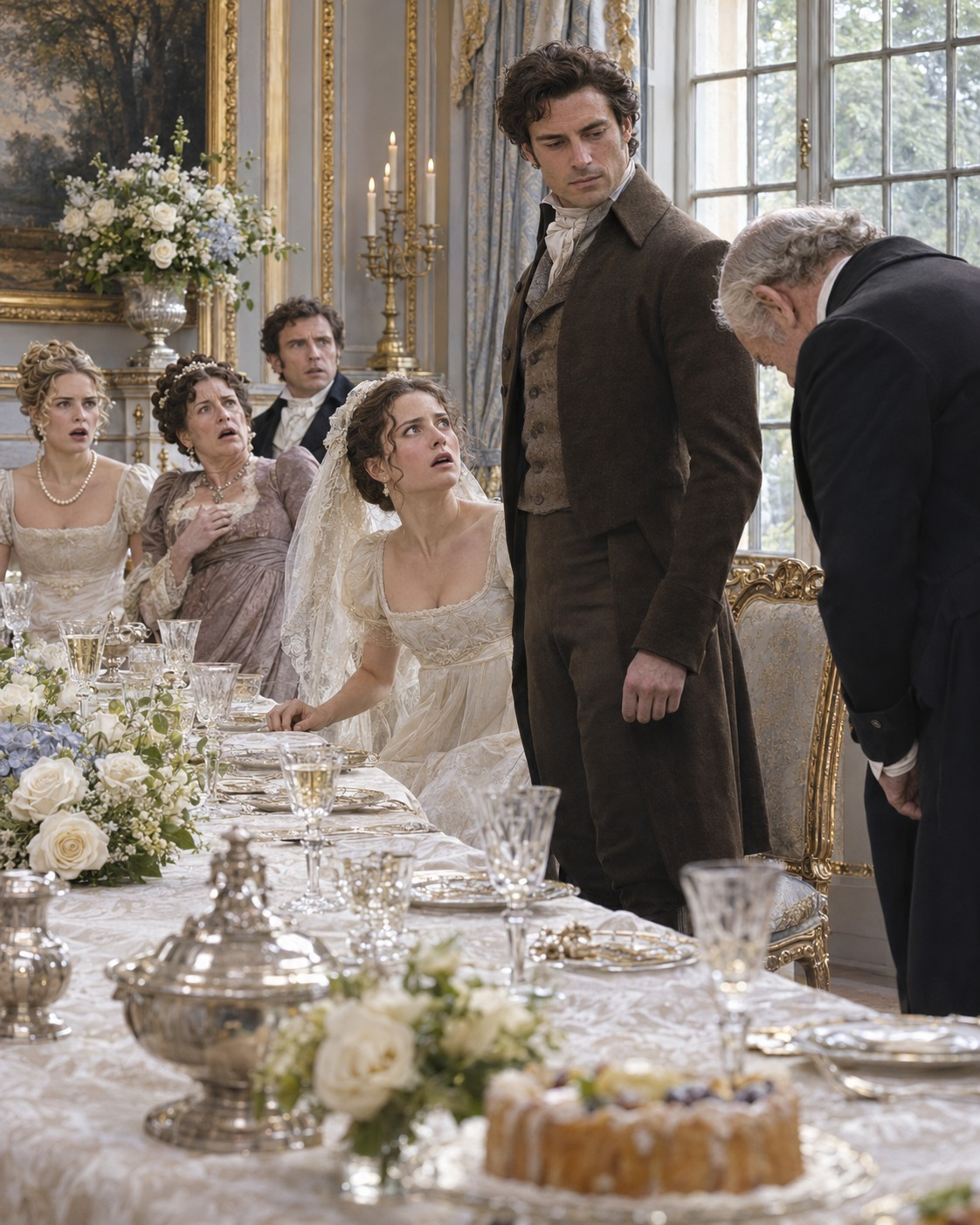
“Mother?” I whispered into the darkness above the staircase.
The woman on the upper landing stopped moving.
For one impossible moment, I could hear nothing except the pounding of my own heart.
Then the voice came again.
“Clara, darling. Please don't read it yet.”
My knees nearly gave way.
I knew that voice.
I had heard it in my dreams for nine years.
It was the voice that had taught me my prayers, comforted me through childhood fevers, and whispered that I was brave when I had been too frightened to sleep.
My mother's voice.
But my mother was dead.
I had watched them carry her coffin into the family chapel.
I had stood beside my father while the vicar read the burial prayers.
I had placed white roses on her grave every spring.
And now someone was speaking to me from the darkness in exactly the voice I remembered.
Edmund moved beside me.
“Clara, stay here.”
I barely heard him.
The woman stood beneath the shadow of the upper gallery, one hand resting against the banister.
I could see the outline of a pale gown.
A narrow waist.
Dark hair gathered loosely at the back of her head.
She was too far away for me to see her face.
“Mother?”
The word escaped before I could stop it.
The figure moved.
Not toward me.
Away.
“Wait!”
I started up the staircase.
Edmund caught my arm.
“Clara.”
“Let me go.”
“We don't know who she is.”
“I know that voice.”
His expression tightened.
“I understand.”
“No, you don't.”
I pulled free.
“You cannot possibly understand.”
I climbed the first three steps.
The woman turned toward the corridor.
“Please,” I cried. “Don't leave me again.”
She stopped.
For one second, I thought she might come back.
Instead, she whispered something I could barely hear.
“Not while she is watching.”
Then she disappeared around the corner.
I ran.
My wedding gown caught beneath my shoes.
I lifted the skirt and hurried upward, ignoring Edmund calling behind me.
By the time I reached the landing, the corridor was empty.
Three doors stood along the wall.
All closed.
A candle burned beside a portrait of my grandfather.
The air smelled faintly of lavender.
My mother's favorite scent.
I stood there shaking.
“Where are you?”
No answer.
“Please.”
The silence was unbearable.
Edmund reached the landing.
Mr. Purvis followed with a lamp.
Dr. Vale remained below, his face turned toward the staircase.
I could see him gripping the banister.
He looked like a man watching a nightmare return.
Edmund approached carefully.
“Clara.”
“She was here.”
“I know.”
“You heard her.”
“Yes.”
“That was my mother's voice.”
He did not answer immediately.
I turned on him.
“Do not tell me I imagined it.”
“I won't.”
“Then where did she go?”
He looked toward the doors.
“We will find out.”
I stared at him.
His composure infuriated me.
How could he stand there so calmly when my entire life had just been torn open?
“How long have you known?” I demanded.
His eyebrows drew together.
“Known what?”
“That my mother might still be alive.”
He looked at me.
Then he said something that frightened me more than any denial.
“I have suspected it for six months.”
I felt the blood drain from my face.
“Six months?”
“Yes.”
“And you never told me?”
“I had no proof.”
“You had enough proof to marry me.”
His jaw tightened.
“Clara—”
“You had enough proof to bring Mrs. Whitcomb here. Enough proof to summon Dr. Vale. Enough proof to arrange for my mother's letters to be delivered.”
“I did not summon Vale.”
I stopped.
“What?”
Edmund looked toward the staircase.
“I have been searching for him. I did not know he would come tonight.”
A cold sensation moved through me.
“Then who brought him here?”
Neither of us spoke.
Below, I heard the sound of hurried footsteps.
Mr. Pritchard was giving orders to the servants.
Somewhere in the house, a door slammed.
Edmund turned toward Mr. Purvis.
“Have every entrance watched. No one leaves the grounds without my permission.”
Mr. Purvis nodded.
“And the woman?”
“Find her. Quietly.”
I stepped between them.
“No.”
Edmund looked at me.
“She may be frightened,” I said. “If that was my mother, I will not have her hunted through the house like a criminal.”
His expression softened.
“You are right.”
I swallowed.
“I want to find her myself.”
“Then I will help you.”
I looked at the three doors.
One led to the old music room.
One to a guest chamber.
And the third—
My breath caught.
The third door led to the corridor outside my mother's bedroom.
The blue bedroom.
The room Beatrice had kept locked for nine years.
I walked toward it.
The brass handle was cold beneath my fingers.
I turned it.
Locked.
Of course.
I looked at Edmund.
“Open it.”
He glanced toward Mr. Purvis.
The older man produced a small ring of keys.
I stared.
“You have the keys?”
Mr. Purvis looked uncomfortable.
“They were obtained from the estate office earlier today.”
I almost laughed.
“Does anyone in this house possess a secret you haven't already discovered?”
Edmund's expression tightened.
“More than I would like.”
Mr. Purvis selected a key.
The lock resisted.
Then it turned.
A soft click sounded in the corridor.
I pushed the door open.
And stepped into the room where my mother had supposedly died.
Nothing had changed.
That was the first thing I noticed.
The pale blue wallpaper remained.
The white curtains still hung beside the tall windows.
The little writing desk stood near the fireplace.
My mother's embroidered cushions rested on the window seat.
Even the silver hairbrush on her dressing table appeared untouched.
I had been told the room was empty.
Beatrice had insisted that every piece of furniture had been removed.
She had lied.
Again.
I walked slowly toward the bed.
The coverlet was neatly folded.
A porcelain vase stood on the bedside table.
Inside it were three dried lavender stems.
I touched them.
They crumbled beneath my fingers.
I remembered the last time I had entered this room.
My mother had been lying in bed, her face pale against the pillows.
She had smiled when she saw me.
I had wanted to climb beside her.
But Dr. Vale had stopped me.
“Your mother needs rest, Miss Clara.”
I remembered his voice.
I remembered the bitter smell of medicine.
I remembered my mother's fingers tightening around mine when the physician turned away.
And I remembered something else.
Something I had forgotten for nine years.
She had whispered a word.
Not my name.
Not a prayer.
A name.
“Evelyn.”
I spoke it aloud.
Edmund turned.
“What?”
I looked at him.
“My mother said a name before she died.”
“What name?”
“Evelyn.”
Mrs. Whitcomb, who had entered behind us, stopped so suddenly that her shoes scraped the floor.
I turned toward her.
“You know it.”
Her face had gone white.
“Miss Clara—”
“Who is Evelyn?”
The older woman looked toward the bed.
Then toward the writing desk.
“I hoped you would never have to ask.”
I felt a wave of anger.
“Everyone keeps saying that.”
She lowered her eyes.
“I know.”
“Then answer me.”
Mrs. Whitcomb took a breath.
“Evelyn was your mother's younger sister.”
I stared at her.
“My mother had no sister.”
“She did.”
“No.”
I shook my head.
“I knew her family. I knew her cousins. I knew the names of my grandparents.”
“Your grandparents did not acknowledge Evelyn.”
“Why?”
Mrs. Whitcomb hesitated.
“Because she married a man they considered beneath her.”
I looked toward Edmund.
He was watching Mrs. Whitcomb with intense concentration.
“What man?” he asked.
She swallowed.
“Arthur Bellamy.”
The name meant nothing to me.
But Dr. Vale, who had appeared in the doorway, made a small sound.
I turned.
His face was gray.
“Arthur Bellamy?” he repeated.
Mrs. Whitcomb nodded.
The physician gripped the doorframe.
“Then God help us.”
I stared at him.
“What does that mean?”
He looked at me.
Then at Edmund.
“Arthur Bellamy was Beatrice's first husband.”
The room went silent.
I felt as though the floor had vanished beneath my feet.
“My mother's sister married Georgiana's father?”
Dr. Vale closed his eyes.
“Yes.”
I looked at Mrs. Whitcomb.
She was crying.
I stepped backward.
“No.”
But the pieces were beginning to arrange themselves.
Beatrice's first husband.
The man whose death had never been properly explained.
The woman my mother had called Evelyn.
The voice on the staircase.
The hidden letters.
And the warning that my father's new wife was not who she claimed to be.
I looked at Edmund.
“Tell me what this means.”
He spoke carefully.
“It may mean that Beatrice entered your family under circumstances far more complicated than anyone understood.”
“Complicated?”
My voice rose.
“My mother's sister married the man Beatrice claimed was her husband. How is that merely complicated?”
Edmund did not answer.
Dr. Vale moved toward the bed.
He looked at the pillow.
Then at the small table where my mother's medicine bottles had once stood.
His face twisted.
“I should have told someone.”
I turned toward him.
“Told them what?”
He swallowed.
“I should have told your father.”
“About Evelyn?”
“About everything.”
I approached him.
“Then tell me now.”
He looked at the door.
As though expecting someone to appear.
“Not here.”
I stared at him.
“Why?”
His voice dropped.
“Because this room was never empty.”
We moved to the adjoining sitting room.
Edmund ordered the servants to bring lamps.
Mrs. Whitcomb sat beside the fireplace.
Dr. Vale remained standing.
He seemed unable to keep still.
I sat across from him with my mother's letter in my lap.
The folded paper from the coffin lay beside it.
I had not opened that one yet.
I was afraid to.
Not because I feared the truth.
Because I feared how much of my life might disappear when I learned it.
Edmund sat beside me.
He did not touch my hand.
I was grateful.
I needed the space.
Dr. Vale cleared his throat.
“Lady Clara—”
“Do not call me that.”
He stopped.
I looked directly at him.
“You told me my mother died of fever.”
His face tightened.
“Yes.”
“Was that true?”
He looked down.
“No.”
The word seemed to empty the room of air.
I stared at him.
“What killed her?”
He swallowed.
“I do not know.”
I felt anger rise.
“You were her physician.”
“Yes.”
“You signed her death certificate.”
“Yes.”
“Then how can you not know?”
His hands began to shake.
“Because I never saw her die.”
Silence.
I stared at him.
“You never saw her die?”
“No.”
“Then whose death did you certify?”
He looked toward the window.
“I was summoned to Hatherleigh Hall shortly after midnight. Lady Beatrice told me your mother had suffered a sudden seizure.”
“Beatrice was not my father's wife then.”
“No.”
“Then why was she here?”
He hesitated.
“She was staying as a guest.”
I remembered that.
Beatrice had visited the house several times before my mother's illness.
My father had described her as a distant acquaintance.
She had always been kind to me in those days.
She brought sweets.
She praised my dresses.
She asked questions about my mother's health.
I had liked her.
The memory made me feel sick.
Dr. Vale continued.
“When I arrived, I was taken to this room. The bed curtains were drawn. A woman lay beneath the coverlet.”
“Was it my mother?”
“I believed so.”
“Did you examine her?”
His eyes filled with shame.
“Not properly.”
I stared at him.
“What do you mean?”
“She was cold. There was no pulse. Her face had been covered.”
“Why?”
“Lady Beatrice said the illness had disfigured her.”
I remembered those words.
The same explanation used to keep me from seeing the coffin.
I felt my hands tighten.
“And you accepted that?”
He looked miserable.
“I was told the family wished to avoid further distress.”
“Did my father see her?”
“No.”
The word struck me.
“Why not?”
“He had been sent to London on urgent business.”
I stared at him.
My father had been away when my mother died.
He returned the following morning.
By then, the coffin had already been prepared.
I remembered him standing in the chapel, his face hollow with grief.
He had held my hand so tightly that it hurt.
And I had believed he had seen my mother die.
But he had not.
Neither had I.
Neither had Mrs. Whitcomb.
Only Beatrice.
I looked at Dr. Vale.
“Who identified the body?”
He swallowed.
“Lady Beatrice.”
I felt cold.
“And you signed the certificate based on her word.”
“Yes.”
“Why?”
He closed his eyes.
“Because she threatened me.”
Edmund leaned forward.
“With what?”
Dr. Vale looked at him.
“My son.”
The room fell silent.
The physician's voice broke.
“My boy was twelve. He had been ill for months. Lady Beatrice knew where he was being treated.”
I stared at him.
“She threatened a child?”
He nodded.
“She told me that if I questioned the death, my son would disappear.”
I felt a terrible mixture of anger and pity.
“You could have gone to the authorities.”
“I know.”
“You could have told my father.”
“I know.”
“You could have told me.”
His face crumpled.
“I know.”
I looked away.
I did not want his apologies.
I wanted my mother.
Edmund stood.
“Dr. Vale, there is something you have not explained.”
The physician looked up.
“The coffin.”
Dr. Vale's expression changed.
“What about it?”
“You said the body was placed inside before the family returned.”
“Yes.”
“Who arranged the burial?”
“Lady Beatrice.”
“And the undertaker?”
“A man named Silas Crowe.”
Mr. Purvis, who had been quietly taking notes, looked up.
“Crowe disappeared three days after the funeral.”
Dr. Vale nodded.
“I heard.”
Edmund continued.
“The burial register contains an entry for a woman named Margaret Bellamy.”
I turned sharply.
“Bellamy?”
He nodded.
“The same surname as Arthur Bellamy.”
Dr. Vale went pale.
I looked between them.
“Who was Margaret Bellamy?”
The physician stared at the floor.
“I don't know.”
Edmund's voice hardened.
“Are you certain?”
Dr. Vale swallowed.
“Yes.”
I watched him.
He was lying.
I had spent years learning to recognize lies.
Beatrice had taught me that skill without intending to.
I knew the way a person's eyes moved when they searched for an answer.
I knew the pause before a carefully prepared explanation.
And I knew the difference between fear and confusion.
Dr. Vale was not confused.
He was terrified.
“You know who she was,” I said.
He looked at me.
“No.”
“You do.”
His lips trembled.
I stood.
“Was Margaret Bellamy my mother's sister?”
Mrs. Whitcomb gasped.
Dr. Vale closed his eyes.
And I knew.
I knew before he spoke.
“Yes,” he whispered.
The room seemed to tilt.
Evelyn.
Margaret.
My mother's younger sister.
A woman whose existence had been erased from the family.
A woman connected to Beatrice's first husband.
A woman whose name appeared in the burial records.
I stared at Dr. Vale.
“Then whose body was in the coffin?”
He did not answer.
I stepped closer.
“Was it Margaret?”
He nodded once.
The movement was so small I almost missed it.
I felt my stomach turn.
My mother's sister had been buried in my mother's grave.
A woman whose name I had never been allowed to know.
A woman who had apparently died in the same room where my mother had supposedly died.
And the person who arranged it had later married my father.
I looked at Edmund.
He had gone very still.
“Did you know?”
His expression was grave.
“I suspected.”
I shook my head.
“You suspected everything.”
“No.”
“You suspected my mother was alive. You suspected the coffin held someone else. You suspected Beatrice had lied about her marriage.”
He looked at me.
“Yes.”
“And still you let me marry you without telling me.”
His face tightened.
“I was trying to protect you.”
I laughed bitterly.
“Everyone keeps protecting me by keeping me ignorant.”
He flinched.
Good.
I wanted him to feel it.
I wanted him to understand what it meant to have your entire life controlled by people who believed they knew better.
I turned away.
“Leave me.”
Edmund hesitated.
“Clara—”
“Please.”
He looked at me for a long moment.
Then he nodded.
“I will be outside.”
He walked toward the door.
Mr. Purvis followed.
Dr. Vale remained.
I looked at him.
“You too.”
He lowered his head.
Then he left.
Mrs. Whitcomb stayed.
I did not ask her to go.
She had known my mother.
She had loved her.
And I needed someone in the room who remembered the woman I had lost.
For a long time, neither of us spoke.
The fire burned low.
Outside, the last light faded from the windows.
I held my mother's portrait miniature.
Her face looked back at me.
Young.
Beautiful.
Alive.
“Was she happy?” I whispered.
Mrs. Whitcomb looked up.
“Who, my dear?”
“My mother.”
Her eyes softened.
“Yes.”
“Before all of this?”
“Yes.”
I swallowed.
“Did she love my father?”
“Very much.”
“Then why did she keep secrets from him?”
Mrs. Whitcomb sighed.
“Because she believed telling him would put him in danger.”
I looked down.
“That seems to be a habit in this family.”
The older woman gave a sad smile.
“Your mother was not perfect, Clara.”
I looked up sharply.
“She was frightened. She made mistakes. She trusted the wrong people.”
“Beatrice?”
Mrs. Whitcomb nodded.
“At first.”
I stared at her.
“My mother trusted Beatrice?”
“Yes.”
“Why?”
“Because Beatrice arrived claiming she could help find Evelyn.”
I felt a chill.
“Find her?”
Mrs. Whitcomb nodded.
“Your mother's sister had disappeared years earlier. There had been a terrible quarrel with the family. Your grandparents refused to speak of her.”
“And Beatrice claimed she knew where she was?”
“Yes.”
I thought of the letter.
My husband's new wife is not who she claims to be.
The wording had troubled me from the beginning.
My father had not married Beatrice until after my mother's death.
Yet the letter referred to her as his new wife.
Perhaps the phrase had been written after the fact.
Perhaps the letter had been altered.
Or perhaps there was another explanation.
I looked at Mrs. Whitcomb.
“Did my mother write that letter herself?”
She hesitated.
“I believe so.”
“Did you see her write it?”
“No.”
I looked down at the paper.
The handwriting was unmistakable.
But the wording was strange.
And the paper had been folded and unfolded many times.
I turned it over.
There was a faint line along the bottom.
A mark where something had been attached.
I touched it.
“Mrs. Whitcomb.”
“Yes?”
“Did my mother ever use sealing wax on her private letters?”
“Always.”
“What color?”
“Blue.”
I looked at the letter.
There was no blue wax.
Only a faint red stain.
The same dark red wax used on the envelope Mr. Purvis had brought.
My heart began to race.
“Who sealed this?”
Mrs. Whitcomb leaned closer.
“I don't know.”
I stared at the stain.
Something was wrong.
Something about the letters.
Something about the timing.
Something about the way Edmund had received them.
I remembered the first letter.
The one he said my mother had given him nine years earlier.
I remembered his exact words.
Your mother gave me this nine years ago.
But if my mother had written about my father's new wife, and Beatrice had not yet married him—
Then either the letter had been written later—
Or someone had changed it.
I felt a cold sensation move through me.
I looked at Mrs. Whitcomb.
“Did my mother ever tell you she was afraid of Edmund?”
The older woman's eyes widened.
“No.”
“Are you certain?”
“Yes.”
I swallowed.
“Then why did she write that he was the only one she could trust?”
Mrs. Whitcomb looked confused.
“What do you mean?”
I held up the letter.
“The first line.”
She leaned closer.
I showed it to her.
Her expression changed.
She stared at the handwriting.
Then she whispered, “Oh, no.”
My heart hammered.
“What?”
She looked at me.
“Clara, that isn't how your mother addressed him.”
I stared.
“What do you mean?”
“She never called him Edmund.”
I felt the room grow cold.
“What did she call him?”
Mrs. Whitcomb swallowed.
“Edward.”
I stared at her.
“Edward?”
“His father.”
The third Duke of Ravensmoor.
The man my mother had trusted.
The man who had investigated the estate accounts.
The man who had died three years earlier.
I looked at the letter again.
Edmund, you are the only one I can trust.
The name had been written in darker ink.
I had not noticed before.
I brought the paper closer to the lamp.
The first letters were slightly thicker than the rest.
As though someone had written over an older name.
I felt my stomach turn.
Someone had altered the letter.
Someone had changed Edward to Edmund.
But why?
I thought of my husband.
His quiet authority.
His careful answers.
His insistence that he had been protecting me.
And his admission that he had allowed my stepmother to arrange our marriage.
For the first time, I wondered whether I had married a man who knew more than he had admitted.
Much more.
I found Edmund in the library.
He stood beside the fireplace, speaking quietly with Mr. Purvis.
Both men stopped when I entered.
I held up the letter.
“Who changed this?”
Edmund frowned.
“What?”
“The name.”
He stepped closer.
I pointed to the first line.
“Someone changed Edward to Edmund.”
Mr. Purvis went still.
Edmund took the paper.
He examined it beneath the lamp.
His expression changed.
For the first time since I had met him, I saw genuine surprise.
“Clara…”
“Did you do it?”
He looked up sharply.
“No.”
“Did your father?”
“No.”
“Then who?”
He stared at the paper.
“I don't know.”
I wanted to believe him.
I wanted desperately to believe him.
But I had learned too much that day to trust anyone easily.
“You told me my mother gave you this letter.”
“She did.”
“Then why would she address it to your father?”
Edmund's jaw tightened.
“Because she may have intended him to read it first.”
I shook my head.
“That is not what you said.”
“No.”
“You said she gave it to you.”
He looked at me.
“Yes.”
“Was that a lie?”
He hesitated.
Then he said, “It was incomplete.”
I laughed bitterly.
“Of course it was.”
He stepped closer.
“Clara, listen to me.”
“No.”
I held out my hand.
“Give me the letter.”
He returned it.
I folded it carefully.
“From this moment forward, I want every document concerning my mother placed in my possession.”
Edmund nodded.
“Agreed.”
“I want access to every room in Hatherleigh Hall.”
“Agreed.”
“I want the estate accounts.”
“Yes.”
“And I want to speak to Dr. Vale without you deciding which questions are appropriate.”
He looked at me.
“Agreed.”
I stared at him.
“You are making this very easy.”
He gave a faint, tired smile.
“I have discovered that arguing with you is rarely productive.”
I did not smile back.
“This is not amusing.”
“I know.”
His expression grew serious.
“You have every reason to distrust me.”
I looked at him.
“Then why should I believe anything you say?”
He was silent for a moment.
Then he said, “Because I am willing to let you prove me wrong.”
The words surprised me.
He continued.
“I will not ask you to trust me because of my title. I will not ask you to forgive me because I claim good intentions.”
He stepped back.
“I will give you the evidence. You may decide for yourself.”
I looked at him for a long moment.
Then I said, “That is the first sensible thing you have said to me since we met.”
He inclined his head.
“I shall endeavor to improve.”
Despite everything, a small, unwilling smile touched my mouth.
It vanished almost immediately.
But he had seen it.
And something in his expression softened.
For one brief moment, I wondered what our marriage might have been if it had begun with honesty.
Then I remembered the woman on the staircase.
My mother's voice.
The letter from the coffin.
The grave that held someone else's body.
And the danger that still surrounded us.
“Where is Dr. Vale?” I asked.
Edmund's expression changed.
“In the east drawing room.”
“Alone?”
“With a servant outside.”
I nodded.
“I want to speak to him.”
Edmund moved toward the door.
“I will accompany you.”
I looked at him.
“No.”
He stopped.
I held his gaze.
“You promised I could ask my own questions.”
His jaw tightened.
Then he stepped aside.
“Very well.”
I walked past him.
At the doorway, he spoke again.
“Clara.”
I turned.
His expression was grave.
“Whatever Vale tells you, remember that he has spent nine years hiding the truth.”
I looked at him.
“So have you.”
He lowered his eyes.
I left before he could answer.
The east drawing room was empty.
The servant outside looked confused when I asked where Dr. Vale had gone.
“He was here only a moment ago, Your Grace.”
I stopped.
The title still felt strange.
“Did he leave?”
“I did not see him.”
I looked at the open window.
Cold air moved the curtains.
A small table stood beneath the sill.
On it lay Dr. Vale's walking stick.
And beside it—
A folded piece of paper.
My name was written across the front.
I picked it up.
The handwriting was hurried.
Uneven.
I opened it.
Clara,
I cannot remain in this house. The woman you heard on the staircase is not who you believe her to be.
My heart began to race.
I should have told you the truth nine years ago. I should have refused to sign the certificate.
The next line was underlined.
Do not trust the first letter.
I stared at the words.
The first letter.
The one Edmund had given me.
The one whose name had been altered.
I continued.
Your mother left three letters. One was altered. One was hidden. The third was never meant to be found.
My fingers tightened.
If you wish to know what happened, go to the old nursery. Look behind the portrait of the white horse.
I stopped breathing.
The old nursery.
My childhood room.
A place Beatrice had ordered closed after my father's death.
I remembered the portrait.
A white horse standing beneath an oak tree.
My mother had hung it above the fireplace when I was six.
I had always loved it.
But why would she hide something behind it?
I folded the note.
Then I noticed one final sentence written at the bottom.
Do not go there after dark.
I looked toward the window.
Night had fallen.
The house was quiet.
And somewhere above me, in the old nursery, there might be a letter my mother had hidden before she disappeared.
I knew I should wait.
I knew I should find Edmund.
I knew that Dr. Vale's warning might be a trap.
But I had spent nine years waiting.
Nine years believing what I was told.
Nine years allowing other people to decide which truths I was strong enough to hear.
I was finished waiting.
I took the lamp from the table.
And walked toward the staircase.
The old nursery stood at the far end of the west corridor.
I had not entered it since I was seventeen.
Beatrice had locked it after declaring that I was too old to keep childhood possessions.
I remembered crying when the servants carried away my dolls.
I remembered begging to keep the little wooden rocking horse my father had made.
Beatrice told me that childish attachments were unbecoming in a young lady.
I had believed her.
Now I wondered whether she had been trying to remove something else.
Something hidden.
Something dangerous.
The corridor was dark.
Only two lamps burned along the walls.
I could hear the faint ticking of a clock somewhere below.
I reached the nursery door.
The lock was old.
I tried the handle.
It turned.
Unlocked.
My heart began to pound.
I pushed the door open.
The room smelled of dust and old wood.
Moonlight fell across the floor.
The furniture had been covered with white sheets.
The fireplace stood cold.
And above it hung the portrait of the white horse.
Exactly where I remembered.
I set down the lamp.
Then I approached the painting.
The frame was heavier than I expected.
I lifted one side.
Nothing.
I tried the other.
A small brass catch clicked.
The painting shifted.
Behind it was a narrow compartment.
My breath caught.
Inside lay a sealed envelope.
The wax was blue.
My mother's color.
I reached for it.
The paper was thick.
The handwriting was unmistakable.
For Clara, when she is ready.
I stared at the words.
For a moment, I could not move.
Then I broke the seal.
Inside was a letter.
And a small silver key.
I unfolded the paper.
My darling Clara,
If you have found this, then someone has finally told you that my death was not what it seemed.
Tears blurred my vision.
I wiped them away.
I cannot explain everything in one letter. There are people involved who would destroy us both if they knew what I had discovered.
My hands trembled.
But there is one truth you must understand before you trust anyone.
I swallowed.
The woman who calls herself Beatrice Ashton is not the woman your father believed he married.
I stared at the sentence.
My mother's handwriting continued.
Her real name is Margaret Bellamy.
The room seemed to spin.
Margaret Bellamy.
The name in the burial register.
The woman Dr. Vale claimed was buried in my mother's coffin.
But if Beatrice was Margaret Bellamy—
Then who was buried?
I read the next line.
Margaret had a sister.
My heart hammered.
Her name was Beatrice.
I stopped breathing.
Two sisters.
Two identities.
A marriage.
A disappearance.
A grave.
I felt the pieces beginning to move into place.
But the letter was not finished.
The woman you know as your stepmother took her sister's name after a terrible crime.
I stared at the words.
My hands were shaking so badly that I could barely hold the paper.
And the man who helped her was someone your father trusted more than anyone.
I swallowed.
The next sentence was written in darker ink.
Clara, if you ever discover who that man is, you must never—
The writing stopped.
The sentence was unfinished.
A dark stain marked the bottom of the page.
I stared at it.
Then I heard a sound behind me.
A soft click.
The nursery door had closed.
I turned.
A woman stood in the doorway.
She wore a pale gown.
Her dark hair was loosely pinned.
Her face remained hidden in shadow.
I could smell lavender.
My mother's scent.
The woman looked at the letter in my hands.
Then she whispered, “You found it.”
My heart stopped.
I took one step forward.
“Mother?”
She did not answer.
Instead, she slowly lifted her hand.
In her palm lay a small gold locket.
I recognized it immediately.
My mother had worn it every day of my childhood.
She had told me it contained a picture of the person she loved most.
I had always assumed she meant my father.
The woman opened the locket.
Inside was a tiny portrait.
Not of my father.
Not of me.
A man's face.
A man with dark eyes and a familiar expression.
I stared at it.
The woman stepped into the lamplight.
And as I finally saw her face, I realized why Edmund had been so frightened of what I might discover.
She looked exactly like my mother.
But she was not my mother.
She smiled sadly.
“Clara,” she whispered, “there is something you must know about the man you married.”
I could barely breathe.
She reached inside her gown.
Slowly, she withdrew another letter.
This one bore the Ravensmoor seal.
And beneath it, in my mother's handwriting, was a name.
The name of the man who had helped destroy our family.
I reached for the letter.
The woman caught my wrist.
Her eyes filled with tears.
“Before you read it,” she whispered, “you must promise me one thing.”
I stared at her.
“What?”
She looked toward the closed nursery door.
Then she leaned closer.
“Whatever happens next, do not let Edmund see the name.”
At that moment, footsteps sounded outside.
Slow.
Measured.
Coming directly toward the nursery.
The woman went pale.
She pressed the letter into my hand.
Then the door handle began to turn.
And from the other side, Edmund's voice said quietly:
“Clara, open the door. I know who is in there with you.”






Comments 0