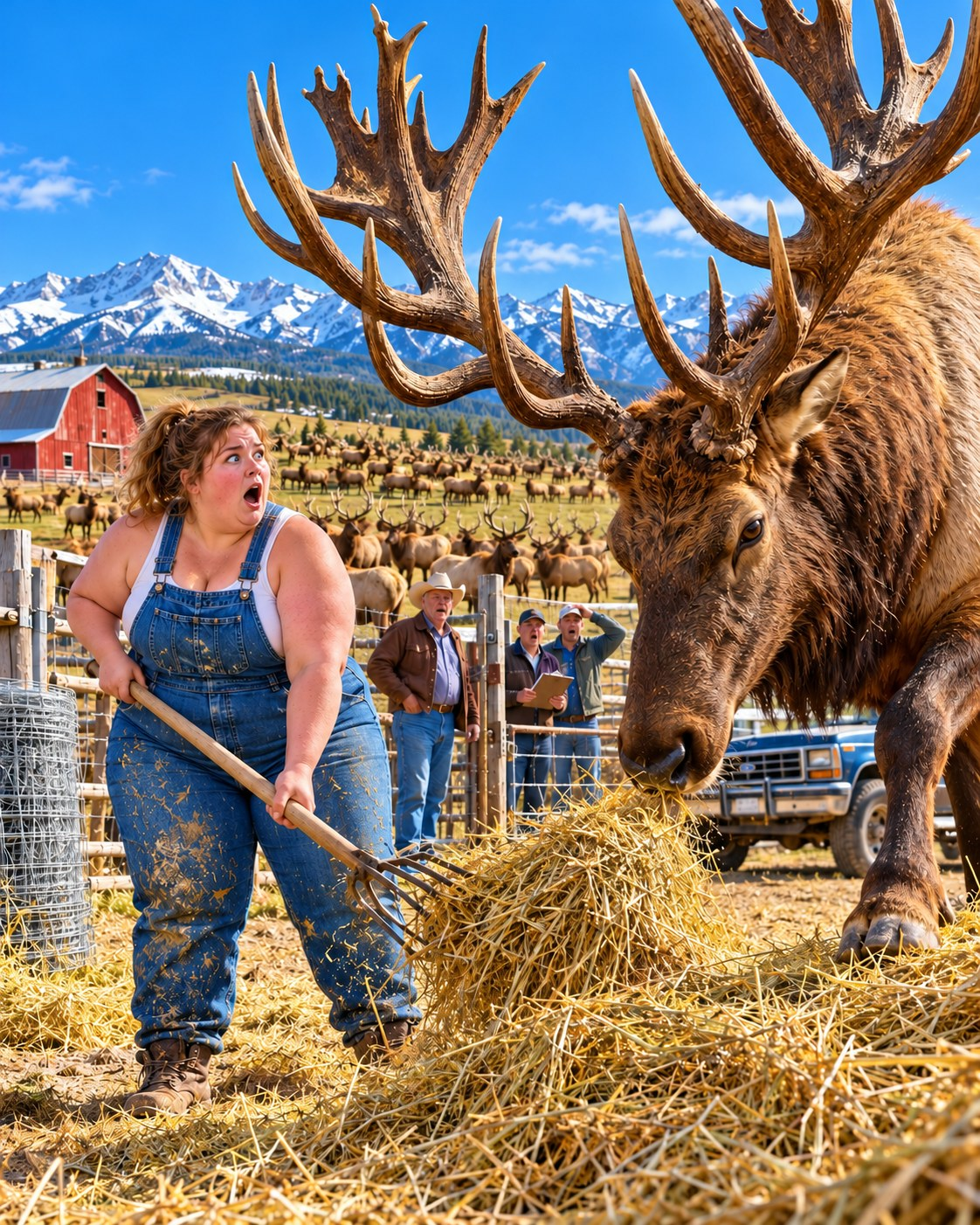
Mara Quinn raised her bidder card as the auctioneer brought his hammer down.
"Eleven hundred dollars!"
A man in the back row burst out laughing.
Everett Voss turned in his chair and stared at her.
On the auctioneer's desk lay a thick folder containing fifty-two incomplete animal records.
One handwritten note on the final page read:
BREEDING HISTORY UNKNOWN.
Everett smiled.
Mara had just bought the biggest problem in Montana.
And she had only twenty-four hours to take it home.
The auction room inside the bankrupt Bitterroot Valley Game Preserve was crowded with ranchers, livestock dealers, county officials, and people who had come mostly to watch the final pieces of a failed business disappear.
The preserve had been struggling for years.
Unpaid taxes had accumulated. Equipment had been sold. Buildings had deteriorated. The animals that remained were being auctioned off to recover whatever money creditors could collect.
Most buyers had arrived looking for something useful.
There were used trailers, fencing equipment, feed bins, water pumps, and several pieces of machinery that still had some life left in them.
Mara had come for wire.
Her western boundary fence had been damaged in several places, and she needed affordable materials before the winter weather made repairs impossible.
She had not planned to buy a single animal.
Certainly not fifty-two.
But when the auction workers opened the last holding pen, she found herself staring at something that made her forget why she had driven seventy miles.
The elk were in terrible condition.
Their coats looked dull and uneven. Several cows had patchy hair. Hipbones and ribs showed beneath their winter coats.
One young bull stood with his head hanging low.
The animals looked as though they had been forgotten for months.
Yet Mara noticed something that nobody else seemed interested in.
They were not scattered randomly around the pen.
The stronger females stood along the outside of the group. Two weakened cows remained near the center, surrounded by the others.
An older bull positioned himself near the open gate.
When a worker slammed a metal panel, the herd tightened together.
They did not panic.
They did not charge blindly around the enclosure.
They moved as a group.
Mara stepped closer to the fence.
The animals raised their heads.
For several seconds, she simply watched them.
She remembered Daniel.
Her husband had worked seasonal jobs around wildlife ranches before they bought their property. He had spent years observing animals, learning their habits, and explaining things that most people never noticed.
One evening, shortly before his death, he had told her something she never forgot.
"A sick animal stops caring about the world before its body gives up, Mara."
He had been sitting on their porch with a cup of coffee.
"If it's still watching you, still listening, still paying attention, there's usually something left worth fighting for."
Daniel had died in 1990, leaving Mara with a twelve-year-old son, a mortgage, and a small ranch that suddenly seemed much larger than one person could manage.
But she remembered his words.
These elk were watching.
They were exhausted, but they were alert.
They were hungry, but they were organized.
And something about that made her hesitate before walking away.
The auctioneer approached the microphone.
"All right, ladies and gentlemen. Last livestock lot of the afternoon. Fifty-two Rocky Mountain elk. Mixed ages, mixed sexes. Incomplete breeding records. No complete historical documentation available."
He glanced at his paperwork.
"Buyer responsible for transportation within twenty-four hours. All required permits, inspections, quarantine arrangements, and transportation expenses are the responsibility of the purchaser."
A few people shifted in their seats.
The auctioneer continued.
"Opening bid, three thousand dollars."
Silence.
He waited.
Nobody moved.
"Two thousand."
Still nothing.
Mara looked toward the pen.
One of the weakened cows had lowered herself onto the straw. Another animal stood beside her.
The older bull had moved slightly, placing himself between the group and the open gate.
"Fifteen hundred dollars?"
A rancher near the aisle shook his head.
Someone whispered that the animals were not worth the transportation costs.
Then Everett Voss laughed.
He was sitting three rows ahead of Mara, wearing an expensive dark jacket and a silver watch that caught the overhead lights.
Everett owned nearly eighteen thousand acres.
His livestock operation supplied several regional buyers, and his private game ranch had become one of the largest in Montana.
He also owned a trucking company and maintained close relationships with people at the county courthouse.
Mara knew him well enough to understand that his smile rarely meant anything good.
He had approached her twice since Daniel's death.
Both times, he had offered to buy her 240 acres.
Both times, she had refused.
Her property sat between several of his cattle leases, and acquiring it would give him a much more convenient connection between two large sections of his operation.
He had never forgiven her for refusing.
Now he turned around.
"You're not seriously considering those animals, are you, Mara?"
She looked at him.
"Why?"
Everett laughed.
"Look at them. Half of them can barely stand."
A few men chuckled.
"You don't have enough land, you don't have enough feed, and you certainly don't have the money to operate a game ranch."
Mara said nothing.
Everett leaned back.
"Those things will be dead before Christmas."
The laughter grew louder.
Mara looked past him toward the auctioneer.
"Eleven hundred dollars."
The room went quiet.
The auctioneer raised his eyebrows.
"Eleven hundred dollars from the lady in the blue jacket."
Everett turned around again.
"You planning to feed those things with good intentions?"
Several men laughed.
Mara kept her eyes on the auctioneer.
"I'm planning to feed them with feed."
Nobody challenged her.
The hammer dropped.
"Sold to Mara Quinn for eleven hundred dollars."
For a moment, nobody spoke.
Then Everett shook his head.
"Well, you've certainly made an investment."
Mara lowered her card.
She had just spent more than a quarter of her available savings on animals she had not planned to own.
And she still had no idea how she would transport them.
The auction manager approached her with a stack of documents.
"Mrs. Quinn, I need you to understand something before you sign."
Mara looked up.
"Go ahead."
"The animals must be removed by three o'clock tomorrow afternoon. The preserve is closing, and we cannot provide overnight holding."
"I understand."
"You'll need approved transportation arrangements."
"I'll arrange them."
"You'll also need to satisfy the applicable state requirements for private elk ownership. Inspections, permits, quarantine expenses, fencing standards. Those costs are separate from your purchase."
Mara glanced down at the paperwork.
The numbers were not friendly.
There were fees she had not anticipated, transportation costs, and several requirements she would have to verify before the herd could legally remain on her property.
She signed the documents anyway.
The manager handed her the receipt.
$1,100.
Fifty-two elk.
Approximately twenty-one dollars per animal.
It looked like a bargain until she considered everything that came afterward.
Outside, the afternoon sun was already beginning to lower behind the mountains.
Mara walked toward her old Ford pickup.
Everett was standing near a group of ranchers.
He noticed her and raised his voice.
"Quinn!"
She stopped.
"Yes?"
"Enjoy your new business."
His friends laughed.
Everett slipped his hands into his jacket pockets.
"I'll make you another offer for your land after the animals are gone. Maybe you'll finally be ready to listen."
Mara looked at him for a moment.
"My land isn't for sale."
"You might feel differently in January."
"Maybe."
She climbed into her truck.
Everett smiled as she started the engine.
He believed he had just watched a desperate widow throw away the last of her money.
He had no idea that Mara was already thinking about something he had overlooked.
The animals had not scattered when the gate opened.
They had stayed together.
That mattered.
At home, Mara placed the auction paperwork on the kitchen table.
Her son was at a neighbor's house for the evening.
The house felt unusually quiet.
She took out a calculator, a legal pad, and the small notebook where she kept track of household expenses.
Her checking account balance was $3,842.
Her mortgage payment was $1,176, due in October.
Her hay supply would last approximately nineteen days.
She had no livestock trailer.
Her fencing was designed for horses and cattle, not elk.
And now she had fifty-two animals that needed to be transported, examined, fed, and safely contained.
Mara wrote the numbers down.
Then she crossed out several things she had hoped to purchase before winter.
A new washing machine.
A repair to the kitchen roof.
The replacement tires she had been postponing for months.
She stared at the remaining balance.
The number seemed smaller every time she looked at it.
At 10:15 p.m., she called a local livestock hauler.
He listened to her explanation before giving her a price.
It was too expensive.
She called another.
He was unavailable.
Finally, at 11:40 p.m., she picked up the telephone and called Earl Maddox.
Earl had been a friend of Daniel's for years.
He owned an aging livestock truck and had helped the couple with fencing repairs on several occasions.
When he answered, his voice sounded sleepy.
"Mara?"
"I'm sorry to call this late."
"What's wrong?"
"Nothing's wrong. I need a favor."
"All right."
"I bought some animals at the preserve auction."
"What kind?"
"Elk."
There was a pause.
"How many?"
"Fifty-two."
Another pause.
Then Earl sighed.
"Mara, that's not a herd. That's a problem with antlers."
Despite everything, she laughed.
"I know."
"Do you have transportation?"
"No."
"Do you have a trailer?"
"No."
"Do you have a plan?"
"I'm working on one."
Earl remained quiet for several seconds.
Then he asked where the animals were being held.
When Mara explained the deadline, he agreed to make three trips with his truck.
He refused to take cash.
Instead, he asked her to replace eight hundred feet of his south fence when the ground thawed in spring.
"Daniel would have done the same for me," he said.
Mara looked down at the legal pad.
"Thank you, Earl."
"Don't thank me yet. We haven't loaded fifty-two wild animals."
By seven o'clock the following morning, Dr. Henry Sloan arrived at the preserve.
Sloan was a semi-retired wildlife veterinarian who had spent much of his career working with large mammals.
He had a weathered face, silver hair, and a habit of listening longer than he spoke.
Mara introduced herself.
"I bought the herd yesterday."
Sloan looked toward the enclosure.
"All fifty-two?"
"All fifty-two."
He studied the animals for a moment.
Then he turned toward her.
"How much do you know about feeding severely starved elk?"
"Not enough."
"Good. At least you know that."
He walked toward the fence.
"Do not feed them heavily."
Mara frowned.
"Why?"
"Because their bodies aren't ready for it. A severely malnourished animal can suffer fatal metabolic complications if you suddenly give it rich feed."
He explained that recovery had to be gradual.
Grass hay.
Clean water.
Appropriate mineral supplementation.
Careful monitoring.
No sudden changes.
Mara listened closely and wrote everything down.
Sloan examined the herd one animal at a time.
He selected four animals for closer monitoring.
Two weakened cows.
The young bull.
And an older female with a rough coat and a noticeable limp.
He checked their breathing, movement, hydration, and general condition.
Fortunately, he found no evidence of a contagious disease.
But as the morning continued, something caught his attention.
The animals were moving around the enclosure with unusual coordination.
Older cows seemed to influence where the others gathered.
The younger animals followed established paths.
When Earl's truck backed toward the loading area, the herd became alert but did not immediately scatter.
Sloan watched carefully.
"Interesting."
Mara looked at him.
"What?"
"Nothing yet."
He continued observing.
The animals gradually moved toward the loading gate.
Not all at once.
Not chaotically.
They seemed to respond to the movements of the older animals.
Sloan looked at Mara.
"Did the auction manager give you any information about their previous ownership?"
"Almost nothing. The breeding records were incomplete."
"Any identification records?"
"Some old tags. Nothing comprehensive."
Sloan glanced back at the herd.
"That's unfortunate."
"Why?"
He did not answer immediately.
Instead, he asked her to bring him the auction paperwork.
Mara handed over the folder.
He studied the pages, turning them slowly.
Then he stopped at the final sheet.
His expression changed slightly.
"Who completed this section?"
"I don't know."
Sloan ran his finger down a column of incomplete animal histories.
He looked toward the enclosure again.
"These animals may have been together much longer than the auction records suggest."
Mara leaned closer.
"Does that matter?"
"It might."
He closed the folder.
"But I need more information before I can tell you anything useful."
By sunset on September 29, all fifty-two elk had reached Mara's property.
Earl's old truck had completed its three trips.
The final animal stepped out of the loading area and joined the others.
Mara stood beside the fence, exhausted.
Her hands hurt.
Her back ached.
Her checking account had already taken a serious hit from the initial purchases and the emergency arrangements.
But the animals were there.
All fifty-two.
For the first time since the auction, she allowed herself to breathe.
Then she noticed a pickup slowing down on the road.
A man inside leaned out of the window.
"Hey, Quinn! Heard you bought yourself a fortune in dead animals!"
He laughed and drove away.
By the next morning, photographs of Earl's truck and the elk were pinned to the bulletin board at the Dry Creek feed store.
Someone had written beneath one picture:
QUINN'S MILLION-DOLLAR MOOSE.
Another person had added:
BRING A SHOVEL BY CHRISTMAS.
The county newspaper published a short interview with Everett Voss.
He described the purchase as irresponsible.
He questioned whether Mara had the proper facilities.
He warned that keeping wild elk behind inadequate fencing could create serious problems.
He did not mention his previous attempts to purchase her property.
Mara read the article over breakfast.
Then she folded the newspaper and placed it beneath her veterinary notes.
She had more important things to do.
The first week was difficult.
The elk tested the posts.
They pressed against sections of fencing.
They moved toward the corners of the enclosure and examined every weakness.
Mara realized quickly that her existing fence was not enough.
She spent $1,640 on used eight-foot game fencing and salvaged posts.
It was money she could barely afford.
By the time the repairs were complete, her checking account was nearly empty.
But she had learned something.
The animals were not simply trying to escape.
They were testing their boundaries.
And the strongest ones seemed to remember exactly where they had found weaknesses before.
Mara began marking those locations on a hand-drawn map.
She checked the fence twice every day.
She recorded feed quantities.
She watched which animals ate first.
She noted the movement of the older cows.
And she kept Dr. Sloan's instructions beside the kitchen telephone.
She was learning.
Slowly.
Carefully.
Just as Daniel would have wanted.
On October 8, the temperature dropped to eighteen degrees.
Mara discovered the weakest cow lying near the northern side of the enclosure.
The animal was breathing, but she could barely lift her head.
Mara immediately called Dr. Sloan.
He was several miles away and could not reach the ranch until morning.
"Listen carefully," he told her over the telephone. "Keep her protected from the wind. Don't force her to stand. Keep water available, and don't give her anything outside the recovery plan."
Mara gathered plywood sheets and several cattle panels.
She worked in the freezing darkness, building a temporary windbreak around the weakened animal.
The other elk remained nearby.
Some stood watching.
Others moved around the outside of the enclosure.
The older bull stayed farther back, facing the open pasture.
Mara worked through the night.
At one point, she slipped on frozen ground and struck her knee against a wooden post.
She sat there for several seconds, holding her leg.
Then she stood up and continued.
Shortly after five in the morning, the cow moved.
First her head.
Then one front leg.
She struggled.
Paused.
Tried again.
Finally, she managed to stand.
Mara watched without moving.
The cow remained upright.
She was still weak, but she was standing.
Mara let out a breath she had been holding for hours.
"All right, girl."
She looked at the animal.
"Your name is June."
It was the first time since Daniel's death that she had named an animal on her own.
For a moment, she felt something close to hope.
But the following morning, another problem arrived.
Her hay supplier called.
He was canceling the next delivery.
Mara stared at the telephone.
"What do you mean, you've sold it?"
The supplier sounded uncomfortable.
"Every decent ton I had was purchased in one order. I'm sorry."
"Who bought it?"
A pause.
Then the man answered.
"Voss Livestock."
Mara slowly lowered the telephone.
Everett Voss had just purchased nearly every available ton of good hay in the area.
And she knew exactly why.
He had not merely predicted that her elk would die.
He was making sure she would struggle to keep them alive.
That afternoon, as Mara stood beside June's windbreak, her old truck rattled into the yard.
Earl Maddox climbed out.
He was holding a folded sheet of paper.
"Mara, you need to see this."
She took it.
It was a delivery notice.
The next hay shipment had been canceled.
But underneath the printed information, someone had written a short message in blue ink.
VOSS SAYS YOU WON'T NEED ANOTHER DELIVERY.
Mara looked toward the pasture.
Fifty-two elk stood behind the fence.
June was still upright.
Then she noticed a vehicle approaching along the western boundary road.
It was Everett Voss's black pickup.
And he was not alone...






Comments 0