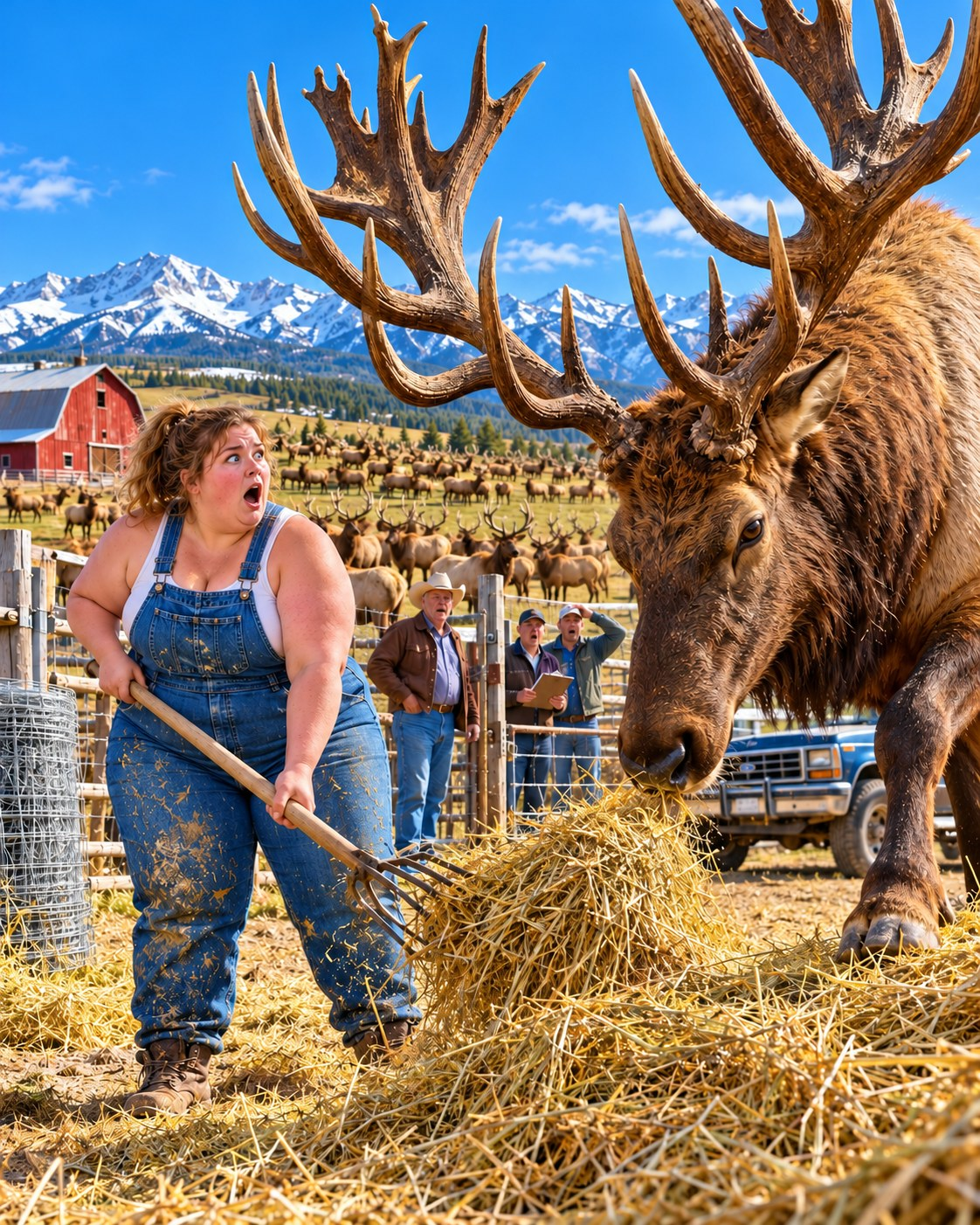
"The laboratory found something in the genetic profile that shouldn't be there."
Mara Quinn gripped the telephone.
"What do you mean, Henry?"
Dr. Sloan sounded unusually cautious.
"I don't want to explain this over the phone. You need to come to the clinic."
"Is the cow in danger?"
"No. She's stable. But the results have raised questions about the original breeding records."
Mara glanced through the kitchen window.
The older cow was standing beside the mature bull.
Fifty-two animals.
Fifty-one survivors from the previous winter.
And one animal that might hold the key to everything.
"Henry, tell me what you found."
He hesitated.
"There's evidence that the Ruona breeding program involved more than one carefully maintained genetic line."
Mara frowned.
"How many?"
"At least two."
She looked toward the pasture again.
"What's wrong with that?"
"Nothing, if the records are accurate."
"And if they aren't?"
Sloan lowered his voice.
"Then somebody may have deliberately concealed the identity of the original breeding animals."
Mara stood.
"I'm coming."
Before ending the call, Sloan added one final warning.
"Bring the documents Eleanor gave you. And Mara, don't tell Everett Voss anything about these results."
Mara arrived at the veterinary clinic shortly before midnight.
Dr. Sloan was waiting in his office.
Several laboratory reports were spread across his desk.
He looked tired.
"Sit down."
Mara placed her coat over the chair.
"Show me."
Sloan handed her the first report.
It contained several identification numbers, genetic markers, and comparisons against historical reference material.
Mara understood very little of the technical language.
But one section had been highlighted.
CONSISTENT WITH A DISTINCT HISTORICAL BREEDING LINE.
She looked up.
"What does that mean?"
"It means the older cow's genetic profile is consistent with the Ruona foundation line."
"That's good, isn't it?"
"Yes. But there's something unusual."
He placed another report beside the first.
"This is the comparison against the reference material associated with the second line."
Mara studied the numbers.
"What's the difference?"
"The two lines were maintained separately. The original records suggest that Werner Ruona deliberately prevented uncontrolled crossbreeding."
"Why?"
"Because he wanted to preserve specific characteristics."
Sloan pointed toward the second report.
"However, this animal carries a marker that appears in a separate historical population."
Mara looked confused.
"Could that happen naturally?"
"Yes. Genetic variation is normal. But the combination here is unusual enough that I want an independent laboratory to verify it."
He opened another folder.
Inside was a photocopy of a handwritten breeding chart.
Several animals were identified by number.
One was marked with a large red circle.
The label beside it read:
NORTHERN FOUNDATION FEMALE — ORIGINAL LINE.
Mara recognized the number.
It matched the identification marker found beneath the old fence.
Sloan continued.
"According to the historical material, Werner maintained two separate groups. One was selected for physical resilience. The other was maintained for reproductive stability and adaptation to difficult forage conditions."
Mara leaned forward.
"Are you saying the animals I bought might belong to both groups?"
"Some may descend from both. The problem is that the records don't explain how the lines were eventually combined."
He pointed toward the bottom of the chart.
There was a handwritten notation.
FINAL CROSS — AUTHORIZATION REQUIRED FROM FAMILY TRUSTEES.
Mara stared at it.
"Who were the trustees?"
Sloan turned the page.
Two names appeared.
Werner Ruona.
And a second name.
Everett Voss's grandfather.
Mara felt her stomach tighten.
"So the Voss family had a legal role in the breeding program?"
"That's what the document suggests."
"Then why did Everett spend years trying to acquire my property?"
Sloan closed the folder.
"Because those animals may represent something his family once had a responsibility to protect."
He paused.
"Or something they took."
The following morning, Mara returned to the ranch.
Caleb was already outside.
He was standing near the northern fence with his notebook.
When he saw her truck, he ran toward it.
"Mom!"
She climbed out.
"What happened?"
"The older cow did something strange."
Mara looked toward the pasture.
"What?"
"She separated from the others."
Mara followed him.
The cow stood near a small group of willow trees.
She was calm, but the other animals had gathered around her.
The young bull was positioned several yards away.
Caleb opened his notebook.
"I recorded it."
Mara looked at the page.
He had written down the time, location, weather conditions, and number of animals present.
"Good."
"Is she sick?"
"No. Dr. Sloan examined her."
Caleb hesitated.
"Then why is everyone watching her?"
Mara studied the herd.
She remembered what Sloan had said about the genetic lines.
"Maybe she's important to them."
Caleb looked toward the cow.
"More important than the others?"
Mara considered her answer.
"Not more important. Just different."
He nodded.
Then he pointed toward the mature bull.
"He's been following her everywhere."
Mara smiled faintly.
"Keep recording it."
She did not tell Caleb about the laboratory results.
Not yet.
At 10:30 a.m., Eleanor Ruona called from the medical center.
Her voice sounded stronger.
"Mara, I heard you spoke to Henry."
"Yes."
"Did he tell you about the genetic results?"
Mara paused.
"He did."
Eleanor sighed.
"Then it's time I told you something Werner never wanted written in the official register."
Mara pulled a chair closer.
"What?"
"Those animals were never intended to be a commercial herd."
Mara listened.
"Werner wanted to establish a self-sustaining population. He believed that animals should be able to survive without depending entirely on expensive feed or artificial management."
"That's what Dr. Sloan said."
"Yes. But he also wanted to preserve two distinct family lines."
Mara looked toward the pasture.
"Why two?"
"Because he believed each had different strengths. One line had exceptional winter resilience. The other had reproductive characteristics that helped maintain a healthy population under difficult conditions."
Mara listened carefully.
Eleanor continued.
"The animals were not supposed to be sold individually. They were meant to remain part of a carefully managed breeding program."
"Then how did they end up at the Bitterroot preserve?"
"That's what Werner's records were supposed to establish."
Mara looked down.
"Did Everett's grandfather transfer them illegally?"
Eleanor was quiet.
Then she answered.
"He transferred more than animals."
"What else?"
"Control of the breeding program."
Mara felt her heartbeat quicken.
"Was that legal?"
"Not according to the agreement Werner signed."
"Then why didn't anybody stop him?"
"Because the original agreement disappeared. The replacement documents claimed the Voss family had purchased the entire operation."
Mara remembered Robert's papers.
The questionable signature.
The altered dates.
The missing register.
"Do you have proof?"
Eleanor sighed.
"I have something better."
Mara waited.
"The original trust agreement."
Eleanor explained that Werner had created a private trust before his death.
It was designed to protect the breeding program from being divided or sold without authorization.
The agreement named several family representatives and established rules governing the animals' transfer.
One clause was particularly important.
The breeding herd could not be permanently transferred to a commercial operation unless the original family trustees approved the transaction.
Mara asked:
"Who were the trustees?"
"Werner, Walter, and one representative from the Voss family."
"Everett's grandfather?"
"Yes."
"Then how could he transfer everything?"
"He couldn't."
Eleanor paused.
"That's why he changed the paperwork."
Mara stared at the telephone.
"Do you have the agreement?"
"Not the complete original."
"Where is it?"
"Werner divided the documents into three separate collections."
"Where are the other two?"
"One was kept in the northern archive. Another was entrusted to my father."
"And the third?"
Eleanor hesitated.
"That is the problem."
Mara waited.
"It was given to someone outside the family."
"Who?"
"A woman named Ruth Bellamy."
Mara wrote down the name.
"Do you know where she is?"
"She died many years ago."
Mara sighed.
"Then the documents are probably gone."
"Not necessarily."
Eleanor lowered her voice.
"Ruth had a daughter. Her name was Margaret. She may still have the original trust papers."
Mara looked at the wall calendar.
"Where does she live?"
"That's what I don't know."
That afternoon, Robert Voss arrived at the ranch.
He looked nervous.
Mara met him outside the barn.
"Your father called me three times this morning."
Robert lowered his eyes.
"What did he want?"
"To know whether I've spoken to Eleanor."
Robert's expression changed.
"Did you?"
"Yes."
He looked toward the pasture.
"Then he knows."
"Knows what?"
"That the original register has been found."
Mara crossed her arms.
"Robert, I need you to tell me exactly what your family knows."
He took a folded document from his jacket.
"My grandfather kept this in a separate file. I found it after the archive was opened."
Mara accepted it.
The paper contained several paragraphs.
At the top was a heading.
PRIVATE BREEDING TRUST — 1945.
Robert continued.
"My grandfather was supposed to serve as a temporary trustee. He wasn't supposed to own the animals."
Mara looked at him.
"Then why did the Voss family claim ownership?"
"Because he signed a different agreement."
"Was it forged?"
Robert nodded.
"That's what I believe."
Mara studied the document.
There was a second signature at the bottom.
It belonged to Werner Ruona.
But unlike the signature on the original agreement, this one appeared unusually neat.
Almost too perfect.
"Did your father know?"
Robert looked away.
"Yes."
Mara stared.
"How can you be certain?"
"Because I found a letter he wrote to my grandfather."
He handed her another sheet.
Mara unfolded it.
The letter was dated 1989.
It contained only a few paragraphs.
The first mentioned the Ruona herd.
The second referred to missing breeding records.
The final paragraph made Mara's blood run cold.
If anyone ever establishes the original bloodline, the family could lose control of the entire property agreement. Do not allow the northern records to be authenticated.
Mara looked at Robert.
"Your father knew."
Robert nodded.
"He knew for years."
That evening, Dr. Sloan visited the ranch.
He brought a second laboratory report.
The independent examination had confirmed the initial findings.
The older cow was a direct descendant of the original northern foundation line.
The report also identified genetic evidence connecting several younger animals to the second historical population.
Sloan placed the papers on the kitchen table.
"There's enough here to justify a formal historical and veterinary investigation."
Mara looked at the report.
"Could the animals be protected under the original trust?"
"That's a legal question. But the genetic evidence supports the historical connection."
Robert leaned forward.
"Then my father can't simply take them."
Sloan looked at him.
"Not without establishing a valid claim."
Mara glanced toward the pasture.
For months, people had treated the fifty-two elk as worthless.
Now it was becoming clear that the animals represented something that had survived generations of manipulation.
But there was still a problem.
The genetic results did not establish the ownership history.
They only established ancestry.
The original trust agreement would be needed to prove who had the right to control the breeding program.
Mara looked at Eleanor's papers.
"Then we need to find Margaret Bellamy."
The following morning, Mara and Robert drove to Kettle Rapids.
They visited the library and asked Helen Mercer to help locate historical records concerning Ruth Bellamy and her daughter.
Helen searched old directories.
She examined newspaper archives.
She checked marriage announcements and property notices.
After nearly two hours, she found a small article from 1978.
It mentioned Margaret Bellamy's appointment to a local agricultural preservation committee.
Beneath the article was an address.
The address was outside a town called Pine Hollow.
Mara copied it.
"Do you think she's still there?"
Helen shook her head.
"I can't promise anything."
Robert studied the article.
"How old would she be now?"
"Probably in her seventies."
Mara thanked the librarian.
As they left, Helen called after them.
"Mrs. Quinn?"
Mara turned.
"There was something else in the newspaper archive."
Helen held up another page.
It was a short notice dated 1990.
Margaret Bellamy requests return of family property documents held by Voss Livestock Enterprises.
Mara stared at the headline.
Robert took the paper.
His face changed.
"I know this."
"How?"
"My father mentioned Margaret once."
"What did he say?"
Robert swallowed.
"He said she had been paid to stop asking questions."
Mara looked at him.
"Paid?"
Robert nodded.
"Or threatened. I never knew which."
On November 30, Mara received another letter from the county.
The deadline for replacing the western fence was approaching.
The estimated cost remained $6,700.
She had managed to save some money through reduced feed expenses, but she was still short.
The letter stated that failure to comply could result in additional penalties or suspension of her operating authorization.
Mara placed it beside the laboratory reports.
She had a growing collection of problems.
A legal dispute.
An incomplete historical trust.
A powerful rancher determined to control her animals.
And a fencing deadline she could not afford.
Caleb entered the kitchen.
He saw the letter.
"Is something wrong?"
Mara folded it.
"Just another expense."
"Can we pay it?"
She looked at him.
"Not yet."
Caleb glanced toward the pasture.
"Maybe the elk will bring us luck."
Mara smiled.
"Maybe."
He returned to his homework.
But Mara remained at the table.
She could not afford to lose the ranch.
She could not afford to lose the animals.
And she could not allow Everett Voss to turn the truth into another document that disappeared.
On December 2, Robert telephoned.
He sounded panicked.
"Mara, I found something."
"What?"
"My father has been meeting with someone from the county."
Mara sat upright.
"Who?"
"I don't know the name. But I found a calendar entry."
"What was the meeting about?"
Robert hesitated.
"An emergency review of your operating permit."
Mara felt her stomach tighten.
"When?"
"Tomorrow morning."
"How did you find out?"
"I saw the documents in his office."
"Does he have the authority to request that?"
"He has connections at the courthouse."
Mara closed her eyes.
"What is he planning?"
Robert's answer came quietly.
"He's trying to have your elk seized before the trust agreement can be authenticated."
The next morning, two county vehicles arrived at Mara's ranch.
Three officials stepped out.
One carried a clipboard.
Another held a thick folder.
The third introduced herself as Patricia Wells, a regional wildlife compliance officer.
"Mrs. Quinn, we need to conduct an immediate review of your operation."
Mara looked at the folder.
"What's the reason?"
"An allegation concerning the historical ownership and legal status of your animals."
She glanced toward the road.
Everett's black pickup was parked near the gate.
He remained inside.
Mara turned back to the officials.
"I have veterinary records, transportation documents, and laboratory results."
Patricia nodded.
"We'll review those."
Mara handed over the folders.
The officials examined the paperwork.
They checked the identification numbers.
They reviewed the feeding records.
They inspected the western fence.
Everything appeared to be in order.
Then Patricia opened a separate document.
Her expression changed.
"Mrs. Quinn, we have received a request for temporary custody of the herd pending an ownership investigation."
Mara stared at her.
"From whom?"
Patricia looked toward Everett's truck.
"Voss Wildlife Enterprises."
Mara felt her hands tighten.
"On what grounds?"
"The company claims the animals were transferred into its ownership through a historical agreement."
"That agreement is disputed."
"I understand."
"Then you cannot simply take them."
Patricia closed the folder.
"We haven't made a final determination."
Mara looked toward the pasture.
The elk were gathering near the northern fence.
The older cow stood beside the bull.
For the first time, Mara understood the real danger.
Everett did not need to prove that he owned the animals immediately.
He only needed to make sure she could not keep them long enough to prove otherwise.
That afternoon, Eleanor called.
Her voice sounded urgent.
"Mara, have you found Margaret Bellamy?"
"Not yet."
"Then you need to hurry."
"Why?"
"Because Margaret has the original trust agreement."
Mara sat down.
"Are you sure?"
"I spoke to her this morning."
Mara's heart quickened.
"You found her?"
"Yes."
"Where is she?"
Eleanor hesitated.
"She's coming to Montana."
Mara exhaled.
"That's wonderful."
But Eleanor did not sound relieved.
"There's a problem."
"What?"
"She told me that someone has already contacted her."
"Who?"
"She wouldn't say."
Mara gripped the telephone.
"Did she tell you when she's arriving?"
"Tomorrow."
"Where will she go?"
Eleanor lowered her voice.
"She's bringing the original document."
Mara looked toward the locked cabinet containing her papers.
"Then we'll meet her."
Eleanor paused.
"One more thing, Mara."
"What?"
"She said the original agreement contains a clause that could change everything."
Mara waited.
"What clause?"
Eleanor's voice trembled.
"The breeding herd was never supposed to belong to the Voss family or the Ruona family individually."
Mara frowned.
"Then who owned it?"
Eleanor took a breath.
"Werner created a permanent preservation trust. The animals were supposed to remain protected for the benefit of the land and the future generations of the herd."
Mara stared at the wall.
"If that's true, Everett has no right to claim them."
"Correct."
"Then why is he so desperate?"
Eleanor was silent for several seconds.
Finally, she answered.
"Because the original trust has one additional provision."
"What provision?"
"Whoever is legally recognized as the keeper of the surviving foundation line inherits the authority to manage the entire preservation estate."
Mara's heart began pounding.
"The entire estate?"
"Yes."
"How much land?"
Eleanor whispered:
"Nearly six thousand acres."
Mara could barely speak.
Then Eleanor added something else.
"And according to Werner's original instructions, the keeper must be chosen by the surviving herd itself."
Mara looked through the window.
The older cow stood quietly among the other animals.
The telephone remained pressed against her ear.
"How could an animal choose a keeper?"
Eleanor answered slowly.
"That's exactly what Margaret's original document explains."
That evening, Mara sat beside Caleb at the kitchen table.
She told him that the county might temporarily remove the elk.
He listened without interrupting.
Then he asked:
"Can Mr. Voss really take them?"
"Not if we can prove the original agreement."
"What if we can't?"
Mara looked at him.
"Then we'll keep fighting."
Caleb nodded.
He opened his notebook.
"I've got something you should see."
He turned several pages.
There were dozens of observations.
The older cow's movements.
The bull's position.
The herd's feeding patterns.
The way the younger animals followed the older females.
Mara smiled.
"You've done a lot of work."
Caleb pointed to one entry.
"Look at December first."
She read it.
The older cow had approached the northern gate.
Then she had turned toward the main pasture.
The other animals had followed.
Caleb pointed to the next entry.
"She did the same thing yesterday."
Mara studied the notes.
Then she noticed something unusual.
The older cow had begun approaching the gate whenever unfamiliar vehicles entered the property.
She never ran away.
She simply stood near the entrance.
Watching.
Mara looked toward the pasture.
The animal was doing it again.
And beyond the fence, a vehicle was approaching.
It was not Everett's truck.
It was a silver sedan.
The driver stopped beside the gate.
An elderly woman stepped out.
She carried a leather briefcase.
Then she looked directly toward Mara's house.
And raised a document bearing the original Ruona family seal...






Comments 0