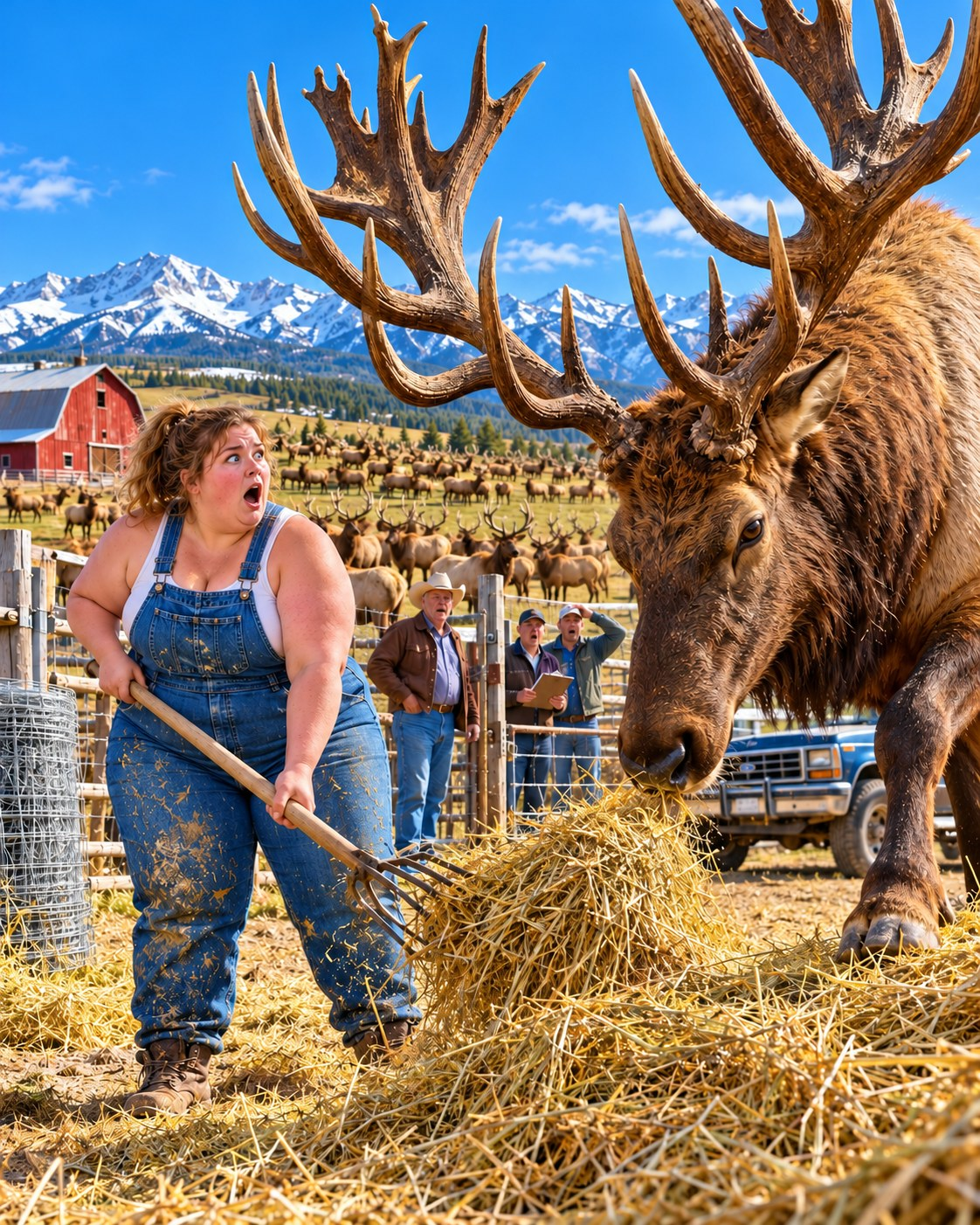
Everett Voss stepped out of his black pickup before Mara could reach the western gate.
He wore the same expensive ranch jacket he had worn at the auction, and his polished boots looked strangely out of place against the muddy ground.
A younger man climbed out of the passenger side.
Mara recognized him as one of Everett's ranch supervisors.
Earl stood beside her, holding the canceled delivery notice.
Everett glanced toward the elk.
"Well, Quinn. Looks like you've got yourself quite a collection."
Mara folded the paper.
"What do you want, Everett?"
"Just checking on your investment."
"You drove all the way out here to check on my investment?"
He smiled.
"I heard your hay delivery fell through."
Mara said nothing.
Everett walked toward the fence.
The elk immediately became alert.
A few moved away from him, while the older bull lifted his head and watched.
Everett pointed toward the animals.
"That's an expensive problem you've created."
"I'll manage."
"With what? Those animals eat every day. Winter hasn't even started, and you've already spent most of your money."
Mara looked at him.
"You seem unusually interested in my finances."
Everett chuckled.
"I'm interested in protecting this valley. Private game operations require responsibility."
"Then I suppose you should start with your own."
His smile disappeared for half a second.
The supervisor looked away.
Everett stepped closer.
"I'll make this simple. Sell me your property."
"No."
"You haven't even heard my offer."
"I've heard it twice."
"This time, I'm prepared to be generous."
Mara turned toward the enclosure.
"Then be generous somewhere else."
Everett studied her for a moment.
He seemed genuinely surprised that she had refused to entertain the conversation.
Finally, he returned to his truck.
"Don't say I didn't try to help you."
Mara watched him drive away.
Earl shook his head.
"That man doesn't help anybody unless he gets something out of it."
Mara looked down at the delivery notice.
"He's trying to make sure I fail."
Earl nodded.
"Looks that way."
"Then we'll have to find another way."
The next three days were among the hardest Mara had experienced since Daniel died.
She called every hay supplier within driving distance.
Some had already sold their stock.
Others quoted prices she could not afford.
A supplier nearly ninety miles away offered lower-grade grass hay, but the transportation costs were considerable.
Mara calculated the expense twice.
It would leave almost nothing for unexpected repairs.
She made the purchase anyway.
She also began looking at the land differently.
Her property had originally been used for cattle.
There were open fields, several brush-covered sections, and a narrow strip of land along a seasonal creek.
Daniel had once talked about rotating livestock through smaller paddocks instead of allowing them to remain in one large pasture.
He had believed that different animals used different plants and that careful rotation could help preserve the land.
Mara remembered those conversations.
She began studying the vegetation.
The elk browsed willow tips.
They ate rabbit brush.
They searched through dry bunch grass.
They also showed interest in plants that her horses and cattle had largely ignored.
Mara started dividing the available land into smaller sections.
She moved the animals gradually, following Sloan's recovery instructions and making sure the changes did not interfere with their health.
It was exhausting work.
She spent mornings checking the water.
Afternoons repairing fencing.
Evenings recording feed quantities and animal behavior.
At night, she sat at the kitchen table with her notebooks.
Her son, twelve-year-old Caleb, noticed the changes.
One evening, he came into the kitchen while she was calculating the next hay delivery.
"Mom?"
Mara looked up.
"What's wrong?"
"Are the elk going to die?"
The question stopped her.
She put down her pencil.
"Why would you ask that?"
"People at school said you bought animals that were already dying."
Mara pulled out the chair beside her.
"Some of them are very weak."
"So they might die?"
"Yes. Some might."
Caleb looked down.
"Then why did you buy them?"
Mara considered her answer.
She could have told him about the money.
She could have explained the auction.
Instead, she looked toward the window, where the pasture was visible in the fading light.
"Because they were still fighting."
Caleb was quiet.
"And because nobody else wanted to give them a chance."
He looked at her.
"Do you think they'll make it?"
"I don't know."
She placed her hand over his.
"But we're going to do everything we can."
The next morning, Caleb accompanied her to the enclosure.
He brought a small notebook of his own.
He began recording the names Mara had given the animals.
June.
The young bull.
The older female with the limp.
The four animals Dr. Sloan had selected for monitoring.
He also began identifying which cows seemed to lead the others.
Mara never asked him to do that.
He simply wanted to help.
On October 14, Dr. Sloan returned.
He examined June first.
The cow was standing steadily, although she remained weak.
Sloan checked her breathing and watched her walk a short distance.
"Better," he said.
Mara smiled faintly.
"She has a stubborn streak."
"That may be why she's still here."
He continued through the herd.
The improvements were slow, but visible.
Some animals were eating more consistently.
Their coats were beginning to look healthier.
Their movements were becoming stronger.
Sloan examined the young bull for several minutes.
Then he stepped back.
"How long have you noticed him doing that?"
"Doing what?"
"Watching the other animals before he moves."
Mara looked toward the bull.
"He does it all the time."
Sloan nodded.
"Interesting."
He watched the herd as a group.
Then he asked Mara to show him the original auction records.
She brought out the folder.
He studied the identification numbers.
"Do you have any older documents from the preserve?"
"No. The manager said the records were incomplete."
"Did he explain why?"
"He said they had lost some paperwork during the bankruptcy."
Sloan looked at the pages again.
"That's not unusual. But it is inconvenient."
He tapped one of the identification columns.
"These numbers don't follow the sequence I'd expect."
Mara leaned closer.
"What does that mean?"
"It means some animals may have been transferred from another operation before they arrived at the preserve."
"Would that explain why they behave differently?"
"Possibly. But behavior alone isn't enough to establish their history."
He closed the folder.
"I'd like to investigate their previous records."
Mara looked toward the herd.
"Can you?"
"I can try."
For the first time, he seemed genuinely interested in more than their recovery.
Meanwhile, Everett Voss was becoming increasingly uncomfortable.
He had expected Mara's operation to collapse within days.
He had expected the animals to deteriorate.
He had expected her to call the bank, ask for help, or finally accept his offer.
Instead, she was making progress.
The photographs circulating around Dry Creek were changing.
The first pictures showed thin animals standing behind temporary fencing.
The newer ones showed several elk grazing in the afternoon sun.
They were still recovering, but the improvement was obvious.
At the feed store, people began asking questions.
A retired rancher named Walter Briggs told the clerk that he had driven past Mara's property and seen the herd.
"They don't look nearly as bad as they did at the auction," he said.
Another man disagreed.
"Give it a month. Winter will finish what the auction started."
Everett heard the conversation.
He placed his coffee on the counter.
"Those animals are being kept under conditions that should concern everyone."
Walter looked at him.
"Have you been out there?"
"I don't need to visit to understand the regulations."
"Then maybe you should visit before telling everyone what you've seen."
Everett's expression hardened.
The room became quiet.
Walter picked up his newspaper.
"Just saying."
Everett left without finishing his coffee.
On October 21, Mara received a letter from the county.
It was a notice reminding her of the requirements for maintaining privately held elk.
She read every paragraph.
There were regulations covering enclosure specifications, inspections, animal identification, movement records, and disease monitoring.
She called the county office.
A clerk explained that her operation would need to meet all applicable standards.
Mara asked whether the county had any concerns about her current setup.
"Not at this time," the clerk answered. "But an inspection may be scheduled."
Mara thanked her and hung up.
She understood the message.
The elk were not simply an agricultural problem.
They were a regulatory responsibility.
One mistake could cost her the entire operation.
That evening, she organized every document she had.
Veterinary records.
Feed receipts.
Transportation paperwork.
Fence measurements.
Daily observations.
She created a separate file for every animal that had been identified.
Caleb helped her arrange the pages.
"Mom, why do we need all this?"
"Because if someone asks what we've done for these animals, I want to be able to show them."
He looked at the growing stack.
"Do you think Mr. Voss will come back?"
Mara placed another receipt into the folder.
"I think he'll come back."
"Why?"
"Because he hasn't gotten what he wants."
By the end of October, the herd was beginning to look different.
The animals were still not fully recovered.
But their ribs were less visible.
Their coats were filling in.
The young bull had become more active.
June was moving around the pasture without assistance.
Mara continued rotating the herd through smaller paddocks.
She also began paying closer attention to the older cows.
One particular female seemed to determine when the group moved between feeding areas.
When she walked, several others followed.
When she stopped, the younger animals often gathered behind her.
The mature bull remained attentive to the perimeter.
It was not random.
There was a pattern.
Mara mentioned it to Sloan during a telephone call.
He listened carefully.
"Are you sure it's the same cow every time?"
"Yes."
"Have you written down the dates?"
"Every time."
"Good. Keep doing that."
"Why?"
"Because if we're seeing consistent leadership behavior, it could tell us something about how this herd was formed."
Mara looked at her notes.
"Something about their breeding history?"
"Possibly. But don't jump ahead. We need records, identification, and proper examination before making conclusions."
He paused.
"One more thing, Mara."
"Yes?"
"Don't let anybody convince you that these animals are worthless simply because their paperwork is incomplete."
She glanced through the kitchen window.
The older cow was standing near the center of the herd.
"Somebody already tried."
"I know."
Sloan's voice became quieter.
"And I suspect there's a reason they were sold without complete records."
On November 3, Mara received an unexpected telephone call.
The caller introduced himself as a former employee of the Bitterroot Valley Game Preserve.
He said he had heard about the auction and wanted to ask whether she still had the original paperwork.
Mara was cautious.
"Why?"
"I'm trying to remember something about that herd."
"What kind of thing?"
The man hesitated.
"I worked around the preserve before it closed. Those elk weren't originally part of the regular breeding program."
Mara sat down.
"What do you mean?"
"I mean they came from somewhere else."
"Where?"
"I don't remember exactly. There was an older operation involved. I remember the manager complaining about missing transfer records."
Mara looked at the folder.
"Can you give me a name?"
The man sighed.
"Not over the telephone."
"Why not?"
"Because I don't know who's listening anymore."
Mara's grip tightened around the receiver.
"Who's listening?"
The line went silent for a moment.
Then the man spoke again.
"Mrs. Quinn, I would be careful about asking questions concerning those animals."
Before she could respond, he added:
"I think you should speak to Dr. Sloan."
The call ended.
Mara remained seated.
She immediately wrote down the time and the caller's exact words.
Then she reached for the telephone again.
She had barely begun dialing when a vehicle stopped outside.
Caleb looked through the front window.
"Mom?"
"What?"
"There's somebody at the gate."
Mara stood.
A county vehicle was parked near the western entrance.
A man in a gray coat climbed out.
He carried a clipboard and a thick envelope.
Mara stepped onto the porch.
"Can I help you?"
The man approached the gate.
"Mrs. Quinn? I'm from the county livestock and wildlife inspection office."
She nodded.
"Yes?"
He opened the envelope.
"We've received a formal complaint concerning your elk operation."
Mara looked at the paperwork.
The complaint had been filed under the name of Voss Wildlife Enterprises.
But beneath the company name was another signature.
A second person had officially requested an immediate inspection.
Mara recognized the name.
It belonged to the man who had just telephoned her...






Comments 0