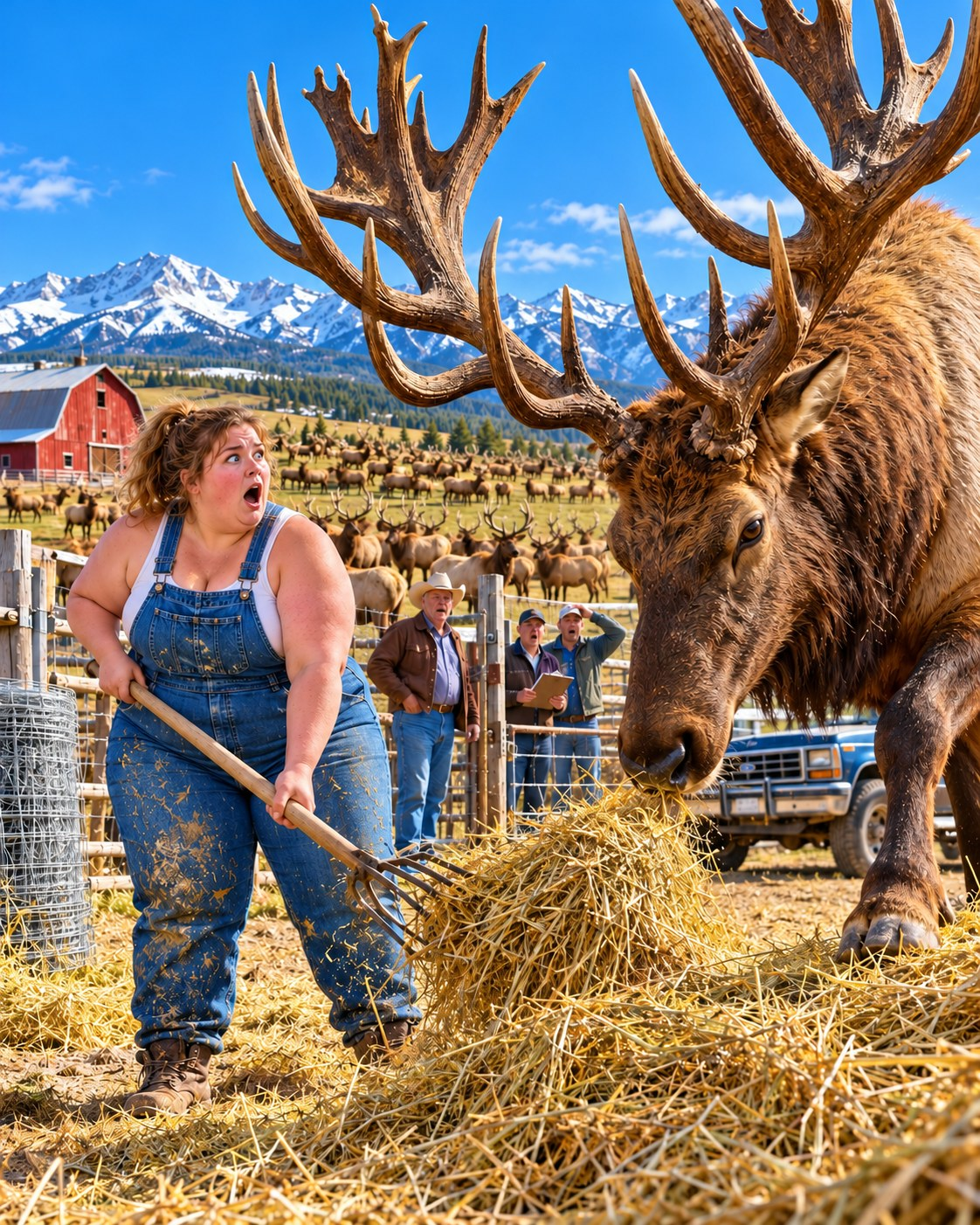
Mara Quinn stood beneath the old wooden sign, holding her flashlight against the blowing snow.
"RUONA WILDLIFE RESERVE."
The words were almost hidden beneath decades of weathering.
But the second line was unmistakable.
ESTABLISHED 1918.
Six elk stood beyond the broken fence, digging through the snow with their hooves and muzzles.
Mara had expected them to panic when they escaped.
Instead, they were behaving as though they knew exactly where they were going.
Then she noticed something that made her step closer.
The snow around the old entrance had been cleared recently.
Someone had been there.
And the tracks did not belong to the elk.
She raised her flashlight toward the trees.
A narrow trail disappeared into the darkness.
Behind her, the ranch telephone began ringing.
Dr. Henry Sloan arrived twenty minutes later.
His truck struggled through the snow before stopping near Mara's pickup.
He climbed out wearing a heavy winter coat and carrying a medical bag.
"Where are they?"
Mara pointed toward the ridge.
"Over there."
Sloan followed her gaze.
The six elk remained near the old entrance.
The mature bull stood slightly apart from the others, watching the surrounding trees.
Sloan studied the animals.
"Are they injured?"
"Not that I can see."
"Then we don't rush them."
He walked toward the broken fence and examined the tracks.
There were several sets of human footprints.
Some appeared to lead toward the old reserve.
Others returned toward the road.
Sloan crouched and touched the snow.
"These are fresh."
"How fresh?"
"Within the last day, possibly less."
Mara looked toward the sign.
"Robert said the old property might still exist."
Sloan nodded.
"Alvar mentioned it."
"Do you think this is the place?"
He examined the weathered lettering.
"Almost certainly."
Mara pointed toward the entrance.
"Then why has someone cleared the snow?"
Sloan stood.
"That's what worries me."
He looked at the animals again.
"Let's get the herd back behind your fence first. We can investigate the property when the weather improves."
Mara nodded.
But the elk were not moving.
The older cow stood near the entrance, her head raised.
The young bull had positioned himself beside her.
Sloan watched them carefully.
"They don't want to leave."
"Why?"
"I don't know."
He took a few steps toward the animals.
The older cow moved forward.
The bull followed.
Then, unexpectedly, all six began walking toward the narrow trail beyond the entrance.
Mara stared.
"Henry?"
"I see it."
The animals moved slowly through the snow.
They were not running.
They were following a path.
Sloan looked toward the trees.
"Something about this place is familiar to them."
Mara returned to the ranch long enough to check on Caleb.
She found him sitting at the kitchen table with his homework untouched.
He looked up immediately.
"Did you find them?"
"Yes. They're safe."
"All six?"
"All six."
He exhaled.
"Good."
Mara removed her gloves.
"Where's Earl?"
"He went to check the northern fence. He said he'd be back."
She nodded.
Caleb looked at the snow-covered window.
"Mom, are those elk going to leave?"
"I don't think so."
"But they went through the fence."
"Because the fence was damaged."
He hesitated.
"That's not what I meant."
Mara pulled out a chair.
"What do you mean?"
Caleb opened his notebook.
"I've been looking at their movement records."
She smiled faintly.
"Again?"
He nodded.
"I think they recognize the old place."
Mara stopped.
"Why?"
He turned the notebook toward her.
He had recorded the direction in which the older cow had led the group on several previous occasions.
The animals had repeatedly moved toward the northern ridge.
Their movements had become more consistent over the previous weeks.
Caleb pointed to the last entry.
"They always turn toward the same side of the pasture."
Mara studied the page.
"Have you shown this to Dr. Sloan?"
"Not yet."
She placed the notebook on the table.
"Keep recording what you see. Don't assume you know why they're doing it."
Caleb nodded.
Then he asked:
"Do you think Dad would have known?"
The question caught her off guard.
She looked at the notebook again.
"Your father would have spent weeks watching them."
"Would he have figured it out?"
"Probably."
Caleb smiled slightly.
Mara reached across the table and squeezed his hand.
"That's why we're keeping records."
The following morning, Earl Maddox arrived with a trailer.
He had heard about the broken fence and immediately offered to help.
The weather had improved slightly, although the temperature remained dangerously low.
Mara showed him the damaged section.
Earl examined the broken post.
"That wasn't just snow."
"What do you mean?"
He pointed toward the base.
"The wood is split on the outside. Something pushed against it."
Mara crouched.
There were deep marks in the frozen ground.
"Could an elk have done that?"
"Maybe. But look here."
He pointed toward a narrow indentation.
"That's where a vehicle might have backed against the post."
Mara looked at him.
"Someone could have weakened it before the storm."
"That's what I'm thinking."
She stared toward the western road.
Everett Voss had already demonstrated that he was willing to use money and influence to pressure her.
Now someone had entered her property.
And six elk had escaped through a damaged section of fencing.
Earl rubbed his hands together.
"Let's get this fixed."
They worked for several hours.
They replaced the broken post, reinforced the surrounding sections, and checked the entire western line.
By noon, the fence was stronger than before.
But Mara was still thinking about the old reserve.
She told Earl about the sign.
He stopped hammering.
"Ruona Wildlife Reserve?"
"Yes."
Earl stared at her.
"Where exactly?"
Mara pointed toward the ridge.
Earl looked uncomfortable.
"I've heard stories about that place."
"What stories?"
He lowered the hammer.
"My father used to talk about an old game property near Kettle Rapids. Said the owner had a strange collection of elk."
"Werner Ruona?"
Earl nodded.
"That sounds right."
"Did your father know him?"
"Not personally. But he remembered the property."
Earl looked toward the distant trees.
"He said the place was abandoned after a dispute over ownership."
Mara thought about the old records.
"Do you know what happened to the animals?"
Earl shook his head.
"No. But I remember one thing he said."
"What?"
"Somebody had spent a lot of money trying to make sure nobody ever found the original breeding records."
Mara looked toward the ridge.
That was exactly what Robert had been trying to tell her.
Dr. Sloan returned that afternoon with a copy of the old photograph from Alvar Teppo.
He wanted to compare the landscape with the location of the abandoned reserve.
Mara spread the photograph across the kitchen table.
The image showed an old wooden building, several animal enclosures, and a large pasture.
In the background stood a line of pine trees.
Sloan placed a county map beside it.
"According to Alvar, the original property was somewhere along this ridge."
Mara leaned closer.
"That would put it near the old entrance."
"Yes."
He pointed toward a marked area.
"There may still be structures standing."
"Could the breeding records be there?"
"Possibly."
Mara looked at the photograph.
"Why would the elk return to that place?"
Sloan considered the question.
"Animals can recognize familiar terrain, particularly if they've spent time there before. But we don't know whether these six were born there or whether their parents came from there."
He tapped the picture.
"There's another possibility."
"What?"
"The herd may have been transported from the original reserve to the preserve years ago. If some of the older animals were familiar with the route, they could retain learned movement patterns."
Mara stared at him.
"So they remember?"
"Not necessarily in the way people remember. But animals can learn routes, recognize environmental cues, and respond to familiar surroundings."
He closed the folder.
"We need to know more."
On November 26, Mara and Sloan drove toward the old reserve.
Earl stayed at the ranch with Caleb.
They followed the tracks visible along the ridge.
The snow was deep in places, but the old access road remained passable.
After nearly forty minutes, they reached a clearing.
The first structure was a small wooden shed.
Its roof had partially collapsed.
Behind it stood a larger building with a weathered green door.
Several windows were broken.
The surrounding fence had almost disappeared beneath the vegetation.
Mara stepped out of the truck.
"This place is enormous."
Sloan looked across the clearing.
"It must have been an impressive operation once."
They walked toward the larger building.
A faded metal plaque remained attached to the wall.
The letters were difficult to read.
RUONA WILDLIFE RESERVE.
Beneath it was a smaller inscription.
PRIVATE BREEDING FACILITY.
Mara brushed snow away.
There were several dates.
1918.
1932.
1945.
She looked at Sloan.
"That last date again."
He nodded.
"That's when the records seem to become complicated."
They examined the building.
The door was locked.
Sloan tried the handle.
It did not move.
Mara looked through the nearest broken window.
Inside were several shelves, an old desk, and what appeared to be metal filing cabinets.
"Henry."
He came closer.
"What?"
"Look."
On the far wall hung a framed photograph.
Even through the dirty glass, Mara recognized the older cow.
The animal was standing beside a smaller calf.
Beneath the photograph was a handwritten label.
FOUNDATION FEMALE — RUONA LINE 1.
Mara felt her heartbeat quicken.
"Henry, that looks like her."
Sloan studied the photograph.
"It could be an ancestor."
"Can we get inside?"
"Not without determining who owns the building."
Mara looked toward the door.
There was a newer padlock attached to the old metal hasp.
Someone had recently secured it.
She crouched.
The lock was not rusty.
It was almost new.
Sloan examined it.
"This place isn't as abandoned as it looks."
They drove back to Dry Creek and contacted Alvar Teppo.
He listened carefully.
When Sloan mentioned the new padlock, Alvar became unusually quiet.
"Are you certain it was recently installed?"
"Yes."
Alvar sighed.
"Then somebody else has been there."
"Do you know who?"
"I have an idea."
Sloan waited.
Alvar continued.
"Werner's younger brother, Walter, had a daughter named Eleanor. She was the last person I knew who had access to the original property records."
Mara leaned closer to the telephone.
"Is she still alive?"
"I believe so."
"Where is she?"
"She moved east many years ago. But I remember hearing that she returned to Montana."
Sloan asked:
"Do you have an address?"
Alvar hesitated.
"No. But I know somebody who might."
Mara wrote down the name he gave them.
A retired librarian in Kettle Rapids.
The following day, Mara visited the Kettle Rapids library.
The librarian, Mrs. Helen Mercer, was in her late sixties.
She listened as Mara explained the auction, the fifty-two elk, and the old Ruona property.
When Mara mentioned Eleanor, Helen removed her glasses.
"That name hasn't come up in years."
"Do you know her?"
"I knew of her family."
Helen walked toward a cabinet containing old newspapers.
She returned with a stack of bound volumes.
"Werner Ruona was mentioned several times in the local papers during the 1940s."
Mara sat down.
Helen opened a volume dated March 1946.
There was an article concerning a dispute involving privately owned livestock and regulated equipment.
Mara recognized the date from the document Sloan had shown her.
Helen turned another page.
A short announcement appeared.
It mentioned an administrative hearing involving Werner Ruona.
Then she opened a later volume.
June 1946.
There was a death notice.
Werner Ruona had died at fifty-one.
Mara read it carefully.
"Was there any mention of the breeding herd?"
Helen searched another page.
"No."
She continued turning pages.
Then she stopped.
"Wait."
Mara leaned closer.
The article was dated several weeks after Werner's death.
It described a dispute involving the transfer of privately owned animals.
Several names were listed.
One was unfamiliar.
Another was Voss.
Helen looked at Mara.
"Do you know the Voss family?"
"Unfortunately."
The librarian lowered her voice.
"There was another article."
She opened a newspaper from 1947.
A small photograph appeared beside a paragraph.
It showed a woman standing outside a wooden building.
Helen pointed toward the caption.
"Eleanor Ruona."
Mara stared.
Beneath the photograph was a sentence.
Miss Ruona stated that the original breeding records had been removed from the family property without authorization.
Mara felt her stomach tighten.
"Did she ever recover them?"
Helen shook her head.
"According to the article, no."
"Did she say who took them?"
The librarian searched the next column.
Then she found another paragraph.
Her expression changed.
"Mrs. Quinn, I think you should read this."
Mara leaned forward.
The article quoted Eleanor as saying that the records had been removed by a representative of a private livestock company.
The company was not named.
But the representative was.
Everett Voss's grandfather.
Mara returned to the ranch with copies of the newspaper articles.
Dr. Sloan was waiting.
She handed him the papers.
He read them slowly.
"This is important."
"Does it prove the Voss family took the records?"
"It establishes that Eleanor made the allegation publicly. We still need supporting evidence."
Mara looked toward the pasture.
The herd was grazing near the northern ridge.
The older cow had moved toward the creek.
The bull stood several yards away.
"Henry, what if Everett knows exactly where the records are?"
Sloan folded the newspaper.
"Then he has a reason to keep people away from the property."
Mara glanced toward the kitchen.
Robert's documents were still stored in a locked drawer.
She had made several copies and kept the originals separate.
She had also begun recording every visit to the ranch.
The threat had changed the way she operated.
She was no longer simply trying to save fifty-two starving elk.
She was protecting evidence.
And perhaps protecting a piece of history that somebody had spent decades trying to erase.
On November 29, Everett Voss made another move.
This time, he did not come to Mara's ranch.
He sent his attorney.
The man arrived carrying a thick folder and a formal letter.
Mara invited him inside.
He introduced himself as Richard Bell.
He was in his late forties, neatly dressed, and spoke with the calm confidence of someone accustomed to handling difficult negotiations.
"Mrs. Quinn, I represent Voss Wildlife Enterprises."
Mara nodded.
"I assumed."
He placed the folder on the table.
"My client wishes to resolve several outstanding concerns regarding your ownership of the elk."
Mara looked at the papers.
"What concerns?"
"Questions about the original transfer records."
She remained silent.
Richard continued.
"There may be discrepancies in the historical ownership chain."
"Those discrepancies existed before I purchased the animals."
"That may be true. However, the current owner is responsible for ensuring the legality of the operation."
Mara looked at him.
"Are you suggesting I don't own the elk?"
"I'm suggesting that the situation requires clarification."
"Then why is your client offering to buy them?"
Richard adjusted his tie.
"Because Mr. Voss believes a negotiated solution would benefit everyone."
Mara almost smiled.
"One hundred thirty-five thousand dollars?"
"That was the original offer."
"And now?"
Richard opened another page.
"Two hundred thousand."
Mara stared at him.
The amount was significantly higher.
Richard continued.
"My client is prepared to pay immediately, subject to the execution of a complete transfer agreement."
Mara looked at the contract.
The same clause appeared.
All animals.
All breeding records.
All identification documents.
Everything.
She closed the folder.
"No."
Richard seemed unsurprised.
"May I ask why?"
"Because I don't believe your client wants to buy my land."
Richard waited.
"I believe he wants something on it."
The attorney's expression remained controlled.
"That's an unfortunate assumption."
"Then explain why the price keeps increasing."
Richard stood.
"I'll convey your response."
He gathered the papers.
At the door, he paused.
"One final thing, Mrs. Quinn."
Mara looked at him.
"My client advises you not to enter the old Ruona property again without proper authorization."
She stared at him.
"How does he know I've been there?"
Richard said nothing.
Then he left.
That evening, Mara telephoned Robert.
She told him about the attorney's visit.
He was silent for several seconds.
Then he spoke.
"My father knows about the reserve."
"How?"
"Because he has been paying someone to watch it."
Mara sat upright.
"Who?"
"I don't know the name."
"Robert, I need more than that."
He sighed.
"I found payment records in his office. Monthly payments to a property security contractor."
"Since when?"
"At least six years."
Mara looked toward the dark pasture.
Six years.
Everett had been monitoring the abandoned property long before the auction.
"Why didn't you tell me?"
"I didn't know what it meant until I saw your photographs."
"Do you have copies?"
"Yes."
"Can you send them?"
"I'll bring them tomorrow."
Mara thanked him.
Before hanging up, Robert said something else.
"There's one more thing."
"What?"
"My father has been looking for Eleanor Ruona."
Mara tightened her grip on the receiver.
"Why?"
"Because she may still have the original breeding ledger."
The next morning, a storm rolled across the valley.
Snow covered the roads.
The wind shook the barn doors.
Mara stayed close to the house, checking the elk through the kitchen window.
At approximately ten o'clock, she noticed something unusual.
The older cow had moved away from the herd.
She was walking toward the northern ridge.
The young bull followed.
Then several other elk began moving in the same direction.
Mara put on her coat.
She stepped outside.
The animals were gathering near the damaged section of the old reserve entrance.
She called Sloan.
He answered immediately.
"Mara?"
"They're doing it again."
"What?"
"Heading toward the old property."
Sloan paused.
"How many?"
"Almost all of them."
"Keep them within the enclosure if you can."
"I don't think they're trying to escape."
"Then what are they doing?"
Mara watched the older cow.
She was standing beside a partially buried wooden structure.
The bull moved closer.
Then the older cow began scraping at the snow.
A few seconds later, another animal joined her.
Mara raised her flashlight.
Something metallic was visible beneath the snow.
She hurried toward the fence.
The elk moved aside.
She crouched and brushed away the snow.
A rectangular metal plate emerged.
It was attached to an old wooden post.
There were several engraved lines.
The first contained a date.
The second contained a name.
The third contained a number.
Mara wiped the surface with her glove.
Then she read the words.
ORIGINAL HERD REGISTER — LOCATION: NORTH ARCHIVE.
Her breath caught.
She immediately called Dr. Sloan.
"Henry, you need to get here."
"What's happened?"
Mara stared at the plate.
"I think the elk have found the archive."
Sloan arrived less than thirty minutes later.
He examined the plate and photographed it.
The inscription was old, but the metal appeared to have been protected from the worst of the weather.
He traced the lettering with his finger.
"North archive."
"Do you know where that is?"
He looked toward the abandoned buildings.
"Alvar mentioned a storage room beneath the original administration building."
Mara looked toward the ridge.
"Then the records could still be there."
"Possibly."
Sloan examined the plate again.
"There's another inscription."
He brushed away a final layer of snow.
A second line appeared beneath the first.
ACCESS RESTRICTED BY ORDER OF W. RUONA.
Mara looked at him.
"Why would Werner restrict access to his own records?"
Sloan studied the wording.
"Perhaps because he knew somebody was trying to take them."
Before Mara could answer, a vehicle appeared on the ridge road.
It was moving slowly through the snow.
The headlights illuminated the old reserve sign.
Mara recognized the black pickup immediately.
Everett Voss stepped out.
He was accompanied by two men.
He looked directly toward the metal plate in Sloan's hand.
Then he shouted across the snow.
"Get away from that entrance!"
Mara stood.
Everett began walking toward them.
Sloan moved beside her.
"Mr. Voss, this is private property."
Everett ignored him.
His eyes remained fixed on the inscription.
"You have no idea what you're looking for."
Mara held her ground.
"Then tell me."
Everett stopped several feet away.
For the first time since she had met him, he looked genuinely angry.
He pointed toward the abandoned building.
"That archive should have been destroyed decades ago."
Mara stared at him.
"Why?"
Everett opened his mouth.
But before he could answer, a sudden metallic sound came from beneath the old building.
A heavy lock had just been released.
Then a voice echoed from somewhere underground.
"Whoever is standing outside, don't open that door..."






Comments 0