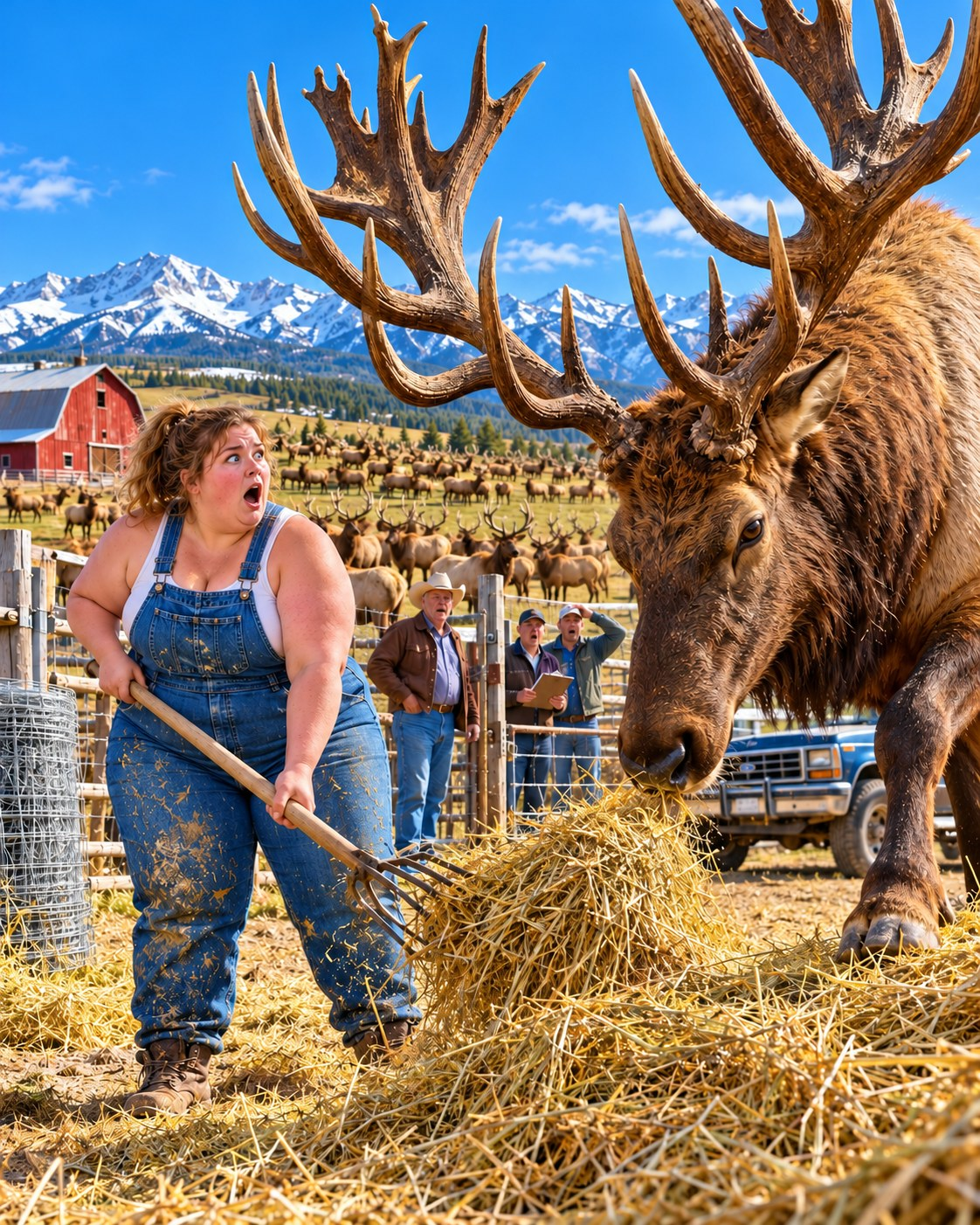
Mara Quinn grabbed her rifle from the mudroom and ran toward the western fence.
"Mom! Wait!"
Caleb's voice came from behind her.
She turned just long enough to see him standing on the porch.
"Stay inside. Lock the door."
"But the elk—"
"Caleb, do exactly what I said."
He nodded reluctantly.
Mara hurried across the pasture.
The older cow had disappeared from the place where she usually rested. The mature bull stood near the creek, his head raised, watching the trees beyond the western boundary.
The fresh tire tracks were unmistakable.
Someone had driven along the fence during the night.
Mara crouched beside the damaged ground.
The tracks were deep, suggesting a heavy vehicle.
There were also several hoofprints leading toward the trees.
She followed them for nearly fifty yards before finding something caught on a low branch.
A piece of dark fabric.
She pulled it free.
It looked like material from a work jacket.
Then she noticed something else.
A section of the western fence had been disturbed.
One wire was loose.
A wooden post had been pushed slightly out of alignment.
Someone had been there.
Someone had been close enough to the elk to frighten them.
Mara returned to the enclosure and called Dr. Sloan.
He answered immediately.
"Mara?"
"Someone came onto my property last night."
"What happened?"
"I found tire tracks along the western fence. There's a damaged post, and one of the older cows is missing from her usual location."
"Is she actually missing?"
"I haven't seen her this morning."
"Don't assume she's gone. Check the northern pasture and the creek first. She may have moved away from the disturbed section."
Mara looked toward the bull.
"He hasn't moved from the creek."
"That could mean nothing. It could also mean he's responding to something unusual. I'll come over."
Before hanging up, Sloan added:
"Don't approach the tracks alone if you think someone is still nearby."
Mara looked toward the trees.
"I understand."
But she did not feel reassured.
Dr. Sloan arrived forty minutes later.
He examined the damaged fence and photographed the tire tracks.
Then he walked along the northern pasture.
Mara followed.
They found the older cow standing beneath a group of willow trees.
She was alive.
But she was unusually alert.
Sloan approached slowly and observed her movement.
"She's not injured."
Mara exhaled.
"Thank goodness."
"However, something disturbed her."
He looked toward the western boundary.
"These animals are becoming familiar with their environment. When something unfamiliar enters their territory, they notice."
Mara glanced toward the bull.
"He stayed near the creek all morning."
"He's probably responding to the same disturbance."
Sloan examined the ground.
Several hoofprints crossed the muddy soil.
There were also bootprints.
Two different sets.
Mara stared at them.
"Two people?"
"Possibly."
"Could they have been trying to steal one of the animals?"
Sloan stood.
"I can't tell you that."
He looked toward the older cow.
"But I can tell you something else. Whoever came here knew where the animals usually gathered."
Mara felt a chill.
The enclosure was large.
There were dozens of places where somebody could have approached unnoticed.
Yet the vehicle had stopped near the western post.
The exact location where Caleb had found the old identification marker.
Someone was looking for something.
Or someone.
That afternoon, Mara called the county sheriff's office.
A deputy named Thomas Reed arrived near four o'clock.
He listened while she explained the tire tracks, the damaged fencing, and the threatening note.
He examined the paper.
"Do you have any idea who sent this?"
Mara looked at him.
"I have a suspicion."
"Everett Voss?"
"His company filed a complaint against my operation. His family has been connected to the old records. And he has repeatedly tried to purchase my property."
The deputy wrote something down.
"Have you received any direct threats from him?"
"He told me to stop asking questions about the animals."
"Did he use those exact words?"
"Not exactly."
Reed studied the note again.
"This doesn't identify the sender."
"I know."
"Still, I'll document it."
Mara showed him the damaged post.
The deputy examined the ground and photographed the tire tracks.
He also asked whether any animals had been injured.
"Not that I can find."
"Any missing?"
"No."
He nodded.
"Keep your records. If you see another vehicle, write down the description and time. Don't confront anyone."
Mara thanked him.
Before leaving, Reed looked toward the pasture.
"That's quite a herd."
"Fifty-two."
He gave her a sympathetic smile.
"I heard about the auction."
Mara sighed.
"Everybody did."
He laughed.
"Well, I hope things work out."
Then he climbed into his vehicle and drove away.
Mara remained near the gate.
She looked at the western boundary.
The damaged post had been repaired temporarily, but the feeling of being watched remained.
The next several days were difficult.
The hay situation continued to worsen.
George Palmer had supplied Mara with everything he could spare, but his remaining stock was limited.
She began calling farmers farther away.
Some were willing to sell.
Others had already committed their hay to established cattle operations.
One farmer told her he had received an offer from Voss Livestock that was nearly twice the local market price.
Another said Everett's company had reserved most of the available winter supply.
Mara began to understand the scale of the problem.
Everett had not simply bought hay for his own operation.
He had bought enough to make sure smaller ranchers could not compete.
For a large operation, the expense was manageable.
For Mara, every additional mile meant more fuel, more transportation costs, and less money available for fencing and veterinary care.
She sat at the kitchen table with her calculator.
Caleb entered carrying two glasses of milk.
"Mom?"
She looked up.
"Yes?"
"Did you find more hay?"
"Some."
"Enough?"
Mara hesitated.
"Not yet."
Caleb placed one glass beside her.
"Maybe we should sell some of the elk."
She looked at him.
He quickly continued.
"I don't mean all of them. Just a few. Then we'd have more money for the others."
Mara studied his face.
It was a reasonable suggestion.
A practical one.
And it was exactly the kind of solution she had been considering herself.
But the animals were not yet healthy enough for any decision involving transportation or sale to be made casually.
"We'll see what Dr. Sloan says," she replied.
Caleb nodded.
Then he looked at the paperwork.
"Is Mr. Voss trying to make us sell?"
Mara put down her pencil.
"I think he wants us to believe we have no other choice."
"Do we?"
She looked toward the window.
Outside, the elk were moving through the pasture.
June stood near the feeding area.
The older cow was grazing beside the bull.
"No," Mara answered.
"Not yet."
On November 17, Dr. Sloan brought a small portable scale and additional monitoring equipment.
He wanted to compare the animals' recovery progress with his original records.
Mara helped him organize the examination.
One by one, the animals were observed.
Their coats had improved.
Their movement was stronger.
Several had gained noticeable weight.
June was doing particularly well.
Sloan checked her carefully.
"She's responding."
Mara smiled.
"I knew she would."
"Don't get ahead of yourself. She's still recovering."
He turned toward the older cow.
"Now, this one interests me."
Mara looked at him.
"Because of the old identification marker?"
"Partly."
He examined the animal from a distance.
Then he opened his notebook.
"Her physical characteristics appear consistent with the descriptions in the historical records."
Mara's eyes widened.
"Are you sure?"
"No. Not yet."
He pointed toward the cow's head.
"Look at the shape, the ear placement, and the overall build. Those characteristics are not enough to prove ancestry, but they give us a reason to investigate."
Mara watched the animal.
"Could she be from the original Ruona bloodline?"
"She could be descended from it."
Sloan paused.
"And if the records are genuine, she may be one of the most important animals in the entire herd."
Mara looked toward the mature bull.
"What about him?"
"His characteristics are interesting too. But I need more information before making any conclusions."
He closed his notebook.
"There's something I want you to understand."
"What?"
"These animals may have been selectively bred for generations. If so, their value may have nothing to do with how much meat they could produce or how many animals someone could sell."
Mara frowned.
"Then what would make them valuable?"
Sloan looked toward the pasture.
"Their genetic history. Their resilience. The records documenting their lineage."
He turned back to her.
"Sometimes the most important thing about an animal is not what you can see standing in front of you."
Three days later, Mara received a telephone call from Everett Voss's office.
His secretary asked whether she would meet with him privately.
Mara almost refused.
But she remembered the complaint, the missing hay, and the documents Robert had brought.
She agreed to meet.
Not because she trusted Everett.
Because she wanted to know what he was afraid of.
On November 21, Mara drove her old Ford pickup to the Voss headquarters.
The building stood on a rise overlooking the valley.
It was larger than most homes in Dry Creek.
Inside, the floors were polished wood, the walls displayed framed photographs of livestock awards, and the reception area contained a large painting of the Montana mountains.
A secretary escorted Mara into Everett's office.
He stood beside a wide window overlooking his property.
"Mara. Come in."
She remained near the door.
"You wanted to see me."
Everett gestured toward a chair.
"Please."
She sat.
He returned to his desk.
A thick folder lay in front of him.
"I've been thinking about your situation."
Mara looked at the folder.
"That's generous."
Everett ignored the remark.
"You're struggling with feed costs."
"Everyone is."
"Your fencing is expensive."
"Yes."
"And the animals require veterinary attention."
"That's correct."
He folded his hands.
"You have a son to raise. A mortgage to pay. A business that is consuming every dollar you have."
Mara stared at him.
"Is there a question somewhere in this conversation?"
Everett smiled faintly.
"I want to offer you a solution."
He opened the folder.
"One hundred thirty-five thousand dollars."
Mara did not move.
Everett continued.
"I'll purchase your 240 acres, including the existing improvements. I'll handle the remaining livestock obligations and take responsibility for the animals."
Mara looked at him.
"All fifty-two?"
"Yes."
"And their records?"
"Everything associated with the operation."
She leaned back.
"That's a lot of money."
"It is."
"It would clear my mortgage."
"Immediately."
"It would pay Daniel's remaining medical debt."
Everett nodded.
"You could move somewhere smaller. Start again. Give Caleb a better opportunity."
Mara looked at the contract.
For a moment, she imagined what it would feel like not to worry about the next hay delivery.
No more late-night calculations.
No more repairing fences in freezing weather.
No more watching the bank balance disappear.
She could buy a comfortable home.
She could pay for Caleb's education.
She could finally stop living one emergency away from losing everything.
Everett watched her carefully.
He knew the offer was attractive.
Then Mara opened the contract.
She read the first page.
Then the second.
The third.
The purchase price was clearly stated.
The property boundaries were described.
The closing date was included.
Everything appeared straightforward.
Until she reached a paragraph near the back.
She read it twice.
Then she looked up.
"What does this mean?"
Everett glanced at the page.
"Which section?"
"This one."
She turned the document toward him.
The paragraph stated that all livestock and privately held game animals located on the property would become the purchaser's exclusive responsibility and property upon closing.
It included animals not individually listed in the sale schedule.
It also transferred associated breeding records, identification documents, and ownership claims.
Mara felt the room become strangely quiet.
"You want the elk."
Everett did not deny it.
"They're part of the operation."
"No. They're the reason for the operation."
He leaned back.
"Mara, you're not in a position to negotiate every detail."
She closed the folder.
"Then I don't need to."
Everett's expression changed.
"You haven't even considered the offer."
"I have."
"One hundred thirty-five thousand dollars is more money than you've probably seen in your bank account in years."
Mara stood.
"You're right."
"Then be sensible."
She looked directly at him.
"Why do you want those animals so badly?"
Everett remained silent.
She continued.
"You told everyone they would be dead before Christmas. You said they were worthless. You tried to make sure I couldn't buy hay. Your company filed a complaint against my operation."
He stared at her.
"And now you're offering me more than my land is worth."
Everett slowly stood.
"Be careful, Mara."
"Why?"
"Because you don't understand what you're involved in."
"Then explain it."
He walked around the desk.
"You owe the bank money."
"So do you."
"That's different."
"Only because you owe them more."
His face tightened.
For several seconds, neither spoke.
Then Mara picked up her coat.
"Thank you for the offer."
Everett watched her approach the door.
"You'll regret refusing it."
She stopped.
Without turning around, she answered:
"I'd regret signing it."
Then she walked out.
On the drive home, Mara thought about the contract.
One hundred thirty-five thousand dollars.
It was enough to solve almost every immediate problem.
But Everett had not been interested in negotiating.
He had wanted the land and every animal on it.
She remembered the sentence about breeding records.
Why would a rancher who owned eighteen thousand acres care so much about fifty-two starving elk?
The answer was becoming increasingly difficult to ignore.
The herd was worth something.
Something Everett believed he could not afford to lose.
When Mara arrived home, Earl Maddox was waiting beside the barn.
He had heard about the meeting from a mutual acquaintance.
"Did he make you an offer?"
"One hundred thirty-five thousand."
Earl whistled.
"That's serious money."
"It was."
"Was?"
Mara nodded.
"I turned it down."
Earl looked at her for several seconds.
"Good."
She smiled faintly.
"You're not even going to ask why?"
"I know Everett Voss. If he's offering that much money for something, he's probably figured out how to make twice as much from it."
Mara laughed.
Then her expression changed.
"There's something in the contract."
She explained the clause concerning livestock and breeding records.
Earl listened carefully.
When she finished, he shook his head.
"That's not a property purchase. That's an attempt to take control of the herd."
"That's what I thought."
He looked toward the pasture.
"Have you spoken to Robert?"
"Not since his father confronted him."
"Maybe you should."
Mara nodded.
She intended to.
That night, Robert called.
His voice sounded strained.
"Did my father make you an offer?"
Mara sat down.
"Yes."
"How much?"
"One hundred thirty-five thousand."
Robert exhaled.
"He really did it."
"Did what?"
"He offered you more than the property is worth."
Mara frowned.
"How do you know?"
"Because I heard him discussing it with his attorney."
"What did he say?"
Robert was quiet.
Then he answered.
"He said the purchase had to be completed before anyone verified the original breeding records."
Mara gripped the telephone.
"Why?"
"Because once the records are authenticated, the ownership history could become a legal problem for him."
"Does he have a claim to the animals?"
"I don't know."
"Robert, I need you to be honest with me."
"I am."
"Then tell me what your family knows."
He took a deep breath.
"My grandfather's papers mention a transfer that was never properly completed. The Ruona family believed the animals were being temporarily relocated. But the receiving company treated them as permanent property."
"Which company?"
"Voss Livestock."
Mara looked toward the kitchen window.
The pasture was dark.
"Was your grandfather involved?"
"I think he knew about it."
"And your father?"
Robert's voice became quieter.
"My father inherited the documents. He always said the past was none of my business."
Mara waited.
Then Robert added something that made her blood run cold.
"There's another reason he wants the animals before winter."
"What reason?"
"I found a letter in my grandfather's box. It mentions a second set of records."
"Where?"
"At the old Ruona property."
Mara sat upright.
"Is the property still there?"
"Part of it."
"Where?"
Robert gave her an address near Kettle Rapids.
Then he said:
"But Mara, you need to understand something. My father isn't the only person who knows about that place."
The following morning, Mara began making plans to investigate the old Ruona property.
She did not intend to leave the elk unattended.
Earl offered to help with the daily checks.
Dr. Sloan agreed to remain available.
Caleb would stay with a neighbor if Mara needed to travel.
But before she could arrange anything, the weather changed.
A cold front moved through the valley.
The temperature dropped sharply.
The sky darkened.
Snow began falling earlier than expected.
Mara spent the afternoon checking the fence.
She inspected the water supply and made sure the hay was protected.
The elk were unusually restless.
The mature bull moved along the western boundary several times.
The older cow remained close to the center of the herd.
June stood near the feeding area.
Mara noticed the animals gathering together.
She had seen that behavior before.
They were responding to the changing weather.
She called Sloan.
"Henry, the herd is moving strangely."
"How?"
"They're gathering near the northern ridge."
"How many?"
"Most of them."
"Keep observing. Don't force them to move unless there's an immediate danger."
Mara looked toward the ridge.
The wind was picking up.
Then she heard a sharp cracking sound.
She turned toward the western fence.
A section of the old boundary line had collapsed beneath the weight of accumulated snow and a weakened post.
Six elk immediately moved toward the opening.
Mara grabbed her flashlight.
"Caleb! Stay inside!"
She ran toward the enclosure.
The animals passed through the damaged section.
But instead of running toward the highway, they turned sharply uphill.
They climbed toward the windswept ridge.
Mara watched in disbelief.
The six elk stopped near a patch of deep snow.
Then they began digging.
Not randomly.
They used their hooves and muzzles to uncover the vegetation beneath the frozen surface.
Mara stood motionless.
The animals were finding food.
In the middle of a snowstorm.
In a place where she had expected them to panic.
Her telephone rang.
It was Dr. Sloan.
"Mara, what's happening?"
"Six elk got through the western fence."
"Are they moving toward the road?"
"No."
"Where are they?"
"On the ridge."
She watched the animals continue digging.
"They're uncovering something beneath the snow."
There was silence on the other end.
Then Sloan spoke.
"Don't move them yet. I'm coming."
Mara looked toward the darkening sky.
The snow was getting heavier.
The six elk remained together.
And just beyond them, near the ridge, she noticed something partially buried beneath the snow.
It looked like an old wooden sign.
As the wind shifted, more of its lettering became visible.
Mara raised her flashlight.
The name on the sign was unmistakable.
RUONA WILDLIFE RESERVE.
But beneath the name was another line.
A date.
ESTABLISHED 1918.
And somebody had recently cleared the snow from the entrance...






Comments 0