"My father told me never to let anyone discover what those animals really are."
Robert Voss stood beneath the ranch light, holding a large manila envelope.
Mara Quinn stared at him.
Behind her, Dr. Henry Sloan had stopped moving.
For several seconds, nobody spoke.
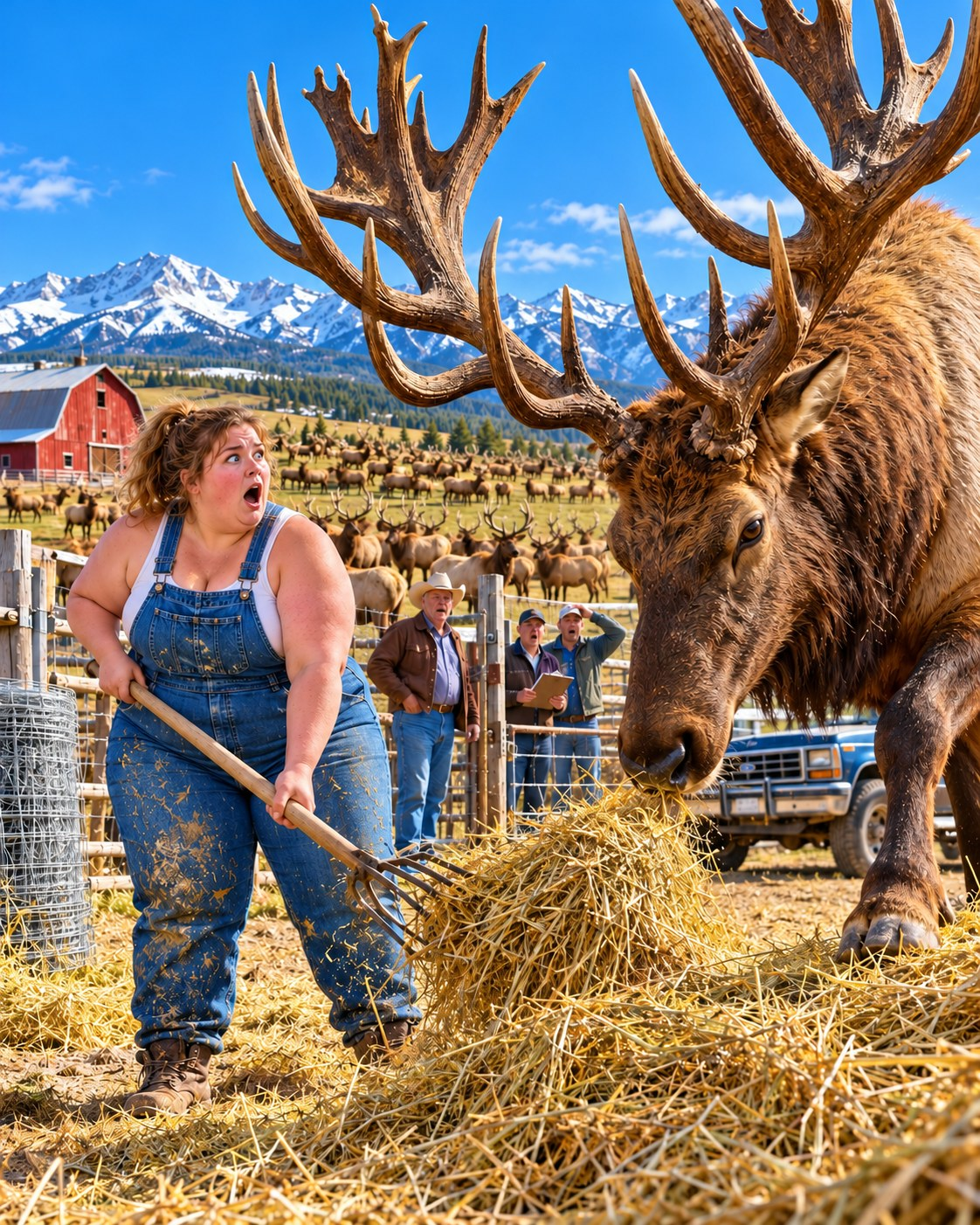
The fifty-two elk stood quietly inside the enclosure. The older bull lifted his head, while several cows gathered near the feeding area.
Mara looked at the envelope.
"What exactly did your father tell you?"
Robert glanced toward the pasture.
"Not here."
"Then why did you come?"
"Because my father doesn't know I'm here."
That answer made Dr. Sloan step forward.
"Robert, I think you'd better explain yourself."
Robert recognized him.
"Dr. Sloan."
"You know me?"
"I know your name. My father mentioned you once."
Sloan's expression hardened.
"What did he say?"
Robert hesitated.
"He said you were the kind of man who kept asking questions after everyone else had decided the matter was finished."
Mara folded her arms.
"That sounds like a compliment."
"It wasn't."
Robert looked toward the road.
Then he held out the envelope.
"My father kept these documents in his office for years. I found them after he moved his personal files out of the old property."
Mara did not take it immediately.
"Why bring them to me?"
"Because I saw your name in a newspaper article."
He looked at the elk again.
"I recognized the auction photographs."
Sloan accepted the envelope.
The first document was an old photograph.
The second was a handwritten letter.
The third appeared to be a breeding record.
Sloan examined the photograph first.
His face changed.
"Where did you get this?"
"I told you. My father's office."
"Was there anything else?"
Robert nodded.
"An entire box."
Mara stepped closer.
"What was in it?"
"Records. Letters. Old registration documents. Some of them were marked confidential."
"Confidential according to whom?"
"My father."
Mara looked at him.
"Robert, your family has been trying to buy my property for two years. Your father publicly questioned my ability to care for these animals. Now you're standing here telling me he hid information about them."
Robert lowered his eyes.
"I know how that sounds."
"Then help me understand."
He took a breath.
"My father inherited more than land and a livestock business. He inherited a secret that nobody in our family was supposed to discuss."
Sloan opened the handwritten letter.
The paper was yellowed, and the ink had faded.
At the top was a date.
June 1946.
The signature at the bottom read Werner Ruona.
Sloan looked at Robert.
"Your father had this?"
"Yes."
"Did he tell you why?"
"No. But he told me something else."
Robert paused.
"He said the Ruona family had made a mistake by trusting the wrong people."
Mara invited Robert inside.
She did not offer him coffee.
She wanted answers.
Caleb had already gone to bed, but Mara made sure the kitchen door remained open so she could hear if he came downstairs.
Sloan spread the documents across the table.
The first letter appeared to discuss an agreement involving a private game herd.
The second mentioned transportation restrictions.
The third contained a list of animal identification numbers.
Sloan compared the numbers against the incomplete auction records.
His finger stopped.
"Look at this."
Mara leaned closer.
"What?"
"These identification numbers."
He placed the old sheet beside the auction document.
Three numbers matched.
Then a fourth.
Then a fifth.
Mara stared at the pages.
"Are you saying these are the same animals?"
"Not necessarily the same individual animals. Some of these records may refer to earlier generations."
Robert leaned forward.
"My father said the original herd was never supposed to be divided."
Sloan looked at him.
"Did he explain why?"
"He said Werner Ruona believed the animals carried a particular combination of traits."
"What traits?"
Robert shook his head.
"He never gave me a scientific explanation."
Mara looked at the old photograph.
The elk in the picture appeared remarkably healthy.
Their bodies were strong.
Their coats were full.
Even the younger animals seemed unusually alert.
She pointed toward the photograph.
"Are those the same kind of elk I have?"
Sloan studied it.
"They're Rocky Mountain elk. But the important question is whether they belong to a documented breeding line."
Robert nodded.
"That's what my father was afraid of."
"Why?"
"Because if the records proved the animals belonged to a protected private bloodline, it could expose what happened to the original herd."
Sloan leaned back.
"Who was responsible for maintaining the records?"
"Werner Ruona."
"And after he died?"
"My father said the documents disappeared."
Mara looked at Robert.
"Your father was involved?"
Robert hesitated.
"I don't know how much he was involved. But I know he had the papers."
"That isn't an answer."
"No. It isn't."
He looked down at his hands.
"But I can tell you something else. My father has spent years trying to acquire your property."
Mara's expression became colder.
"Because of its location?"
"That's what he told people."
"And what do you believe?"
Robert looked through the kitchen window toward the pasture.
"I think he wanted those animals."
The following morning, Mara found Everett Voss waiting near the western entrance.
He was standing beside his black pickup.
His expression was controlled, but his eyes moved immediately toward the house.
Mara stepped outside.
"You're early."
Everett looked at her.
"Where's my son?"
She did not answer.
"Robert was here last night."
Mara remained silent.
Everett's jaw tightened.
"I asked you a question."
"And I heard it."
He walked closer.
"Whatever he told you, you shouldn't believe it."
"Why?"
"Because he doesn't understand the situation."
"Then explain it to me."
Everett looked toward the enclosure.
The older bull stood near the feeding area.
Several cows were grazing behind him.
For a moment, Everett seemed to forget what he had come to say.
Then he turned back.
"I'll offer you two hundred thousand dollars for the ranch."
Mara stared at him.
Two hundred thousand.
It was more than the previous offer.
It would clear her mortgage.
It would pay Daniel's remaining medical debt.
It would give Caleb a financial future.
It would allow her to start again somewhere else.
But she remembered the contract Everett had offered in November.
The paragraph that transferred every privately held game animal to him.
She had learned to read every line twice.
"What do you want in return?"
"The property."
"And the elk?"
Everett's expression barely changed.
"They're part of the property."
"No, they're not."
He sighed.
"You're making this unnecessarily difficult."
Mara stepped closer.
"You offered me money before. I refused. Now your son comes here with documents about the animals, and suddenly the price goes up."
"Robert is confused."
"Then why are you worried about what he told me?"
Everett's face hardened.
"Because family matters should stay within the family."
Mara almost laughed.
"You've spent two years trying to make my land a family matter."
He looked toward the house.
"Listen carefully, Mara. Those animals are not worth what you think they are."
"Then why do you want them?"
Everett did not answer.
Instead, he adjusted his jacket.
"Think about my offer."
He walked back toward his truck.
Before climbing inside, he turned around.
"And keep Robert away from your operation."
Mara watched him drive off.
She knew one thing with certainty.
Everett had not come to make a business proposal.
He had come because he was frightened.
At noon, Dr. Sloan returned with additional paperwork.
He had spent the morning comparing the old breeding records with the animal identification numbers.
Mara met him near the barn.
"Did you find anything?"
"Some things."
"Are they important?"
"Potentially."
He opened his notebook.
"Werner Ruona appears to have maintained a closed breeding program. He selected animals for health, size, hardiness, and the ability to survive difficult winters."
Mara listened.
"Does that explain the herd's behavior?"
"It might explain part of it. Some behaviors are learned and passed through social structures. Others have genetic influences. We need to separate those possibilities."
He pointed toward the older cow.
"That animal may be particularly important."
Mara followed his gaze.
"June?"
"No. The other one. The older female."
"She leads the herd."
"I've noticed."
Sloan studied her.
"If the original breeding records are accurate, she could be descended from one of the foundation females in the Ruona program."
Mara looked surprised.
"How old is she?"
"Hard to determine without a closer examination. But she is certainly mature."
"Could she have been part of the original herd?"
"Not from 1945. But she may belong to a later generation."
He paused.
"That's why we need the records."
Mara looked toward the feeding area.
The older cow had stopped eating.
She raised her head and watched the younger animals.
Then she began walking toward the western side of the enclosure.
Several others followed.
The bull remained behind for a moment before moving after them.
Sloan watched the entire sequence.
"There's another thing."
"What?"
"Look at where they're going."
Mara followed his gaze.
The animals were heading toward a narrow section of pasture near the creek.
She had noticed that area before.
It contained a mixture of willow, dry grass, and low brush.
But the animals always seemed to approach it from the same direction.
Sloan took out his notebook.
"Have you ever seen them use the southern entrance?"
"Only occasionally."
"Why?"
"I don't know."
He looked at the older cow.
"I'd like to observe them for a few days."
The next week brought another problem.
Mara's hay supply was nearly exhausted.
The supplier Earl had recommended could provide only a limited quantity.
The hay was lower grade than she wanted, and transportation costs were high.
Mara calculated how long it would last.
At the current feeding rate, she would have enough for twelve days.
After that, she would need another source.
She drove to the northern valley and met the retired farmer.
His name was George Palmer.
He had worked the same land for nearly forty years before selling most of his cattle.
His remaining hay was stored in an old wooden barn.
He walked Mara through the stacks.
"It's not pretty," he said. "But it's clean."
Mara inspected the bales.
She checked for mold, dust, and signs of moisture damage.
Then she nodded.
"I'll take what you can spare."
George looked at her.
"You're the woman with the elk?"
"Yes."
He smiled.
"My grandson keeps telling me about you."
Mara laughed faintly.
"Hopefully not the auction jokes."
"Some of those too."
George showed her another stack.
"These are better."
Mara examined them.
The price was still difficult, but manageable.
She agreed to purchase the hay.
Before leaving, George asked a question.
"Why did you buy them?"
Mara looked toward the open barn door.
"Because they needed somewhere to go."
"That's all?"
She thought about Daniel.
Then she nodded.
"That's enough."
On November 12, Caleb noticed something unusual.
He had been helping Mara record the movement of the herd.
He was standing near the fence with his notebook when the older cow began walking toward the creek.
The young bull followed.
Then another group of animals moved behind them.
Caleb counted.
He counted again.
Then he ran toward the house.
"Mom!"
Mara came out of the barn.
"What happened?"
"They're doing it again."
"Doing what?"
"Going to the same place."
He pointed toward the northern pasture.
Mara looked.
The herd was gathering near the creek.
Caleb opened his notebook.
"Look."
He showed her several entries.
He had recorded the same movement on four different dates.
Each time, the older cow had led the group.
Each time, the bull had moved to the outside.
And each time, the younger animals had followed the same route.
Mara studied the notes.
"Good work."
Caleb looked pleased.
"But there's something else."
He pointed toward the western fence.
"Every time they go there, the bull stops at that same post."
Mara looked toward the enclosure.
The bull was standing beside a weathered wooden post.
He was not eating.
He was watching the ground beyond the fence.
Mara walked closer.
The post was older than the surrounding fencing.
Its wood was darker.
There were several deep scratches near the bottom.
She crouched.
Something metallic was partially buried beneath the soil.
Mara brushed away the dirt.
A small piece of metal appeared.
It looked like an old identification marker.
She pulled gently.
The marker came loose.
There were numbers engraved on its surface.
And beneath them was a name.
RUONA.
Mara called Dr. Sloan immediately.
Sloan arrived less than an hour later.
He examined the marker carefully.
"Where exactly did you find this?"
Mara pointed toward the post.
"Under the soil."
He turned it over.
There was another number on the reverse side.
Sloan took photographs.
Then he compared the numbers with the old breeding records.
His face became serious.
"Henry?"
He looked at her.
"This may be the first physical link between your current herd and the original Ruona operation."
Mara stared at the marker.
"Does that prove the animals belong to that bloodline?"
"No. But it gives us something concrete to investigate."
He placed the marker in a protective envelope.
"I want this examined properly."
Mara nodded.
"Do you think Everett knows about it?"
Sloan looked toward the road.
"I think he knows more than he's telling us."
That evening, Robert Voss telephoned.
Mara answered after the second ring.
"Hello?"
"It's Robert."
"What happened?"
"I need to speak with you."
"About what?"
"My father found out I gave you the documents."
Mara stood up.
"What did he do?"
"He went through my office."
"Did he take anything?"
Robert hesitated.
"Yes."
"What?"
"The original breeding ledger."
Mara felt her stomach tighten.
"Where was it?"
"In a locked cabinet."
"How did he know about it?"
"He must have found the inventory list."
Mara looked toward the kitchen table.
The photocopies were still there.
"Robert, do you have any other documents?"
"I have one."
"What is it?"
"A letter from my grandfather."
"Does it mention the elk?"
"Yes."
"What does it say?"
Robert took a breath.
"It says the Ruona family never intended to sell the original breeding herd."
Mara gripped the telephone.
"Then who transferred them?"
"That's what I wanted to tell you."
He lowered his voice.
"My grandfather said the transfer was arranged without Werner's permission."
Mara stared at the window.
"Who arranged it?"
Robert did not answer immediately.
Then he spoke.
"Someone from my family's business."
The next morning, Dr. Sloan arrived with a message from Alvar Teppo.
Alvar had located another surviving document.
It was a handwritten inventory from 1946.
The document listed several animal identification numbers, transportation dates, and the names of people involved in a transfer.
Sloan placed it on Mara's kitchen table.
"Alvar believes this may be the missing link."
Mara examined the page.
There were seven names.
Six were unfamiliar.
The seventh was not.
Everett Voss's grandfather.
She read the line twice.
Then she noticed something written in the margin.
A short sentence in faded ink.
Fifty-two animals retained. Original breeding female excluded.
Mara looked up.
"What's that supposed to mean?"
Sloan leaned closer.
"I don't know."
He studied the wording.
"But it suggests the herd may have been divided deliberately."
"Where did the original female go?"
"That's the question."
Mara looked toward the pasture.
The older cow was standing alone near the creek.
The young bull had moved closer to her.
Sloan followed her gaze.
"There's one more thing I haven't told you."
Mara turned.
"What?"
He placed another paper beside the inventory.
It was a photograph of an old animal identification tag.
The number was almost identical to the marker Caleb had found.
Almost.
But one digit was different.
Sloan pointed toward the photograph.
"According to Alvar, the missing original breeding female carried this identification number."
Mara looked at the marker on the table.
Then at the photograph.
The numbers were close enough to be related.
But not identical.
She stood up.
"Henry, are you telling me the older cow could be her descendant?"
"Possibly."
"How do we find out?"
Sloan opened his mouth to answer.
But before he could speak, Caleb came running into the kitchen.
"Mom!"
Mara turned.
"What is it?"
Caleb was pale.
He held a folded piece of paper in his hand.
"I found this under the gate."
Mara took it.
There was no envelope.
No return address.
Only one sentence written in black ink.
STOP INVESTIGATING THE RUONA HERD, OR THE NEXT ANIMAL THAT DISAPPEARS WON'T BE AN ACCIDENT.
Mara looked toward the pasture.
The older cow was no longer beside the creek.
The bull was standing alone.
And beyond the western fence, a fresh set of tire tracks led toward the trees...






Comments 0