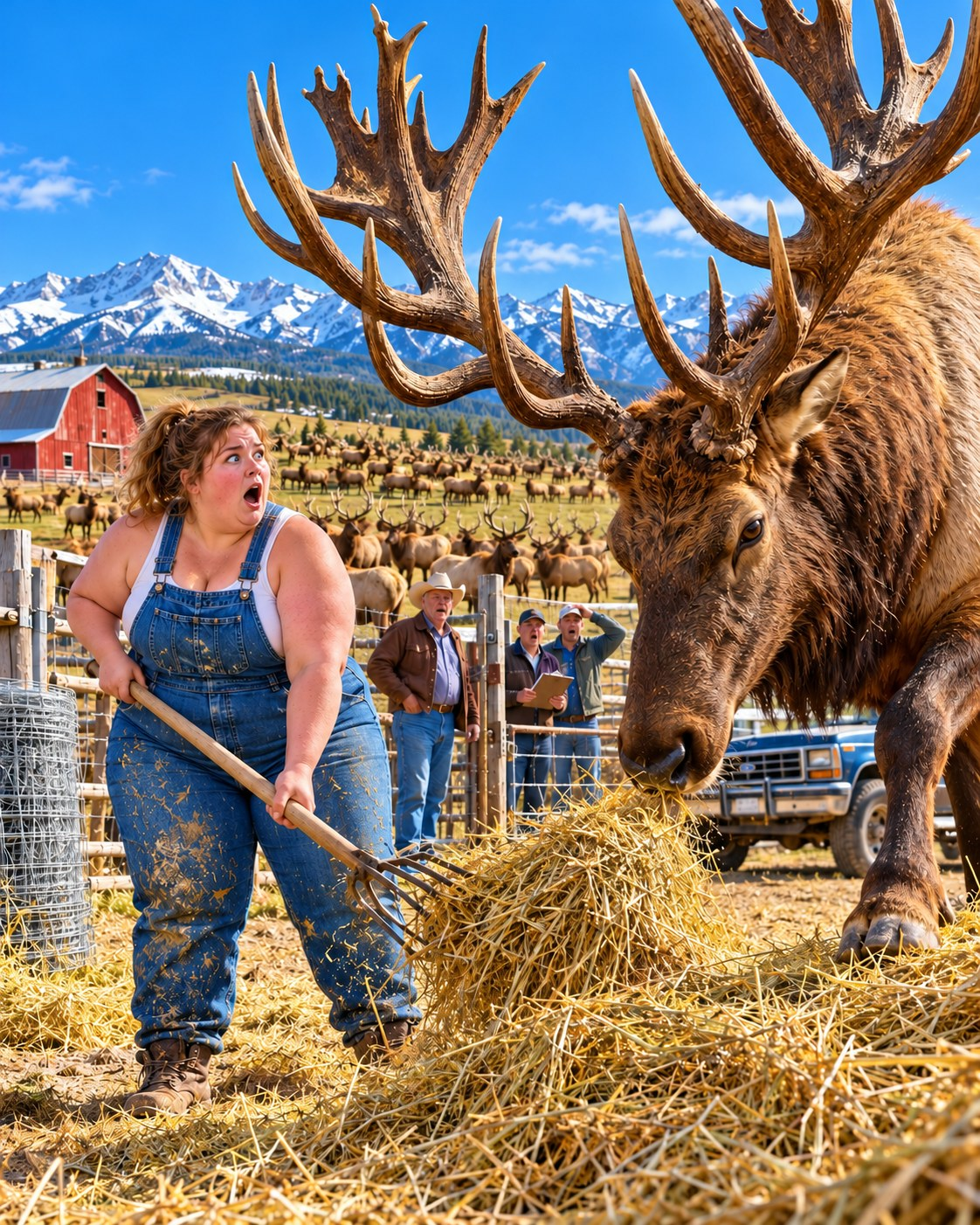
Mara Quinn stared at the signature on the county complaint.
For several seconds, she forgot about the inspector standing in front of her.
The name at the bottom of the document was not Everett Voss.
It belonged to Calvin Rusk, a former employee of the Bitterroot Valley Game Preserve.
The same man who had called her less than twenty minutes earlier.
The same man who had warned her to be careful about asking questions concerning the fifty-two elk.
And now, apparently, he had requested an official inspection of her property.
Mara slowly raised her eyes.
"Did this man personally submit the complaint?"
The inspector adjusted his clipboard.
"Mr. Rusk submitted a supporting statement. The original complaint came from Voss Wildlife Enterprises."
"What exactly did he say?"
The inspector handed her another sheet.
Mara read the first paragraph.
The complaint alleged that her enclosure might not meet state requirements, that her water capacity was insufficient, and that the animals were being maintained under potentially dangerous conditions.
She continued reading.
Then she stopped.
One sentence had been underlined.
The animals may have originated from an undocumented private breeding operation, raising questions about their legal ownership and identification.
Mara looked at the inspector.
"Why would a former employee make that allegation?"
"That's something you may want to discuss with him."
"Do you know where he is?"
The inspector shook his head.
"I only know that he provided a written statement."
Mara folded the paper.
"Then I want a copy of everything he submitted."
"That's your right."
The inspector looked past her toward the pasture.
The elk were gathered near the northern feeding area.
Some were eating.
Others stood watching the unfamiliar vehicle.
The inspector observed them for several seconds.
"How long have you owned these animals?"
"Since September twenty-ninth."
"And you purchased all fifty-two at the bankruptcy auction?"
"Yes."
"Do you have transportation records?"
"Yes."
"Veterinary records?"
"Yes."
"Feeding records?"
Mara nodded.
"Everything."
The inspector seemed mildly surprised.
"All right. I'll need to review those."
Mara stepped aside.
"Come inside."
The inspection lasted nearly two hours.
Mara brought out the auction receipt, transportation documents, Dr. Sloan's veterinary notes, and her daily feeding records.
She showed the inspector the four animals being monitored most closely.
She explained how the herd had been gradually introduced to the recovery feeding schedule.
She also showed him the temporary windbreak she had built for June during the freezing night in October.
The inspector listened carefully.
He measured several sections of fencing.
He checked the water supply.
He walked along the western boundary and examined the posts.
Most of the setup appeared adequate for the current stage of the operation.
However, he noted several sections that would require additional attention.
"You're doing more documentation than some established operations," he said.
Mara looked at him.
"Is that good?"
"It certainly helps."
He turned another page.
"But I want to be clear. A complaint means we have to investigate. It doesn't mean the allegations are true."
"I understand."
"There's one other thing."
He pointed toward the animals.
"Who identified the herd as fifty-two Rocky Mountain elk?"
"The auction paperwork."
"Did anyone verify every identification number?"
"Dr. Sloan checked the animals."
"Did he compare their identification records against the original transfer documents?"
Mara hesitated.
"I don't think he had those documents."
The inspector made a note.
"That may become important."
Mara felt something tighten in her stomach.
"Why?"
He closed his folder.
"Because the complaint specifically questions where these animals came from."
He looked toward the pasture again.
"That is a different matter from whether your fence is strong enough."
After the inspector left, Mara telephoned Dr. Sloan.
He answered after the third ring.
"Henry Sloan."
"It's Mara."
"How are the animals?"
"Still alive."
He chuckled.
"That's always a good beginning."
"I need you to come out here."
His tone changed.
"What happened?"
"Someone filed a complaint about the herd."
"Who?"
"Voss Wildlife Enterprises. And Calvin Rusk."
There was a long silence.
"Calvin Rusk?"
"You know him?"
"I know the name."
Mara sat down.
"Henry, he called me this morning. He said the elk originally came from another operation. He said there were missing transfer records. Then he warned me not to ask questions."
Sloan remained quiet.
"What else did he say?"
"He told me to speak to you."
Another pause.
"Did he give you a reason?"
"No."
Sloan exhaled.
"I'll come tomorrow morning."
"Henry, what is going on?"
"I don't know yet."
"You sound like you know more than you're telling me."
"That's because I'm trying not to make assumptions."
Mara glanced toward the window.
The older cow had moved toward the center of the pasture.
The young bull followed several yards behind.
"Henry?"
"Yes?"
"Could these animals have come from a special breeding program?"
Sloan did not answer immediately.
"Possibly."
"Could they be related?"
"Almost certainly some of them are. But that's not what concerns me."
"What does?"
He lowered his voice.
"The possibility that somebody deliberately removed their original records."
That evening, Mara sat at the kitchen table with the auction folder spread in front of her.
Caleb was doing homework nearby.
She had called Earl earlier and asked him to come by the next morning.
She wanted another pair of eyes on the paperwork.
The auction records contained several identification numbers.
Some were handwritten.
Others had been typed onto older forms.
A few entries had been crossed out.
One page included the name of a previous holding facility, but the address had been removed.
Mara leaned closer.
There was something strange about the final sheet.
The paper was older than the others.
It had a faint crease down the middle and a small rectangular mark where something appeared to have been attached.
She turned it over.
Nothing.
Then she held it toward the kitchen light.
A few faint impressions appeared on the back.
They looked like writing that had been pressed into another sheet of paper above it.
Mara took a pencil and carefully rubbed the side of its lead across the surface.
Gradually, several letters became visible.
R.
U.
O.
N.
A.
She stopped.
The letters meant nothing to her.
But underneath them, another line appeared.
TRANSFER — PRIVATE HERD.
Caleb looked up.
"What is it?"
Mara turned the page toward him.
"Do you see these letters?"
He leaned closer.
"Ruona?"
"That's what it looks like."
"Is that a person's name?"
"Maybe."
She returned to the document.
There was a small number beneath the writing.
1945.
Mara stared at it.
The auction paperwork was supposed to document animals transferred into the preserve's ownership.
But this sheet appeared to be much older.
And somebody had deliberately removed the address.
The next morning, Earl arrived shortly after seven.
He brought two coffees and a paper bag containing breakfast sandwiches.
"You look like you haven't slept."
"I haven't."
"Bad night?"
Mara handed him the document.
"Tell me what you see."
Earl adjusted his glasses.
He studied the writing for several seconds.
"Ruona."
"Do you recognize it?"
He shook his head.
"Not personally."
Mara pointed toward the faded line.
"What about the date?"
"Forty-five?"
"Yes."
Earl leaned back.
"That's a long time ago."
"I know."
He examined the paper again.
"Could be an old transfer record."
"That's what I'm thinking."
"Have you shown Sloan?"
"He's coming this morning."
Earl took another sip of coffee.
"Well, whatever it means, I'd make copies."
Mara looked at him.
"Why?"
"Because if Voss is involved, I wouldn't trust those papers to stay where you leave them."
She glanced toward the window.
The western boundary was visible from the kitchen.
The fencing looked solid in the morning light.
But she remembered the way Everett had watched her during the auction.
He had not looked surprised when she bought the animals.
He had looked entertained.
Almost as though he knew something about them that she did not.
Dr. Sloan arrived at 9:20.
He walked directly toward the enclosure before entering the house.
The elk had gathered near the feeding area.
June was standing beside the older female with the limp.
The young bull remained several yards away.
Sloan watched them.
Then he called Mara over.
"Look at the older cow."
Mara followed his gaze.
The animal was walking slowly toward a section of the pasture where several willow shrubs grew.
The others began moving behind her.
The bull lifted his head.
Then he turned and followed.
Sloan took out his notebook.
"How often does she lead them?"
"Almost every day."
"Does the bull follow her?"
"Usually."
"Does he ever lead?"
"Sometimes when something approaches the fence."
Sloan continued watching.
The older cow stopped near the shrubs.
Several younger animals gathered around her.
The bull positioned himself farther out.
Sloan frowned thoughtfully.
"That's consistent."
Mara folded her arms.
"What does it mean?"
"It means the herd may have maintained a stable social structure for a long time."
"Is that unusual?"
"Not necessarily. But it becomes interesting when you combine it with their condition, their coordinated movement, and the missing records."
He looked toward the pasture.
"These animals may have been managed as a distinct herd before the preserve acquired them."
Mara remembered the faint writing.
"Henry, I found something."
She handed him the document.
Sloan studied it.
His expression changed when he reached the bottom.
"Where did you get this?"
"It was in the auction folder."
He turned the paper over.
Then he held it closer to the sunlight.
"Ruona."
"Do you recognize the name?"
He nodded slowly.
"I've heard it."
"Where?"
"From an old wildlife veterinarian I worked with years ago. He mentioned a private operation that existed shortly after the war."
Mara waited.
"What kind of operation?"
Sloan looked at the date.
"That's what I don't remember."
He returned to the document.
"But I remember one thing. The animals associated with that operation were supposed to have unusually strong genetic characteristics."
Mara frowned.
"What characteristics?"
"I can't tell you without records."
He carefully placed the paper on the table.
"I need to speak to someone older than me."
That afternoon, Sloan drove to a small house outside Dry Creek.
The owner was Alvar Teppo, an eighty-three-year-old retired wildlife and livestock dealer who had spent much of his life around Montana ranches.
Teppo was known for remembering details that other people had forgotten.
He also disliked being interrupted.
Sloan knocked twice.
A few moments later, the door opened.
Teppo looked at him.
"Henry Sloan."
"Good afternoon, Alvar."
"What brings you here?"
"I need to ask you about an old name."
Teppo sighed.
"That usually means trouble."
Sloan handed him a photocopy of the auction document.
Teppo put on his reading glasses.
He examined the page.
Then he stopped.
"Where did you get this?"
"From a herd purchased at the Bitterroot Valley Game Preserve auction."
Teppo looked up.
"How many animals?"
"Fifty-two."
The old man's expression changed.
He looked back at the document.
"You're telling me those animals are still alive?"
"Most of them are recovering."
Teppo lowered the paper.
"Henry, do you understand what you're looking at?"
Sloan shook his head.
"That's why I'm here."
Teppo walked toward the living room.
He motioned for Sloan to follow.
On the wall hung several old photographs.
There were cattle auctions, ranch buildings, loading pens, and groups of men standing beside trucks.
Teppo pointed toward a framed photograph.
"That was taken in 1946."
Sloan leaned closer.
The picture showed a group of elk standing behind an old wooden fence.
A handwritten note beneath it read:
RUONA PRIVATE GAME HERD.
Sloan stared at the photograph.
"Alvar, who owned these animals?"
"Walter Ruona and his brother Werner."
"Where were they located?"
"Near Kettle Rapids. They operated a small private game property."
Teppo sat down.
"They weren't ordinary commercial animals. Werner was obsessed with maintaining certain bloodlines. He believed that animals raised under difficult conditions should not lose the instincts that allowed them to survive."
Sloan remembered the herd at Mara's ranch.
The organized movement.
The older cows.
The bull guarding the outside.
"Did they keep detailed breeding records?"
"Meticulous records."
"Where are they now?"
Teppo shook his head.
"That's the problem."
He looked toward the window.
"After the war, there were restrictions on the allocation and transfer of certain agricultural and livestock equipment. Werner became involved in a dispute with federal officials."
"What happened?"
"He died in 1946."
"And the herd?"
"That was never properly explained."
Teppo stood and walked toward an old cabinet.
He opened a drawer and removed a thin folder.
"Some people said the animals were sold. Others claimed they were transferred to another private operation."
He placed the folder on the table.
"One thing I remember clearly is that Werner was not interested in selling his breeding stock to just anybody."
Sloan looked at him.
"Why?"
Teppo opened the folder.
"Because he believed the bloodline was more valuable than the individual animals."
Back at Mara's ranch, she was unaware of the conversation taking place.
She was checking the water troughs when Caleb came running from the house.
"Mom!"
She turned.
"What happened?"
"There's a truck at the gate."
Mara looked toward the road.
A white pickup had stopped near the western entrance.
The driver remained inside.
She recognized the vehicle.
It belonged to the hay supplier who had canceled her delivery.
Mara walked toward the gate.
The man climbed out.
He looked uncomfortable.
"Mrs. Quinn."
"Hello, Frank."
He glanced toward the herd.
"I owe you an explanation."
Mara waited.
"I didn't want to cancel your order."
"Then why did you?"
He rubbed the back of his neck.
"Voss bought everything. He paid in advance for the remaining stock."
"I know."
Frank looked toward the road.
"But that's not all."
Mara crossed her arms.
"What else?"
"He told me not to sell to anyone who was supplying your operation."
She felt her jaw tighten.
"Did you agree?"
"I needed the money. He offered more than the regular price."
Mara looked at him for a long moment.
Frank lowered his eyes.
"I'm sorry."
She could have shouted.
She could have reminded him that her son needed food and that the animals depended on those deliveries.
Instead, she simply asked:
"Do you know where I can buy hay?"
Frank hesitated.
"There's a retired farmer near the northern valley. He still has some old grass hay. Not much, but enough to help."
"Will he sell to me?"
"I think so."
Mara nodded.
"Thank you."
Frank climbed back into his truck.
Before leaving, he rolled down the window.
"Mrs. Quinn?"
"Yes?"
"Be careful with Voss."
Then he drove away.
That evening, Dr. Sloan returned to the ranch.
He looked tired.
Mara met him near the porch.
"What did you find?"
He held up the old photograph.
"Do you recognize this?"
She studied it.
It showed a group of elk behind a wooden fence.
The photograph was faded, but several animals had distinctive markings.
"Where did you get it?"
"From Alvar Teppo."
Mara looked up.
"What did he tell you?"
Sloan glanced toward the pasture.
"Your elk may have come from an old private breeding operation established shortly after the Second World War."
He explained what Teppo had remembered.
The Ruona family.
The carefully maintained herd.
The missing records.
The possibility that some animals had been transferred without proper documentation.
Mara listened without interrupting.
"Are you saying my fifty-two elk could be descendants of that herd?"
"That's one possibility."
"Would that make them valuable?"
Sloan looked at her.
"Potentially. But I don't want you thinking about money yet."
"Why not?"
"Because if the historical records are accurate, there may be legal questions surrounding the ownership of their descendants."
Mara felt her stomach tighten.
"Could someone claim they belong to somebody else?"
"Someone could try."
She looked toward the pasture.
The young bull was standing beside the older cow.
For several seconds, neither moved.
Then the bull raised his head.
The rest of the herd gradually became alert.
Mara turned back to Sloan.
"Who would want them?"
Sloan did not answer immediately.
Instead, he opened his folder and showed her another document.
It was a photocopy of a newspaper notice dated March 14, 1946.
The headline concerned an administrative hearing involving the withholding of regulated machinery.
Beneath it was a list of names.
One belonged to Werner Ruona.
Another belonged to a financial institution that had since merged into a larger bank.
And a third belonged to a company Mara recognized immediately.
Voss Livestock.
She stared at the page.
"Everett's family?"
Sloan nodded.
"That's what I thought."
Mara looked toward the road.
The pieces were beginning to fit together.
The missing records.
The old breeding operation.
The complaint.
Everett's determination to acquire her land.
But there was still something she did not understand.
Why had he been so certain the elk would die?
Why had he laughed when she bought them?
And why was he suddenly trying so hard to have her operation shut down?
Sloan placed the document on the porch railing.
"There's something else, Mara."
She looked at him.
"What?"
"Alvar believes the original breeding records may still exist."
"Where?"
"He doesn't know."
Sloan paused.
"But he remembers who was responsible for keeping them."
Mara waited.
"Who?"
Sloan looked at the old photograph again.
"Werner Ruona's younger brother."
Mara glanced at the date.
"Is he still alive?"
Sloan shook his head.
"No. But according to Alvar, he had a daughter."
"Where is she?"
"That's what we're trying to find out."
Before Mara could respond, a truck engine sounded near the western boundary.
She turned.
A dark vehicle had stopped outside the fence.
Its headlights illuminated the pasture.
A man stepped out.
He walked toward the gate carrying a large envelope.
Mara recognized the vehicle.
It belonged to Everett Voss.
But the man approaching her was not Everett.
He stopped beneath the ranch light.
Then he raised the envelope.
"Mara Quinn?"
She nodded.
"My name is Robert Voss."
He looked past her toward the fifty-two elk.
Then he spoke the words that made Dr. Sloan go completely still.
"My father told me never to let anyone discover what those animals really are..."






Comments 0