The message on my phone ended with five words that made my stomach tighten.
"The person who witnessed it was..."
Nothing followed.
No name.
No explanation.
Just an unfinished sentence beneath a photograph of a navy-blue folder.
I stared at the screen, wondering whether the sender had deliberately stopped typing or whether something had interrupted them.
Then another message arrived.
"Do not discuss the blue folder with Michael or Rebecca. Not yet."
I sat perfectly still.
Downstairs, my children were laughing about their inheritance.
Upstairs, I was holding a letter from my dead wife that had just led me to sixty-three million, four hundred thousand dollars.
And someone I had never met seemed to know exactly what Eleanor had hidden.
I typed a reply.
"Who are you?"
The message showed as delivered.
I waited.
Thirty seconds passed.
Then a minute.
Finally, three dots appeared.
Someone was typing.
I leaned forward.
But instead of a name, the response contained only six words.
"Your wife trusted me with this."
I read the sentence twice.
Then I called the number.
It rang once.
Twice.
On the third ring, the call disconnected.
I tried again.
This time, it went directly to voicemail.
There was no recorded name.
Only an automated voice asking me to leave a message.
I ended the call without speaking.
Something about the situation disturbed me more than the discovery of Eleanor's hidden fortune.
My wife had always been careful.
Even during the years when her businesses were struggling, she had maintained records that would have impressed a federal auditor.
She never signed an agreement without reading it.
She never trusted a financial arrangement merely because someone appeared respectable.
And she never kept secrets without a reason.
Yet here I was, learning that the woman I had shared a bed with for forty-six years had created an enormous private trust, connected it to our children's businesses, and left instructions that seemed designed to protect me from my own family.
I looked toward her photograph.
"Eleanor," I whispered, "what were you afraid of?"
The room offered no answer.
But from downstairs came Michael's voice.
"There's no reason to wait six months. We can start making changes immediately."
Rebecca replied.
"Exactly. Dad will adjust."
I closed my eyes.
For a moment, I wished I had never opened the envelope.
Not because I wanted to remain ignorant.
Because the money had exposed something I had spent years refusing to acknowledge.
My children did not simply underestimate me.
They had stopped respecting me long before their mother died.
And I had allowed it.
I had explained away their careless remarks, forgiven their forgotten birthdays, and convinced myself that their ambition was merely a reflection of Eleanor's determination.
But Eleanor had been ambitious without being cruel.
She could negotiate a contract worth ten million dollars and still remember the name of the woman who cleaned her office.
She could dismiss an executive for dishonesty and then spend an afternoon helping a factory worker arrange medical care for his wife.
She understood the difference between power and character.
Our children had inherited her appetite for success.
Somewhere along the way, they had forgotten the rest.
I placed the phone on the bed.
Then I opened the drawer of Eleanor's nightstand.
Inside were the ordinary things she had left behind.
A small bottle of hand lotion.
Two pens.
A packet of tissues.
A folded receipt from a bookstore.
And a little velvet box containing the inexpensive silver bracelet I had given her on our tenth wedding anniversary.
She had owned jewelry worth hundreds of thousands of dollars.
But she kept that bracelet beside her bed.
I picked it up.
One of the links had been repaired with a tiny piece of silver wire.
I remembered fixing it at our kitchen table after she accidentally caught it on a cabinet handle.
She had laughed when I offered to buy her a replacement.
"Absolutely not," she said. "This one has history."
I turned the bracelet over in my palm.
Then I remembered another conversation.
It had happened almost a year before her death.
We were sitting in the garden behind the mansion.
Eleanor had been watching Michael argue with someone over the phone.
His voice carried through the open patio doors.
"I don't care what the agreement says," he shouted. "Find a way around it."
Eleanor waited until he ended the call.
Then she looked at me.
"Thomas, have you ever wondered whether we gave them too much?"
I thought she meant money.
"They've worked hard," I said.
"Have they?"
"Michael runs one of your divisions. Rebecca manages several properties."
"That wasn't my question."
I looked at her.
She seemed unusually tired.
"What are you asking?"
She folded her hands.
"Do you think they understand what it costs to build something?"
I considered the question.
"They understand business."
"Business isn't the same as sacrifice."
I smiled gently.
"You sound disappointed."
"I am."
"With them?"
"With myself."
That surprised me.
Eleanor rarely blamed herself for anything without a good reason.
She looked toward the house.
"When they were little, I wanted them to have everything we didn't. Good schools. Security. Opportunities. I thought if they never had to struggle the way we did, they'd become better people."
"You gave them a wonderful childhood."
"Did I give them enough responsibility?"
I didn't answer.
She turned toward me.
"Michael thinks every problem can be solved by finding someone weaker to absorb the consequences. Rebecca thinks ownership means never having to consider another person's feelings."
"They're still our children."
"I know."
Her voice softened.
"That's what makes it hurt."
I remembered taking her hand.
"We can still talk to them."
Eleanor gave me a sad smile.
"Thomas, I've been talking to them for years."
At the time, I thought she was simply frustrated.
Now I wondered whether that conversation had been part of something much larger.
I returned the bracelet to its box.
Then I stood and walked to the bedroom door.
I could hear voices below.
The sensible thing would have been to remain upstairs until morning.
But I needed to know exactly what Michael and Rebecca intended to do.
I slipped Eleanor's envelope into the inside pocket of my cardigan.
Then I went downstairs.
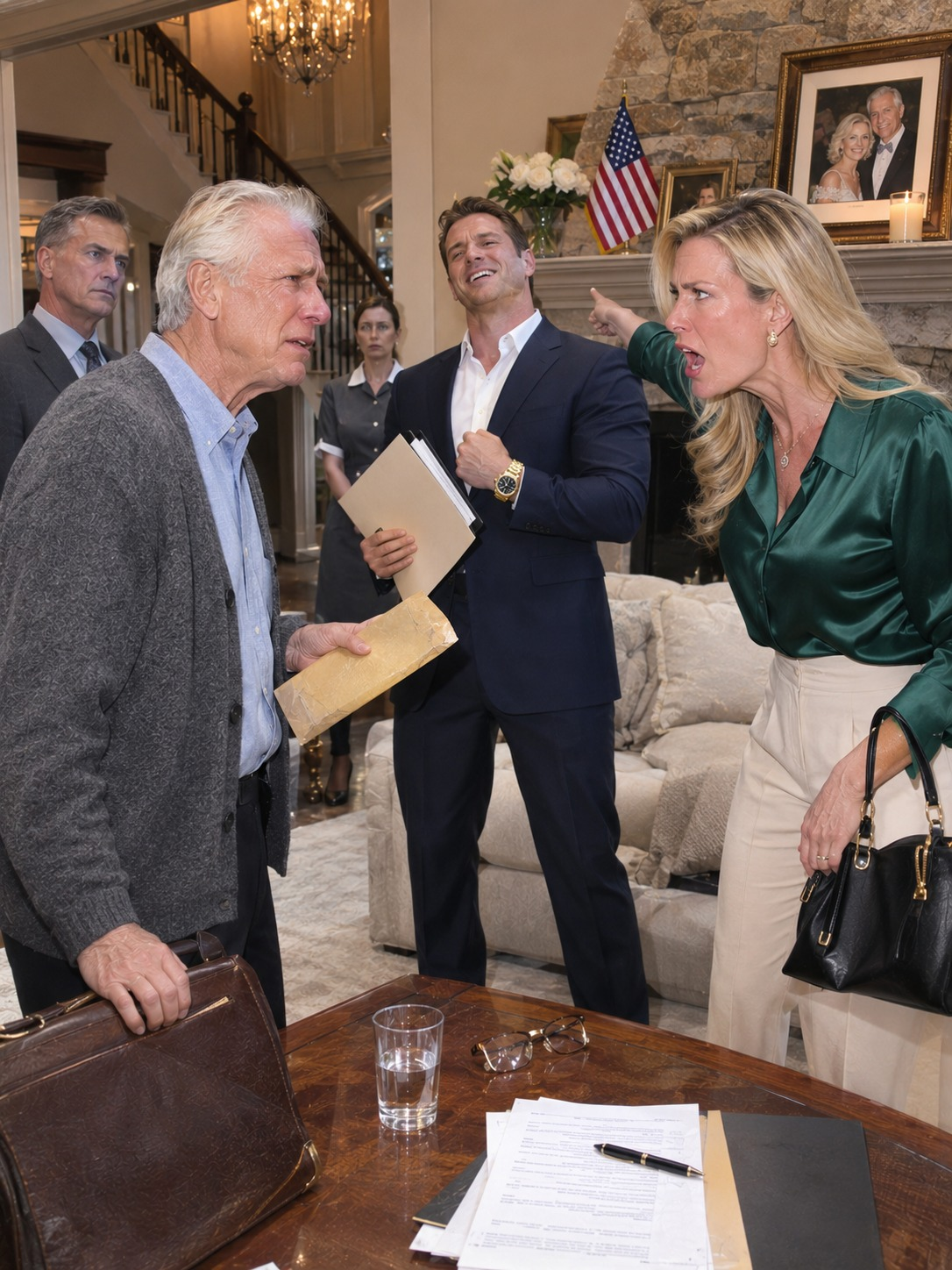
Michael was standing beside the fireplace when I entered the living room.
He had removed his jacket and rolled up his sleeves.
Rebecca sat on the sofa with her laptop open.
Richard Collins was still there.
That surprised me.
He looked up immediately.
"Thomas."
"Richard."
Michael glanced at me.
"Dad. We thought you'd gone to bed."
"It's six-thirty."
He gave a short laugh.
"Right. Of course."
Rebecca barely looked away from her screen.
"We're discussing the estate."
"I gathered that."
Michael walked toward the coffee table.
"Actually, it's good you're here. We need to talk about the house."
Richard closed the folder in front of him.
"Michael, I already advised that any discussion about occupancy should wait until the relevant documents have been reviewed."
Michael waved a hand.
"We're just having a family conversation."
I looked at him.
"Then let's have one."
Rebecca finally raised her eyes.
"We don't want this to become emotional."
I almost smiled.
My wife had been dead for three weeks.
My children had spent the afternoon dividing her fortune.
And my daughter was worried that I might become emotional.
"What do you want to discuss?" I asked.
Michael sat down.
"Rebecca and I have been reviewing the property's expenses. The maintenance costs are substantial."
"I know what the maintenance costs are."
"Of course. But now that Mom's gone, we have to think differently."
"Why?"
He frowned.
"Because the estate structure has changed."
Richard spoke quietly.
"That does not automatically determine Thomas's right to remain here."
Rebecca sighed.
"Richard, we're not evicting him tonight."
I looked at her.
"How generous."
Her face tightened.
"Dad, please don't start."
I remained standing.
Michael leaned forward.
"Look, nobody wants to hurt you. But this house is too much for one person. You're seventy-one. You don't need twelve bedrooms and a staff."
"Your mother and I built our lives here."
"Memories aren't a financial plan."
The sentence was delivered so casually that it took me a moment to absorb it.
I studied my son.
"Is that what you think?"
"What?"
"That memories don't matter?"
He rubbed his forehead.
"Dad, that's not what I said."
"It's exactly what you said."
Rebecca closed her laptop.
"Michael is trying to be practical."
I looked at her.
"Did either of you visit your mother during her final week?"
Silence.
Michael's expression changed.
"Dad, don't do that."
"Do what?"
"Use Mom's death to make us feel guilty."
I stared at him.
"She asked for you."
He looked away.
"She knew I was busy."
"She asked for both of you."
Rebecca crossed her arms.
"I called the hospital."
"Twice."
"That's unfair."
"She was dying, Rebecca."
Her eyes flashed.
"And what exactly were we supposed to do? Sit there and watch? We had responsibilities."
I felt the old familiar ache return.
Not anger.
Something heavier.
"You had a mother."
Rebecca looked down.
Michael stood abruptly.
"Enough."
I turned toward him.
He pointed toward the hallway.
"You're not going to stand here and accuse us of not loving Mom."
"I didn't say you didn't love her."
"That's what you're implying."
"I said she asked for you."
He opened his mouth.
Then closed it.
Richard rose from his chair.
"I think we should conclude the meeting."
Michael looked irritated.
"We're not finished."
"I am," Richard said.
His tone was firm enough to surprise everyone.
He gathered his papers.
"Before anyone makes decisions regarding the property, the ownership records, estate documents, and any applicable occupancy rights must be reviewed. I strongly advise against pressuring Thomas to leave."
Rebecca looked at him.
"Are you saying we can't sell the house?"
"I'm saying you should not assume the answer before examining the complete legal situation."
Michael gave a humorless laugh.
"Everything has to be complicated with lawyers."
Richard did not respond.
He placed the folders in his case.
Then he turned toward me.
"Thomas, may I speak with you privately before I leave?"
Michael's eyes narrowed.
"About what?"
Richard looked at him.
"A matter concerning your father."
Rebecca sat upright.
"Is there another inheritance document?"
Richard's expression remained neutral.
"I have professional obligations regarding confidential matters."
Michael glanced at me.
For the first time that afternoon, I noticed something besides arrogance in his face.
Suspicion.
It lasted only a second.
Then he smiled.
"Fine. Have your private conversation."
Richard walked toward the front hallway.
I followed.
When we reached the door, he lowered his voice.
"Thomas, are you all right?"
I looked at him.
"No."
He nodded.
"I understand."
"Do you?"
He hesitated.
Then he said, "I knew Eleanor for twenty-three years. I know how much she valued you."
I felt my throat tighten.
"Then why did she leave me an envelope?"
Richard studied me carefully.
"Have you opened it?"
"Yes."
His expression changed almost imperceptibly.
"Then I imagine you have questions."
"Quite a few."
He glanced toward the living room.
"Have you spoken with anyone about its contents?"
I hesitated.
"Why?"
"Because Eleanor was very specific about the confidentiality of certain arrangements."
I looked directly at him.
"Richard, did you know about the trust?"
He did not answer immediately.
Then he said, "I was aware that separate estate-planning arrangements existed. I was not the attorney responsible for administering all of them."
"Why didn't you tell me?"
"Because the envelope was intended to direct you to the appropriate people, and because I was bound by the instructions governing the information I could disclose."
I considered that.
"Do Michael and Rebecca know?"
"Not from me."
"Could they?"
He paused.
"Thomas, you should speak with William Prescott tomorrow."
My heart gave a small jolt.
"You know William?"
"Yes."
"He's expecting me at nine."
Richard nodded.
"Good."
I lowered my voice.
"Someone sent me a photograph of a blue folder tonight."
Richard became very still.
"What did you say?"
"A message. From an unknown number."
"Did it mention anything else?"
"Michael. Something he signed."
Richard looked toward the living room.
Then back at me.
"Do not forward that message to anyone until its source has been verified."
"Why?"
"Because you don't know who sent it or what they want."
That was sensible.
But his expression suggested something more.
"Richard," I said, "is my son in trouble?"
He took a slow breath.
"I cannot answer questions about documents I have not reviewed."
"That's not what I asked."
"I know."
He placed a hand on my shoulder.
"Thomas, whatever you discover tomorrow, take your time before acting. Eleanor trusted your judgment."
Then he opened the front door.
Before stepping outside, he turned back.
"And keep the original envelope somewhere secure."
I watched him leave.
When I returned to the living room, Michael was pouring himself a drink.
Rebecca was standing beside the mantel.
Both looked at me.
"Well?" Michael asked.
"Well what?"
"What did Richard want?"
"To see whether I was all right."
Michael snorted.
"That was worth a private meeting?"
I didn't answer.
Rebecca studied my face.
"Did Mom leave you something else?"
I felt the envelope against my chest.
"Why do you ask?"
She shrugged.
"Richard was acting strangely."
"Perhaps he was uncomfortable with how you treated me."
Her expression hardened.
"Are we going to keep having this conversation?"
"No."
"Good."
I started toward the stairs.
Michael spoke behind me.
"Dad."
I stopped.
"We're not trying to push you out."
I turned.
"Then what are you trying to do?"
He looked at Rebecca.
Then back at me.
"We're trying to make sure everyone moves forward."
I nodded slowly.
"Everyone?"
"Yes."
"Or just the two of you?"
His jaw tightened.
"That's unfair."
I almost laughed.
Unfair.
That word had become remarkably popular in our family.
It was unfair when I mentioned their mother's final week.
Unfair when I questioned their plans for the house.
Unfair when I refused to accept their version of events.
But apparently, telling a grieving father that he had inherited nothing and should find somewhere else to live was simply practical.
I looked at my son.
"Michael, do you remember the year your mother almost lost her first company?"
He frowned.
"What?"
"1998."
He shrugged.
"Vaguely."
"You were young."
"What's your point?"
"Do you remember how we kept the factory open?"
He looked impatient.
"Mom refinanced. She found investors. She did what business owners do."
I studied him.
"Is that what she told you?"
"That's what happened."
"Not entirely."
Rebecca sighed.
"Dad, please. We don't need another story about the old days."
I turned toward her.
"Do you know where the money came from?"
She looked at Michael.
Then back at me.
"Why does that matter now?"
I could have told them.
I could have explained about my father's land.
About the sale.
About the nights I spent repairing industrial equipment after working a full day at my engineering job.
About the mortgage payments I delayed so Eleanor could keep her employees.
But something stopped me.
Perhaps it was Eleanor's note.
Perhaps it was Richard's warning.
Or perhaps I finally understood that people who had spent years refusing to see my contributions were unlikely to appreciate them because I made one more speech.
So I simply said, "It matters to me."
Michael shook his head.
"Whatever you say, Dad."
I walked upstairs.
This time, I did not look back.
At eight-thirty, Margaret knocked on my bedroom door.
"Mr. Bennett?"
"Come in."
She entered carrying a tray.
A bowl of soup.
Two slices of bread.
A cup of tea.
I stared at it.
"Margaret, you didn't have to do that."
"I know."
She placed the tray on the small table near the window.
Then she hesitated.
"May I say something?"
"Of course."
Her eyes filled with emotion.
"Mrs. Bennett would have been very upset by what happened downstairs."
I looked away.
"Yes. I think she would."
Margaret folded her hands.
"I worked for your wife for seventeen years. She spoke about you constantly."
I smiled faintly.
"Usually to complain that I left my shoes in the hallway."
Margaret laughed softly.
"Sometimes."
Then her expression became serious.
"But mostly she talked about how much you helped her."
I looked at her.
"She did?"
"All the time."
I felt something tighten in my chest.
Margaret continued.
"She used to say that everyone saw the companies, the properties, and the money. But nobody saw the man who made it possible for her to keep going."
I lowered my eyes.
"That sounds like Eleanor."
Margaret hesitated again.
Then she said, "There was something she told me last year."
I looked up.
"What?"
"She said that if anything happened to her, I should make sure you weren't left alone with people who wanted something from you."
A chill passed through me.
"She said that?"
Margaret nodded.
"She was very serious."
I thought about the trust.
The envelope.
The unknown message.
"Did she mention Michael or Rebecca?"
Margaret looked uncomfortable.
"Not by name."
I waited.
Then she added, "But she looked toward the family photographs when she said it."
For a moment, neither of us spoke.
Finally, I thanked her.
She moved toward the door.
Then stopped.
"Mr. Bennett?"
"Yes?"
"Please don't leave this house just because someone tells you that you don't belong here."
My eyes filled.
"Thank you, Margaret."
She nodded.
Then quietly closed the door.
I ate the soup.
It was the first proper meal I had managed since the funeral.
And for reasons I could not explain, that simple kindness nearly made me cry again.
Later that evening, I returned to Eleanor's desk.
It stood in a small alcove connected to our bedroom.
She had used it for personal correspondence, family photographs, and the occasional business document she wanted to review at home.
I had avoided touching it since her death.
Now I opened the top drawer.
Inside were neatly arranged pens, stationery, and envelopes.
A small calendar lay beneath a leather notebook.
I turned through its pages.
Most entries were ordinary.
Doctor appointments.
Birthdays.
Lunches with friends.
But several dates from the previous year contained only initials.
W.P.
R.C.
And once, beside a date in October, a single word.
Protection.
I stared at it.
William Prescott.
Richard Collins.
I could not be certain, but the initials seemed too familiar to ignore.
I turned another page.
There was a note in Eleanor's handwriting.
Thomas must have time to understand before anyone pressures him.
My breath caught.
She had anticipated pressure.
Not merely disappointment.
Not simply an argument about inheritance.
Pressure.
I sat down.
For years, Eleanor had been telling me that our children were becoming careless with money.
Michael had repeatedly pushed for larger loans to expand the manufacturing businesses.
Rebecca had taken on increasingly ambitious real estate projects.
Both insisted that debt was a normal part of building wealth.
Eleanor had sometimes disagreed.
I remembered one dinner when Michael announced plans to acquire a struggling supplier.
He claimed the deal would double production capacity.
Eleanor asked how he intended to finance it.
"Debt," he replied.
"What kind?"
"Private lending."
"At what rate?"
He gave her a number.
Eleanor set down her fork.
"That's too expensive."
Michael shrugged.
"It's manageable."
"Only if everything goes right."
"Mom, you can't build a business by being afraid of risk."
She looked at him for a long moment.
"There's a difference between taking a risk and making someone else responsible for the consequences."
Michael rolled his eyes.
I had assumed it was an ordinary disagreement.
Now I wondered whether that conversation had been connected to the loans held by Eleanor's trust.
I closed the calendar.
Then I noticed a narrow compartment beneath the desk drawer.
It had always been there.
Eleanor used to keep stamps inside it.
I pulled it open.
There were no stamps.
Only a small folded note.
It was addressed to me.
Thomas, if you ever begin to doubt yourself, remember that I knew what you sacrificed. I knew about the land. I knew about the factory repairs. I knew about the years you worked two jobs without telling anyone. You thought I didn't notice. I noticed everything.
I pressed the paper against my chest.
For several seconds, I could not see clearly.
Then I continued reading.
You never asked me to repay you. That is why I wanted to make sure you would never have to ask anyone else for permission to live with dignity.
I closed my eyes.
The room seemed painfully quiet.
I remembered 1998.
Not the version Michael knew.
The real version.
The year our savings disappeared.
The year Eleanor cried because thirty-seven employees might lose their jobs.
The year I drove three hours to meet a buyer for my father's land.
My father had left me that property because he believed it would someday give me security.
It was the only significant asset I had inherited.
I sold it without hesitation.
When Eleanor discovered what I had done, she was furious.
Not because she wanted the land.
Because she knew what it meant to me.
"Thomas, that was your father's."
"I know."
"You should have talked to me."
"You would have told me not to do it."
"Of course I would."
"Then we would have spent another week arguing while the factory fell apart."
She cried.
I held her.
And I told her that the land had served its purpose.
It had protected our family.
I never regretted selling it.
Not once.
But now, twenty-eight years later, I was beginning to understand that Eleanor had spent a long time remembering a sacrifice I considered ordinary.
I folded the note carefully.
Then my phone vibrated.
Another message.
The same unknown number.
I opened it immediately.
"Mr. Bennett, I apologize for the earlier message. I could not finish it safely."
I stared at the screen.
A second message appeared.
"The document Michael signed in 2022 was not an ordinary business agreement."
My heart began pounding.
I typed:
"What was it?"
The response came almost immediately.
"A personal certification connected to one of the trust's largest loans."
I frowned.
"What did he certify?"
Three dots appeared.
Then disappeared.
I waited.
Another message arrived.
"He certified that certain financial information was complete and accurate. Your wife later discovered discrepancies."
I sat upright.
"Are you saying Michael lied?"
The answer took longer.
"I am saying the records need to be reviewed before anyone makes accusations."
That sounded cautious.
Professional.
Almost like something Richard would say.
I typed again.
"Who are you?"
This time, the response came quickly.
"Someone who worked with Eleanor on the records."
I stared at the words.
"Then why won't you tell me your name?"
No response.
I waited.
Finally, the phone vibrated again.
"Because I don't know who has access to your phone or your house."
I looked toward the bedroom door.
For the first time, I became aware of how vulnerable I was.
Michael and Rebecca were downstairs.
They had access to the household.
They knew my routines.
They believed I was powerless.
And someone was warning me not to trust the situation.
I typed:
"What should I do?"
The answer appeared.
"Meet William Prescott tomorrow. Ask for the blue folder. Do not sign anything your children give you tonight."
I read that final sentence several times.
Then I heard footsteps in the hallway.
I quickly locked my phone.
A knock sounded at the door.
"Dad?"
Michael.
I placed Eleanor's notes inside the desk drawer.
"Come in."
He entered carrying a glass of water.
His expression was different now.
Less arrogant.
Almost friendly.
"Thought you might want this."
He placed the glass on the bedside table.
"Thank you."
He looked around the room.
His eyes lingered on Eleanor's desk.
Then on the envelope lying beside me.
"Still going through Mom's things?"
"A little."
He nodded.
"Must be hard."
"It is."
He sat in the chair near the window.
For a moment, neither of us spoke.
Then he leaned forward.
"Dad, I've been thinking about what happened earlier."
I looked at him.
"Have you?"
"Yeah."
He rubbed his hands together.
"Rebecca gets carried away. You know how she is."
I waited.
"She shouldn't have shouted at you."
"You're right."
He nodded.
"And I probably shouldn't have laughed."
I studied his face.
It was not quite an apology.
But it was closer than anything he had offered that afternoon.
"I appreciate you saying that."
He smiled.
"Of course."
Then his expression changed.
"Actually, there's something I wanted to ask you."
I felt a small tightening in my stomach.
"What is it?"
He reached into his jacket pocket.
And removed a folded document.
"I need your signature on something."
I looked at the paper.
"What kind of document?"
"Just an acknowledgment related to the estate."
"Richard didn't mention it."
"Richard handles the legal side. This is more of an administrative form."
He unfolded the paper.
I could see several paragraphs of dense text.
A signature line waited at the bottom.
"What's it for?" I asked.
Michael smiled.
"It confirms that you're satisfied with the inheritance arrangements and won't challenge the distributions."
I stared at him.
He continued.
"It's standard. It protects everyone from unnecessary complications."
I looked at the document again.
"Why do you need it tonight?"
He shrugged.
"Efficiency."
I said nothing.
He pushed the paper toward me.
"Come on, Dad. We both know Mom wanted Rebecca and me to run the businesses."
"That may be true."
"Then there's no reason not to sign."
I looked into my son's eyes.
And suddenly, I remembered the message.
Do not sign anything your children give you tonight.
I slowly folded my hands.
"Michael, I'm not signing anything without Richard reviewing it."
His smile faded.
"Richard already knows about the estate."
"Then he won't mind reviewing one more document."
"Dad, it's a simple acknowledgment."
"Then it can wait."
His jaw tightened.
For a moment, I saw the same expression he had worn downstairs.
The impatience.
The entitlement.
The belief that my hesitation was an inconvenience.
Then he forced a smile.
"Fine."
He folded the document.
"No big deal."
But his voice had changed.
He stood.
"Get some rest."
"I will."
He moved toward the door.
Then stopped.
Without turning around, he asked, "Dad, did Mom ever talk to you about a private trust?"
My heart seemed to stop.
I kept my voice steady.
"Why do you ask?"
He turned.
"Just something I heard."
"From whom?"
He shrugged.
"People."
I looked at him.
"Your mother handled a lot of financial matters."
"Right."
He studied my face.
Then smiled again.
"Forget I asked."
He left.
I waited until his footsteps disappeared.
Then I stood and locked the bedroom door.
My hands were shaking.
Michael knew something.
Perhaps not everything.
But enough to ask about a private trust.
Enough to bring me a document that might have affected my rights.
Enough to make the unknown sender's warning feel terribly real.
I picked up my phone.
There was one more message.
"Did Michael bring you a document?"
I stared at it.
Then typed:
"Yes."
The reply came immediately.
"Do not let him know you have been warned."
I felt cold.
"How did you know?"
No answer.
I typed again.
"Are you inside this house?"
Three dots appeared.
Then disappeared.
I waited.
Finally, the screen lit up.
"No. But someone who was present when Eleanor prepared the original records has been watching what happens to you."
I looked toward the door.
My mind raced.
Richard?
Margaret?
Someone from the bank?
I typed one final question.
"Who witnessed Michael's signature?"
This time, the response was immediate.
"I can show you. Look at the photograph I'm sending."
An image began downloading.
I watched the progress indicator.
The picture opened slowly.
First, I saw the edge of a conference table.
Then a legal document.
Then Michael's signature.
Below it was a second signature.
The witness.
I enlarged the image.
My fingers went numb.
I recognized the handwriting.
Before I could read the printed name beneath it, someone knocked on my locked bedroom door.
Three sharp knocks.
Then a woman's voice whispered from the hallway.
"Mr. Bennett, please don't open that photograph. The person who signed as the witness is standing downstairs right now."






Comments 0