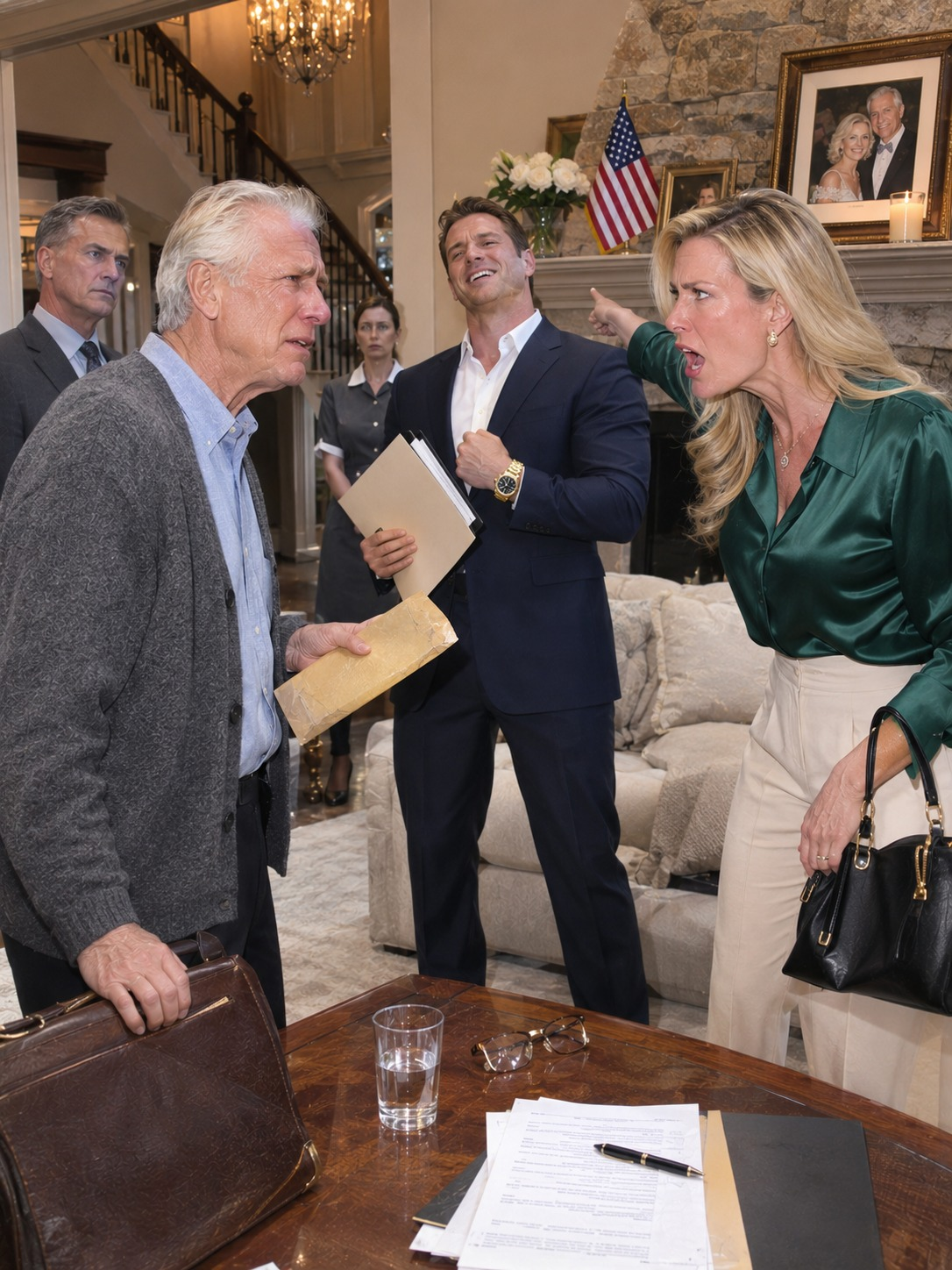
"Mr. Bennett, please don't open that photograph. The person who signed as the witness is standing downstairs right now."
I froze with my phone in my hand.
The woman's voice came from the other side of my locked bedroom door.
It was Margaret.
Our housekeeper had worked for Eleanor and me for seventeen years. She had seen our children grow into adults, attended family celebrations, and helped care for my wife during the final months of her life.
I trusted her.
But the fear in her voice made me wonder whether trusting anyone was still safe.
"Margaret?" I whispered.
"Yes, sir."
"What's happening?"
"Please lower your voice."
I looked toward the photograph on my phone.
Michael's signature was clearly visible on the document.
Below it was the witness's signature.
I had almost enlarged the image enough to read the name.
"Margaret, who is downstairs?"
There was a pause.
Then she whispered, "Someone who wasn't supposed to know about that document."
My heart began pounding.
"Who?"
"Please. Just open the door a little."
I hesitated.
The last time I had trusted someone without asking questions, my own son had tried to persuade me to sign away rights I did not fully understand.
I was not eager to repeat that mistake.
"Are you alone?"
"Yes."
I placed the phone facedown on Eleanor's desk.
Then I crossed the room.
I unlocked the door but kept the chain engaged.
When I opened it a few inches, Margaret stood in the hallway.
Her face was pale.
She glanced toward the staircase.
"Mr. Bennett, we need to talk."
"Then talk."
She swallowed.
"I heard your son speaking on the telephone."
I waited.
"He was angry. He said someone had contacted you about the trust."
A cold sensation spread through my chest.
"Who was he talking to?"
"I don't know. But he mentioned a signature."
I looked at her.
"His signature?"
She shook her head.
"No, sir. Someone else's."
I felt my fingers tighten around the door.
Margaret leaned closer.
"He said, 'If Dad sees who witnessed that document, he'll start asking questions about the hospital.'"
For a moment, I forgot how to breathe.
"The hospital?"
She nodded.
I stared at her.
"What does the hospital have to do with a business loan?"
"I don't know."
"Did he say anything else?"
Margaret looked toward the stairs again.
"He said the witness was downstairs and that they needed to make sure you didn't speak to that person alone."
I felt the blood drain from my face.
"Margaret, who is downstairs?"
She opened her mouth.
Then stopped.
Footsteps sounded at the far end of the hallway.
Margaret immediately straightened.
I heard Rebecca's voice.
"Margaret? What are you doing up here?"
The housekeeper turned.
"Checking whether Mr. Bennett needed anything, ma'am."
Rebecca appeared near the staircase.
She was still wearing her purple silk blouse, but her hair had been pulled back.
Her expression was sharp.
"Dad, why is your door chained?"
I looked at my daughter.
"Because I wanted privacy."
She frowned.
"From us?"
"From everyone."
Rebecca crossed her arms.
"That's a little dramatic."
Margaret lowered her eyes.
Rebecca looked between us.
"Michael wants to speak with you."
"About what?"
"Something important."
"He can speak with me tomorrow."
She sighed.
"Dad, you're making everything unnecessarily difficult."
I had heard that accusation several times in the past twenty-four hours.
It was becoming a familiar response whenever I declined to do exactly what my children wanted.
"Then tomorrow will be difficult too," I said.
Rebecca stared at me.
For a moment, she seemed genuinely surprised.
Then her expression hardened.
"Fine."
She turned toward Margaret.
"Come downstairs. We have guests."
Guests.
At nearly ten o'clock at night.
Three weeks after Eleanor's funeral.
I looked at Margaret.
She gave me the smallest possible nod.
Then she followed Rebecca down the hallway.
I closed the door.
Locked it.
And returned to my phone.
The photograph was still open.
I enlarged the lower portion.
Michael Bennett.
His signature was unmistakable.
Beneath it was another line.
Witnessed by:
The printed name was partially obscured by a dark mark.
But the signature above it was visible.
I recognized the first letter.
An R.
Then a sweeping curve.
The handwriting looked familiar.
Painfully familiar.
I stared at it for several seconds before realizing why.
I had seen that same distinctive curve on documents Richard Collins had signed.
But Richard's handwriting was not unusual enough to prove anything.
And a photograph sent by an anonymous person was not evidence I could safely rely on.
I remembered Richard's warning.
Do not forward that message to anyone until its source has been verified.
I locked my phone.
Then I sat beside Eleanor's empty pillow.
For the first time that evening, I understood how carefully I needed to proceed.
If the documents were genuine, they could reveal serious problems inside Michael's businesses.
If they were false, someone might be trying to manipulate me.
Either possibility was dangerous.
And I had no intention of allowing grief to make my decisions for me.
I barely slept.
Every time I closed my eyes, I saw Eleanor sitting beside me in the hospital.
Her thin fingers wrapped around mine.
Her voice asking me to promise that I would never question the value of my love.
I remembered the final week of her life.
The nurses had told me she was becoming weaker.
There were moments when she seemed perfectly aware of everything around her.
Other moments when speaking exhausted her.
One afternoon, she asked me to bring her favorite blue cardigan from home.
I drove back to the mansion, found it folded neatly in her closet, and returned to the hospital.
When I entered her room, she was speaking with a woman I did not recognize.
The woman wore a gray business suit and carried a dark leather portfolio.
She stood when she saw me.
"Oh, I'm sorry," I said. "I didn't realize Eleanor had a visitor."
My wife smiled.
"Thomas, sweetheart. You're back."
The woman gathered her papers.
"We've finished everything, Mrs. Bennett."
Eleanor nodded.
"Thank you."
The woman turned toward me.
"Your wife is a remarkable person, Mr. Bennett."
I smiled politely.
"I've been telling people that for forty-six years."
She laughed softly.
Then she left.
I never asked who she was.
At the time, I assumed she was another business associate.
Eleanor had continued handling certain financial matters even during her illness.
Now I wondered whether that visitor had been connected to the trust.
Or to the documents someone was sending me.
I remembered another detail.
After the woman left, Eleanor had asked me to sit beside her.
"Thomas, do you remember when we almost lost the factory?"
"Of course."
"Do you remember what you told me?"
"That we'd figure something out."
She shook her head.
"No. Before that."
I thought for a moment.
Then I smiled.
"I told you that if we lost everything, we'd build it again."
Her eyes filled with tears.
"Yes."
I kissed her forehead.
"Why are you thinking about that?"
She looked toward the window.
"Because I finally understand what you gave me."
I laughed gently.
"Eleanor, we gave each other everything."
She turned back toward me.
"That's what I want you to remember."
I had thought she was speaking about love.
Now I was beginning to understand that she had been speaking about something else as well.
Protection.
Independence.
Dignity.
And perhaps the future she feared our children would create after she was gone.
At seven the following morning, I dressed carefully.
I chose a clean light-blue shirt, charcoal trousers, and the gray cardigan Eleanor had bought me for my seventieth birthday.
She used to say it made me look distinguished.
I looked in the mirror.
I saw an old man with tired eyes.
A man who had spent three weeks grieving.
A man whose children had begun discussing his departure from the family home before their mother's belongings had even been packed away.
But I also saw someone who had survived difficult years before.
I had helped Eleanor rebuild a company from the edge of bankruptcy.
I had raised two children.
I had worked hard, paid my obligations, and kept promises even when doing so cost me something.
I was not helpless.
I had simply forgotten that for a while.
I placed the original envelope in my briefcase.
I added Eleanor's handwritten note and the small calendar I had found in her desk.
Then I photographed the relevant pages for my own records.
I left the original documents in a locked compartment inside the briefcase.
Before leaving the bedroom, I looked at Eleanor's photograph.
"I don't know what you planned," I whispered. "But I'm going to understand it."
I touched the frame.
Then I went downstairs.
Michael was in the kitchen.
He stood beside the counter drinking coffee and looking at his phone.
Rebecca sat at the breakfast table.
She had changed into a dark business suit.
Both looked up when I entered.
"Morning, Dad," Michael said.
"Good morning."
Rebecca studied my clothes.
"Going somewhere?"
"Yes."
"Where?"
"Into the city."
Michael lowered his coffee cup.
"Why?"
"I have an appointment."
"With whom?"
I looked at him.
"Someone I need to speak with."
Rebecca frowned.
"Dad, we're only asking."
"And I've answered."
Michael gave a small laugh.
"Since when did you become so secretive?"
I poured myself a cup of coffee.
"Since I discovered that everyone in this house seems to have plans for me."
Rebecca looked offended.
"That's unfair."
I took a sip.
"Perhaps."
Michael approached the table.
"Look, about that acknowledgment form last night—"
"I'm not signing it."
He stopped.
"I wasn't going to ask you to."
"Good."
"I was going to explain it."
"Richard can explain it."
Michael's expression tightened.
"Dad, you don't need to involve attorneys in every little thing."
I looked directly at him.
"Your mother involved attorneys in almost everything."
"That was business."
"So is this."
For a moment, neither of my children spoke.
Then Rebecca leaned forward.
"Have you been talking to someone about the estate?"
I set down my coffee.
"Why?"
"Because you're acting differently."
I studied her.
"How should I be acting?"
She hesitated.
"You're usually more cooperative."
The words settled between us.
More cooperative.
That was how she described me.
Not patient.
Not generous.
Not considerate.
Cooperative.
I picked up my briefcase.
"I'll be back later."
Michael stepped slightly toward the doorway.
"Dad, wait."
I stopped.
His eyes moved toward the briefcase.
"Are you taking Mom's envelope somewhere?"
I felt my pulse quicken.
"Why would that concern you?"
He shrugged.
"Just curious."
"Then you'll have to remain curious."
I walked past him.
He did not stop me.
But as I reached the front door, I heard Rebecca whisper something.
I could not make out the words.
Then Michael answered.
"Let him go. We'll find out."
I kept walking.
The drive into Philadelphia took a little over forty minutes.
I had made that journey hundreds of times with Eleanor.
Sometimes we talked about business.
Sometimes we argued about where to have lunch.
Sometimes we sat in comfortable silence while she rested her hand on mine.
That morning, the passenger seat was empty.
I found myself reaching toward it once.
Then I remembered.
The grief came so suddenly that I had to pull into a parking lot.
I sat behind the wheel and cried.
Not for long.
Just long enough to feel the full weight of her absence.
Then I wiped my face, started the car, and continued.
The private banking office occupied several floors of a modern building downtown.
A receptionist greeted me when I entered.
"Mr. Bennett?"
"Yes."
"Mr. Prescott is expecting you."
She led me to a quiet conference room overlooking the city.
A silver-haired gentleman stood near the window.
He appeared to be in his early sixties.
He wore a dark suit and had the calm manner of someone accustomed to handling sensitive financial matters.
"Mr. Bennett," he said, extending his hand. "I'm William Prescott."
"Thomas, please."
"Thomas."
We shook hands.
His expression softened.
"Before we begin, I'm very sorry about Eleanor."
"Thank you."
"She was an extraordinary woman."
I looked toward the window.
"She was."
William gestured toward a chair.
"Please sit."
A glass of water and a neatly arranged stack of documents waited on the table.
Beside them lay a thick navy-blue folder.
I recognized it immediately.
It looked exactly like the one in the anonymous photograph.
William noticed my gaze.
"I imagine you have many questions."
"More than I know how to ask."
He nodded.
"Then let's start with the most important one."
He opened the folder.
"Your wife established a private trust more than twenty years ago. She funded it through investments and assets separate from the businesses distributed under her will."
I stared at him.
"Twenty years?"
"Yes."
"She never told me."
"She wanted the arrangement to remain private until the appropriate time."
"Why?"
William folded his hands.
"Because she believed you had spent much of your life placing everyone else's financial security ahead of your own."
I looked down.
"That's what families do."
"That is what you did."
His answer surprised me.
William continued.
"Eleanor spoke about you often."
I smiled sadly.
"Everyone keeps telling me that."
"Then perhaps you should believe us."
I looked at him.
He opened the first section.
There were investment statements.
Ownership records.
Historical account summaries.
Documents concerning technology investments, commercial lending arrangements, and other financial assets Eleanor had acquired personally over the years.
William explained that she had begun investing through separate arrangements long before her illness.
Some investments had grown significantly.
Others had been sold and reinvested.
The trust had also acquired interests in a private lending entity.
Everything had been documented.
Everything had been structured with professional assistance.
I stared at the figures.
"How much is actually there?"
William turned a statement toward me.
"The current reported value is approximately sixty-three million, four hundred thousand dollars."
I looked at the number.
Even seeing it printed did not make it feel real.
$63,400,000.
I had spent the previous afternoon listening to my children laugh because they believed I had received nothing.
Now I was sitting in a conference room looking at a financial arrangement larger than the inheritance they had celebrated.
"Is all of this mine?" I asked.
William answered carefully.
"You are the designated beneficiary and successor trustee under the governing documents. The trust's assets are held and administered according to its terms. Upon Eleanor's death, the relevant succession provisions became effective."
I nodded slowly.
"So I have control?"
"You have substantial authority, subject to the trust documents, fiduciary duties, and applicable law."
I appreciated the precision.
Eleanor would have too.
She hated vague promises.
William continued.
"Your wife amended the trust last year to strengthen your authority and provide clear instructions for administration after her death."
"Why last year?"
He hesitated.
"Because she became concerned about the possibility of financial pressure from family members."
I felt my chest tighten.
"Michael and Rebecca."
William did not immediately answer.
Then he said, "Eleanor was worried that certain people might try to influence your decisions before you understood your rights."
I looked at him.
"She knew."
He lowered his eyes.
"She anticipated the possibility."
For several seconds, I said nothing.
Then I asked the question that had been troubling me since the previous evening.
"Did she believe our children would try to throw me out of our home?"
William's expression became serious.
"Thomas, I cannot tell you exactly what Eleanor believed would happen. But I can tell you she wanted your housing situation and financial independence protected."
I looked away.
The city stretched beyond the windows.
Cars moved through the streets below.
People walked toward offices and restaurants.
The world continued as though nothing extraordinary had happened.
But my entire understanding of my marriage was changing.
Eleanor had not merely left me money.
She had spent years making sure that I would never have to depend on the goodwill of people who might not show me any.
I pressed my hands together.
"Why didn't she just tell me?"
William considered the question.
"She wrote something about that."
He reached into the folder and removed a sealed envelope.
My name was written across the front.
Eleanor's handwriting.
Again.
My throat tightened.
"She left another letter?"
"Yes."
I accepted it.
The paper felt heavier than it should have.
"Would you like privacy?" William asked.
I nodded.
He stood.
"I'll give you a few minutes."
When he left, I carefully opened the envelope.
Inside was a handwritten letter.
My dearest Thomas,
If you are reading this, then I have gone somewhere you cannot follow me yet.
My eyes filled immediately.
I continued.
I know you will be hurting. I know you will miss our ordinary mornings, our little arguments about the thermostat, and the way I always stole the last bite of dessert from your plate.
I laughed through my tears.
She had done that for forty-six years.
I wish I could hold your hand one more time.
I stopped reading.
For several moments, I simply held the paper against my chest.
Then I continued.
There is something I should have told you long ago.
You spent your life believing that the things you did for me were ordinary acts of love. You sold your father's land when my company was failing. You repaired machines after working full days. You stayed home with our children when I traveled. You gave up opportunities because you believed my dreams were worth protecting.
You never kept score.
But I did.
Tears rolled down my face.
Not because I believed love should be measured in dollars.
Because I knew the world would measure my success that way, and I never wanted anyone to convince you that your contribution had been smaller simply because it was harder to see.
I wiped my eyes.
I built this trust because I wanted you to have choices.
I wanted you to wake up each morning knowing that no one could threaten your security or make you feel like a guest in the life we built together.
I also know our children may disappoint you.
My hands tightened.
I have watched Michael become increasingly reckless with money. I have watched Rebecca confuse ownership with authority. I tried to teach them gratitude, but somewhere along the way, I allowed success to become entitlement.
That failure belongs partly to me.
I shook my head.
"Eleanor, no."
But the letter continued.
The trust is not a weapon.
It is protection.
If you discover that our children have made serious mistakes, do not act out of anger. Understand the facts. Listen carefully. Protect what is rightfully yours, but do not become cruel simply because someone has been cruel to you.
I paused.
That sounded exactly like her.
Even when she was furious, Eleanor never confused revenge with good business.
And Thomas, please remember one thing.
You were never standing behind me.
You were the foundation beneath everything I built.
Love always,
Eleanor.
I lowered the letter.
Then I cried.
Not quietly.
Not politely.
I cried the way a man cries when he realizes that the person he loved most had understood him more deeply than he ever knew.
For forty-six years, I had believed I was simply doing my part.
Eleanor had seen every sacrifice.
Every difficult decision.
Every night I came home exhausted.
Every opportunity I declined.
Every time I chose our family over myself.
She had remembered.
And now, even after her death, she was still trying to protect me.
William returned several minutes later.
I had folded the letter carefully and placed it inside my briefcase.
He looked at my face.
"Would you like more time?"
"No."
"Are you certain?"
I nodded.
"I want to understand everything."
He sat down.
"Then we should discuss the lending arrangements."
I straightened.
"The loans connected to my children?"
"Yes."
William opened another section of the folder.
He showed me corporate names.
Loan dates.
Outstanding balances.
Repayment schedules.
Security agreements.
Financial reporting requirements.
I recognized two names immediately.
Bennett Advanced Manufacturing.
Bennett Residential Holdings.
Michael's company.
Rebecca's company.
William pointed toward a summary.
"Over the past eight years, these businesses entered into several borrowing arrangements with a private lending entity owned by Eleanor's trust."
I stared at the figures.
"The trust lent money to our children?"
"To businesses associated with them, yes."
"How much?"
"The outstanding principal and accrued interest currently total approximately eighteen million, six hundred thousand dollars."
I leaned back.
Eighteen point six million.
I repeated the number silently.
My children had inherited ownership interests in businesses worth millions.
But those businesses carried substantial obligations to a lender connected to the trust Eleanor had placed under my control.
"Does that mean they owe me the money?"
William shook his head slightly.
"The legal obligations are owed to the lending entity. Your authority over the trust gives you an important role in decisions concerning those assets, but everything must be handled according to the governing documents and applicable law."
I nodded.
"What happens if they can't repay?"
"That depends on the individual agreements, collateral, repayment schedules, and financial condition of the borrowers."
"Could they lose the companies?"
"In certain circumstances, lenders may have lawful remedies involving pledged assets or other contractual protections. But that is not a conclusion we can reach without a complete review."
I looked at him.
"Eleanor knew about these loans?"
"Yes."
"Did Michael and Rebecca know the lender belonged to her trust?"
William hesitated.
"They were provided with documents identifying the relevant lending entities. Whether they understood the ultimate ownership structure is something we would need to establish."
I thought about Michael's question the previous evening.
Did Mom ever talk to you about a private trust?
He knew something.
Perhaps more than he had admitted.
I looked toward the navy-blue folder.
"William, someone sent me a photograph last night."
His expression changed.
"What photograph?"
"A loan document. Michael's signature. And a witness."
William became very still.
"Who sent it?"
"I don't know."
"May I see it?"
I took out my phone.
Opened the message.
And handed it to him.
He examined the photograph carefully.
Then he enlarged the lower portion.
His expression tightened.
"Thomas, where did you get this?"
"An unknown number."
"When?"
"Last night."
He looked at the image again.
Then he set the phone on the table.
"Have you shown this to anyone else?"
"No."
"Good."
I leaned forward.
"William, who witnessed my son's signature?"
He did not answer.
Instead, he opened the navy-blue folder and searched through several pages.
Then he stopped.
He looked at the photograph.
Then at the original records.
His face had become noticeably pale.
"Thomas," he said slowly, "there is something unusual about this document."
"What?"
"The witness information in your photograph does not match the version maintained in our official file."
I stared at him.
"What does that mean?"
"It means we need to establish which document is authentic and why the versions differ."
My heart began pounding.
"Are you saying someone changed it?"
"I'm saying the discrepancy requires investigation."
He closed the folder.
Then reached for the telephone on the conference table.
"I need our legal department to review this immediately."
I watched him dial.
He spoke quietly.
Asked for a senior attorney.
Then requested that certain records be preserved.
I could not hear the entire conversation.
But I heard one phrase clearly.
"Potentially inconsistent execution records."
When he ended the call, he looked at me.
"Thomas, before we go any further, I need to ask you something."
"Anything."
"During Eleanor's final months, did anyone ask you to sign documents on her behalf?"
I frowned.
"No."
"Did anyone ask you to authorize transfers?"
"No."
"Did Michael or Rebecca ever request access to Eleanor's private financial records?"
I thought carefully.
"Michael asked me once whether Mom had given me authority over her accounts."
"When?"
"About two months before she died."
"What did you tell him?"
"That Eleanor handled her own affairs."
William nodded slowly.
"And Rebecca?"
I hesitated.
"She asked whether Eleanor had updated her estate documents."
"When?"
"A few weeks before the funeral."
William looked down.
I felt a chill.
"Why are you asking?"
He opened a smaller file.
"Because Eleanor made a notation concerning attempts to obtain information about the trust."
I stared at him.
"What notation?"
He turned the page toward me.
There, in Eleanor's handwriting, were three short lines.
Michael requested lender ownership information.
Rebecca asked about beneficiary changes.
Do not release confidential records without proper authorization.
I felt sick.
My children had been asking questions while their mother was dying.
Questions about money.
Questions about ownership.
Questions about what would happen after she was gone.
I looked at William.
"Did Eleanor believe they were trying to take something?"
He answered carefully.
"She was concerned enough to document the inquiries."
I lowered my head.
For several moments, I could not speak.
Then I remembered Margaret's warning.
The hospital.
The witness.
The person downstairs.
I looked up sharply.
"William, there's something else."
He waited.
"Last night, Margaret heard Michael talking about the witness. He mentioned the hospital."
William's expression changed.
"The hospital?"
"Yes."
"Are you certain?"
"That's what she told me."
He looked toward the folder.
Then back at me.
"Thomas, did Eleanor receive any visitors from our office during her final hospitalization?"
I remembered the woman in the gray suit.
The leather portfolio.
The conversation I had interrupted.
"Yes," I said.
"Who?"
"I don't know her name."
"Can you describe her?"
I did.
William listened without interrupting.
When I finished, he sat very still.
Then he asked, "Did she have dark hair?"
"Yes."
"Shoulder length?"
"I believe so."
He looked troubled.
"Did she carry a dark brown portfolio with a brass clasp?"
I stared at him.
"Yes."
William slowly closed his eyes.
"Thomas, I need to make another call."
Before he could reach for the telephone, his mobile phone vibrated.
He looked at the screen.
His expression changed immediately.
He answered.
"Prescott."
I watched him listen.
His face grew tense.
"What do you mean, the file was accessed?"
A pause.
"When?"
Another pause.
"Who authorized it?"
He stood abruptly.
"Do not release anything. Preserve the access logs. I'm coming down."
He ended the call.
I rose from my chair.
"William, what's happening?"
He looked toward the conference room door.
Then back at me.
"Someone accessed a restricted section of Eleanor's trust records this morning."
My mouth went dry.
"Who?"
"We're verifying that."
"Does it involve Michael?"
"I don't know."
He gathered the documents.
"Thomas, I want you to remain here for a few minutes."
"Why?"
"Because the restricted section contains records your wife specifically instructed us to protect."
I looked at the navy-blue folder.
"What records?"
William hesitated.
Then he spoke quietly.
"Records concerning the circumstances under which certain documents were signed during her final hospitalization."
My heart began pounding.
Before I could ask another question, someone knocked on the conference room door.
William turned.
"Yes?"
The door opened.
A young bank employee stood outside.
Her face was pale.
"Mr. Prescott, I'm sorry to interrupt."
"What is it?"
She looked at me.
Then back at William.
"The woman who accessed the restricted file is downstairs."
William went completely still.
"Are you certain?"
"Yes, sir."
"Did security identify her?"
The employee swallowed.
"Yes."
William stepped toward the door.
"Who is she?"
The employee lowered her voice.
"Sir, she's asking to see Mr. Bennett. She says she was with Mrs. Bennett at the hospital when the final documents were signed."
I felt the room tilt.
William looked at me.
Then the employee added one final sentence.
"She also says the witness signature in the blue folder belongs to someone Mr. Bennett has trusted for more than twenty years."
William slowly turned toward the folder.
His hand moved to the sealed section.
He broke the security seal.
Inside was a single document.
He unfolded it.
His eyes moved to the signature line.
Then he looked at me with an expression I had never seen on a banker before.
"Thomas," he whispered, "the witness named on this document is..."






Comments 0