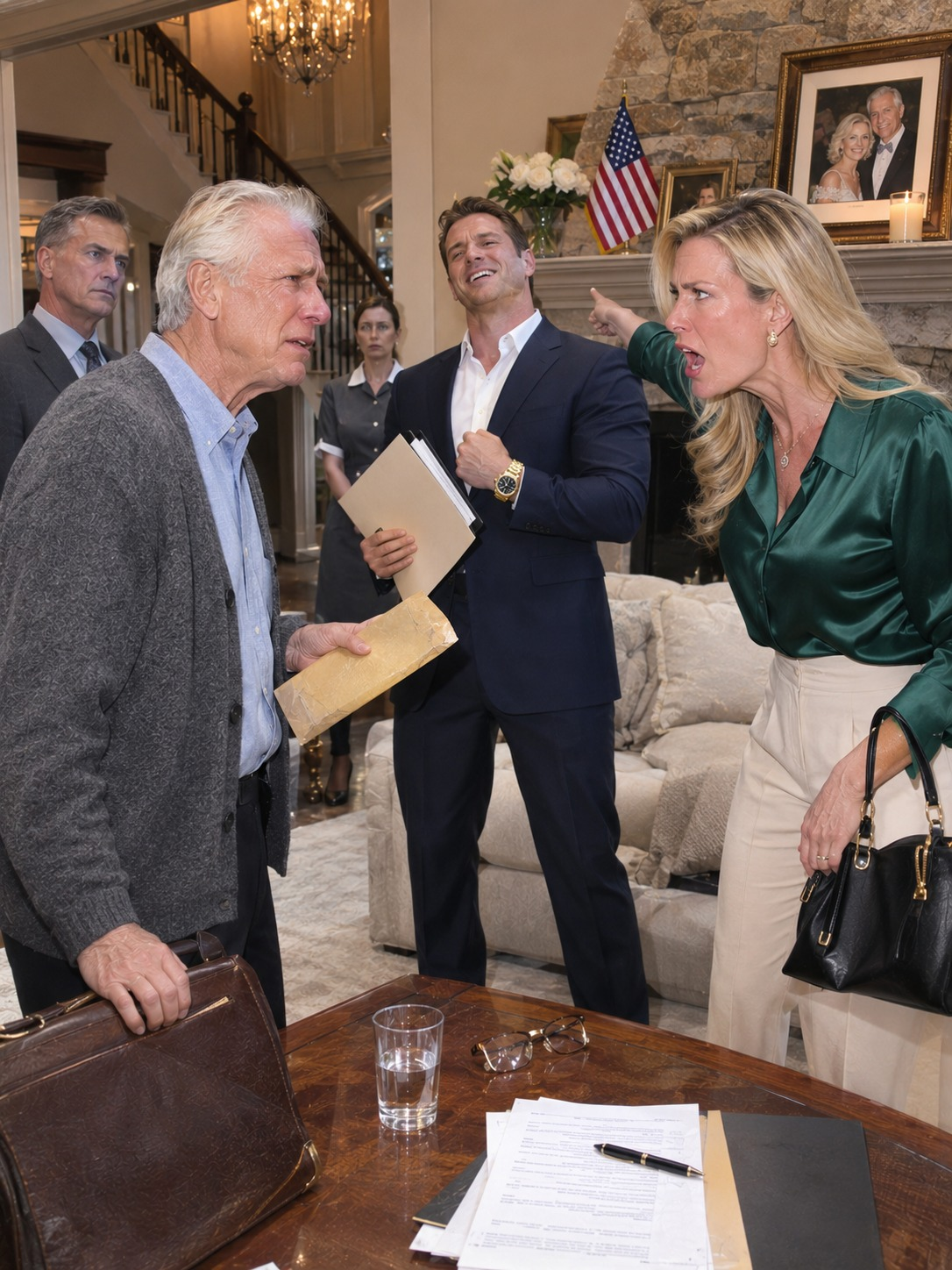
"THAT'S IMPOSSIBLE! SHE WASN'T SUPPOSED TO BE INVOLVED!"
Michael's shout echoed through the living room.
Richard Collins stood beside the coffee table, holding the document Eleanor had signed during the final week of her life.
My daughter stared at her brother.
I stared at the name printed beneath the authorization clause.
Catherine Brooks.
The attorney I had met only hours earlier.
The woman who had calmly explained that I should never sign anything without understanding my rights.
The woman who had warned me not to leave my home simply because my children demanded it.
Eleanor had named her as an independent legal protector of certain property arrangements.
And somehow, my son already knew who she was.
I slowly raised my eyes.
"Michael, how do you know Catherine Brooks?"
His face changed.
For the first time since Eleanor's funeral, I saw something that looked remarkably like fear.
"I don't," he answered too quickly.
I looked at Richard.
Then back at my son.
"You just said she wasn't supposed to be involved."
Michael glanced toward Rebecca.
"That's not what I meant."
"Then what did you mean?"
He rubbed his forehead.
"Dad, you're taking everything out of context."
I had heard that phrase before.
Usually from people who wanted to escape the meaning of something they had said.
I remained standing beside the table.
"Then give me the context."
Michael looked toward Richard.
"Can you explain this before Dad starts making accusations?"
Richard did not move.
"Michael, Thomas asked you a reasonable question."
My son stared at him.
For several seconds, nobody spoke.
Then Rebecca stepped forward.
"Can someone please explain why a woman we've never heard of has anything to do with our mother's house?"
Richard carefully placed the document on the table.
"Because Eleanor established an additional arrangement concerning the residence."
I looked down.
The document referred to a residential property protection agreement connected to a separate trust arrangement.
Catherine Brooks had been designated as independent legal counsel whose written review and approval would be required before certain transactions involving the mansion could proceed.
Richard continued.
"The document appears to impose restrictions on the sale or transfer of the property while Thomas remains entitled to occupy it. We need to review the complete title history and related instruments before reaching final conclusions."
Rebecca folded her arms.
"So we inherited a house we can't sell?"
"That is not a conclusion I'm prepared to make yet," Richard replied.
Michael gave a bitter laugh.
"Mom really thought of everything."
I looked at him.
"She usually did."
He turned toward me.
"Dad, you don't understand what this means."
"Then explain it."
He gestured toward the papers.
"It means we could be stuck maintaining an enormous property while you live here indefinitely."
I studied my son.
"Yesterday, you told me I should find a reasonably priced place to stay."
He looked away.
"That was before we knew about these restrictions."
"Before you knew I might have rights."
His jaw tightened.
Rebecca interrupted.
"Dad, nobody is saying you don't have rights."
I turned toward her.
"You shouted that this house belonged to you and Michael."
She opened her mouth.
Then closed it.
"You told me your mother hadn't left me a cent."
"That was before—"
"Before you saw the trust statement?"
Silence.
I looked at the paper lying between us.
Sixty-three million, four hundred thousand dollars.
The number had changed everything.
Not because I had suddenly become a different man.
But because my children were beginning to realize that the man they had dismissed might possess financial authority they could not ignore.
I looked at Michael.
"Now answer my question. How do you know Catherine Brooks?"
He took a slow breath.
"Because Mom mentioned her."
"When?"
"Last year."
"Why?"
He hesitated.
"She said Catherine was helping with some estate planning."
I considered that.
It was possible.
Eleanor had been increasingly concerned about the future during her final year.
But Michael's reaction suggested he knew more.
"Then why did you say she wasn't supposed to be involved?"
He looked directly at me.
"Because Mom told me the arrangement was supposed to remain private."
Richard's expression changed.
"Michael, privacy is not the same as exclusion."
My son gave him an angry look.
"You're supposed to be our family attorney."
Richard answered calmly.
"I have professional obligations to the clients I represent and to the law. Those obligations do not disappear because someone is unhappy with the documents."
I almost smiled.
Eleanor would have appreciated that answer.
Michael did not.
He turned away and walked toward the fireplace.
For several seconds, he stared at our wedding photograph.
Then he spoke without looking at me.
"Mom never trusted me."
The words surprised me.
I had expected another argument.
Another demand.
Another attempt to dismiss what I had discovered.
Instead, my son sounded wounded.
I looked at him.
"That's not true."
He laughed bitterly.
"Really? She gave me a company and then made sure I couldn't make a move without someone watching."
"She gave you ownership interests in two businesses worth millions."
"With strings attached."
"With responsibilities."
He turned.
"You always take her side."
I felt something tighten in my chest.
"Michael, your mother is dead."
He looked away.
I continued quietly.
"I'm not taking sides. I'm trying to understand what she left behind."
Rebecca picked up the trust summary.
"Sixty-three million dollars," she whispered.
I looked at her.
She stared at the number as though it were written in a language she had never seen.
Then she raised her eyes.
"Dad, did you know about this before Mom died?"
"No."
"Not even a little?"
"No."
She looked toward Richard.
"Did you?"
Richard answered carefully.
"I knew Eleanor had separate planning arrangements. I did not administer every component."
Rebecca looked back at me.
"So she hid more money from us than she gave us."
I felt a sharp pain in my chest.
"She didn't hide it from you because it belonged to you."
Rebecca stared.
"What?"
I spoke slowly.
"Your mother had the right to decide what happened to her own assets."
"Of course she did."
"Then why are you speaking as though she stole something from you?"
Her expression hardened.
"That's not what I'm saying."
"Then what are you saying?"
She looked at Michael.
Then back at me.
"I just don't understand why she would leave you so much."
The room became very quiet.
I looked at my daughter.
Forty-six years.
Forty-six years of marriage.
Two children.
A lifetime of sacrifices.
And she could not understand why Eleanor might have wanted to provide for her husband.
I felt something inside me settle.
Not anger.
Not bitterness.
A kind of clarity.
I nodded.
"That tells me more than you realize."
Rebecca frowned.
"Dad—"
I raised one hand.
"Enough."
She stopped.
I turned toward Richard.
"I want copies of the documents. I want Catherine to review them. And I don't want anyone making decisions about the house until the legal position is clear."
Richard nodded.
"That's sensible."
Michael turned sharply.
"And what about the businesses?"
I looked at him.
"What about them?"
He glanced toward the trust statement.
"Are you planning to interfere?"
I studied his face.
"Why would you think that?"
"Because you're suddenly asking questions about financing."
I did not answer immediately.
Then I said, "Perhaps you should tell me what you're worried about."
His expression changed.
And for the first time, I understood that the inheritance meeting had not merely disappointed my children.
It had frightened them.
They just hadn't realized it yet.
Richard stayed for another twenty minutes.
He explained that the property documents required further review and that the financial arrangements connected to Eleanor's trust should be handled separately.
He also made it clear that Michael's proposed acknowledgment form needed independent examination before I considered signing anything.
Michael was visibly irritated.
Rebecca remained unusually quiet.
When Richard finally prepared to leave, I followed him into the hallway.
"Richard."
He turned.
"Yes, Thomas?"
"Did Eleanor ask Catherine Brooks to protect me?"
He considered the question.
"She retained Catherine for certain independent matters. The document suggests that Eleanor wanted an additional safeguard concerning the residence."
I looked toward the living room.
"She knew our children might try to push me out."
Richard's expression softened.
"She was concerned about that possibility."
I lowered my head.
"Why didn't she tell me?"
"Perhaps because she wanted your final months together to be about your marriage rather than legal arrangements."
I looked at him.
That sounded like Eleanor.
Even when she was frightened, she had tried to protect me from worry.
Richard continued.
"Thomas, there's something I want you to understand."
"What?"
"Your wife never described you as financially dependent."
I felt my throat tighten.
"Then how did she describe me?"
He smiled sadly.
"As the person who made it possible for her to take risks she could never have taken alone."
I looked away.
For a moment, I could not speak.
Then Richard added, "And she was very clear that you should never be pressured into giving up your rights simply to keep peace in the family."
I nodded slowly.
"Thank you."
He placed a hand on my shoulder.
"Get some rest. You've had a difficult two days."
I almost laughed.
Difficult did not begin to describe it.
But I thanked him.
Then I watched him leave.
That evening, I ate dinner alone.
Margaret brought me a plate of roasted chicken and vegetables.
She placed it on the small table beside Eleanor's favorite chair.
"Would you like anything else, Mr. Bennett?"
"No, thank you."
She hesitated.
"Your children are having dinner in the dining room."
"I know."
She looked uncomfortable.
"Mr. Michael asked me whether you had spoken with anyone at the bank."
I set down my fork.
"What did you tell him?"
"That I didn't know."
I nodded.
"Good."
Margaret lowered her voice.
"He seemed upset."
"He's had a difficult day."
She looked at me.
Then said quietly, "So have you."
I smiled faintly.
"Yes."
She started toward the door.
Then stopped.
"Mrs. Bennett used to say something about you."
I looked up.
"What?"
"She said you were the only person she knew who could be surrounded by people shouting and still make the room feel calm."
I laughed softly.
"She was exaggerating."
Margaret shook her head.
"No, sir."
Then she left.
I looked toward Eleanor's photograph.
I wished she were there.
Not because I needed her to solve the problem.
Because I wanted to tell her everything.
I wanted to hear her laugh at Michael's expression when he saw the trust statement.
I wanted to ask why she had kept so much from me.
And I wanted to tell her that I finally understood what she had meant when she asked me never to question the value of my love.
But the room remained silent.
I finished my dinner.
Then I went upstairs.
At eight-thirty, Catherine Brooks called.
"Thomas?"
"Yes."
"It's Catherine."
"Hello."
"I've reviewed the preliminary documents William sent over."
I sat down.
"Is everything all right?"
"There are several matters we need to discuss."
My stomach tightened.
"That doesn't sound reassuring."
She gave a small, sympathetic laugh.
"It isn't necessarily bad news. But the situation is more complicated than the inheritance meeting suggested."
I looked toward Eleanor's envelope.
"Tell me."
"First, the trust's reported assets are substantial and the governing documents appear to provide you with significant authority. We still need to verify the complete holdings and review the terms carefully."
I nodded.
"All right."
"Second, the lending entity owned by the trust has several outstanding commercial loans involving businesses associated with Michael and Rebecca."
"William told me."
"Yes. The current aggregate balance is approximately eighteen million, six hundred thousand dollars."
I closed my eyes.
Hearing the number again made it feel more real.
"How much of that belongs to Michael's companies?"
Catherine consulted her notes.
"Approximately eleven million, two hundred thousand dollars is associated with the manufacturing businesses."
"And Rebecca?"
"Approximately seven million, four hundred thousand dollars is associated with the residential holding entities."
I repeated the figures silently.
Eleven point two million.
Seven point four million.
Eighteen point six million altogether.
"Are the loans overdue?"
"Some are approaching maturity. Others contain reporting requirements and financial covenants that need to be reviewed. We should not assume default without examining the current records."
I nodded.
"What does that mean for me?"
"It means you need accurate information before deciding whether the trust should consider extensions, restructuring, or other lawful options."
I looked down.
"Eleanor said the trust wasn't a weapon."
Catherine paused.
"That sounds consistent with what I've seen in her instructions."
"She wanted me to understand the facts."
"Exactly."
I took a slow breath.
"Then I want a complete review."
"That's what I recommend."
She continued.
"There's another issue."
I straightened.
"What?"
"Several documents contain references to related-party transactions."
I frowned.
"What does that mean?"
"Transactions involving parties who have existing relationships or overlapping interests. They aren't necessarily improper, but they require careful examination."
I thought about Michael.
Rebecca.
Eleanor.
The family businesses.
"Are you saying someone moved money between the companies?"
"I'm saying there are transactions we need to trace."
My heart began pounding.
"How much?"
"We don't know the full amount yet."
I stared at the wall.
Then I asked, "Did Eleanor know?"
Catherine hesitated.
"She appears to have identified some of the same questions before her death."
I closed my eyes.
Of course she had.
Eleanor had spent decades reading financial statements.
She could spot an inconsistency faster than most accountants.
If something was wrong, she would have noticed.
And if she had noticed, she would have wanted answers.
Catherine continued.
"Thomas, I want to ask you something."
"Go ahead."
"Did Michael ever tell you that one of his companies was having trouble meeting its obligations?"
I thought carefully.
"No."
"Did Rebecca mention financial pressure involving the apartment complexes?"
"No."
"Did either of them ask Eleanor for additional money during her illness?"
I hesitated.
Then I remembered something.
A conversation from the previous spring.
Michael had visited the mansion on a Sunday afternoon.
He and Eleanor spent nearly an hour in her office.
When he left, he looked furious.
I found Eleanor sitting at her desk.
She was staring at a financial report.
"Everything all right?" I asked.
She looked up.
"Michael wants another extension."
"On what?"
"A financing arrangement."
"Is it serious?"
She sighed.
"It could become serious if he keeps treating borrowed money like income."
I sat beside her.
"Can you help him?"
She looked at me.
"Helping him isn't the problem."
"What is?"
"Making sure he understands that help comes with responsibility."
I remembered her expression.
Not angry.
Disappointed.
I told Catherine about the conversation.
She listened carefully.
"That may be relevant."
I swallowed.
"Did Eleanor refuse the extension?"
"I don't know yet."
I looked toward the window.
The city lights were visible beyond the trees.
For years, I had assumed Michael's confidence reflected financial success.
Now I was beginning to wonder whether it had been hiding financial pressure.
Catherine continued.
"There's one more thing I want to emphasize."
"What?"
"Do not confront your children with allegations about the loans until the records have been reviewed."
"I wasn't planning to."
"Good. And don't make promises about forgiving or restructuring debts. Those decisions must be evaluated under the trust's terms and your fiduciary responsibilities."
I nodded.
"I understand."
She paused.
"Thomas, Eleanor left you substantial protection. But she also left you responsibilities."
I looked at her name on my phone.
"I know."
"You're not required to solve everything tonight."
I smiled sadly.
"That's what everyone keeps telling me."
"Because it's true."
I thanked her.
Then I ended the call.
For several minutes, I sat in silence.
The numbers repeated in my mind.
$63.4 million.
$18.6 million.
$11.2 million.
$7.4 million.
My children had celebrated inheriting more than forty million dollars.
But they had inherited businesses carrying obligations they could not simply ignore.
And the lender connected to those obligations belonged to the trust Eleanor had placed under my authority.
The balance of power had changed.
I just wasn't sure my children understood how much.
The next morning, I received a call from William Prescott.
"Thomas, we've completed a preliminary review of the loan schedule."
I sat at Eleanor's desk.
"What did you find?"
"Several payments have been made as required, but there are upcoming maturities and reporting obligations that deserve attention."
"How soon?"
"One of the manufacturing loans has a significant payment due within the next several weeks."
I felt my stomach tighten.
"How significant?"
"Approximately three million dollars, including amounts scheduled under the relevant agreement."
I stared at the desk.
"Can Michael pay it?"
"We don't yet have sufficient verified information to answer that."
I looked toward the bedroom door.
Michael had spent the previous evening drinking expensive bourbon and complaining about the trust.
Now I was learning that one of his businesses might face a major payment obligation.
"Did Eleanor know this was coming?"
"She had reviewed the maturity schedule."
I nodded slowly.
"Of course."
William continued.
"She also requested that no extension be approved automatically without updated financial information."
I closed my eyes.
That was important.
Eleanor had not instructed the trust to destroy Michael.
She had instructed it to insist on responsible financial management.
I looked at the photograph of us outside the factory.
"William, can I ask you something?"
"Certainly."
"Did Eleanor ever say she regretted helping our children?"
He was quiet for a moment.
Then he answered.
"She said she regretted allowing them to believe that help would always be available without conditions."
I lowered my head.
That sounded painfully familiar.
I had spent years doing the same thing.
When Michael needed money for a car, I helped.
When Rebecca wanted to move into a more expensive apartment, Eleanor helped.
When they made mistakes, we protected them from the consequences.
We told ourselves we were being loving parents.
Perhaps we had been.
But perhaps we had also taught them that someone else would always absorb the cost.
William continued.
"Your wife believed they were capable of running successful businesses. She wanted them to prove it."
I nodded.
"Then that's what we'll ask them to do."
"With proper review and professional guidance."
"Yes."
I ended the call.
Then I sat back.
For the first time since Eleanor's death, I felt a small sense of purpose.
I could not bring her back.
I could not erase what my children had said.
But I could honor the care she had taken.
I could protect the trust.
I could insist on honesty.
And perhaps, if Michael and Rebecca were willing to change, I could help them understand what their mother had spent her life trying to teach them.
I knew that was a hopeful thought.
But I was still their father.
Hope was not something I could simply turn off.
At noon, Michael knocked on my bedroom door.
"Dad?"
"Come in."
He entered wearing a navy sweater and dark trousers.
His expression was unusually serious.
"Can we talk?"
I gestured toward the chair.
"Of course."
He sat down.
For a moment, he looked almost like the boy who used to come to me when he had done something wrong.
I waited.
Finally, he spoke.
"Rebecca and I have been talking."
I nodded.
"About what?"
"The trust."
I remained silent.
He leaned forward.
"Dad, I want you to understand something. Mom's businesses are complicated."
"I know."
"There are loans, contracts, suppliers, employees. You can't just look at a bank statement and understand everything."
"I agree."
He seemed surprised.
"Good."
I folded my hands.
"That's why I've hired independent professionals to review the documents."
His expression changed.
"You hired people?"
"Yes."
"Who?"
"Attorneys and financial advisers."
He stared at me.
"Dad, that's unnecessary."
"Why?"
"Because I can explain the businesses to you."
I looked at him.
"Then explain the eleven million, two hundred thousand dollars your manufacturing companies owe to the lender connected to Eleanor's trust."
He went completely still.
For several seconds, neither of us spoke.
Then he gave a short laugh.
"Where did you get that number?"
"From the loan records."
He looked away.
"Those are normal business obligations."
"Then you shouldn't mind having them reviewed."
His jaw tightened.
"Dad, you're making this adversarial."
I shook my head.
"No. I'm asking questions."
He stood.
"Mom never would have done this."
I looked at him.
"Your mother arranged the trust."
He stopped.
I continued.
"She also requested a compliance review before extensions were considered."
His face changed.
"She what?"
"She wanted updated financial information."
Michael stared at me.
Then he turned toward the window.
For a moment, I thought he might shout.
Instead, he spoke quietly.
"You don't understand what that could do."
I felt my stomach tighten.
"What could it do?"
He did not answer.
"Michael?"
He turned.
His face was pale.
"Dad, if those lenders start demanding things at the wrong time, it could create serious problems."
I studied him.
"Then tell me what the problems are."
He shook his head.
"It's complicated."
"Then we'll take our time."
He looked at me.
For the first time, his eyes held something that resembled desperation.
"Dad, I need you to trust me."
I felt a sharp ache in my chest.
"Michael, yesterday you asked me to sign a document without explaining it."
He looked away.
"You told me I had no right to stay in my home."
"That was Rebecca."
"You laughed."
He closed his eyes.
I continued quietly.
"Trust isn't something you demand because you're frightened. It's something you earn by telling the truth."
He stared at me.
Then he said something I had not expected.
"Fine."
I waited.
He swallowed.
"Then maybe it's time you knew how bad things really are."
My heart began pounding.
I leaned forward.
"Tell me."
Michael opened his mouth.
Then his phone rang.
He glanced at the screen.
His expression changed immediately.
He stood.
"I have to take this."
"Michael—"
"It's important."
He walked toward the door.
Then stopped.
Without turning around, he said, "Dad, whatever happens next, please remember that I never wanted to hurt you."
I stared at him.
Before I could respond, he left.
I heard his footsteps moving quickly down the hallway.
Then his voice.
Low.
Urgent.
I could not make out the words.
But I heard one sentence clearly.
"No. He knows about the loans."
I stood.
My heart began pounding.
Then my phone vibrated.
A message from Catherine Brooks.
"Thomas, please call me immediately. We've identified a serious discrepancy in the collateral records."
I called her.
She answered at once.
"Catherine?"
"Thomas, are you alone?"
"Yes."
"Good. I need you to listen carefully."
My stomach tightened.
"What happened?"
"We've been reviewing the security documents connected to the manufacturing loans."
"And?"
"One of the collateral schedules includes an asset that may not have belonged to the borrowing company."
I frowned.
"What asset?"
She hesitated.
"The family mansion."
I felt the room tilt.
"Our house?"
"Yes."
I gripped the edge of the desk.
"How is that possible?"
"We don't know yet whether the schedule is valid, whether the property was actually pledged, or whether the entry was an error. But the description matches your residence."
I stared at Eleanor's photograph.
"Did Eleanor authorize it?"
"That's one of the questions we're investigating."
I felt cold.
Catherine continued.
"Thomas, we need to compare the original documents, title records, and signatures before drawing conclusions."
I nodded, though she could not see me.
"All right."
Then she said something that made my heart stop.
"There's a signature on the collateral authorization page."
I swallowed.
"Whose?"
She paused.
"Thomas, the document appears to carry your name."
I stared at the wall.
"My name?"
"Yes."
I shook my head.
"That's impossible."
"Why?"
"Because I never signed anything pledging our home as collateral for Michael's business."
There was a long silence.
Then Catherine spoke.
"That's exactly why we need to examine the original."
My hands began trembling.
I looked toward the bedroom door.
Michael's voice had gone quiet.
The hallway was silent.
I lowered my voice.
"Catherine, what date is on that document?"
She consulted the record.
"October 14, 2022."
The same date as Michael's certification.
The same date Richard had witnessed a signature.
I felt my stomach drop.
"Catherine, who witnessed the authorization?"
She hesitated.
"That's what we're trying to verify."
I closed my eyes.
The pieces were beginning to connect.
The altered witness information.
The hospital records.
The questions Eleanor had asked.
The loan discrepancies.
And now a document that appeared to carry my signature on an authorization I had never given.
I opened my eyes.
"Catherine, I want the truth."
"I know."
"Whatever it is."
"We'll establish what the evidence supports."
Then I heard another voice on her end of the call.
Someone speaking urgently.
Catherine stopped.
"One moment, Thomas."
I waited.
I heard papers moving.
A muffled conversation.
Then silence.
Catherine returned.
Her voice had changed.
"Thomas, we've just received another document."
My heart began pounding.
"What document?"
"A copy of the original collateral authorization."
I gripped the phone.
"And?"
She hesitated.
"The signature is different from the version we were reviewing."
I stared at the desk.
"Different how?"
"The first copy appears to bear your name. The newly received copy contains another signature."
My mouth went dry.
"Whose?"
There was a pause.
Then Catherine said, "Thomas, I need you to come to my office. I don't want to discuss this over the telephone."
I looked toward Eleanor's photograph.
"Catherine, please. Just tell me whether my wife signed it."
She did not answer immediately.
Then she spoke quietly.
"No. Eleanor's signature isn't the one I'm concerned about."
I felt my heart pounding against my ribs.
"Then whose is it?"
Before she could answer, a loud crash came from downstairs.
Glass shattered.
Someone shouted.
I turned toward the bedroom door.
Then I heard Rebecca scream.
"MICHAEL! WHAT HAVE YOU DONE?"
I rushed into the hallway.
At the bottom of the staircase, Michael stood beside the coffee table.
A broken glass lay at his feet.
Rebecca was holding a document.
Her face was white.
Richard Collins had just entered through the front door.
He looked from Rebecca to Michael.
Then toward me.
I hurried down the stairs.
"What happened?"
Rebecca turned.
Her hands were shaking.
"Dad, you need to see this."
Michael stepped toward her.
"Rebecca, don't."
She backed away.
"No. I'm done protecting you."
I stopped halfway down the staircase.
Michael looked up at me.
His face was filled with fear.
"Dad, please. Let me explain."
Rebecca raised the document.
"This is the authorization Michael used to support the loan."
I stared at it.
She pointed toward the signature line.
"And the person who signed it wasn't you."
Michael closed his eyes.
Richard stepped forward.
"Rebecca, put the document on the table."
But she ignored him.
She looked directly at me.
"Dad, the signature belongs to someone who had access to Mom's records during her final illness."
I felt my blood turn cold.
"Who?"
Rebecca opened her mouth.
Then the front doorbell rang.
Richard turned.
Margaret appeared from the hallway.
She looked frightened.
"Mr. Bennett, there's a woman outside asking for you."
I stared at her.
"What woman?"
Margaret swallowed.
"She says she was there when the authorization was signed."
Michael's face went completely pale.
He took one step backward.
"No," he whispered.
Margaret looked toward the front door.
"She says she has the original document."
Richard moved toward the entrance.
But before he reached it, someone knocked three times.
A woman's voice came through the door.
"Thomas Bennett, my name is Laura Whitcomb. Eleanor told me to come if your children tried to use that document."
I stood motionless.
Laura.
The woman from the hospital.
The woman who had helped Eleanor preserve her records.
Michael suddenly grabbed Rebecca's arm.
"Don't open that door."
Rebecca pulled away.
"Why?"
His face twisted with panic.
"Because if she has the original, she'll know who signed it."
I looked at my son.
Then at the door.
Laura knocked again.
This time, her voice was louder.
"Mr. Bennett, please open the door. I have something your wife wanted you to see."
Richard reached for the handle.
Michael shouted.
"WAIT!"
But Richard opened the door.
Laura stood outside holding a sealed dark-gray folder.
Her expression was grave.
She looked past Richard.
Directly at me.
"Thomas," she said, "before you look at the signature, you need to know why Eleanor kept this document hidden."
I stepped forward.
Laura opened the folder.
She removed a single page.
Then turned it toward me.
At the bottom was a signature.
A signature I recognized.
A signature belonging to someone I had trusted for years.
I leaned closer.
My hands began trembling.
And just as I was about to read the printed name beneath it, Michael whispered behind me, "Dad, if you see who signed that, you'll never look at our family the same way again."






Comments 0