"Thomas," William whispered, "the witness named on this document is Richard Collins."
For several seconds, I could not move.
Richard Collins.
The attorney who had handled our family's legal affairs for more than twenty years.
The man who had sat in our living room while my children laughed at the old brown envelope Eleanor left me.
The man who had warned Michael and Rebecca not to pressure me into leaving the mansion.
The man who had quietly told me to protect the envelope and speak with William Prescott.
His name was on the document.
I stared at William.
"That can't be right."
William turned the paper toward me.
Near the bottom was a signature I recognized immediately.
Richard Collins.
Below it was a date.
October 14, 2022.
Beside the signature was a notation identifying Richard as a witness to Michael's execution of a commercial loan certification.
I looked at the document again.
"Richard never told me about this."
William's expression remained serious.
"He may have had legitimate reasons not to discuss confidential client matters with you."
"But he knew Michael had signed something."
"He appears to have witnessed at least one version of the document."
"One version?"
William placed the paper beside the photograph on my phone.
"That's the problem."
I leaned forward.
The documents looked almost identical.
Both carried Michael's signature.
Both referred to the same borrowing arrangement.
Both displayed the same date.
But the witness sections were different.
On the official copy, Richard's name appeared clearly.
On the photograph sent to my phone, the witness's printed name was partly obscured.
And the signatures did not appear to match perfectly.
I felt my stomach tighten.
"Are you saying Richard signed one document and someone changed another?"
"I'm saying we have two records that appear inconsistent. We need to establish their origin before drawing conclusions."
I looked toward the conference room door.
"And the woman downstairs?"
William carefully returned the documents to the folder.
"She may be able to explain how the records were handled."
"Then I want to speak with her."
He hesitated.
"Thomas, I think it would be wise to have our legal counsel present."
I shook my head.
"I've spent the last twenty-four hours discovering that people have been making decisions about my life without telling me. I'm not interested in waiting while everyone else decides what I'm allowed to hear."
William studied me.
Then he nodded.
"All right."
He picked up the conference room telephone.
"Please escort our visitor to the adjoining meeting room. Ask Ms. Hart from legal to join us."
He ended the call.
I looked at him.
"William, do you trust Richard?"
He considered the question carefully.
"I have worked with Richard on several matters. He has a strong professional reputation."
"That wasn't my question."
William folded his hands.
"I have no evidence that Richard acted improperly."
I appreciated the distinction.
But I could not ignore the knot forming in my chest.
Richard had been one of the few people I believed I could trust.
If he had known something important about Michael's financial arrangements, why had he remained silent while my children treated me like an unwanted guest?
Then I remembered his words from the previous evening.
I was aware that separate estate-planning arrangements existed. I was not the attorney responsible for administering all of them.
Perhaps he had been telling the truth.
Perhaps he had been choosing his words carefully because he was protecting confidential information.
Or perhaps there was something else.
Something Eleanor had discovered before she died.
I looked at the blue folder.
"William, what exactly did Michael sign?"
He opened the document again.
"A certification connected to a refinancing arrangement involving Bennett Advanced Manufacturing."
"Was it a loan?"
"The certification supported the lender's review of a loan modification and additional financing. It contained representations about the company's financial condition."
"What kind of representations?"
"That the financial statements provided were complete and accurate in all material respects, that certain liabilities had been disclosed, and that the company was complying with specified obligations."
I frowned.
"And Eleanor discovered discrepancies?"
"Her notes indicate that she had concerns about the information provided."
"Did she confront Michael?"
"I don't know."
I stared at the paper.
My son had spent years presenting himself as a brilliant businessman.
He drove expensive cars.
Wore watches worth more than some families earned in months.
Spoke confidently about acquisitions, expansion, and financial strategy.
But I had never seen him sit at our kitchen table at midnight, trying to decide which supplier could wait another week to be paid.
I had never seen him repair a machine because the company could not afford to replace it.
Michael understood the appearance of success.
I was beginning to wonder whether he understood the responsibilities that came with it.
William closed the folder.
"Thomas, before we speak with the visitor, there's something else you should understand."
I looked up.
"Eleanor did not instruct us to punish your children."
"I know."
"She specifically requested a careful review of the loans, the collateral, and the financial reporting requirements."
"Why?"
"Because she wanted the businesses to remain viable if that could be achieved responsibly."
I nodded slowly.
"She spent her life building them."
"Exactly."
He leaned forward.
"Your wife wanted you protected. But she also wanted you to make informed decisions rather than emotional ones."
I looked down at my hands.
They were trembling slightly.
"I don't want revenge, William."
"I believe you."
"I just want to know why my children looked me in the eye and told me I had no right to stay in the home their mother and I built."
William's expression softened.
"Then perhaps we should begin by understanding what Eleanor knew."
The woman waiting in the adjoining meeting room stood when I entered.
She was in her late forties, with shoulder-length dark hair and tired brown eyes.
She wore a simple gray jacket over a cream blouse.
A dark leather portfolio rested on the table beside her.
I recognized her immediately.
Not from the bank.
From Eleanor's hospital room.
I stopped in the doorway.
"You."
Her eyes filled with recognition.
"Mr. Bennett."
I looked at the portfolio.
The brass clasp.
The worn leather corners.
It was the same one she had carried when I interrupted her conversation with Eleanor during the final months of my wife's life.
"You visited my wife."
She nodded.
"Yes."
"Who are you?"
"My name is Laura Whitcomb."
William gestured toward the chairs.
"Laura is an independent financial records specialist. She assisted Eleanor with document organization and certain confidential reviews."
I looked at her.
"Why didn't Eleanor tell me?"
Laura lowered her eyes.
"She wanted to. More than once."
I felt a sudden ache in my chest.
"Then why didn't she?"
Laura hesitated.
"Because she believed you were already carrying more than enough."
I sat down slowly.
A woman named Ms. Hart, the bank's legal counsel, joined us and introduced herself.
She explained that the discussion would concern records whose authenticity and confidentiality needed to be established.
I barely heard her.
My attention remained on Laura.
"You were with Eleanor at the hospital."
"Yes."
"What were you doing?"
Laura opened her portfolio.
"Your wife asked me to organize certain financial records and preserve copies of documents she believed might become important after her death."
"What documents?"
"Loan agreements. Corporate reports. Correspondence. And records concerning changes requested by people associated with the family businesses."
I looked at her.
"Michael?"
She nodded.
"And Rebecca?"
"Some of the records involve Bennett Residential Holdings."
I leaned back.
The room felt suddenly too warm.
Laura continued.
"Mrs. Bennett was worried that you would be pressured to make decisions before you understood the trust."
"She told you that?"
"Repeatedly."
I stared at her.
"Did she know they would try to remove me from the mansion?"
Laura's expression changed.
"She was concerned about that possibility."
I looked toward William.
He remained silent.
Laura opened a small notebook.
"Your wife asked me to write down something she said during our last meeting."
She turned a page.
Then read aloud.
"If Thomas is ever made to feel like a burden, remind him that he was the reason I could build any of this."
My throat tightened.
Laura looked up.
"She wanted you to know that."
I lowered my head.
For several moments, I could not speak.
Then I whispered, "She should have told me."
Laura's voice softened.
"She believed you would refuse the money if she tried to give it to you while she was alive."
I looked at her.
She gave a sad smile.
"She said you would tell her to spend it on the children."
Despite everything, I laughed.
Because she was right.
That was exactly what I would have said.
Laura placed a small sealed packet on the table.
"This was prepared under Eleanor's instructions. William has the corresponding authorization records."
Ms. Hart examined the packet and the accompanying documentation before allowing Laura to continue.
Inside was a photocopy of an old property deed.
I recognized it immediately.
My father's land.
The parcel I had sold in 1998.
My breath caught.
I had not seen that document in nearly three decades.
I reached for it.
The address.
The parcel number.
The signature.
Everything was familiar.
"Where did Eleanor get this?"
Laura looked at me.
"She kept a copy."
I stared at the paper.
I remembered the day I sold that land.
My father had died several years earlier.
He was a quiet man who believed that owning a little property was the surest way to protect a family from uncertainty.
The land was nothing spectacular.
A few wooded acres outside a small Pennsylvania town.
But he loved it.
He used to take me there on Sunday afternoons.
We would walk along the creek, collect fallen branches, and talk about whatever happened to be troubling me.
When I was sixteen, he told me that the land would someday belong to me.
"Don't sell it just because someone offers you a good price," he said.
"Why not?"
"Because money disappears faster than people think."
I remembered laughing.
He had smiled.
"One day you'll understand."
Years later, when Eleanor's company nearly collapsed, I did understand.
I understood that security mattered.
I understood that my father had wanted to protect me.
And I understood that the woman I loved was terrified of losing everything she had worked to build.
So I sold the land.
I used the proceeds to help Eleanor negotiate with creditors and keep the factory operating.
I never told my children the details.
They were young.
And I did not want them growing up believing their mother had failed.
I wanted them to remember her as strong.
Capable.
Determined.
But Eleanor had remembered the land.
Laura placed another document beside the deed.
It was a handwritten note from my wife.
Thomas gave up the one inheritance his father left him so that I could keep my dream alive.
I pressed my lips together.
Below that sentence, Eleanor had written:
I will never let his sacrifice be forgotten.
I closed my eyes.
For a moment, I could almost hear her voice.
The voice that had called me sweetheart when we were young.
The voice that had encouraged me when I worried about providing for our family.
The voice that had whispered my name in the hospital.
I opened my eyes.
"Did she keep records of everything?"
Laura nodded.
"She kept records of the major contributions you made during the early years."
"Why?"
"Because she believed the history of the businesses had become distorted."
I looked at her.
"Distorted?"
"Your children often described Eleanor as having built the empire entirely on her own."
I gave a tired smile.
"She did most of the visible work."
"Your wife disagreed with the idea that visible work was the only work that mattered."
Laura turned another page.
There were copies of old invoices.
Repair records.
Bank statements.
Letters from suppliers.
Even a photograph of me standing beside a machine at Eleanor's first factory.
I was forty-three in the picture.
My hair was dark.
My sleeves were rolled up.
There was grease on my cheek.
I remembered the day.
One of the production machines had failed.
A technician had quoted a repair price we could not afford.
I spent most of the weekend diagnosing the problem.
By Monday morning, the machine was operating again.
Eleanor had taken the photograph.
I had forgotten it existed.
Laura pointed toward a note on the back.
Thomas saved us again.
My eyes filled.
I looked at William.
"She kept all of this?"
He nodded.
"She considered it part of the history of the business."
I stared at the photograph.
Then I whispered, "I thought nobody remembered."
Laura shook her head.
"She remembered."
After a while, Ms. Hart redirected the conversation toward the disputed documents.
She asked Laura to explain how she had obtained the copies in her portfolio.
Laura described her work for Eleanor and identified the records she had been authorized to preserve.
She also explained that she had not personally witnessed Michael signing the 2022 certification.
That detail mattered.
I had been so frightened by the anonymous photograph that I had begun treating every possibility as fact.
But Laura was careful.
She distinguished what she had seen from what she had been told.
She did not accuse Michael of fraud.
She did not accuse Richard of misconduct.
She simply explained that Eleanor had asked for a comparison of several versions of the same financial documents.
"Why?" I asked.
Laura looked toward William.
Then back at me.
"Because certain numbers appeared to change between versions."
"What numbers?"
"Liabilities, projected revenue, and information concerning collateral."
I frowned.
"Could those changes have been legitimate?"
"Some changes may have been corrections or updates. Others were not explained in the materials I reviewed."
Ms. Hart nodded.
"That's why an independent review is necessary."
I looked at Laura.
"Did Eleanor believe Michael was hiding something?"
Laura hesitated.
"She believed there were questions he needed to answer."
I sat back.
That sounded like Eleanor.
She never liked making accusations without evidence.
Even when she suspected someone had been dishonest, she insisted on understanding the facts.
I remembered a factory manager who had once been accused of stealing inventory.
Everyone wanted him fired.
Eleanor refused.
She ordered an audit.
The audit revealed that the inventory system had been recording damaged goods incorrectly.
The manager had done nothing wrong.
Afterward, she told me, "A suspicion isn't a fact just because someone repeats it loudly enough."
I had never forgotten that.
Now I realized I needed to apply the same principle to my own son.
No matter how cruelly he had treated me.
No matter how much I wanted an explanation.
I could not confuse my hurt with proof.
I looked at William.
"What happens next?"
He opened a legal pad.
"First, we preserve the records. Second, we conduct a compliance review of the relevant loans. Third, we establish whether any reporting discrepancies exist and whether they are material under the agreements."
"And the trust?"
"You will receive a complete explanation of your responsibilities and authority. We will also arrange independent legal advice for you regarding any conflicts of interest."
I nodded.
"Good."
Laura looked relieved.
Then she reached into her portfolio again.
"There's one more thing Eleanor wanted you to have."
She removed a small blue envelope.
My name was written across the front.
I almost laughed.
Another envelope.
Eleanor had apparently decided that paper was the best way to continue speaking to me after she was gone.
I accepted it.
Inside was a single photograph.
Eleanor and me.
Taken in 1998.
We were standing outside the first factory.
She had her arm around my waist.
I was holding a toolbox.
Both of us were smiling.
On the back, she had written:
The year we almost lost everything.
Below that:
The year I learned what real wealth meant.
I stared at the photograph.
Then I turned it over again.
There was another sentence.
Thomas, when the time comes, remember that our children are not the businesses.
I read it twice.
Our children are not the businesses.
I looked at William.
"What did she mean?"
He considered the words.
"I can't interpret Eleanor's personal intentions with certainty. But she often spoke about separating family relationships from financial decisions."
I nodded slowly.
I understood.
Or at least I was beginning to.
Michael and Rebecca were my children.
I loved them.
Even after everything.
But their businesses were legal entities with obligations.
Those obligations could not simply disappear because they were family.
And I could not allow my children to use our relationship to pressure me into decisions that might harm the trust.
Eleanor had understood that long before I did.
By noon, William had arranged for me to meet an independent attorney experienced in trusts and commercial lending.
Her name was Catherine Brooks.
She was in her early fifties, with short dark hair and a direct manner that reminded me of Eleanor.
She listened carefully while William explained the basic situation.
Then she turned toward me.
"Mr. Bennett, I want to make one thing clear."
"Please."
"You do not have to make any major decisions today."
I nodded.
"That's a relief."
"Your first responsibility is to understand the documents, preserve records, and avoid being pressured into signing anything you haven't reviewed."
I thought of Michael standing in my bedroom with the acknowledgment form.
"I've already been asked to sign something."
Catherine's expression sharpened.
"What?"
I explained.
She asked me to describe the document as precisely as I could.
I told her it appeared to be an acknowledgment of the estate distributions and a waiver of certain potential claims.
She made notes.
"Did you sign it?"
"No."
"Good. If you obtain a copy, let us review it. We shouldn't assume its legal effect without seeing the language."
I nodded.
She continued.
"Also, the fact that you are a beneficiary and successor trustee does not mean you can treat trust assets as personal cash without regard to the trust's terms."
"I understand."
"Good. Eleanor appears to have structured this carefully. We should honor that care."
I smiled faintly.
"She would have liked you."
Catherine returned the smile.
"I'll take that as a compliment."
Then she asked about the mansion.
I explained what Michael and Rebecca had said.
She listened without interrupting.
When I finished, she leaned back.
"We need to review the title records, the will, and any relevant trust or occupancy provisions before determining who has what rights."
"Could they force me out?"
"I won't speculate before reviewing the documents. But you should not leave merely because someone demands it."
I felt a weight lift slightly from my shoulders.
For the first time since Eleanor died, someone was treating me as a person with rights rather than an obstacle to someone else's plans.
Catherine continued.
"If anyone threatens you, pressures you to sign documents, or attempts to interfere with your access to personal belongings, document what happens and contact us."
I nodded.
Then I asked the question that had been troubling me all morning.
"What if Michael and Rebecca really have made serious financial mistakes?"
Catherine studied me.
"Then we address the facts and the legal obligations. We don't punish them for hurting your feelings, and we don't excuse misconduct because they're your children."
I looked down.
"That's what Eleanor would have said."
"Then she gave you good advice."
When I left the bank that afternoon, I felt exhausted.
Not physically.
Emotionally.
I had spent hours listening to financial explanations, reviewing documents, and learning about arrangements Eleanor had built over more than twenty years.
The trust was real.
The assets were substantial.
The loans were documented.
And the questions surrounding Michael's financial reporting were serious enough to require professional review.
But the thing I carried most carefully was not a bank statement.
It was the photograph of Eleanor and me outside the factory in 1998.
I sat in my car and looked at it.
For a moment, I was forty-three again.
Eleanor was thirty-nine.
We were exhausted.
We were frightened.
But we believed in each other.
I remembered the night after the factory finally received enough money to keep operating.
Eleanor came home carrying a grocery bag.
Inside were two inexpensive steaks and a small bottle of sparkling cider.
"We're celebrating," she announced.
I laughed.
"Can we afford to?"
"Probably not."
She cooked dinner.
We ate at the kitchen table.
Michael and Rebecca were asleep upstairs.
Afterward, Eleanor took my hand.
"Someday," she said, "I'm going to make sure you never have to worry about money again."
I smiled.
"Eleanor, I don't need to be rich."
"I know."
"Then why are you so determined?"
She looked at me.
"Because I want you to have the freedom you've given me."
At the time, I thought she was speaking romantically.
I had no idea she would spend the next twenty-eight years turning that promise into something real.
I placed the photograph inside my briefcase.
Then I started the car.
On the drive home, my phone rang.
Michael.
I let it ring.
A minute later, he called again.
Then Rebecca.
I pulled into a parking lot and checked my messages.
Michael had written:
"Dad, where are you? We need to discuss something important."
Rebecca's message was more direct.
"Please come home immediately. Richard is here."
I stared at the screen.
Richard.
At the mansion.
With my children.
I called Catherine.
She answered on the second ring.
"Mr. Bennett?"
"Thomas, please."
"Thomas. Is everything all right?"
"My children say Richard Collins is at the house."
There was a pause.
"Did they explain why?"
"No."
"Have they asked you to sign anything else?"
"Not yet."
She considered that.
"Go home if you feel safe doing so, but don't sign documents or make commitments under pressure. If Richard wants to discuss legal matters involving the estate or trust, you can ask to have independent counsel present."
I thanked her.
Then I called Richard.
He answered immediately.
"Thomas."
"Richard, are you at my house?"
"Yes."
"Why?"
He hesitated.
"Michael asked me to come."
"About what?"
"A document he wants to discuss."
My grip tightened.
"The acknowledgment?"
"Possibly. I haven't reviewed everything yet."
I stared through the windshield.
"Richard, I need to ask you something."
"Of course."
"Did you witness Michael signing a commercial loan certification in October 2022?"
Silence.
I waited.
Then Richard spoke.
"Thomas, where did you hear about that?"
"Please answer the question."
Another pause.
"Yes. I witnessed a signature on a document connected to a financing transaction."
My heart began pounding.
"Why didn't you tell me?"
"Because it was a confidential business matter, and at the time you weren't a party to that transaction."
I considered his answer.
"Did Eleanor know?"
"Yes."
"Did she ask you to review the document later?"
Richard hesitated.
"Thomas, I think we need to discuss this in person."
"Then why are you at my house with Michael?"
"Because he contacted me about a separate estate matter."
I looked at the phone.
"Richard, did you know Eleanor was concerned about discrepancies in the loan records?"
There was a long silence.
Then he said, "I knew she had questions."
"Did you help her investigate?"
"I advised her on certain matters."
"Did you tell Michael?"
"No."
I closed my eyes.
For a moment, I felt ashamed of how quickly I had begun doubting him.
But the inconsistent documents still troubled me.
"Richard, someone sent me a photograph of a document that doesn't match the official copy."
His voice changed.
"What photograph?"
"I'll explain when we meet."
"Thomas, please don't discuss it with Michael or Rebecca until we understand what it is."
"I wasn't planning to."
He exhaled.
"Good."
Then he said something that made me sit upright.
"And Thomas, there's another reason I wanted to speak with you."
"What?"
"I reviewed the preliminary property records this morning."
"The mansion?"
"Yes."
My heart began pounding.
"What did you find?"
He hesitated.
"Something Eleanor arranged that may affect the assumptions Michael and Rebecca have been making."
I stared through the windshield.
"Richard, what are you saying?"
"I'm saying the house may not be theirs to dispose of in the way they believe."
I closed my eyes.
Eleanor.
Even now, she was still protecting me.
But Richard continued.
"There's a complication. Someone submitted a request for information about the property's title this morning."
"Who?"
"I don't know yet."
I felt cold.
"Was it Michael?"
"I can't confirm that."
He lowered his voice.
"Thomas, please come home carefully. And don't let anyone persuade you to sign anything."
I ended the call.
Then I sat in silence.
My children had inherited more than forty million dollars.
They had celebrated.
They had mocked me.
They had told me to leave.
But the more I learned, the more I realized that Eleanor had anticipated their behavior with astonishing precision.
She had protected my financial independence.
She had preserved records of our sacrifices.
She had arranged for professional guidance.
And she may even have protected my right to remain in the home we built together.
I looked toward the photograph in my briefcase.
"Thank you, sweetheart," I whispered.
Then I drove home.
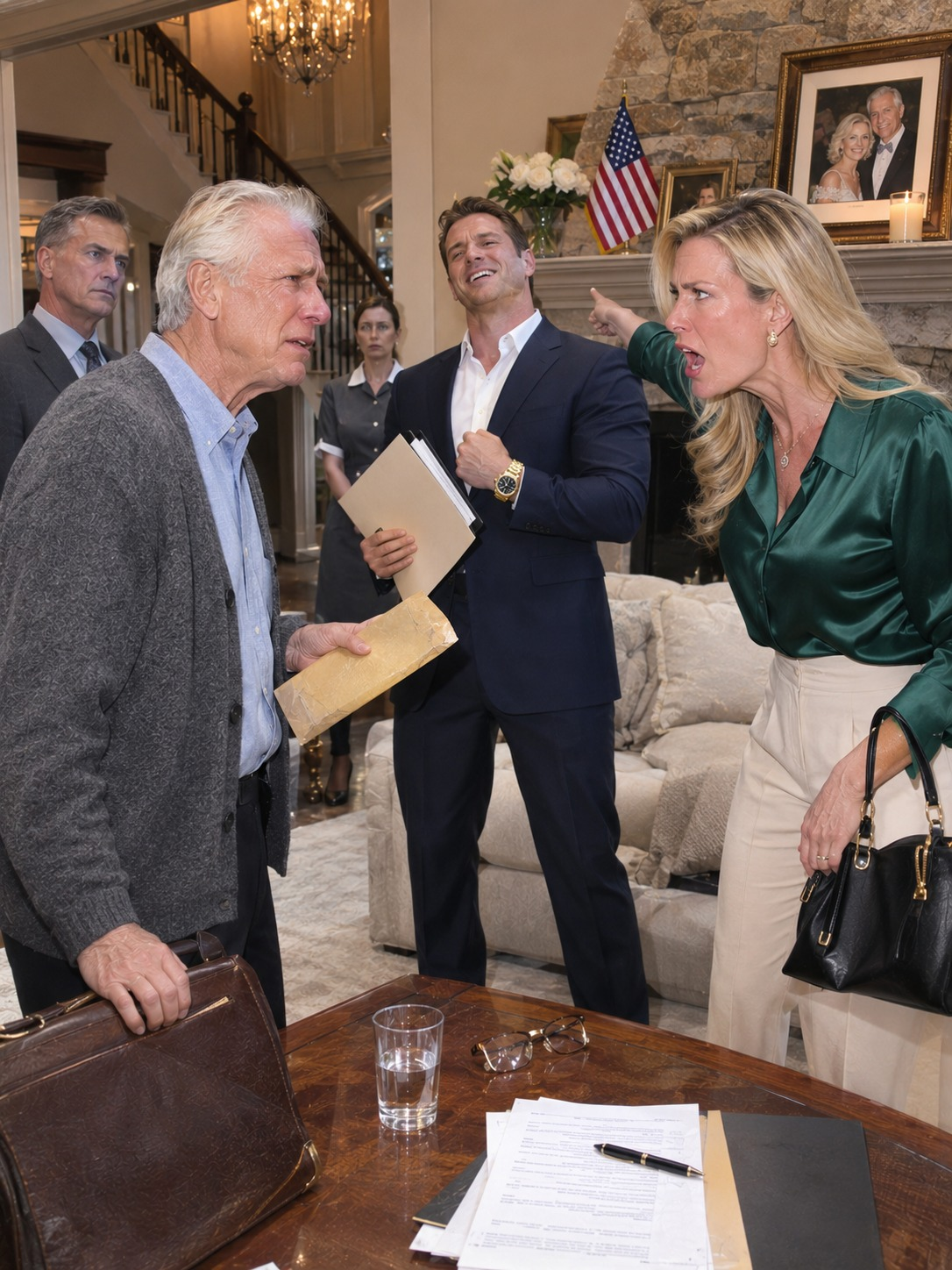
When I entered the mansion, the living room was quiet.
Too quiet.
Michael stood near the fireplace.
Rebecca sat on the sofa.
Richard Collins was beside the coffee table.
The same table where my children had laughed at Eleanor's envelope.
But this time, nobody was laughing.
Michael looked at my briefcase.
"Where have you been?"
I set it down carefully.
"Meeting with people who understand my wife's arrangements."
Rebecca's face changed.
"What arrangements?"
I looked at Richard.
He gave me a small, almost imperceptible nod.
Michael stepped forward.
"Dad, we need to talk."
"I know."
He gestured toward the table.
"Richard says there may be some confusion about the estate."
I looked at him.
"Confusion?"
"About certain documents."
Rebecca stood.
"Mom left us the businesses and properties. That's what the will says."
I nodded.
"That's what the will says."
Michael frowned.
"Then what's the problem?"
I opened my briefcase.
Slowly.
Carefully.
I removed Eleanor's old brown envelope.
Then I placed it on the coffee table.
The same envelope they had laughed at.
Rebecca stared at it.
"Why do you keep carrying that thing around?"
I looked at her.
"Because your mother wanted me to have it."
Michael gave an impatient sigh.
"Dad, please."
I raised my eyes.
"Your mother also wanted me to understand something."
"What?"
I looked toward Richard.
He remained silent.
I took out the photograph of Eleanor and me outside the factory.
I placed it beside the envelope.
Michael glanced at it.
"What's that?"
"1998."
Rebecca frowned.
"What about it?"
I looked at my children.
"The year your mother almost lost everything."
Michael crossed his arms.
"We know the story."
"No," I said quietly. "You know part of it."
Rebecca looked irritated.
"Dad, can we please focus on the legal issues?"
I nodded.
"That's exactly what we're going to do."
Then I reached into my briefcase again.
This time, I removed a copy of the trust's financial summary.
I placed it facedown on the table.
Michael's eyes narrowed.
"What is that?"
I looked at him.
"Something your mother prepared."
Rebecca stepped closer.
"Another inheritance document?"
I did not answer.
Instead, I turned toward Richard.
"Would you explain what it means for someone to inherit ownership interests in a company that still owes money to a lender?"
Richard looked at me carefully.
Then he said, "It means the ownership transfer does not, by itself, eliminate the company's existing financial obligations."
Michael's expression changed.
"Why are we talking about loans?"
I looked at my son.
"Because your mother wanted me to understand the businesses before I made any decisions."
Rebecca glanced at Michael.
He stared at the paper.
Then he looked at me.
"Dad, what exactly did Mom leave you?"
I placed my hand on the financial summary.
For the first time, neither of my children interrupted.
Neither laughed.
Neither smiled.
I slowly turned the document over.
Michael leaned forward.
Rebecca moved closer.
Richard remained perfectly still.
The number appeared at the top of the page.
$63,400,000.
Michael's face went pale.
Rebecca's mouth opened.
But before either could speak, Richard's phone rang.
He glanced at the screen.
His expression changed immediately.
He answered.
"Collins."
A pause.
Then his eyes moved toward me.
"What do you mean?"
Another pause.
"Are you certain?"
He slowly lowered himself into a chair.
Michael stared at him.
"Richard, what's wrong?"
Richard did not answer.
He listened for several more seconds.
Then he ended the call.
His face had lost its color.
I felt my stomach tighten.
"Richard?"
He looked at me.
"Thomas, the title review just uncovered an additional document."
I stared at him.
"What document?"
He swallowed.
"An amendment Eleanor signed before her death."
Rebecca stepped forward.
"An amendment to what?"
Richard looked at her.
Then at Michael.
Finally, he turned toward me.
"Thomas, this changes the question of who has the right to control the mansion."
Michael slammed his hand onto the table.
"Then tell us what it says!"
Richard opened his leather case.
He removed a sealed folder.
The folder carried Eleanor's name.
And beneath it was a date from the final week of her life.
Richard broke the seal.
He unfolded the document.
His eyes moved down the page.
Then he stopped.
He looked directly at me.
"Thomas, Eleanor didn't just protect your right to remain in this house. She named someone who must approve any attempt to sell it."
Rebecca's face tightened.
"Who?"
Richard turned the document toward us.
I leaned forward.
There was a name printed beneath the authorization clause.
A name none of us had expected to see.
And when Michael read it, he suddenly shouted, "THAT'S IMPOSSIBLE! SHE WASN'T SUPPOSED TO BE INVOLVED!"






Comments 0