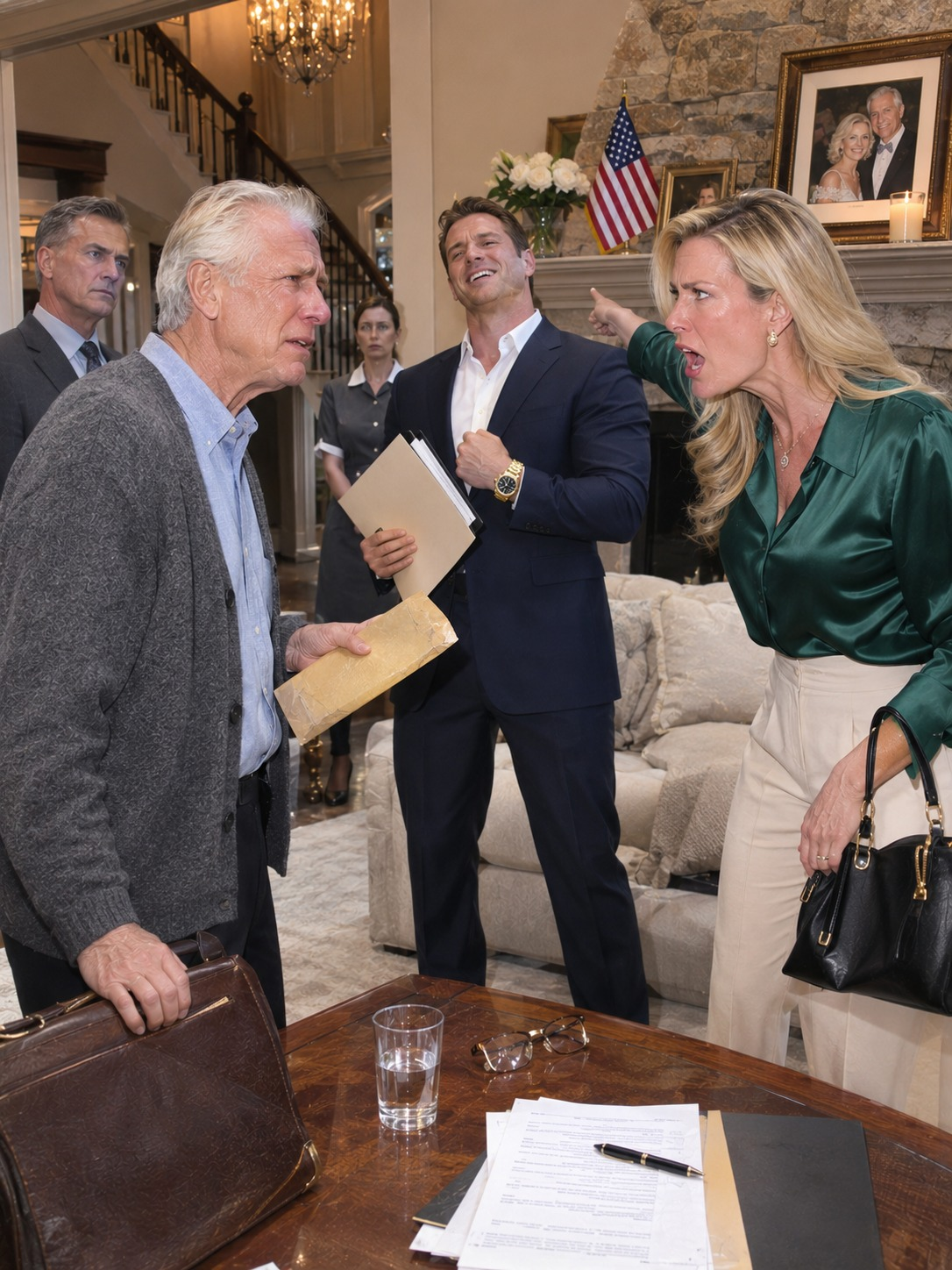
My daughter pointed toward the front door and screamed.
"GET OUT, DAD! THIS HOUSE BELONGS TO US NOW!"
Our family attorney stood beside the coffee table, holding a thick folder.
A small handwritten notation appeared on the old brown envelope in my hand.
For Thomas. Remember 1998.
My daughter had no idea what those words meant.
Neither did my son.
But I suddenly understood that my wife had left me something neither of them could buy.
My name is Thomas Bennett.
I was seventy-one years old when my wife died, and until the afternoon my children tried to throw me out of my own home, I believed the worst pain a man could experience was burying the woman he loved.
I was wrong.
Losing Eleanor had broken my heart.
What Michael and Rebecca did afterward nearly destroyed what was left of it.
The strangest part was that neither of them seemed to understand why.
They believed they were simply claiming what belonged to them.
They believed money had finally settled an argument that had existed quietly inside our family for years.
And they believed their father was too old, too tired, and too financially dependent to do anything about it.
I suppose I had given them plenty of reasons to think that way.
For forty-six years, I had been the man standing beside Eleanor Bennett.
Not in front of her.
Not above her.
Beside her.
The newspapers called her a visionary entrepreneur. Business magazines praised her instincts. At charity dinners, politicians and executives competed for a few minutes of her attention.
Eleanor had built three manufacturing companies, acquired commercial properties throughout Pennsylvania, invested in luxury apartment buildings, and assembled a collection of automobiles that made our garage look like a private showroom.
By the time she became seriously ill, the business empire associated with her name was worth tens of millions of dollars.
People loved telling the story of Eleanor Bennett.
They just usually left me out of it.
I had never minded.
At least, that was what I told myself.
When Eleanor and I married, we had almost nothing.
Our first apartment had a leaking kitchen faucet and windows that rattled whenever a truck passed outside. We owned one car, two mismatched dinner plates, and a sofa that my brother helped us carry up three flights of stairs.
Eleanor worked in the purchasing department of a small industrial supplier.
I was an electrical engineer.
She came home with ambitious ideas scribbled on napkins.
I came home with grease on my hands and a paycheck that barely covered our bills.
We were happy.
Not because life was easy.
Because we believed we were building something together.
I still remembered the night she first told me she wanted to start a manufacturing company.
We were eating spaghetti at our tiny kitchen table.
She pushed her plate aside, looked directly at me, and said, "Thomas, I think I can do better than the men running that place."
I laughed.
Not because I doubted her.
Because I knew she was right.
"Then do it," I told her.
She stared at me.
"Just like that?"
"Just like that."
"We could lose everything."
I reached across the table and took her hand.
"Then we'll build it again."
She never forgot those words.
Neither did I.
But our children grew up in a different world.
Michael and Rebecca never saw the leaking apartment or the secondhand furniture.
They never watched their mother sit at the kitchen table at midnight, trying to figure out how to pay employees when a customer was late with an invoice.
They never knew what it felt like to wonder whether the electricity would stay on another month.
By the time they were teenagers, we lived in a beautiful house outside Philadelphia.
By the time they graduated from college, Eleanor owned multiple companies.
By the time they reached middle age, they had convinced themselves that wealth was something a Bennett was simply entitled to possess.
And somewhere along the way, they stopped seeing me as their father.
I became the man who lived in their mother's house.
The man who attended company Christmas parties but never appeared on the business magazine covers.
The man who reminded them to call their mother on her birthday.
The man who, according to Michael, had enjoyed a comfortable life because Eleanor was the one with ambition.
I had heard that last remark at a family dinner three years earlier.
Michael had been drinking expensive bourbon with two executives from one of Eleanor's companies.
Someone asked what I did before retirement.
Before I could answer, Michael laughed.
"Dad's real talent was marrying the right woman."
Everyone chuckled.
Even Rebecca smiled.
I remember looking at Eleanor.
Her expression changed immediately.
"Your father was an electrical engineer," she said. "And if you understood half of what he did for this family, you wouldn't make jokes like that."
Michael shrugged.
"Relax, Mom. I was kidding."
Eleanor did not smile.
"Then find a better joke."
I thought that was the end of it.
I did not realize how much she had begun noticing.
Or how carefully she was preparing for a future neither of us wanted to imagine.
Six months before her death, Eleanor's health deteriorated.
The woman who had once walked through factories in high heels and argued with bankers twice her size began struggling to cross our bedroom without becoming exhausted.
Doctors gave us treatment plans.
Specialists gave us probabilities.
Friends gave us encouragement.
None of them could give us what we wanted.
More time.
I spent nearly every day beside her.
I learned the names of her medications. I helped her eat when her hands trembled. I brought fresh flowers because she hated the sterile smell of hospital rooms.
At night, when the nurses dimmed the lights, I sat beside her bed and read aloud from the mystery novels she loved.
Sometimes she listened.
Sometimes she slept.
Sometimes she simply held my hand.
Michael visited when his schedule allowed.
Rebecca came when she wasn't traveling.
I tried not to judge them.
They had businesses and responsibilities.
That was what I kept telling myself.
But during Eleanor's final week, neither child came to see her.
Michael was negotiating a manufacturing contract.
Rebecca was attending a real estate conference.
Both promised they would visit soon.
Soon never came.
On the last evening Eleanor was able to speak clearly, she asked me to close the hospital room door.
I did.
Then she reached for my hand.
Her fingers felt terribly light.
"Thomas," she whispered, "will you promise me something?"
"Anything, sweetheart."
She studied my face.
For a moment, I saw the young woman who had once sat across from me in our little apartment, dreaming about owning a factory.
"Never allow them to make you believe that the love you gave me had no value."
I frowned.
"Who?"
She squeezed my hand.
"You know who."
I tried to smile.
"Don't worry about me."
"Promise."
"I promise."
She closed her eyes.
Then she whispered something I did not fully understand.
"I made sure."
I leaned closer.
"Made sure of what?"
But she was exhausted.
Her fingers relaxed.
And she fell asleep.
Eleanor died two days later.
I was holding her hand.
For several minutes after the doctor told me she was gone, I could not bring myself to let go.
Forty-six years.
That was how long I had known the warmth of her hand.
And suddenly, I was expected to live without it.
The funeral was beautiful.
Michael arranged expensive flowers.
Rebecca selected a magnificent photograph of her mother.
Business associates flew in from several states.
A former governor spoke about Eleanor's contributions to the community.
People told me how extraordinary she had been.
I thanked them.
I shook hands.
I accepted condolences.
And each night, I returned to our bedroom, where her slippers still sat beside the bed.
I did not move them.
I could not.
Three weeks after the funeral, our attorney, Richard Collins, called to arrange the formal reading of Eleanor's will.
Richard had worked with our family for years.
He was a careful man who chose his words deliberately and rarely revealed what he was thinking.
He suggested we meet at his office.
Michael insisted that the meeting take place at the mansion instead.
"There's no reason to make everyone drive downtown," he said. "We're all family."
Rebecca agreed.
I didn't care where we met.
At the time, I was still having trouble remembering to eat breakfast.
The meeting was scheduled for Thursday afternoon.
Michael arrived first.
He drove a black luxury sedan and wore a charcoal business suit with a platinum watch that probably cost more than my first car.
He greeted me with a quick pat on the shoulder.
"How are you holding up, Dad?"
"One day at a time."
"Good. Good."
Then he asked whether Richard had arrived.
Rebecca appeared fifteen minutes later.
She wore a purple silk blouse, black tailored trousers, and carried a designer handbag that she placed carefully beside the sofa.
She kissed my cheek without really looking at me.
"Hi, Dad."
"Hello, sweetheart."
She glanced around the room.
"Has anyone started discussing the property?"
I looked at her.
"What property?"
"The house. The estate. Everything."
"Your mother has been gone three weeks."
Rebecca sighed.
"I know, Dad. But these things don't stop being complicated just because we're grieving."
I said nothing.
There are moments when a parent hears something from a child and realizes that arguing would only make the pain worse.
That was one of them.
Richard arrived shortly afterward.
He carried two thick folders and a smaller leather document case.
Our housekeeper, Margaret, brought coffee and water before quietly returning toward the staircase.
Richard sat in the armchair facing the fireplace.
Michael took the center sofa.
Rebecca sat beside him.
I remained in Eleanor's favorite chair.
For a moment, I found myself staring at the framed photograph above the mantel.
It showed Eleanor and me on our wedding day.
She was twenty-five.
I was twenty-six.
We looked impossibly young.
And happy.
Richard cleared his throat.
"Thank you all for coming."
Michael leaned forward.
"Let's get started."
Richard opened the first folder.
He explained that Eleanor had prepared a comprehensive estate plan, including a will governing certain assets held in her name.
He began reading.
Michael would receive controlling ownership interests in two manufacturing companies.
Rebecca would inherit the apartment complexes and several luxury residential properties.
Other commercial investments, automobiles, and financial assets would be distributed according to detailed provisions.
The total estimated value of the assets passing to Michael and Rebecca exceeded forty million dollars.
I watched their faces change.
Michael's eyes brightened.
Rebecca began taking notes.
When Richard mentioned a particularly valuable apartment complex, she actually smiled.
I sat quietly.
Not because I was angry about their inheritance.
Eleanor had built those businesses.
She had every right to decide what happened to them.
But I could not understand how our children could appear so pleased while sitting beneath their mother's wedding photograph.
Richard continued for nearly an hour.
There were discussions about ownership percentages, tax responsibilities, property management, and corporate governance.
Michael asked several questions about voting control.
Rebecca wanted to know how quickly certain real estate transfers could be completed.
Neither asked whether I was comfortable with the arrangements.
Finally, Richard closed the first folder.
"That concludes the principal distributions under the will."
Michael leaned back.
"Excellent."
Rebecca exhaled with satisfaction.
Then Richard looked toward me.
"Mr. Bennett, Eleanor made a separate provision for you."
Michael straightened.
Rebecca stopped writing.
Richard reached into his leather case and removed an old brown envelope.
It looked strangely out of place among the polished folders and neatly printed legal documents.
The paper had yellowed.
One corner was slightly bent.
My name was written across the front in Eleanor's handwriting.
Richard placed it in my hands.
"Your wife specifically requested that you receive this."
I stared at it.
For a moment, I forgot everyone else was in the room.
I recognized her handwriting immediately.
Eleanor had always made the capital T in Thomas unusually large.
She used to joke that it was because I was the tallest man she knew when we met.
I ran my thumb across the letters.
Then Michael laughed.
At first, I thought I had misunderstood the sound.
But he laughed again.
"Wait. That's it?"
Richard looked at him.
"Michael—"
"Dad gets an envelope?"
Rebecca leaned closer.
"Is there something inside?"
"That is for your father to examine privately," Richard replied.
Michael shook his head.
"You've got to be kidding me."
He looked at his sister.
"Forty-six years of marriage, and Mom leaves Dad a piece of old stationery."
Rebecca smiled.
"Maybe she finally decided who actually contributed to the family's wealth."
I felt something tighten in my chest.
Not because I believed her.
Because she sounded so certain.
I looked at Richard.
"Is this everything Eleanor left me?"
He paused.
Then he answered carefully.
"It is everything being transferred to you under the terms of this particular will."
I noticed the wording.
This particular will.
Before I could ask what he meant, Michael interrupted.
"Don't worry, Dad. We'll make sure you're taken care of."
I turned toward him.
"What does that mean?"
He spread his hands.
"You're retired. You don't have to worry about business matters. We'll help you find a comfortable place."
"A comfortable place?"
Rebecca nodded.
"Something manageable. Maybe a nice retirement community."
I stared at her.
"Why would I need that?"
She glanced toward Michael.
Then she looked directly at me.
"Because the mansion is part of the estate, Dad."
I felt the room become very quiet.
Rebecca continued.
"Michael and I have been discussing it. Keeping a property this size doesn't make financial sense unless we're using it properly."
"Using it?"
"We might sell it. Or convert it into something more practical."
I looked around the room.
The fireplace Eleanor had insisted on restoring.
The staircase where our children had posed for prom photographs.
The sofa where Eleanor had fallen asleep beside me during countless Christmas evenings.
The home we had built together.
And my daughter was discussing it as though it were an empty commercial building.
"Rebecca," I said quietly, "your mother and I lived here for more than thirty years."
"I know."
"This is my home."
Her expression hardened.
"Legally, that may not be how things work anymore."
Richard shifted in his chair.
"Rebecca, the ownership and occupancy issues require careful review. No one should assume—"
But she interrupted him.
"Richard, with respect, Michael and I understand what we inherited."
Michael stood.
"Dad, don't make this difficult."
I looked at my son.
He was taller than me now.
Stronger.
Confident in the way men sometimes become when they believe money has made them untouchable.
"Michael, I'm not making anything difficult."
"Then be reasonable."
"About what?"
"Moving on."
Two words.
Moving on.
As though forty-six years of marriage were a business transaction that had already closed.
I stood slowly.
My knees hurt.
They had been hurting more often since the long nights at the hospital.
Rebecca rose from the sofa.
"Where are you going?"
"Upstairs."
"We're not finished."
"I am."
She stepped closer.
"Dad, you need to understand something."
I stopped.
Her voice rose.
"THIS HOUSE IS OURS NOW, DAD! MOM DIDN'T LEAVE YOU A CENT!"
The words struck harder than I expected.
For a moment, I could not breathe.
Michael gave a short laugh.
"Rebecca, calm down."
But he was smiling.
That was what I remembered most.
Not my daughter's shouting.
My son's smile.
The boy I had taught to ride a bicycle.
The teenager whose first broken heart I had listened to at two in the morning.
The young man whose college tuition Eleanor and I had paid without ever asking for anything in return.
He was smiling while his sister told me I no longer belonged in my own home.
Margaret stood near the staircase.
She looked horrified.
Richard closed his folder.
"Enough," he said firmly.
But I raised one hand.
"It's all right."
Rebecca frowned.
"No, Dad, it's not all right if you think we're going to support you forever."
I looked at her.
Then at Michael.
"I understand."
Michael's smile widened.
"Good."
I picked up my leather briefcase.
The old envelope was still in my hand.
Rebecca glanced at it.
"At least Mom left you something sentimental."
I slipped it into my jacket.
"Yes," I said. "She did."
Then I walked toward the stairs.
No one followed me.
No one apologized.
Behind me, Michael began asking Richard about the manufacturing companies again.
By the time I reached the landing, they were discussing management appointments.
I entered the bedroom Eleanor and I had shared.
I closed the door.
And for the first time since her funeral, I cried so hard I could barely stand.
I sat on the edge of the bed and covered my face with my hands.
I cried for Eleanor.
I cried for the children we had raised.
And I cried for the family I had believed would survive her death.
After a while, I looked toward her side of the bed.
Her reading glasses were still on the nightstand.
A half-finished novel rested beneath them.
Beside the lamp stood our wedding photograph.
I picked it up.
"You would have hated what happened today," I whispered.
Of course, she did not answer.
But I remembered her final promise.
Never allow them to make you believe that the love you gave me had no value.
I reached into my jacket and removed the envelope.
For several minutes, I simply held it.
Then I noticed something unusual.
There was a small handwritten notation near the lower edge.
The letters were faded.
I moved closer to the bedside lamp.
For Thomas. Remember 1998.
My breath caught.
1998.
I had not thought about that year in a very long time.
That was when Eleanor's first manufacturing company nearly collapsed.
A major customer had gone bankrupt.
Invoices went unpaid.
Creditors threatened legal action.
Our mortgage was overdue.
Michael and Rebecca were still children.
And Eleanor had cried at our kitchen table because she believed she was about to lose everything.
I had sold a parcel of land my father left me.
I had spent nights repairing machines at her factory.
I had used my engineering experience to keep equipment operating when the company could not afford outside technicians.
I had never asked Eleanor to repay me.
I had never considered it a loan.
We were married.
Her problems were my problems.
Her dreams were my dreams.
But why would she mention 1998 now?
I turned the envelope over.
The flap was sealed.
I carefully slid my finger beneath the edge.
Inside was a single folded sheet of paper.
I opened it.
Eleanor's handwriting filled the center.
This belongs to the man whose love for me was always genuine.
My eyes filled again.
Beneath the message was a bank account number.
And a telephone number.
I stared at them.
A bank account?
Eleanor had managed most of our investments.
We had separate retirement accounts and joint household funds, but I had never seen this particular number before.
Perhaps she had left me a modest savings account.
Perhaps it contained money for my living expenses.
Whatever it was, I felt grateful.
Not because of the amount.
Because she had remembered me.
I picked up my phone.
Then I hesitated.
It was nearly six o'clock.
The bank might already be closed.
But the number appeared to belong to a private banking department.
I dialed.
A woman answered.
"Good evening. Private Client Services. How may I assist you?"
"My name is Thomas Bennett. My wife recently passed away, and she left me an account number."
"I'm very sorry for your loss, Mr. Bennett."
"Thank you."
"May I have the account number?"
I read it aloud.
There was a pause.
Then I heard typing.
"One moment, please."
I waited.
The woman returned.
"Mr. Bennett, I can see that there are special instructions associated with this account. I'll need to verify your identity before discussing any details."
"Of course."
She guided me through several security procedures.
I provided identification information.
She asked additional questions.
At one point, I was transferred to another department.
The process took nearly twenty minutes.
I began wondering whether I had misunderstood the entire thing.
Finally, the representative returned.
"Thank you for your patience, Mr. Bennett. Your identity has been verified."
I exhaled.
"Could you tell me what kind of account this is?"
"It's associated with a private trust arrangement."
"A trust?"
"Yes, sir."
I frowned.
"Eleanor never mentioned a trust."
"I understand."
"Could you tell me the balance?"
Another brief pause.
"Certainly."
I looked toward the wedding photograph.
The woman spoke clearly.
"The current reported value is sixty-three million, four hundred thousand dollars."
I did not move.
For a moment, I thought I had misheard her.
"I'm sorry?"
"Sixty-three million, four hundred thousand dollars, Mr. Bennett."
I stared at the wall.
My hands began trembling.
That was more than the entire inheritance Michael and Rebecca had spent the afternoon celebrating.
"Are you certain?"
"Yes, sir."
I lowered myself onto the bed.
My mind struggled to make sense of what I had heard.
Eleanor had built a private fortune larger than the one our children inherited.
And she had arranged for me to receive it.
Without telling them.
Without telling me.
I looked at her photograph again.
"Eleanor," I whispered, "what did you do?"
The representative continued.
"Mr. Bennett, there are additional instructions concerning your role as beneficiary and successor trustee. Our trust administrator would like to meet with you."
I swallowed.
"Why?"
"Your wife made several arrangements that require your attention."
"What arrangements?"
"I can provide general information, but the documents will need to be reviewed with the administrator."
I pressed my fingers against my forehead.
"Please. I've had a very difficult day."
Her voice softened.
"I understand, Mr. Bennett."
I waited.
Then she said something that made my heart begin pounding.
"Your wife also left instructions concerning financial obligations associated with businesses controlled by Michael and Rebecca Bennett."
I sat upright.
"My children?"
"Yes, sir."
"What kind of obligations?"
There was a pause.
Then she spoke again.
"Mr. Bennett, I believe you should speak with our trust administrator before making any decisions. There are confidential loan records that need to be explained."
I stared at the envelope.
My children had inherited more than forty million dollars.
They had laughed at me.
They had told me to leave my home.
And now a stranger was telling me that Eleanor's hidden trust had financial connections to their businesses.
"Who should I speak with?" I asked.
"William Prescott. He is the senior administrator responsible for your wife's trust."
"When can I see him?"
"Tomorrow morning at nine."
"I'll be there."
She gave me the address.
I wrote it on the back of an old receipt.
Before ending the call, I asked one final question.
"Did Eleanor know my children might treat me this way?"
The woman hesitated.
"I can't speak to your wife's personal thoughts, Mr. Bennett."
"I understand."
"But I can tell you that she took considerable care in preparing these arrangements."
I thanked her.
Then I ended the call.
For a long time, I sat in silence.
Downstairs, I could hear Michael laughing.
Rebecca was speaking loudly about renovation plans.
They were already discussing what to do with the mansion.
I looked toward Eleanor's photograph.
For the first time since her death, I felt something other than grief.
Not happiness.
Not revenge.
Something quieter.
A sense that my wife had known more than I realized.
I unfolded her note again.
There was another line written in tiny letters along the bottom.
I had missed it earlier.
I moved closer to the lamp.
Thomas, ask for the blue folder.
My pulse quickened.
The blue folder.
What blue folder?
I turned the paper over.
Nothing.
Then I noticed a faint indentation beneath the handwriting, as though Eleanor had written something on another sheet while this one rested underneath.
I angled the paper toward the light.
A few letters became visible.
Then a word.
Then another.
I reached for my reading glasses.
And slowly, the hidden impression began to take shape.
It was a company name.
A name I recognized immediately.
Because it belonged to the business my son had just inherited.
I leaned closer.
Beneath the company name was a date.
And beside the date, Eleanor had written three words that made my blood run cold.
"Michael signed it."
I stared at the paper.
Then my phone vibrated.
A new message appeared from an unknown number.
It contained a photograph of a sealed navy-blue folder.
Underneath was a single sentence.
"Mr. Bennett, before you meet William Prescott tomorrow, there is something you must know about what your son signed. The person who witnessed it was..."






Comments 0