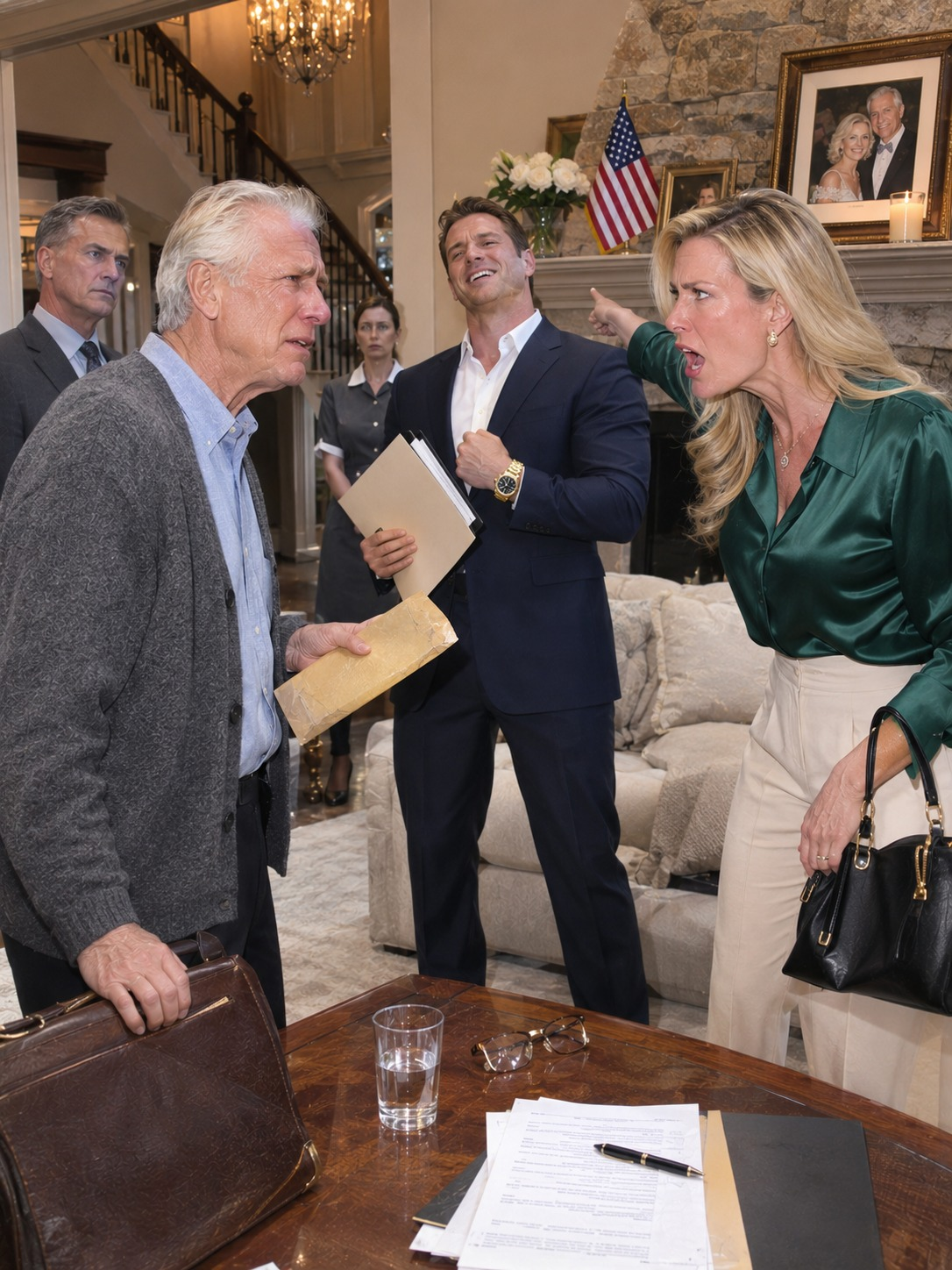
Richard Collins stood at the top of the staircase.
In his right hand was a thick blue folder.
In his left was a document bearing Eleanor's signature.
For a moment, nobody moved.
Dr. Amelia Grant stood beside me, clutching the small metal box she had brought from the hospital. Laura Whitcomb remained near the front door. Margaret had gone pale.
I looked up at the man who had represented our family for more than twenty years.
"Richard?"
He descended two steps.
"Thomas, I can explain."
My heart began pounding.
Those were the words I had heard too many times.
Michael had said them.
Rebecca had said them.
Daniel Mercer had said them.
And now Richard was standing in my house holding a document my wife had refused to sign.
I gripped the banister.
"Before you explain anything, tell me why you have that agreement."
Richard looked at the paper.
"Because I was trying to protect it."
"From whom?"
He hesitated.
"From the people who created it."
I stared at him.
"Then why were you hiding it?"
He looked genuinely wounded.
"I wasn't hiding it from you."
Dr. Grant stepped forward.
"Mr. Collins, I believe we need to discuss what happened at the hospital."
Richard's expression changed.
He looked at her identification badge.
Then at the metal box.
"Amelia?"
She nodded.
"Hello, Richard."
I felt my stomach tighten.
They knew each other.
I turned toward Dr. Grant.
"Was Richard the person in the photograph?"
She looked at him.
"Yes."
Richard slowly closed his eyes.
I stared at him.
"You were there."
He nodded.
"Yes."
"On the day Victor Hale came to Eleanor's room?"
"Yes."
"And you told me you weren't."
He looked down.
"I did."
The admission hurt more than I expected.
I had spent days trying to believe Richard might be innocent.
Now he was admitting that he had lied to me.
I took a slow breath.
"Why?"
Richard descended the remaining stairs.
"Because Eleanor asked me not to tell you until we had secured the evidence."
I shook my head.
"Don't use my wife's name to excuse another lie."
He stopped.
For a moment, he looked as though I had struck him.
Then he nodded.
"You're right."
The hallway became silent.
Richard looked directly at me.
"I made a mistake, Thomas. I believed I was honoring Eleanor's wishes, but I should have told you the truth once the documents began appearing."
I studied him.
"Then tell me now."
He held out the blue folder.
"This is the original agreement Victor Hale wanted Eleanor to sign."
I looked at it.
"And?"
"She refused."
"I know that."
Richard swallowed.
"What you don't know is why I was in the room."
I waited.
He opened the folder.
"Eleanor had asked me to attend the scheduled review of the proposed agreement. Victor arrived early. By the time I reached the hospital, he was already pressuring her."
Dr. Grant nodded.
"That's consistent with the visitor records and the recording."
I looked at Richard.
"Why did you sign the visitor register under another name?"
He hesitated.
"Because Eleanor was concerned Victor might learn that her attorney was observing the meeting."
I frowned.
"How?"
Richard lowered his eyes.
"I signed in as Robert Ellis, a family friend. It was a foolish decision. I should have used my real name."
I stared at him.
"You understand how that looks?"
"Yes."
"Your name appears on disputed financial documents. You deny signing them. Then I discover you visited Eleanor under a false name."
Richard nodded.
"I understand why you don't trust me."
I looked toward Catherine's number on my phone.
"Then we aren't discussing this without my attorney."
Richard gave a tired smile.
"That's exactly what Eleanor would have wanted."
Catherine arrived twenty-five minutes later.
She brought William Prescott.
We gathered in Eleanor's office, where so many of our family's most important decisions had been made.
Dr. Grant placed the metal box on the desk.
Richard laid the original agreement beside it.
Catherine examined the documents.
Then she turned toward Dr. Grant.
"Can you explain the recording?"
Dr. Grant nodded.
"Eleanor requested that the meeting be documented. The hospital permitted a recording under the circumstances, and the participants were informed."
I looked at her.
"Did Eleanor know Richard was there?"
"Yes."
"Did Victor?"
"Yes, once Mr. Collins entered the room."
Catherine nodded.
"Then let's hear it."
Dr. Grant connected the storage device to a laptop.
A moment later, Eleanor's voice filled the room.
Weak.
Tired.
But unmistakably hers.
"Mr. Hale, I have read your agreement."
My eyes filled immediately.
Victor's voice followed.
"Then you understand the urgency."
"I understand that you're asking me to acknowledge obligations that have not been properly explained."
"Eleanor, your son's company needs this arrangement."
"Then my son's company needs honest financial statements."
I closed my eyes.
There she was.
My Eleanor.
Even from a hospital bed, she refused to be intimidated.
Victor continued.
"If you don't sign, Michael could lose the business."
Eleanor answered without hesitation.
"Then Michael will have to face that possibility."
A pause.
"You don't understand the consequences."
"I understand them perfectly well."
I pressed my hand against my mouth.
Then Eleanor said something that made my chest ache.
"I spent my life building those businesses. I will not spend my final days helping someone conceal what happened to them."
There was a rustling sound.
Victor spoke again.
"The agreement is already prepared. Your attorney can review it afterward."
"No."
"Eleanor—"
"I said no."
A chair moved.
Then Richard's voice entered the recording.
"Mr. Hale, the meeting is over."
Victor sounded startled.
"Who are you?"
"Richard Collins. Mrs. Bennett's attorney."
A long silence.
Then Victor said, "This is a private business matter."
Richard answered, "And my client has declined to sign."
I heard Eleanor breathe heavily.
Dr. Grant's voice followed.
"Mrs. Bennett needs to rest."
Victor spoke one last time.
"You are making a serious mistake."
Eleanor answered quietly.
"No, Mr. Hale. I made my mistake when I allowed people to believe that money mattered more than honesty."
The recording ended.
Nobody spoke.
I sat motionless.
Then I began crying.
I had heard my wife's voice so many times in the past few days.
But this was different.
She was frightened.
She was exhausted.
Yet she was still defending what we had built together.
I looked at Richard.
"You were protecting her."
He nodded.
"I tried."
"Then why didn't you tell me?"
He wiped his eyes.
"Because she made me promise that your last days together would not be consumed by business."
I looked down.
He continued.
"She wanted you to remember her as your wife, not as someone fighting another financial battle."
I covered my face.
For a long moment, I could not speak.
Then I whispered, "I would have fought beside her."
Richard nodded.
"I know."
The recording did not answer every question.
But it answered the one that had haunted me most.
Eleanor had not willingly authorized Victor Hale's final agreement.
She had refused it.
Clearly.
Repeatedly.
And with witnesses present.
The next question was how a document bearing her signature had appeared afterward.
Catherine turned toward Richard.
"Where did you obtain the original unsigned agreement?"
Richard opened the blue folder.
"Eleanor asked me to retain it after the hospital meeting. I also kept the correspondence showing the version she rejected."
Catherine examined the pages.
"Why did your name appear on Hawthorne's authorized representative list?"
Richard shook his head.
"I never agreed to act as an authorized representative for Hawthorne."
"Do you have evidence?"
"Yes."
He produced a letter.
It was dated several months before Eleanor died.
In it, Richard had demanded that Hawthorne stop identifying him as its representative and correct its records.
Catherine read the letter.
Then she examined the delivery confirmation.
"This is useful," she said. "But we'll still need to verify the underlying records."
Richard nodded.
"Of course."
I looked at him.
"And the attempted nine-million-dollar transfer?"
"I did not authorize it."
"Someone used your signature?"
"That is what the evidence appears to suggest."
I leaned back.
For the first time, the scattered pieces began to form a recognizable picture.
Victor Hale had obtained copies of old documents.
Patricia had admitted supplying some of them.
Daniel had approved questionable transactions.
Michael had failed to supervise his company.
And someone had apparently used familiar signatures to create the appearance of authority.
But one question remained.
"Who submitted the final agreement?"
Richard looked at Catherine.
"We believe the electronic records will identify the account used."
Catherine nodded.
"Daniel's counsel has agreed to provide the relevant information."
I stared at her.
"Does Daniel know?"
"He says he knows who instructed him to upload it."
My stomach tightened.
"Then why hasn't he told us?"
"He has. Through counsel."
I leaned forward.
"Who?"
Catherine looked directly at me.
"Victor Hale."
I closed my eyes.
The man who had pressured Eleanor.
The man who had offered Michael financing.
The man connected to Hawthorne.
The man who had attended my wife's funeral and shaken my hand.
I felt anger rise.
"Did Daniel know Eleanor had refused to sign?"
Catherine answered carefully.
"He says Victor told him she had later approved a revised version."
I looked down.
"Did Daniel verify that?"
"No."
I shook my head.
Another failure of judgment.
Another person trusting a convenient explanation.
Catherine continued.
"Daniel has admitted that he uploaded documents without independently confirming the signatures. His responsibility for that conduct will need to be addressed."
I nodded.
"And Victor?"
"The relevant records are being provided to investigators and the appropriate authorities."
I looked at Eleanor's photograph.
My wife had been right.
The truth was complicated.
But it was finally coming into view.
The next several weeks were the hardest of my life.
I attended meetings.
Read reports.
Spoke with attorneys.
Reviewed documents I had never imagined needing to understand.
At seventy-one, I found myself learning more about commercial lending, corporate governance, and financial investigations than I had learned in all the previous decades.
I did not enjoy it.
But I understood why it mattered.
Eleanor had left me a responsibility.
Not merely money.
A responsibility to protect what had been built honestly.
And to stop pretending that love required me to ignore wrongdoing.
Helen Ward's review eventually established a clearer picture of the financial transactions.
The manufacturing company had suffered genuine operating losses.
Michael had expanded too quickly.
He had relied too heavily on optimistic projections.
And he had allowed Daniel Mercer to exercise far more control over the company's finances than was prudent.
Daniel had approved questionable transactions and inaccurate reporting adjustments.
Some payments to Westbridge had legitimate business purposes.
Others lacked adequate supporting documentation.
Hawthorne had received substantial fees through arrangements that were not properly disclosed to the trust's lending entity.
The disputed nine-million-dollar instruction had never resulted in the requested transfer.
The bank's controls had stopped it.
The separate two-million-dollar payment associated with Rebecca's company had been traced to an intercompany financing arrangement that had been recorded improperly and authorized using credentials Rebecca said she had not provided.
Investigators later established that the relevant credentials had been used by an employee working under Daniel's supervision.
The employee had relied on instructions attributed to Victor Hale.
The evidence was preserved.
The records were reviewed.
And the appropriate authorities were notified.
The original hospital agreement, the recording, the electronic submission logs, and the disputed signatures became central pieces of evidence.
Victor Hale's network of companies was examined.
His attempts to enforce the disputed collateral arrangements were challenged.
And the investigation eventually resulted in criminal charges concerning fraudulent financial documents and related transactions.
Months later, Victor entered a guilty plea to charges arising from that conduct.
He was sentenced under the applicable law.
The judgment did not erase the damage he had caused.
But it established something Eleanor had wanted from the beginning.
The truth would not be buried to protect appearances.
Daniel also faced consequences.
He cooperated with investigators, acknowledged his role in the inaccurate reporting, and accepted responsibility through the legal process.
I did not celebrate his humiliation.
I had seen enough suffering.
But I was relieved that the people who had helped create the problem were finally being held accountable.
Richard's disputed signatures were examined.
The available evidence supported his account that they had been copied or reproduced without his authorization.
His false visitor registration remained a serious lapse in judgment.
He acknowledged it openly.
He apologized to me.
And he cooperated with the review.
Our friendship was never quite the same afterward.
But it survived.
Because Richard had eventually told the truth.
And because I had learned that forgiveness did not require pretending a mistake had never happened.
Michael's company was another matter.
There was no dramatic rescue.
No miraculous check that made every debt disappear.
The business was still struggling.
Its obligations were real.
Its employees were frightened.
And the trust's lending entity was still owed eighteen million, six hundred thousand dollars in principal, together with applicable interest.
I refused to pretend otherwise.
At the first restructuring meeting, Michael sat across from me with his attorney.
His hands were trembling.
"Dad," he said, "I know I don't deserve another chance."
I looked at him.
"This isn't about what you deserve."
He lowered his head.
"It's about whether the company has a future."
Helen Ward presented an independently reviewed cash-flow forecast.
The numbers were difficult.
Some equipment would have to be sold.
Certain expansion plans would have to be abandoned.
Management expenses would need to be reduced.
The company would have to negotiate with creditors and focus on the contracts it could actually fulfill.
Michael listened without interrupting.
For once, he did not argue with the facts.
When Helen finished, he looked at me.
"Can we save it?"
I took a slow breath.
"That's what the professionals are trying to determine."
He nodded.
Then he whispered, "I'll do whatever it takes."
I looked at him.
"Then start by giving up control of the financial decisions you don't understand."
He stared at me.
For a moment, I thought he would become angry.
Instead, he nodded.
"All right."
The restructuring negotiations were difficult.
The trust's lending entity, acting through the appropriate decision-makers and with independent advice, agreed to a conditional extension and revised repayment schedule.
The arrangement required accurate reporting, independent financial oversight, and measurable operating improvements.
It was not a gift.
It was not forgiveness disguised as a loan.
It was a commercially evaluated opportunity to preserve a viable business and protect the interests of everyone involved.
Michael accepted those conditions.
He stepped away from day-to-day financial control while remaining involved in operations under professional supervision.
For the first time in years, he began asking questions instead of pretending he already knew the answers.
The company survived.
Not unchanged.
Not without painful sacrifices.
But it survived.
And most importantly, the majority of its employees kept their jobs.
When Michael told me that, he cried.
"So many families were counting on us," he whispered.
I looked at him.
"Now you understand why your mother cared so much."
He nodded.
"Yes, Dad."
Rebecca's transformation was quieter.
She had always been intelligent.
Eleanor knew it.
I knew it.
But Rebecca had spent years allowing other people to make difficult decisions while she enjoyed the appearance of success.
That changed.
She hired an independent property management adviser.
She began attending financial meetings herself.
She learned how to read debt schedules, operating statements, and lease reports.
She sold two luxury properties that had become expensive distractions.
She used the proceeds to strengthen the residential company's financial position.
And she stopped treating the inheritance as proof that she was entitled to a certain lifestyle.
One afternoon, she came to see me in Eleanor's garden.
She wore jeans and a simple sweater.
No expensive jewelry.
No designer handbag.
Just my daughter.
"Dad, can I show you something?"
I smiled.
"Of course."
She handed me a folder.
Inside were plans for renovating one of the older apartment buildings.
I studied them.
"What's this?"
"A project I've been working on."
I looked up.
She smiled nervously.
"The building needs repairs. The previous management kept delaying them."
I nodded.
"And?"
"I want to fix it properly."
I examined the budget.
The numbers were clear.
The plan was practical.
She had included contingency funds and realistic timelines.
I looked at her.
"Did you prepare this?"
She nodded.
"With help."
I smiled.
"That's how good work gets done."
Her eyes filled.
"Dad, I think Mom would have liked it."
I looked at the plans again.
Then I nodded.
"She would have."
Rebecca began crying.
I held her.
And for the first time since Eleanor died, my daughter cried because she wanted to do something worthwhile.
Not because she was afraid of losing money.
The question of the mansion was resolved through a careful review of the property documents.
Eleanor had placed the house within a separate residence arrangement that protected my right to live there for the rest of my life.
Margaret had been named as an independent protector with a limited consent role concerning any proposed sale or transfer that might affect my occupancy rights.
That was the name Michael had shouted about when Richard first revealed the amendment.
Margaret.
The housekeeper he had treated as though she were invisible.
The woman Eleanor trusted because she had watched her care for our family for seventeen years.
Michael had been furious when he learned about her role.
Now he understood why Eleanor had chosen her.
Margaret had never wanted power.
She had wanted me to be safe.
The final review confirmed that my occupancy rights could not simply be ignored because my children had inherited other property interests.
I could remain in the mansion.
No one could force me out merely because they wanted to sell it.
When Catherine explained the final arrangements, I felt an enormous weight lift from my shoulders.
But I also knew something.
The house was not valuable because it was large.
It was valuable because Eleanor had lived there.
Because our children had grown up there.
Because every room held a memory.
I asked Margaret to sit with me in the kitchen.
She looked nervous.
"Mr. Bennett, have I done something wrong?"
I smiled.
"No."
She relaxed slightly.
I took her hand.
"Margaret, Eleanor trusted you."
Her eyes filled.
"I loved Mrs. Bennett."
"I know."
"She was good to me."
I nodded.
"And you were good to her."
Margaret began crying.
I continued.
"I want you to know that you will always have a place here."
She shook her head.
"Mr. Bennett, you don't have to—"
"I know."
I smiled.
"But I want to."
We sat together for a while.
Then she whispered, "Mrs. Bennett told me you were the heart of this house."
My throat tightened.
I looked toward the window.
"And she was its soul."
The sixty-three-million, four-hundred-thousand-dollar trust remained under proper administration.
I did not treat it as a personal checking account.
I worked with William, Catherine, and independent advisers to understand its assets, obligations, and responsibilities.
The trust held investments, lending interests, and other property.
Some assets were liquid.
Others were not.
Some carried risks.
All required careful management.
I learned to ask questions.
I learned to demand clear explanations.
And I learned that having money did not mean I had to spend it.
Eleanor had left me financial security.
But she had also left me a choice.
I could spend the rest of my life guarding the fortune.
Or I could use the opportunities it provided to do something meaningful.
I thought about the factory in 1998.
The thirty-seven employees.
The night Eleanor and I sat at our kitchen table, wondering whether we could keep the business alive.
I remembered how frightened we had been.
And I remembered the relief on those workers' faces when we told them their jobs were safe.
That memory stayed with me.
So I worked with the trustees and advisers to establish a charitable initiative in Eleanor's name, funded from resources I was legally entitled to direct.
We called it the Eleanor Bennett Opportunity Fund.
Its purpose was simple.
To support vocational training, emergency assistance for workers facing unexpected hardship, and educational opportunities for families connected to the communities where Eleanor had built her businesses.
I did not want a giant monument.
I did not want my name on a building.
I wanted something useful.
Something Eleanor would recognize.
Michael and Rebecca asked whether they could help.
I told them yes.
But I gave them a condition.
They would have to work.
Not pose for photographs.
Not attend ceremonies and make speeches.
Actually work.
Michael helped organize apprenticeships at the manufacturing company.
Rebecca helped develop a housing assistance partnership for families experiencing temporary financial hardship.
They attended meetings.
Reviewed applications.
Listened to people.
And slowly, something changed.
They began to understand the difference between possessing wealth and being responsible for it.
Six months after Eleanor's death, Michael asked me to meet him at the old factory.
I had not visited the building in years.
The original sign was still above the entrance.
The paint had faded.
The brickwork needed repairs.
But the building remained.
Michael stood outside waiting for me.
He wore work boots and a plain jacket.
For a moment, he reminded me of myself at his age.
"Dad."
"Michael."
He smiled nervously.
"Come inside."
I followed him.
The factory smelled of metal, oil, and machine lubricant.
It was a smell I had known for decades.
We walked past equipment.
Employees greeted us.
Some recognized me immediately.
"Mr. Bennett!"
I smiled and shook hands.
Then Michael led me to a small conference room.
On the wall hung an old photograph.
Eleanor and me.
1998.
Standing outside the factory.
I was holding a toolbox.
Eleanor had one arm around my waist.
We were exhausted.
But smiling.
Beneath the photograph was a small plaque.
It read:
Thomas and Eleanor Bennett
The people who believed that honest work and loyalty were worth more than money.
I stared at it.
My eyes filled.
Michael stood beside me.
"I found the picture in Mom's records."
I nodded.
"She kept it."
He swallowed.
"I didn't understand what it meant."
I looked at him.
He continued.
"I thought she built everything by herself."
I felt a sharp ache.
Michael looked at the photograph.
"I never knew you sold Grandpa's land to save the factory."
I nodded.
"Your mother didn't like talking about it."
He wiped his eyes.
"Why?"
"Because she never wanted people to think she owed me something."
Michael looked at me.
"But she did."
I smiled sadly.
"We owed each other everything."
He began crying.
"Dad, I'm sorry."
I put my hand on his shoulder.
"I know."
He looked at me.
"I was so ashamed when the company started failing. I thought if I admitted I needed help, you'd think I was weak."
I shook my head.
"Michael, asking for help is not weakness."
He nodded.
"I know that now."
I looked at the photograph.
"Your mother knew it too."
For a long moment, we stood together.
Then Michael whispered, "I want to become someone she'd be proud of."
I looked at my son.
"Then keep doing the work."
He nodded.
"I will."
A year after Eleanor's death, we gathered in the garden for a small family dinner.
It was not a grand celebration.
There were no reporters.
No business associates.
No expensive decorations.
Just family.
Michael.
Rebecca.
Their children.
Margaret.
A few close friends.
And me.
We ate at the long wooden table Eleanor had insisted on buying years earlier.
She had said she wanted a table large enough for everyone.
At the time, I laughed.
"Sweetheart, we don't know that many people."
She smiled.
"Then we'll make room for the ones who matter."
Now the table was full.
The children laughed.
Michael helped serve dinner.
Rebecca brought a homemade dessert.
It wasn't perfect.
She had burned the edges.
We ate it anyway.
And laughed.
For the first time in a long time, the laughter felt genuine.
After dinner, Michael stood.
He held a glass of water.
"Dad, can I say something?"
I smiled.
"Of course."
He looked around the table.
Then he looked at me.
"A year ago, I made the worst mistake of my life."
The room became quiet.
He swallowed.
"I treated my father like he was worth less than the money my mother left behind."
My throat tightened.
Michael continued.
"I thought inheritance meant ownership. I thought success meant never admitting failure."
He looked at Rebecca.
"And I hurt the people who loved me most."
Rebecca wiped her eyes.
Michael turned back to me.
"Dad, I can't undo what I said."
I nodded.
"But I want you to know that I'm grateful you didn't give up on me."
My eyes filled.
He raised his glass.
"To Mom."
Everyone raised their glasses.
Michael's voice broke.
"And to Dad, who taught us that love doesn't mean ignoring the truth."
I lowered my head.
For a moment, I could not speak.
Then Rebecca stood.
She looked at me.
"Dad, I have something too."
I smiled through my tears.
"What is it?"
She reached into her handbag.
Then removed a small velvet box.
My heart tightened.
She placed it in front of me.
"Open it."
I did.
Inside was Eleanor's wedding ring.
I froze.
For a moment, I could not breathe.
I looked at Rebecca.
"Where did you get this?"
She began crying.
"Mom gave it to me before she died."
I stared at the ring.
The simple gold band.
The one I had placed on her finger forty-six years earlier.
The one she had worn through every hardship and every triumph.
Rebecca continued.
"She told me to keep it safe until I understood what marriage really meant."
My eyes filled.
I looked up.
"And now?"
Rebecca wiped her cheeks.
"Now I understand that it wasn't about what you could give each other."
She looked at the ring.
"It was about what you were willing to carry together."
I began crying.
Rebecca moved beside me.
She placed her arms around my shoulders.
"Mom said that one day, when I understood, I should give it back to you."
I held the ring in my palm.
It was warm from the velvet.
Small.
Ordinary.
Worth almost nothing compared with the fortune Eleanor had left.
And yet it was the most precious thing in the world.
I pressed it against my heart.
"Thank you, sweetheart."
Rebecca cried.
I held her.
And across the table, Michael wiped his eyes.
Later that evening, after everyone had gone home, I sat alone in Eleanor's office.
The house was quiet.
The garden lights glowed beyond the windows.
On the desk lay her final letter.
Beside it was our photograph from 1998.
And in my hand was her wedding ring.
I looked around the room.
So much had changed.
The financial investigations were concluded.
The disputed transactions had been addressed through the legal process.
The businesses had been stabilized under new oversight.
The trust was being managed responsibly.
The mansion was secure.
My children were rebuilding their lives.
And the family that had nearly been destroyed by money was learning how to love one another again.
But Eleanor was still gone.
That was the one thing no amount of money could change.
I looked at her photograph.
"Well, sweetheart," I whispered, "we made it."
My voice trembled.
"I wish you were here."
I sat quietly for a long time.
Then I opened the bottom drawer of her desk.
Inside was an old notebook.
The cover was worn.
I recognized it immediately.
It was the notebook we had used in 1998 when we were trying to save the factory.
I opened it.
The first pages were filled with calculations.
Repair costs.
Payroll.
Supplier bills.
The amount we received from selling my father's land.
I smiled sadly.
Then I turned to the final page.
There was a note in Eleanor's handwriting.
Thomas,
If we lose the factory, we'll still have each other.
If we save it, we'll build something good.
But whatever happens, promise me we'll never forget that the best thing we ever built was our family.
I closed my eyes.
Tears rolled down my cheeks.
I remembered the night she wrote those words.
We had been sitting at the kitchen table.
The bills were scattered everywhere.
We were exhausted.
Frightened.
And desperately in love.
I had taken her hand.
Then I told her something I had never forgotten.
"Eleanor, even if we lose everything, I'll still be the richest man in the world."
She laughed.
"Why?"
"Because I have you."
She kissed me.
And for a moment, the fear disappeared.
Now, decades later, I understood something I had not fully appreciated when we were young.
We had never been rich because of the factories.
Or the properties.
Or the millions of dollars.
We had been rich because we had chosen one another.
Every day.
Through hardship.
Through success.
Through illness.
Through fear.
And through love.
I placed her wedding ring beside mine.
Then I looked toward the garden.
The roses were blooming again.
Margaret had planted new ones that spring.
Red.
White.
And soft pink.
Eleanor's favorites.
I smiled.
"Goodnight, sweetheart."
Then I turned off the office light.
The following spring, I attended the first graduation ceremony supported by the Eleanor Bennett Opportunity Fund.
Twenty-three young people had completed vocational training.
Some were entering manufacturing.
Others had studied electrical work, building maintenance, or technical trades.
Their families filled the auditorium.
There were flowers.
Photographs.
Laughter.
And more than a few tears.
I sat in the front row beside Michael and Rebecca.
When the ceremony ended, a young woman approached me.
She looked nervous.
"Mr. Bennett?"
I smiled.
"Yes?"
"My name is Sarah."
She held out her hand.
I shook it.
"I wanted to thank you."
I looked at her.
"For what?"
"For the scholarship."
I smiled.
"I'm glad it helped."
She nodded.
"My dad lost his job last year. We were having a hard time."
I listened.
"Then I found out about the program."
Her eyes filled.
"Now I have a job waiting for me."
I felt my chest tighten.
"That's wonderful."
She smiled.
"I just wanted you to know that it changed my life."
For a moment, I could not speak.
Then I looked at Michael.
He was smiling.
Rebecca was wiping her eyes.
I turned back to Sarah.
"Can I tell you something?"
She nodded.
"This program was named for my wife."
"I know."
"She believed that people deserved a chance to build something good with their lives."
Sarah smiled.
"She sounds like a wonderful woman."
I looked down.
Then I nodded.
"She was."
Sarah thanked me again.
Then she returned to her family.
I watched her go.
And I knew Eleanor would have loved that moment.
Not because someone had thanked us.
But because a young woman had been given an opportunity.
A chance.
A future.
Something worth more than a number on a bank statement.
On the anniversary of our wedding, I returned to the little church where Eleanor and I had exchanged our vows.
Michael and Rebecca came with me.
We stood together near the front.
I held Eleanor's wedding ring.
The church was quiet.
Sunlight filtered through the stained-glass windows.
I remembered the day we married.
Eleanor wore a simple white dress.
Her hair was pinned back.
She was nervous.
So was I.
When the minister asked whether I promised to love her for better or worse, I answered so loudly that everyone laughed.
Eleanor smiled at me.
And whispered, "You don't have to shout, Thomas."
I whispered back, "I want the whole world to hear."
Now, forty-six years later, I stood in the same church.
Older.
Wiser.
And carrying a love that had survived even death.
Michael placed his hand on my shoulder.
Rebecca took my arm.
For a moment, we stood together without speaking.
Then I looked at my children.
"I want you both to remember something."
They turned toward me.
"Your mother never expected you to be perfect."
Michael nodded.
"She expected you to be honest."
Rebecca wiped her eyes.
"And kind," she whispered.
I smiled.
"Yes."
I looked toward the altar.
"And brave enough to admit when you were wrong."
Michael took a slow breath.
"Dad, we'll keep trying."
I nodded.
"That's all I ask."
We left the church together.
Outside, the sun was shining.
The air smelled of spring flowers.
Michael opened the car door for me.
Rebecca smiled.
And for the first time since Eleanor's death, I felt something I had almost forgotten.
Peace.
Not because everything had been easy.
Not because the pain had disappeared.
But because we had finally stopped running from the truth.
That evening, I returned home.
I walked through the mansion slowly.
Past the dining room where Eleanor had hosted countless family dinners.
Past the staircase where my children had once raced each other to bed.
Past the living room where I had sat with my brown envelope, wondering whether the family I loved had forgotten me.
Then I entered Eleanor's office.
I placed her wedding ring in a small wooden box beside our photograph.
I opened her final letter one last time.
At the bottom, beneath her signature, was a sentence I had read many times.
Forever yours.
I smiled.
Then I took out a piece of paper.
For the first time since her death, I wrote her a letter.
My dearest Eleanor,
You were right about so many things.
You were right that our children needed to learn responsibility.
You were right that money could make people forget what mattered.
And you were right that the truth was worth protecting, even when it hurt.
Michael is learning.
Rebecca is learning.
And I am learning too.
The businesses are still standing.
The house is safe.
The people you cared about are finding their way.
And the fund we created in your name is helping young people build better futures.
I wish you could see it.
I wish you could sit beside me at dinner.
I wish I could hear you laugh when I sing badly.
But I know what you would tell me.
You would tell me to keep living.
To keep loving.
To keep making room at the table.
So that is what I will do.
Thank you for forty-six years.
Thank you for every ordinary morning.
Thank you for every difficult night.
Thank you for believing in me when I had nothing but a toolbox, a tired pair of hands, and a promise.
You were never just the woman who built an empire.
You were the woman who made my life worth living.
And if I could begin again, knowing everything we would face, I would still choose you.
Every single time.
Forever yours,
Thomas.
I folded the letter.
Placed it beside hers.
Then I looked at our photograph.
Two young people.
Standing outside a struggling factory.
Smiling as though the future belonged to them.
Perhaps it had.
Not because we knew what would happen.
But because we had chosen to face it together.
I turned toward the window.
The garden was glowing in the evening light.
Beyond the roses, I could see the long wooden table.
There would be another family dinner on Sunday.
Michael was bringing the children.
Rebecca had promised to make dessert again.
Margaret was already planning the menu.
The house would be filled with laughter.
And Eleanor would be there in every memory we shared.
I rested my hand on the window frame.
Then I smiled.
"My love," I whispered, "we built something good."
I turned off the light.
And walked toward the life she had wanted me to keep living.






Comments 0