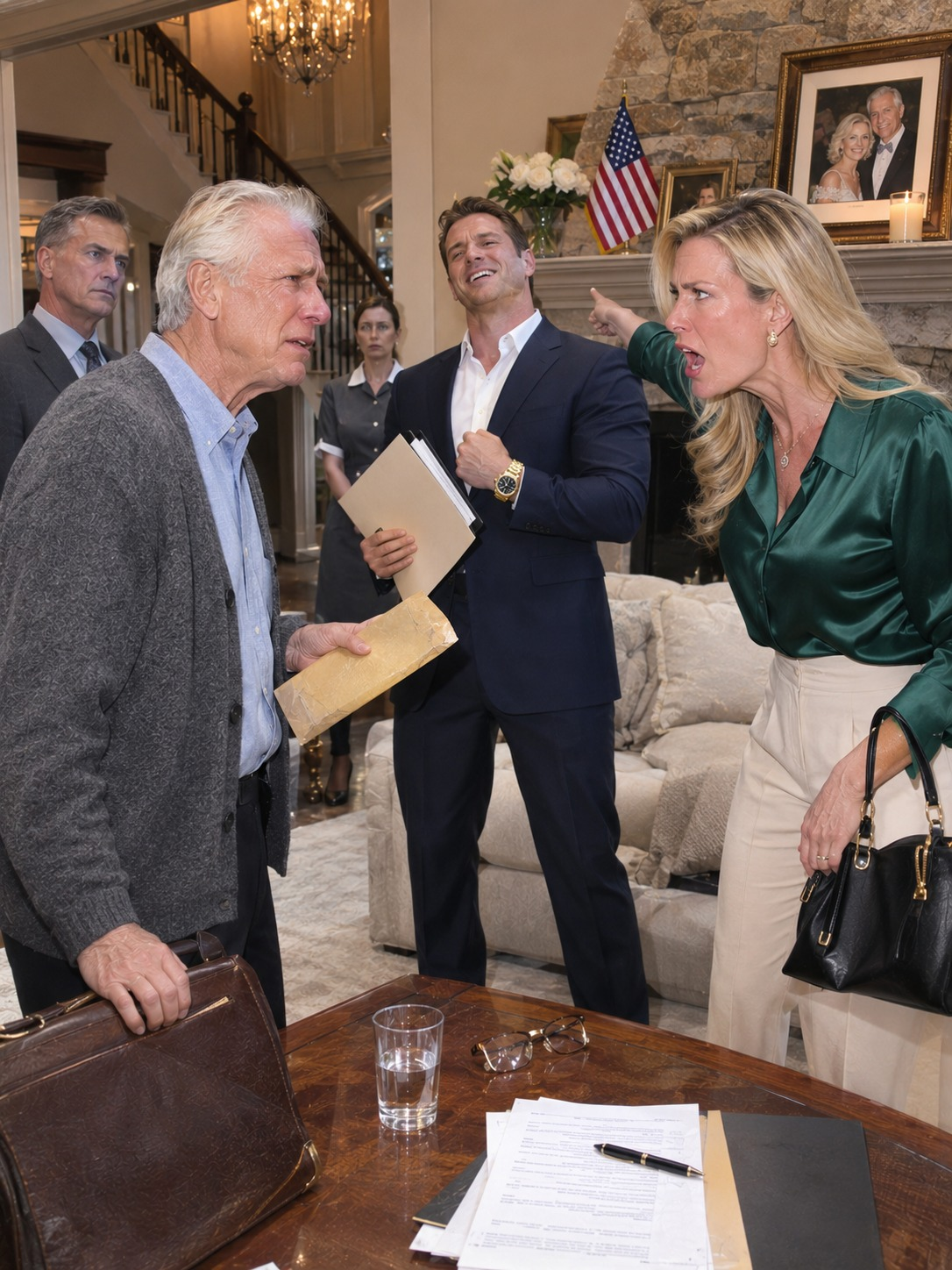
The figure stepped into the light.
Laura Whitcomb.
The woman who had visited Eleanor in the hospital.
The woman who had helped preserve my wife's financial records.
The woman who had delivered the original collateral authorization and insisted that the truth mattered more than appearances.
She stood at the top of the staircase holding a small leather notebook.
Her expression was grave.
"Thomas," she said, "before you believe what Michael says, you need to know who really authorized those transfers."
I stared at her.
"Laura?"
She descended slowly.
Michael stepped away from the front door.
Rebecca tightened her grip on my arm.
Margaret remained motionless near the hallway.
I looked at Laura.
"What are you doing upstairs?"
"I was retrieving something Eleanor asked me to keep safe."
"From her office?"
She nodded.
I glanced toward the notebook.
"Does it have anything to do with the account in Rebecca's name?"
"Yes."
Michael closed his eyes.
I turned toward him.
"Then perhaps you should sit down."
He shook his head.
"Dad, I can explain."
"You've had several opportunities."
He looked wounded.
I continued.
"Every time I ask a question, you tell me the answer is complicated. Every time I discover another document, you tell me I'm misunderstanding it."
I stepped toward the coffee table.
"Now I want everyone to stop talking around the truth."
Rebecca slowly released my arm.
Laura reached the bottom of the staircase.
She placed the notebook beside the bank statement.
"I need to clarify something before we begin," she said. "Eleanor asked me to preserve this notebook, but I didn't personally witness every transaction described in it."
Catherine Brooks had taught me to appreciate that distinction.
A record was not automatically proof.
A suspicion was not a fact.
And a signature did not establish who had physically signed a document until its authenticity had been verified.
I nodded.
"Then tell us what you know."
Laura opened the notebook.
Inside were Eleanor's handwritten notes.
Dates.
Account references.
Names.
Questions.
I recognized her handwriting immediately.
Near the top of one page, she had written:
Rebecca's name appears on an account she may not control.
Below that:
Determine who opened it. Determine who benefits.
Rebecca leaned forward.
"Mom knew?"
Laura nodded.
"She discovered the account during a review of intercompany transactions."
My daughter stared at the notebook.
"Why didn't she tell me?"
Laura hesitated.
"She wanted to establish whether the account was genuinely unauthorized before making an accusation."
Michael gave a bitter laugh.
"She suspected everyone."
I turned toward him.
"She asked questions."
He looked away.
Laura continued.
"The account appears to have been opened using documentation associated with Bennett Residential Holdings. Eleanor was concerned because certain payments into and out of it did not match the records she had been given."
I looked at Rebecca.
"Did you know about it?"
She shook her head.
"No."
"Did you ever authorize anyone to open an account using your name?"
"Not that account."
Laura looked at Michael.
"And you?"
He stared at the floor.
"I knew it existed."
Rebecca turned sharply.
"What?"
Michael rubbed his forehead.
"I knew there was a special-purpose account."
"Under my name?"
He hesitated.
"Under documentation connected to your company."
Rebecca stepped closer.
"Michael, that is not the same thing."
He looked at her.
"I didn't open it."
"Then who did?"
He swallowed.
"Daniel."
The room became silent.
Daniel Mercer.
Michael's chief financial officer.
The man connected to Westbridge Consulting Group.
The man Eleanor had repeatedly asked to explain questionable transactions.
I looked at my son.
"Did Daniel tell you why he opened it?"
Michael nodded slowly.
"He said it was needed for a temporary financing arrangement."
"Did you verify that?"
He looked away.
"No."
Rebecca stared at him.
"You let someone use my company and my name without telling me?"
Michael's expression hardened.
"I didn't know the account was being used that way."
"Then why didn't you ask?"
He raised his voice.
"Because I was trying to keep the manufacturing company alive!"
The words echoed through the room.
I watched my son.
His face was flushed.
His hands were trembling.
For the first time, he was not pretending everything was under control.
I spoke quietly.
"Michael, sit down."
He looked at me.
Then slowly lowered himself onto the sofa.
I sat across from him.
"Tell me what happened."
He stared at his hands.
For several seconds, he said nothing.
Then he whispered, "We were losing major contracts."
I leaned forward.
"When?"
"About three years ago."
"Why?"
He shook his head.
"Supply costs increased. We expanded too quickly. Some of the new equipment didn't perform the way we expected."
I listened.
"We borrowed money to cover the expansion. Then interest costs increased. We needed more working capital."
I nodded.
"Why didn't you tell Eleanor?"
He looked at me.
"Because she warned me not to expand that fast."
I felt a familiar ache.
Eleanor had always been cautious about borrowing.
She believed debt could help a business grow.
But she also believed that debt became dangerous when people began treating future success as guaranteed.
Michael continued.
"I thought I could fix it."
"Did you?"
He shook his head.
"No."
Rebecca sat down beside him.
He looked at her.
"Daniel said he had a plan."
"What plan?" I asked.
"He said we could move certain expenses through related entities while we negotiated new financing."
I frowned.
"Was that legitimate?"
Michael hesitated.
"He said it was."
I looked at Laura.
She remained silent.
I turned back to my son.
"Did you understand what he was doing?"
"Not completely."
"Then why did you allow it?"
His eyes filled.
"Because I was scared."
For a moment, I saw the boy who had broken the neighbor's window.
The boy who once believed that telling the truth was more important than avoiding punishment.
I wanted to reach for him.
But I stayed where I was.
Fear could explain a decision.
It could not erase its consequences.
"Michael," I said, "you need to tell Catherine everything."
He nodded.
"I know."
Then Rebecca spoke.
"And what about me?"
We turned toward her.
She looked at her brother.
"You used my company."
Michael shook his head.
"I didn't know Daniel was using your identity."
"But you knew there was an account."
"Yes."
"And you said nothing."
He lowered his head.
Rebecca stood.
Her face was pale.
"I trusted you."
Michael looked up.
"I know."
"No," she whispered. "You don't."
She walked toward the window.
For a long moment, nobody spoke.
Then Laura closed the notebook.
"There's another reason Eleanor was concerned."
I looked at her.
"What?"
"She believed the account might have been used to create the appearance that certain obligations had been paid when the underlying money was simply moving between related entities."
My stomach tightened.
"Would that affect the loan records?"
"Potentially. That's why the transactions need independent review."
I looked toward Michael.
He had covered his face with his hands.
I thought about the eighteen million, six hundred thousand dollars the companies owed to the trust's lending entity.
I thought about the upcoming three-million-dollar payment.
And I wondered how much of the apparent financial strength my children had inherited was real.
Catherine arrived the following morning.
I had called her after Laura's explanation.
She listened carefully and asked that the documents be preserved.
She also advised us not to confront Daniel Mercer directly until the relevant records could be secured through proper channels.
Now she sat in Eleanor's office with William Prescott, Richard Collins, and an independent forensic accountant named Helen Ward.
Helen was a woman in her late fifties with silver-streaked hair and a quiet, precise manner.
She had spent more than thirty years examining complex financial records.
I liked her immediately.
Not because she promised to solve everything.
Because she refused to pretend that she already knew the answers.
"Mr. Bennett," she said, "the first thing we need to do is separate confirmed facts from unresolved questions."
I nodded.
"That sounds sensible."
She opened a notebook.
"We have records indicating significant transfers involving Westbridge Consulting Group. We have an account associated with Rebecca Bennett's identity. We have discrepancies between certain financial reports. And we have questions concerning collateral authorizations."
I listened carefully.
"None of those facts, individually, tells us exactly what happened."
I nodded.
"Then how do we find out?"
"We reconstruct the transactions."
"How?"
"Bank statements, invoices, contracts, general ledgers, approval records, communications, and independent confirmation from the institutions involved."
I looked at William.
"Can the trust require that information?"
He answered carefully.
"The lending agreements contain reporting and inspection provisions. We'll need to follow the applicable procedures and respect any legal limitations."
Catherine nodded.
"We'll coordinate the requests."
I looked toward the window.
"How long will it take?"
Helen considered the question.
"Some issues may be clarified quickly. Others could take weeks or longer."
I sighed.
"Then we'd better begin."
She gave a small smile.
"That's the right attitude."
Catherine placed another folder on the desk.
"Thomas, there's something else we need to discuss."
I looked at her.
"What?"
"Your authority over the trust."
I straightened.
"Is there a problem?"
"Not necessarily. But we need to make sure the administration is properly documented and that no one can create confusion about your role."
I frowned.
"What kind of confusion?"
She hesitated.
"Someone has requested information about the process for challenging or modifying trustee authority."
I stared at her.
"Who?"
"We're verifying the source of the inquiry."
My heart began pounding.
"Was it Michael?"
"I don't know."
I looked toward the doorway.
Rebecca had been unusually quiet since the previous evening.
She had apologized for her behavior after the will reading.
She had seemed genuinely distressed by the account opened under her name.
But I had also seen how quickly money could change the way people treated one another.
I looked back at Catherine.
"What would someone have to do to take control of the trust?"
She answered carefully.
"That depends on the governing documents and applicable law. A beneficiary or interested party cannot simply seize control because they disagree with a trustee's decisions."
I nodded.
"But someone could try?"
"Someone could make allegations or pursue legal proceedings. Whether those efforts had merit would depend on the facts."
I felt a chill.
"Do you think my children might do that?"
Catherine studied me.
"I think we should be prepared for the possibility of pressure."
I looked at Eleanor's photograph.
My wife had anticipated so much.
Had she anticipated this too?
That afternoon, Rebecca asked to speak with me.
We sat in the garden.
It was the same garden where Eleanor had once told me she feared our children were becoming entitled.
The roses had begun to fade.
Autumn leaves covered the stone path.
Rebecca wore a cream sweater and dark trousers.
She looked younger without her usual expensive jewelry.
For a while, we sat in silence.
Then she said, "Dad, I want to ask you something."
"Of course."
"Do you trust me?"
The question hurt more than I expected.
I looked at her.
"I love you."
She lowered her eyes.
"That's not what I asked."
I took a slow breath.
"Rebecca, trust is something we're going to have to rebuild."
Her face tightened.
"Because of what I said after the will reading?"
"That was part of it."
She stared at the garden.
"I apologized."
"I know."
"Wasn't that enough?"
I looked at her.
"An apology matters. But it doesn't erase what happened."
She folded her arms.
"So you're going to punish me forever?"
I felt a familiar sadness.
"No."
"Then what do you want?"
"Honesty."
She looked away.
I continued.
"I want you to understand your businesses. I want you to take responsibility for the decisions made in your name. And I want you to stop treating your mother's money as though it proves how much she loved you."
Rebecca's eyes filled.
"She left you more than she left us."
I looked at her.
"She left me financial security after forty-six years of marriage."
Rebecca shook her head.
"Sixty-three million dollars."
"Yes."
"And we're supposed to be happy about that?"
I stared at my daughter.
"Why wouldn't you be?"
She looked at me as though I had asked something absurd.
"Dad, that's more than we inherited."
I nodded.
"Your mother had the right to make that decision."
Rebecca's expression hardened.
"She didn't even tell us."
"She didn't tell me either."
"That's different."
"Why?"
She opened her mouth.
Then stopped.
I waited.
Finally, she whispered, "Because you're her husband."
I nodded slowly.
"Exactly."
For a moment, she looked ashamed.
Then she turned away.
I thought the conversation was over.
But after several seconds, she spoke again.
"Michael says you could destroy our companies."
I felt my chest tighten.
"Michael is frightened."
"He says the trust controls the loans."
"The trust's lending entity holds those obligations."
"And you control the trust."
"I have authority and responsibilities under its terms."
She looked at me.
"So you could refuse extensions."
"Any extension would need to be evaluated properly."
She stared at me.
"Even if it means we lose everything?"
I took a slow breath.
"Rebecca, your mother did not leave me this trust so I could use it to hurt you."
Her expression softened slightly.
"Then promise me you won't."
I looked at her.
"I promise I will act responsibly."
"That's not what I asked."
"It's the only promise I can make."
She looked away.
And something in her expression frightened me.
Not anger.
Calculation.
That evening, I received a call from Richard Collins.
"Thomas, are you alone?"
"Yes."
"I need to speak with you about a document."
My stomach tightened.
"What document?"
"An inquiry concerning the trust."
I sat down.
"From whom?"
He hesitated.
"Rebecca's attorney."
I closed my eyes.
Of course.
"What does she want?"
"Her attorney has requested information about the trust's administration and the circumstances surrounding Eleanor's final amendments."
I stared at the wall.
"Why?"
"The letter raises questions about whether Eleanor had sufficient capacity when she signed certain documents."
For a moment, I could not speak.
Then I whispered, "She's questioning her mother's mind?"
Richard answered carefully.
"Her attorney has raised the issue. That does not mean the allegation is supported."
I looked toward Eleanor's photograph.
My wife had spent her final months fighting illness.
She had been exhausted.
Sometimes frightened.
Sometimes in pain.
But she had remained determined to protect the people she loved.
And now our daughter was questioning the validity of her decisions.
I felt something inside me tighten.
"Richard, did Eleanor understand what she was signing?"
He answered immediately.
"In my interactions with her, she demonstrated a clear understanding of the matters we discussed."
I closed my eyes.
"Then why is Rebecca doing this?"
"I can't speak for her motives."
I nodded.
"What happens next?"
"Catherine should review the inquiry and respond appropriately. We should also preserve the records concerning Eleanor's estate planning and capacity."
I thanked him.
Then I ended the call.
For several minutes, I sat in silence.
I thought about the garden conversation.
Rebecca asking whether I trusted her.
Rebecca demanding that I promise not to enforce the loan agreements.
Rebecca becoming angry when I refused.
And now this.
I felt betrayed.
But I also felt something else.
Concern.
My daughter was frightened.
She had inherited valuable properties carrying substantial debt.
She had discovered that someone might have used her identity in financial transactions.
And she was beginning to understand that the inheritance she had celebrated might be far more complicated than she imagined.
Perhaps she believed controlling the trust would solve everything.
Perhaps someone had convinced her of that.
Either way, she was making another mistake.
And this time, I could not protect her from the consequences by remaining silent.
The next morning, Catherine came to the mansion.
She carried a copy of the inquiry.
I read it carefully.
The language was formal.
Respectful.
But the meaning was unmistakable.
Rebecca's attorney was questioning the validity of certain trust amendments and seeking information about my authority as successor trustee.
The letter also suggested that the trust's lending arrangements might create conflicts affecting the inherited businesses.
I looked at Catherine.
"Is any of this true?"
She answered carefully.
"Some issues deserve proper review, including conflict management. But the letter contains allegations and requests, not established findings."
I nodded.
"Can Rebecca take control?"
"Not simply by sending this letter."
I felt a small sense of relief.
Catherine continued.
"However, we should respond through counsel and ensure the trust's administration is properly documented."
I looked at the paper again.
"Did Eleanor expect this?"
Catherine hesitated.
"She anticipated that family members might question her decisions."
I stared at her.
"How do you know?"
She opened her briefcase.
Then removed a sealed envelope.
My name was written across the front.
Eleanor's handwriting.
Again.
I felt my throat tighten.
"What is that?"
"An instruction letter Eleanor left with me."
I accepted it.
My hands trembled.
I opened the envelope.
Inside was a single page.
Thomas,
If Rebecca questions my decisions, please remember that fear often makes people behave in ways they later regret.
I love our daughter.
But I have watched her become increasingly dependent on Michael's judgment.
She is intelligent and capable, yet she has allowed herself to believe that disagreement is rejection.
Do not surrender your rights to prove your love.
I stopped reading.
Tears filled my eyes.
I continued.
If she challenges the trust, let the professionals handle the legal questions.
Do not argue with her about money.
Ask her what she is afraid of losing.
I lowered the letter.
For a moment, I could almost hear Eleanor speaking.
Calm.
Practical.
Loving.
Even now, she was reminding me that our daughter was more than her worst decisions.
I looked at Catherine.
"She knew Rebecca might do this."
Catherine nodded.
"She was concerned about the possibility."
I looked down.
"Did she leave anything else?"
Catherine hesitated.
"Yes."
My heart began pounding.
"What?"
"She left instructions concerning the documentation of her estate-planning decisions."
I looked at her.
"What kind of documentation?"
"Meeting notes, correspondence, and other records that may help establish the circumstances under which she signed the amendments."
I nodded slowly.
"Then we should preserve them."
"We already have."
I looked toward Eleanor's photograph.
"She really did think of everything."
Catherine smiled sadly.
"She tried."
That afternoon, I asked Rebecca to meet me in the living room.
She arrived wearing a dark business suit.
Her expression was guarded.
"Dad, what's this about?"
I gestured toward the sofa.
"Sit down."
She hesitated.
Then sat.
I remained in Eleanor's chair.
For a moment, I studied her.
She looked so much like her mother at that age.
The same determined chin.
The same dark eyes.
The same habit of folding her hands when she was nervous.
I felt my chest tighten.
"Rebecca, I received a letter from your attorney."
Her expression changed.
"Oh."
I nodded.
"Yes."
She looked away.
"Dad, I was going to tell you."
"When?"
She hesitated.
"I don't know."
I took a slow breath.
"Why are you challenging the trust?"
She folded her arms.
"I'm not challenging you."
"The letter questions my authority."
"It's just asking for information."
"It also questions your mother's capacity."
Rebecca looked down.
"My attorney said we needed to preserve our options."
I stared at her.
"Options for what?"
She hesitated.
"Protecting the businesses."
I leaned forward.
"Rebecca, do you understand what you're asking?"
She looked at me.
"I'm asking for transparency."
"Then why didn't you come to me?"
She shook her head.
"Because you already have lawyers."
"So do you."
She looked away.
I continued.
"Your mother wanted the trust administered responsibly. She wanted the loans reviewed. She wanted the businesses to succeed if they could do so honestly."
Rebecca's eyes filled.
"Then why did she make everything so complicated?"
I felt a sharp ache.
"Because she knew money could destroy a family if people stopped telling the truth."
Rebecca wiped her eyes.
For several seconds, neither of us spoke.
Then I remembered Eleanor's letter.
Ask her what she is afraid of losing.
I leaned forward.
"Rebecca, what are you afraid of?"
She looked up.
"What?"
"What are you afraid of losing?"
Her face changed.
She opened her mouth.
Then closed it.
I waited.
Finally, she whispered, "Everything."
I felt my chest tighten.
"Tell me."
She shook her head.
"Dad, you don't understand."
"Then help me."
Tears rolled down her cheeks.
She looked toward the window.
Then back at me.
"Michael says the residential company could collapse if the loans aren't extended."
I nodded.
"That may be a real concern."
"He says if the trust demands repayment, the bank could take the properties."
"We need to understand the actual obligations and available options."
She shook her head.
"He says you won't help us."
I stared at her.
"Have I said that?"
"No."
"Then why do you believe it?"
She lowered her head.
"Because he said Mom wanted to teach us a lesson."
I felt anger rise.
Not at Rebecca.
At the way fear was being used to turn us against one another.
I took a slow breath.
"Rebecca, your mother did not build the trust to punish you."
She looked up.
"Then why didn't she tell us?"
"Because she wanted you to become responsible for your own decisions."
Rebecca cried quietly.
I moved beside her.
For a moment, she leaned against my shoulder.
I held her.
Just as I had when she was a child.
Then she whispered something that made me freeze.
"Dad, I didn't want to challenge the trust."
I looked down.
"What?"
She wiped her eyes.
"Michael said it was the only way."
My heart began pounding.
"The only way to do what?"
She hesitated.
"To stop the review."
I stared at her.
"What review?"
"The one Catherine and William are conducting."
I felt cold.
"Why would Michael want to stop it?"
Rebecca looked frightened.
"He said if the accountants found certain records, the companies could be ruined."
I stared at her.
"What records?"
She shook her head.
"I don't know."
I took her hands.
"Rebecca, listen to me. You need to tell Catherine everything."
She nodded.
"I will."
I looked into her eyes.
"And you need to decide whether you're going to keep letting Michael make decisions for you."
She lowered her head.
"I know."
For a moment, I felt hope.
Perhaps my daughter was finally beginning to understand.
Perhaps she was ready to stop hiding behind her brother.
Perhaps Eleanor's words had reached her through me.
Then Rebecca's phone vibrated.
She looked at the screen.
Her expression changed immediately.
I frowned.
"What is it?"
She swallowed.
"Michael."
I looked at her.
"What does he want?"
She turned the phone toward me.
The message read:
"DO NOT TELL DAD ABOUT THE SECOND ACCOUNT."
My heart began pounding.
I looked at Rebecca.
"There's another account?"
She nodded slowly.
Tears filled her eyes.
"Dad, I was going to tell you."
I stared at her.
"What account?"
She hesitated.
Then whispered, "The one Mom discovered before she died."
I felt my stomach drop.
"Rebecca, what are you talking about?"
She looked toward the hallway.
Then back at me.
"Mom found a transfer that didn't belong to any of our companies."
I leaned forward.
"How much?"
She swallowed.
"Almost nine million dollars."
I stared at her.
"Where did it go?"
She shook her head.
"I don't know."
"Who authorized it?"
Her face went pale.
She looked toward Eleanor's photograph.
Then back at me.
"Dad, that's the part I was afraid to tell you."
I felt my heart pounding.
"Tell me."
She opened her mouth.
Then stopped.
Her phone vibrated again.
Another message from Michael.
This time, it contained a photograph.
Rebecca stared at it.
Her face changed to horror.
I leaned closer.
"What is it?"
She slowly turned the screen toward me.
The photograph showed a bank authorization form.
At the bottom was a signature.
A signature that looked exactly like Eleanor's.
But the date was three days after my wife's death.
I stared at the screen.
My hands began trembling.
"Rebecca, where did Michael get this?"
She shook her head.
"I don't know."
Then a third message appeared.
It contained only six words.
"ASK DAD WHO SIGNED FOR MOM."
I felt my blood turn cold.
Rebecca looked at me.
Her voice trembled.
"Dad, what does that mean?"
Before I could answer, the doorbell rang.
Margaret appeared in the hallway.
Her face was pale.
"Mr. Bennett, there's a woman outside asking for you."
I stood.
"What woman?"
Margaret swallowed.
"She says she's from the bank."
I looked toward the door.
"What does she want?"
Margaret hesitated.
"She says she has the original authorization for the nine-million-dollar transfer."
My heart began pounding.
"Then let her in."
Margaret opened the door.
A woman in a dark coat stepped inside.
She carried a sealed envelope.
Her expression was grave.
"Mr. Thomas Bennett?"
"Yes."
"I'm here because your wife's trust may have been used in a transaction after her death."
I stared at her.
"What transaction?"
She opened the envelope.
Inside was a document.
She placed it on the coffee table.
Rebecca stepped closer.
I leaned forward.
At the bottom was Eleanor's name.
But beneath it was another line.
Authorized Representative.
I looked at the woman.
"Who signed as her representative?"
She hesitated.
Then turned the page.
My heart stopped.
Because the name printed beneath the signature belonged to someone who had been sitting beside me at Eleanor's funeral.
Someone who had comforted me while I cried.
Someone who had promised to protect our family.
And as I leaned closer to read the name, Rebecca suddenly grabbed my arm and whispered, "Dad, please don't. If that's who I think it is, everything Mom told us was a lie."






Comments 0