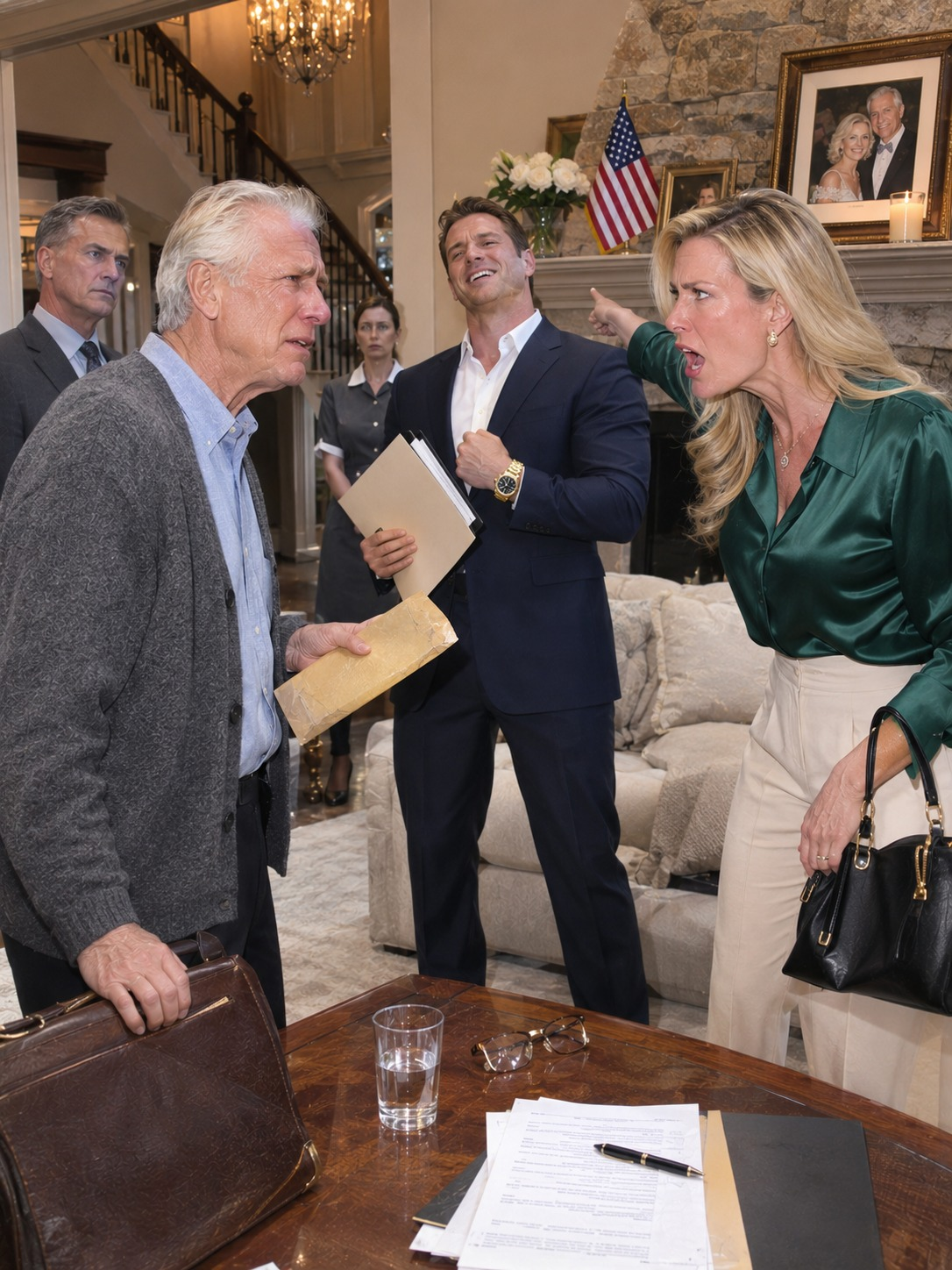
"Thomas, don't touch that page. There's something written on the back that changes everything."
Catherine Brooks caught my wrist just as I reached for the document.
I looked at her.
"What is it?"
She carefully turned the page over.
Across the back, in Eleanor's unmistakable handwriting, were seven words.
THIS SIGNATURE WAS NEVER AUTHORIZED BY ME.
My heart began pounding.
Below that sentence was another.
Ask Richard why his name appears here.
I slowly raised my eyes.
"Richard?"
Catherine studied the document.
"Thomas, we need to establish exactly what Eleanor meant."
I looked at the front again.
The third authorized representative listed beneath Daniel Mercer and Victor Hale was Richard Collins.
Our family attorney.
The man who had handled our legal affairs for more than twenty years.
The man who had witnessed Michael's loan certification.
The man whose name appeared on the attempted nine-million-dollar transfer after Eleanor died.
And now his name was on a document connected to Hawthorne Capital Services.
I stared at the page.
"How many times can one man's name appear in questionable documents before it stops being a coincidence?"
Catherine did not answer immediately.
Then she said, "As many times as someone chooses to misuse it, potentially. Or there may be another explanation. That's why we need the originals."
I looked at her.
"You still think Richard might be innocent?"
"I think we need evidence."
I closed my eyes.
Eleanor had said almost the same thing in her recording.
Never sacrifice an innocent person to protect our family.
I took a slow breath.
"All right."
Laura Whitcomb sat across from me.
Her face was pale.
I turned toward her.
"Did Eleanor ever confront Richard about this?"
Laura hesitated.
"She asked him whether he had authorized anyone to use his name in connection with Hawthorne."
"What did he say?"
"He denied it."
I stared at her.
"Did she believe him?"
Laura looked down.
"She wanted to."
The words hurt.
Because I understood them perfectly.
I wanted to believe Richard too.
He had been our attorney through difficult business decisions, property purchases, family disagreements, and the final painful months of Eleanor's life.
He had stood beside me at her funeral.
He had looked me in the eye and told me she loved me.
But trust was no longer enough.
Not when millions of dollars were involved.
Not when documents appeared to carry signatures people denied making.
And not when my children were standing on the edge of financial disaster.
I looked at Catherine.
"What happens now?"
She placed the document inside a protective sleeve.
"We preserve this copy, request authentication of the underlying records, and ask Richard for an explanation with appropriate counsel present."
I nodded.
"And Michael?"
Catherine's expression became serious.
"There's an urgent issue involving his manufacturing company."
My stomach tightened.
"What issue?"
She looked toward William Prescott.
William opened his folder.
"The bank has completed its preliminary review of the upcoming loan payment."
I leaned forward.
"How bad is it?"
He hesitated.
"Thomas, the company may not have sufficient verified liquidity to meet its scheduled obligation."
I felt cold.
"How much is due?"
"Approximately three million dollars."
I stared at him.
"And when?"
"Very soon."
I looked toward Eleanor's photograph on my phone.
For years, Michael had spoken about his company as though it were an unstoppable success.
Now I was learning that the business might not be able to make a payment that Eleanor had warned him about long before she died.
I looked at William.
"What happens if he can't pay?"
"That depends on the agreement, any applicable notice and cure provisions, and whether a lawful restructuring can be negotiated."
I nodded.
"Can we help?"
Catherine answered.
"Possibly. But we cannot simply ignore the loan terms or approve an extension without understanding the company's true financial condition."
I looked down.
Eleanor had left me sixty-three million, four hundred thousand dollars.
My children had inherited businesses worth more than forty million dollars on paper.
And somehow, we were sitting in a conference room discussing whether my son's company could survive the next few weeks.
I felt a deep sadness.
Not because of the money.
Because I knew how much Eleanor had sacrificed to build those businesses.
And I knew how much pain she would have felt watching them unravel.
Michael called me that evening.
I was sitting in Eleanor's office, looking through old photographs.
"Dad?"
His voice sounded strained.
"Michael."
"Are you home?"
"Yes."
He hesitated.
"Can I come over?"
I almost laughed.
For three days, he had behaved as though the mansion belonged to him and I was merely a guest.
Now he was asking permission to enter.
"Of course," I said.
He was still my son.
Twenty minutes later, I heard his car in the driveway.
He entered without his usual confidence.
His shoulders were hunched.
His eyes were red.
He looked ten years older than he had at the will reading.
I met him in the living room.
"Sit down."
He lowered himself onto the sofa.
For several moments, neither of us spoke.
Then he whispered, "Dad, I'm in trouble."
I looked at him.
"I know."
He shook his head.
"No. You don't understand."
I sat across from him.
"Then tell me."
He stared at his hands.
"The bank wants updated financial statements."
I nodded.
"That's reasonable."
"They want explanations for the Westbridge payments."
"Also reasonable."
"They want documentation for the Hawthorne agreements."
I waited.
His eyes filled.
"And I don't have everything they're asking for."
I felt my chest tighten.
"Why not?"
He shook his head.
"Daniel handled those records."
"Where is Daniel?"
"I don't know."
"Have you reported the missing records?"
"Our attorneys are working on it."
I nodded.
"Good."
Michael leaned forward.
"Dad, if the bank doesn't extend the loan, we could lose the company."
I studied his face.
"Have you told the bank the truth about the financial problems?"
He looked away.
"Not all of it."
My heart sank.
"Michael."
He covered his face.
"I was trying to fix things."
I waited.
He lowered his hands.
"Every time I thought we were getting ahead, something else went wrong."
I looked at him.
"What went wrong?"
He swallowed.
"We lost a major contract. Then a supplier demanded payment earlier than expected. Then Daniel told me we needed temporary financing."
I nodded.
"And?"
"He said Hawthorne could provide it."
"Did they?"
Michael hesitated.
"Some money came in."
"How much?"
"About four million dollars over several transactions."
I stared at him.
"At what cost?"
He looked down.
"High fees. Short repayment periods. Additional security."
My stomach tightened.
"Security involving what?"
He hesitated.
"Certain company assets."
"And our home?"
He closed his eyes.
"I thought the house was included in a preliminary collateral schedule that would be corrected before closing."
I stared at him.
"You knew our home was listed?"
He nodded slowly.
"Yes."
"And you didn't tell me?"
He looked at me.
"Dad, I thought it would never become effective."
I felt anger rise.
I took a slow breath.
"Michael, you don't get to gamble with someone else's home because you hope a document won't matter."
His eyes filled.
"I know."
I looked away.
For a moment, I remembered teaching him to drive.
He was sixteen.
We were in an empty parking lot.
He accelerated too quickly and nearly struck a concrete barrier.
I slammed my foot against an imaginary brake.
He laughed nervously.
"Sorry, Dad."
I told him something I had repeated many times over the years.
"Confidence is useful, Michael. But confidence without judgment can hurt people."
He had nodded.
Then he drove more carefully.
Now, twenty-five years later, he had made the same mistake on a scale I could barely comprehend.
I looked at him.
"Did you ever ask Eleanor for help?"
He nodded.
"Yes."
"What did she say?"
His voice broke.
"She said she would help me understand the problem, but she wouldn't sign another blank promise."
I closed my eyes.
That sounded like Eleanor.
Michael continued.
"I thought she was being cruel."
I looked at him.
"She was trying to protect you."
He began crying.
Not quietly.
Not politely.
He bent forward and covered his face.
For the first time since he was a child, I watched my son cry without trying to hide it.
"Dad, I ruined everything."
I felt my chest tighten.
I wanted to tell him he hadn't.
I wanted to say the company would be fine.
That the money would be there.
That I would make everything disappear.
But I couldn't.
I did not know whether the company could survive.
And I had finally begun to understand that protecting Michael from consequences might be the worst thing I could do.
I moved beside him.
Then I placed my hand on his shoulder.
"Son, look at me."
He raised his head.
His face was wet.
"I love you."
He nodded.
"But I need you to tell the truth."
He looked away.
"All of it."
He swallowed.
Then whispered, "I don't know if I can."
I felt my heart sink.
"Why?"
He stared at the floor.
"Because if I tell the truth, I might lose everything."
I looked at him.
"Michael, you may already be losing the company."
He closed his eyes.
"But you don't have to lose your integrity too."
He began crying again.
And I sat beside him.
Not as a banker.
Not as a trustee.
As his father.
The next morning, Catherine called.
"Thomas, we need to meet with Michael's attorneys."
I sat at Eleanor's desk.
"Why?"
"The lender has issued a formal request for information and documentation under the loan agreements."
I nodded.
"Is the company in default?"
"That determination requires careful review. There are potential reporting issues and an approaching payment obligation."
I looked toward the window.
"What does Michael need to do?"
"Provide accurate records, preserve evidence, and work with his advisers on a realistic financial plan."
I nodded.
"Can the trust consider an extension?"
"Yes, if it's legally appropriate and consistent with your duties. But we need verified financial information and a credible proposal."
I looked down.
"Then let's hear one."
Catherine paused.
"Thomas, I want you to understand something."
"What?"
"Your children may try to make this personal."
I gave a tired smile.
"They already have."
"I know. But the trust's lending decisions cannot be based solely on guilt, anger, or family pressure."
I nodded.
"Eleanor said the trust wasn't a weapon."
"Exactly."
I looked at her name on the screen.
"Then I won't use it as one."
At eleven, Michael arrived at Catherine's office with his attorney, James Porter.
James was a tall man in his early fifties with graying hair and a serious expression.
He shook my hand politely.
"Mr. Bennett."
"Thomas, please."
He nodded.
"Thank you."
Michael sat beside him.
William and Helen Ward were already present.
Catherine opened the meeting.
"We're here to discuss the manufacturing company's financial position and the information needed to evaluate possible options."
James nodded.
"Understood."
Helen placed a summary on the table.
"Based on the records currently available, the company has experienced significant operating losses and cash-flow pressure."
Michael looked down.
Helen continued.
"Several intercompany transfers remain unexplained. We also need to verify the treatment of certain liabilities."
James made notes.
I looked at Michael.
He avoided my eyes.
William spoke.
"The lender needs a complete picture before considering any modification."
James nodded.
"We understand."
Catherine turned toward Michael.
"Mr. Bennett, do you have a current cash-flow forecast?"
Michael looked at James.
James answered.
"We're preparing one."
Helen asked, "Has an independent accountant reviewed the underlying assumptions?"
"Not yet."
I leaned back.
The company was facing a major payment.
And they still did not have a verified forecast.
I looked at my son.
"Michael, why wasn't this done months ago?"
He stared at the table.
"I thought Daniel had it under control."
I felt a familiar ache.
Daniel.
Again.
The man who seemed to have been responsible for everything.
And yet was nowhere to be found.
Catherine continued.
"We also need to understand the company's obligations to Hawthorne."
James looked uncomfortable.
"We're reviewing those agreements."
Helen placed another page on the table.
"Some payments appear to have been made to Hawthorne without corresponding loan proceeds appearing in the records we've received."
Michael looked up.
"What?"
Helen studied him.
"Did you know about that?"
He shook his head.
"No."
James leaned forward.
"Let's be careful. We need to verify the records before drawing conclusions."
Helen nodded.
"Agreed."
I looked at Michael.
He seemed genuinely shocked.
But I had learned that shock could mean many things.
Surprise.
Fear.
Confusion.
Or the realization that a secret was no longer safe.
I waited.
Then Helen asked another question.
"Michael, did Daniel Mercer have authority to initiate transfers without your approval?"
He hesitated.
"Up to certain limits."
"What limits?"
"Usually two hundred fifty thousand dollars."
Helen looked at the spreadsheet.
"Several transfers exceeded that amount."
Michael's face changed.
"What?"
She pointed toward the figures.
"Some were substantially larger."
He stared at the page.
Then whispered, "He couldn't have done that alone."
The room became quiet.
I leaned forward.
"What do you mean?"
Michael looked at James.
Then at Helen.
"He would have needed another approval."
My heart began pounding.
"Whose?"
He hesitated.
"Mine. Or another authorized officer's."
I stared at him.
"Did you approve them?"
He shook his head.
"Not all of them."
Catherine leaned forward.
"Then we need to identify the approving credentials and verify who used them."
Michael nodded slowly.
His face had gone pale.
I looked toward the window.
The situation was worse than I had imagined.
Not because I knew someone had stolen money.
I didn't.
But because the people responsible for millions of dollars could not explain who had authorized major transactions.
Eleanor would have been furious.
Not because of the losses.
Because of the carelessness.
After the meeting, Michael asked to speak with me privately.
We sat in a small conference room.
He looked exhausted.
"Dad, can I ask you something?"
"Of course."
He hesitated.
"Would you consider helping the company?"
I looked at him.
"What kind of help?"
He swallowed.
"An extension. Maybe additional time to refinance."
I nodded.
"That's something the lender can evaluate."
He leaned forward.
"But you control the trust."
"I have responsibilities under the trust."
"Dad, please."
I looked at him.
He continued.
"If we don't get more time, the company could collapse."
I felt my chest tighten.
"Then you need to provide accurate records and a realistic plan."
He shook his head.
"That takes time."
"Then start now."
His eyes filled.
"Dad, I'm begging you."
I looked at him.
He had never begged me for anything as an adult.
Not openly.
He had asked.
Demanded.
Assumed.
But never begged.
Now he sat across from me, frightened and desperate.
"Please don't let Mom's company die."
The words struck me harder than I expected.
I looked away.
For a moment, I saw Eleanor standing on the factory floor in 1998.
Her hair tied back.
Her sleeves rolled up.
Her face tired but determined.
I remembered her telling me she couldn't bear to lay off thirty-seven employees.
I remembered selling my father's land.
I remembered repairing machines late into the night.
We had fought to save that company.
Not because we wanted to become rich.
Because people depended on it.
Now, decades later, those same principles mattered.
Employees still depended on the business.
Families still depended on their paychecks.
And my son was asking me to save something he had not managed responsibly.
I looked at him.
"Michael, I will not destroy the company out of anger."
He exhaled.
"But I will not approve a financial arrangement I don't understand."
His expression tightened.
"Dad—"
"No."
I leaned forward.
"Listen to me."
He stopped.
"If the company can be saved responsibly, I want that."
His eyes filled.
"But you must tell the truth. You must cooperate with the review. And you must stop blaming everyone else for decisions you made."
He lowered his head.
"I know."
I continued.
"Your mother didn't build that company so you could use it to prove you were important."
He looked up.
"She built it because she believed work could give people dignity."
Tears rolled down his cheeks.
I placed my hand over his.
"Now you need to decide whether you're willing to honor that."
He nodded.
"I am."
I wanted to believe him.
More than anything.
That afternoon, Helen called Catherine with new information.
Catherine asked me to join a video meeting.
I sat at Eleanor's desk.
Helen appeared on the screen.
"Thomas, we've located additional records from a backup accounting system."
My heart began pounding.
"What do they show?"
"Several transactions involving Westbridge and Hawthorne."
I nodded.
"And?"
"Some payments appear to have been routed through accounts controlled by entities whose ownership is not yet fully established."
I frowned.
"Can we identify the people behind them?"
"We're working on it."
I sighed.
Then Helen continued.
"There's something more important."
I straightened.
"What?"
"We found evidence that certain financial reports may have been altered after Eleanor requested them."
My stomach tightened.
"Altered how?"
"Some entries were reclassified. Others were removed from the versions provided to her."
I stared at the screen.
"Who made the changes?"
"We have system logs identifying user accounts. But we still need to establish who actually used those accounts."
I nodded.
"Which accounts?"
Helen hesitated.
"One belonged to Daniel Mercer."
I closed my eyes.
Of course.
"And the others?"
She looked toward Catherine.
Then back at me.
"One was associated with Michael's office."
My heart sank.
I stared at the screen.
"Did Michael know?"
"We don't know."
I took a slow breath.
"Then we ask him."
Catherine nodded.
"Through counsel, with the records preserved."
I looked toward Eleanor's photograph.
The more we investigated, the more complicated everything became.
I wanted one clear answer.
One person.
One explanation.
But real life was rarely that simple.
People made mistakes.
People hid mistakes.
Other people took advantage of them.
And sometimes, by the time the truth emerged, everyone had something they regretted.
That evening, Rebecca came to my room.
She looked nervous.
"Dad?"
"Come in."
She sat beside me.
For a moment, she stared at her hands.
Then she whispered, "Michael told me he asked you for help."
I nodded.
"He did."
"Are you going to help him?"
"If the company can be saved responsibly."
She looked relieved.
Then she hesitated.
"What about my properties?"
I studied her.
"What about them?"
She swallowed.
"The residential company has debt too."
"I know."
"And if the manufacturing company collapses, it could affect us."
"Possibly."
She looked down.
"Dad, I'm scared."
I felt my chest tighten.
I moved closer.
"Tell me what you're afraid of."
She wiped her eyes.
"That Mom left us businesses we don't know how to run."
I stared at her.
For the first time, she had said something honest about the inheritance.
Not about how much she deserved.
Not about how unfair Eleanor had been.
But about her own uncertainty.
I took her hand.
"Then learn."
She looked up.
"What?"
"Learn how to run them."
She gave a sad laugh.
"Dad, it's not that easy."
"I know."
I smiled faintly.
"Neither was building them."
She lowered her head.
I continued.
"Your mother spent decades learning. She made mistakes. She asked questions. She listened to people who knew more than she did."
Rebecca nodded.
"You can do the same."
Tears filled her eyes.
"Do you really think I can?"
I looked at her.
"Yes."
She began crying.
I held her.
For a moment, she was my little girl again.
The girl who had returned a lost wallet.
The girl who wanted to make her parents proud.
I hoped she could find her way back to that person.
At ten-thirty, my phone rang.
William Prescott.
I answered immediately.
"William?"
"Thomas, I'm sorry to call so late."
"It's all right."
"We've received an urgent communication from the bank's compliance department."
My stomach tightened.
"What happened?"
He hesitated.
"There's been a development involving the attempted nine-million-dollar transfer."
I sat upright.
"What development?"
"The bank has identified additional records connected to the authorization package."
I felt cold.
"Do they show who submitted it?"
"Not conclusively. But they contain information about the source of the documents."
I looked toward the window.
"What information?"
William took a slow breath.
"Thomas, the authorization package appears to have included a scanned copy of Eleanor's signature from an older legitimate document."
My heart began pounding.
"So someone copied her signature?"
"That is one possibility under investigation."
I closed my eyes.
"And Richard's?"
"We're examining that too."
I nodded.
Then William continued.
"There's another issue."
I felt my stomach tighten.
"What?"
"The bank has located an instruction letter that was submitted shortly before Eleanor died."
I stared at the phone.
"From Eleanor?"
"It bears her name."
I swallowed.
"What does it say?"
He hesitated.
"It requests changes to certain account access permissions."
I felt cold.
"Did Eleanor authorize it?"
"We haven't established that."
I looked toward her photograph.
"Who submitted it?"
William paused.
"That's what concerns us."
My heart began pounding.
"William."
He took a breath.
"The submission was associated with a person who had access to Eleanor's private office."
I stared at the wall.
"Who?"
He hesitated.
"Thomas, I think we need to discuss this in person."
I closed my eyes.
"No. Tell me."
A long silence.
Then William whispered, "The records point toward someone who was present during Eleanor's final hospital stay."
My heart stopped.
I thought of Laura.
Margaret.
Richard.
Michael.
Rebecca.
The people who had visited Eleanor.
The people who had held her hand.
The people who had promised to protect her.
I swallowed.
"William, who was it?"
Before he could answer, I heard a knock at my bedroom door.
Three sharp knocks.
Then Margaret's voice.
"Mr. Bennett?"
I turned.
"Yes?"
"There's someone downstairs asking for you."
I felt cold.
"Who?"
She hesitated.
"Mr. Daniel Mercer."
My heart stopped.
Daniel.
The missing chief financial officer.
The man connected to Westbridge.
The man who had handled Michael's financial records.
The man who seemed to have disappeared just as the investigation began.
I stood.
"Margaret, is he alone?"
She hesitated.
"No, sir."
My heart began pounding.
"Who's with him?"
She swallowed.
"A woman."
I stared at the door.
"What woman?"
Margaret's voice trembled.
"She says she was with Mrs. Bennett when the final authorization was signed."
I looked toward the phone.
William was still on the line.
"Thomas?" he said urgently. "Don't let anyone remove documents from the house."
I felt my blood turn cold.
I opened the bedroom door.
Margaret stood in the hallway.
Her face was white.
"Mr. Bennett," she whispered, "you need to come downstairs."
I stepped past her.
At the bottom of the staircase, Daniel Mercer stood beside the front door.
He looked exhausted.
His jacket was wrinkled.
His eyes were bloodshot.
Beside him stood a woman in a dark coat.
Her face was partly hidden.
Daniel looked up.
When he saw me, his expression changed.
"Mr. Bennett," he said, "I'm sorry."
I stopped halfway down the stairs.
"Daniel, where have you been?"
He swallowed.
"Trying to find the original records."
My heart pounded.
"Did you find them?"
He nodded.
I stared at him.
"Then give them to Catherine."
Daniel looked toward the woman beside him.
She slowly removed her coat.
I froze.
Because I recognized her.
She had been at Eleanor's funeral.
She had stood beside me.
She had comforted me while I cried.
And now she was standing beside the man who might know where millions of dollars had gone.
I gripped the banister.
"Why are you here?"
The woman looked up.
Her eyes filled with tears.
Then she whispered, "Thomas, before Daniel tells you what happened, you need to know why Eleanor asked me to keep the final letter."
My heart stopped.
"Who are you?"
She stepped into the light.
And when I saw her face clearly, I realized she was someone I had trusted for years.
Someone whose name had appeared in Eleanor's private records.
Someone who had been present during the final days of my wife's life.
She reached into her handbag.
Removed a sealed envelope.
And held it toward me.
"Thomas," she whispered, "Eleanor told me to give you this only if Michael's company was about to collapse."
I stared at the envelope.
My hands began trembling.
Then Daniel stepped forward.
"Mr. Bennett, there's something you need to understand."
I looked at him.
"What?"
He swallowed.
"The person who authorized the transfers wasn't acting alone."
My heart pounded.
"Who was helping?"
Daniel looked toward the woman.
Then back at me.
His face went pale.
And just as he opened his mouth to say the name, the woman suddenly grabbed his arm and whispered, "Don't. If you tell Thomas who signed the final agreement, he'll discover what happened to Eleanor in the hospital."






Comments 0