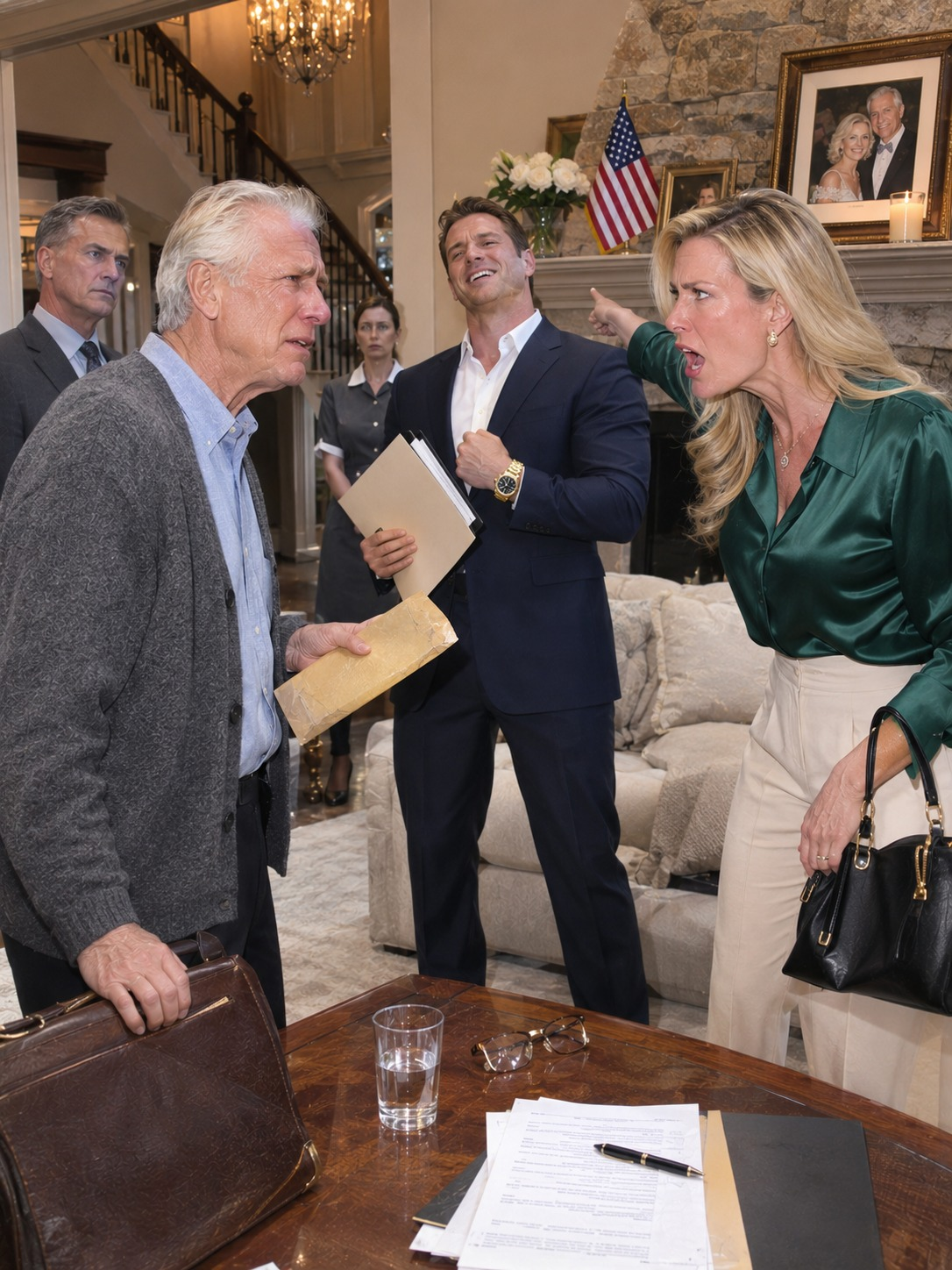
"Mr. Bennett, before I show you the surveillance photograph, you need to know that the person who entered the authorization code was Margaret Ellis."
For a moment, I thought I had misheard him.
Margaret.
Our housekeeper.
The woman who had brought me soup when my children humiliated me.
The woman who had cared for Eleanor during her final illness.
The woman who had worked in our home for seventeen years.
I stared at the security officer.
"That's impossible."
He looked uncomfortable.
"Sir, the system recorded an authorization associated with Mrs. Ellis's credentials."
I turned toward Margaret.
She stood beside the staircase.
Her face had gone completely white.
"Margaret?"
She shook her head.
"Mr. Bennett, I didn't authorize anything."
The security officer raised one hand.
"Please understand that an account identifier does not establish who physically entered the code. That's why we're investigating."
I looked at him.
"Then why did you say it was Margaret?"
"Because her name appears in the authorization record. I should have been more precise."
William Prescott stepped forward.
"Let's establish exactly what the records show before anyone draws conclusions."
I nodded.
That was what Eleanor would have wanted.
But I could barely think.
The past three days had already changed everything I believed about my family.
Now someone was suggesting that Margaret might be involved in an attempted transfer of nearly four million dollars.
I looked at her again.
Her eyes were filled with tears.
"Thomas," she whispered, "I swear I didn't do this."
I had never heard her use my first name before.
Not once in seventeen years.
I moved toward her.
"Margaret, look at me."
She did.
"Did Eleanor ever give you access to her financial accounts?"
Margaret hesitated.
"She gave me permission to help with certain household payments when she became ill."
"What kind of payments?"
"Medical bills. Household expenses. Staff wages. Things like that."
William frowned.
"Did she give you access to the trust's lending accounts?"
"No."
"Did you ever receive a security token or authorization device?"
Margaret shook her head.
"Not that I know of."
The security officer opened his report.
"Mrs. Ellis, did you ever use a computer in Mrs. Bennett's private office?"
"Sometimes. When she asked me to print something."
"Did you have a password?"
"She would sign in for me."
I watched his expression change.
"Did anyone else have access to that computer?"
Margaret looked toward Michael.
Then Rebecca.
Then Richard.
"I don't know."
The room became very quiet.
Michael crossed his arms.
"This is ridiculous. Margaret has worked here forever."
I turned toward him.
Only yesterday, he had treated me like an inconvenience.
Now he was suddenly defending our housekeeper.
I wanted to believe it was kindness.
But I had learned not to mistake a confident statement for the truth.
The security officer continued.
"The attempted transfer was initiated through a remote session. The authorization code was associated with a credential previously registered under Mrs. Ellis's name for a limited administrative function."
William looked sharply at him.
"Limited administrative function?"
"Yes. The credential appears to have been created during Mrs. Bennett's illness."
Catherine Brooks stepped closer.
"Was that credential authorized to approve a commercial lending transfer?"
"According to the current permission records, no."
I felt my chest tighten.
"Then how did someone use it?"
"That's what we need to determine."
He looked down at the report.
"The system recorded an attempted privilege escalation before the transfer instruction was submitted."
I frowned.
"What does that mean?"
William answered.
"Someone may have tried to obtain authority the credential did not ordinarily possess."
The security officer nodded.
"That's one possibility. The logs require forensic review."
I looked toward Margaret.
She was trembling.
"Margaret, sit down."
She shook her head.
"I'm all right."
"No, you're not."
I guided her toward a chair.
She sat slowly.
Then she whispered, "Mrs. Bennett warned me something like this might happen."
Everyone turned toward her.
I felt my heart begin pounding.
"What did Eleanor say?"
Margaret looked down at her hands.
"She told me that if anyone ever accused me of accessing her financial accounts, I should ask for the second folder."
William went completely still.
"The second folder?"
Margaret nodded.
"She said it would explain why my name might appear on certain records."
I stared at her.
"Where is it?"
Margaret looked toward the staircase.
"In her private office."
Eleanor's office was at the far end of the second-floor hallway.
For years, it had been one of the busiest rooms in our home.
She worked there early in the morning, late at night, and sometimes during family holidays when an urgent business matter required her attention.
The room smelled faintly of leather, paper, and the lavender hand cream she always kept beside her keyboard.
I had avoided entering it since her death.
Not because it frightened me.
Because I could still imagine her sitting behind the desk.
Reading glasses low on her nose.
A pen between her fingers.
Looking up when I entered and smiling.
"Thomas, sweetheart. Give me five minutes."
She always said five minutes.
Sometimes it became an hour.
I never minded.
Now I stood in the doorway with Catherine, William, Richard, Laura, Margaret, Michael, Rebecca, and the security officer.
The room felt crowded.
I looked at everyone.
"Not all of us need to go inside."
Catherine nodded.
"Agreed. We should preserve the condition of the room and document any records we examine."
William asked the security officer to remain outside while the bank continued reviewing the access logs.
Michael immediately objected.
"Why? We're all family."
I turned toward him.
"That's exactly why I want independent professionals present."
His expression tightened.
Rebecca said nothing.
I asked Margaret to show us where Eleanor had kept the folder.
She walked toward a tall cabinet beside the window.
It was made of dark walnut.
Eleanor had purchased it during our twentieth wedding anniversary trip.
I remembered carrying it into the house myself because the delivery men had scratched the front door while bringing in another piece of furniture.
Margaret pointed toward the lower drawer.
"Mrs. Bennett said the folder was behind the old tax records."
William looked at Catherine.
"Should we proceed?"
Catherine nodded.
"Let's document what we find."
Laura photographed the closed cabinet.
Then Margaret opened the drawer.
Inside were several neatly labeled files.
Property Taxes.
Insurance.
Household Accounts.
Historical Records.
Margaret removed the first three folders.
Behind them was a thick black binder.
And beneath the binder lay a second navy-blue folder.
I felt my breath catch.
The first blue folder had revealed the trust.
This one had been hidden in Eleanor's private office.
Margaret looked at me.
"That's it."
I reached toward it.
Then stopped.
Catherine placed a hand on my arm.
"Thomas, let's examine it carefully."
I nodded.
She photographed the folder before opening it.
On the cover, Eleanor had written three words.
FOR THOMAS ONLY.
My throat tightened.
Below them was a date.
November 2, 2025.
Almost a year before her death.
I stared at the handwriting.
"Eleanor," I whispered.
Catherine opened the folder.
Inside were copies of financial records.
Emails.
Bank authorization forms.
A handwritten timeline.
And a sealed envelope.
My name appeared on the front.
Again.
I looked at Catherine.
"May I?"
She nodded.
I opened the envelope.
Inside was a letter.
My darling Thomas,
If you are reading this, someone has probably tried to make you doubt a person who has been loyal to our family.
I looked toward Margaret.
She began crying.
I continued.
Margaret helped me during the months when I was too weak to manage ordinary household matters. I authorized limited administrative access for her so she could pay bills and help keep our home running.
That access was never intended to permit transfers involving the trust's commercial lending accounts.
I looked at William.
He nodded slowly.
The letter continued.
I became concerned when I discovered that someone had requested additional permissions using Margaret's name.
My heart began pounding.
She did not request them.
I lowered the letter.
Margaret covered her mouth.
I looked at her.
"She knew."
Margaret nodded through her tears.
"She told me she was looking into it."
I continued reading.
I instructed the bank to restrict the credential and preserve the access records. If anyone later attempts to use it, the records should show that the activity requires investigation.
Do not accuse Margaret without evidence.
I felt tears fill my eyes.
Even while dying, Eleanor had been protecting the people who cared for her.
I looked at Margaret.
"I'm sorry you had to hear your name connected to this."
She shook her head.
"You didn't accuse me, Mr. Bennett."
I placed my hand on hers.
"No. And I won't."
Catherine looked toward William.
"We need to compare this letter with the bank's historical authorization records."
William nodded.
"Immediately."
The security officer, who had been waiting in the hallway, was called back to examine the relevant entries.
He reviewed the copies.
Then spoke quietly.
"These records appear to identify a prior restriction request. We'll verify them against the bank's originals."
I looked at him.
"Does that mean Margaret is cleared?"
"Not conclusively, sir. But it provides important context and a specific lead for the investigation."
I nodded.
I appreciated his honesty.
For the first time that morning, Margaret seemed able to breathe.
But the folder contained much more.
And the next document made my stomach tighten.
It was a spreadsheet.
Several columns.
Dates.
Amounts.
Company names.
Transaction descriptions.
At the top, Eleanor had written:
INTERCOMPANY TRANSFERS REQUIRING EXPLANATION.
I stared at the page.
Bennett Advanced Manufacturing.
Bennett Residential Holdings.
A third company I barely recognized.
Westbridge Consulting Group.
The amounts varied.
$175,000.
$420,000.
$680,000.
$1.1 million.
Some were labeled consulting fees.
Others were recorded as management services.
Several had been transferred between the manufacturing and real estate businesses.
I looked at William.
"What is this?"
He examined the spreadsheet.
"These appear to be transactions Eleanor wanted reviewed."
Catherine leaned closer.
"Are there supporting invoices?"
Laura searched the folder.
"Some. Not all."
Michael stepped forward.
"Those are legitimate business expenses."
Everyone turned toward him.
I looked at my son.
"Then you can explain them."
He folded his arms.
"Westbridge provided consulting services."
"What services?"
"Strategic planning. Financial analysis. Acquisition support."
I nodded.
"Who owns Westbridge?"
Michael hesitated.
"A private investment group."
"Which group?"
He looked away.
"Why does that matter?"
I felt my chest tighten.
"Because your mother thought it mattered."
Rebecca stepped closer.
She studied the spreadsheet.
Then frowned.
"Michael, why are there payments from my residential company to Westbridge?"
He looked at her.
"Shared services."
She shook her head.
"I don't remember approving those."
"You approved the annual budgets."
"That doesn't mean I approved every transfer."
Michael gave an impatient sigh.
"Rebecca, don't start."
Her expression hardened.
"Don't tell me not to start. That's my company."
I looked at both of them.
"Your mother believed the transactions needed explanations."
Michael turned toward me.
"Dad, you don't understand how corporate structures work."
I felt a familiar irritation.
Not because he was questioning my financial expertise.
Because he was using my lack of familiarity as a reason I should stop asking questions.
I looked at him calmly.
"Then explain them in a way I can understand."
He stared at me.
For a moment, he seemed ready to argue.
Then he looked toward Catherine.
"I want my own attorney present before we discuss any more documents."
Catherine nodded immediately.
"That's reasonable."
Michael appeared surprised.
She continued.
"These are serious financial matters. Independent representation is appropriate."
I looked at my son.
"Then call someone."
He hesitated.
Then reached for his phone.
Rebecca looked at him.
"Who are you calling?"
"My attorney."
"Since when do you have a separate attorney?"
He ignored her.
I watched him leave the room.
And I wondered how many other things my children had kept from one another.
We continued examining the folder without Michael.
Catherine made it clear that the documents were preliminary evidence, not proof of misconduct.
Some transactions might be legitimate.
Others might require correction.
But Eleanor's notes showed a pattern of concern.
She had been asking questions for months.
Questions about transfers.
Questions about collateral.
Questions about whether financial statements accurately reflected the companies' obligations.
And questions about who had been requesting access to her private records.
Laura turned to another page.
"This is important."
She placed a printed email on the desk.
It was dated March 18, 2026.
The sender was Eleanor.
The recipient was a financial officer at Bennett Advanced Manufacturing.
The subject line read:
Request for Supporting Documentation.
I read the message.
Eleanor had asked for invoices, engagement agreements, and proof of services connected to payments made to Westbridge Consulting Group.
The reply was brief.
Mrs. Bennett, these transactions have been reviewed by senior management and are consistent with approved operating budgets.
I looked at Laura.
"Who wrote that?"
She pointed toward the signature block.
Daniel Mercer.
Chief Financial Officer.
I recognized the name.
Daniel had worked with Michael for nearly seven years.
He was in his early forties, always impeccably dressed, and spoke with the confidence of someone who believed every question had a technical answer.
I had met him at several company dinners.
He was polite to me.
But I remembered how he sometimes looked toward Michael before answering questions.
As though waiting for permission.
I looked at the email again.
"Did Eleanor ever receive the invoices?"
Laura shook her head.
"Not all of them."
"Why?"
"She continued requesting them."
Catherine examined the correspondence.
"That doesn't establish wrongdoing, but it does show an unresolved information request."
I nodded.
Then I noticed a handwritten note in the margin.
Daniel says Michael approved. Michael says Daniel handled it. Who actually authorized these payments?
I stared at the sentence.
Eleanor had been trying to identify responsibility.
And neither man had given her a clear answer.
I looked toward the doorway.
Michael was still in the hallway speaking on his phone.
His voice was low.
Urgent.
I could not hear the words.
But I saw the way he kept glancing toward the office.
I turned back to the documents.
"What's next?"
Laura opened the final section.
Inside was a printed organizational chart.
Bennett Advanced Manufacturing.
Bennett Residential Holdings.
Westbridge Consulting Group.
Several arrows connected the companies.
At the bottom was a handwritten question.
Who benefits?
I stared at it.
Then I looked at Catherine.
"Can we find out who owns Westbridge?"
"Yes. We can review available corporate records and request relevant documents through appropriate channels."
William nodded.
"And we can examine whether any of the transactions affected the borrowers' compliance with their loan agreements."
I looked down.
Eleanor had spent her final year trying to understand where money was going.
While I was sitting beside her hospital bed, holding her hand, she had been worried about financial decisions made by our children and the people they trusted.
I felt a wave of sadness.
She had carried so much alone.
I wished she had told me.
I wished I had noticed.
But I also understood why she hadn't.
She knew I was already frightened of losing her.
She had wanted our remaining time together to be about us.
Not money.
Not documents.
Not arguments with our children.
I looked at her photograph on the desk.
"You should have let me help," I whispered.
By early afternoon, Catherine had arranged for copies of the relevant records to be securely preserved.
William contacted the bank's security team.
Richard began reviewing the property and collateral documents.
Laura prepared a chronology of Eleanor's inquiries.
And Margaret returned to her work downstairs, visibly relieved that someone was taking her situation seriously.
I remained in the office.
For a while, I simply sat in Eleanor's chair.
It felt strange.
The leather had softened over the years.
There was a faint indentation where she usually sat.
I placed my hands on the desk.
Then I remembered a conversation from several years earlier.
Eleanor had come home late after a difficult board meeting.
She looked exhausted.
I was in the kitchen making soup.
She sat at the table and watched me.
"Thomas?"
"Yes?"
"Do you ever regret marrying me?"
I turned around.
"What kind of question is that?"
She smiled faintly.
"A serious one."
I sat beside her.
"Why would I regret marrying you?"
"Because my work has taken so much of our lives."
I thought about it.
Then I said, "Your work gave us a life too."
She shook her head.
"You gave me a life."
I laughed.
"Eleanor, you built an empire."
She reached across the table and took my hand.
"And you made sure I never forgot why I wanted one."
I remembered kissing her fingers.
Then telling her that I would marry her again even if we had nothing.
She cried.
I had teased her about it.
Now, sitting in her chair, I wished I could go back to that kitchen.
I wished I could tell her that the money had never mattered as much as she thought.
But perhaps she already knew.
Perhaps that was why she had trusted me with it.
At three o'clock, Rebecca entered the office.
She knocked softly.
"Dad?"
I looked up.
"Come in."
She stood near the doorway.
"Can we talk?"
I nodded.
She sat across from me.
For a moment, she stared at the floor.
Then she said, "I didn't know about Westbridge."
I watched her.
"All right."
"I knew there were shared service expenses. But I didn't know how much money was being transferred."
I nodded.
"Then you need to understand your company's records."
She looked at me.
"I know."
Her voice was quiet.
Almost ashamed.
I leaned forward.
"Rebecca, your mother spent years teaching you how to manage property."
She nodded.
"She did."
"She trusted you with valuable assets."
Tears filled her eyes.
"Then why did she keep questioning me?"
"Because trust doesn't mean never checking."
She looked up.
I continued.
"When you were little, I taught you how to ride a bicycle."
She gave a small, confused smile.
"I remember."
"At first, I held the seat."
"Yes."
"Then I let go."
She nodded.
"But I kept watching."
Her eyes filled.
"Because you thought I'd fall?"
"Because I knew you might. And I wanted to be there if you needed help."
Rebecca lowered her head.
For several seconds, she cried quietly.
Then she whispered, "I thought Mom didn't believe in me."
I felt my chest tighten.
"She believed you could become a good businesswoman."
Rebecca looked at me.
"But she wanted you to become a good person too."
She wiped her eyes.
"I know."
I studied her.
"Do you?"
She nodded.
Then she said something that surprised me.
"Dad, Michael told me Mom was planning to take control of my properties."
I frowned.
"What?"
"He said she didn't trust my decisions. That she wanted to move the assets into another company."
I stared at her.
"When did he tell you that?"
"About six months before she died."
My stomach tightened.
"Did you ask her?"
Rebecca shook her head.
"No."
"Why not?"
"Because I was angry."
I looked down.
Another misunderstanding.
Another conversation that never happened.
Another wound left open until it became something worse.
I looked at my daughter.
"Rebecca, your mother was worried about debt. That doesn't mean she wanted to take your life away."
She nodded.
"I know that now."
Then she hesitated.
"There's something else."
I looked up.
"What?"
She glanced toward the hallway.
"Michael asked me to sign a confidentiality agreement last year."
My heart began pounding.
"What agreement?"
"He said it was related to a potential acquisition."
"Did you sign it?"
"Yes."
"Did you keep a copy?"
She nodded.
"I think so."
I leaned forward.
"Rebecca, I want you to give Catherine a copy."
She looked frightened.
"Why?"
"Because I don't want you signing or hiding anything you don't understand."
She nodded slowly.
Then she whispered, "Dad, what if Michael lied to me?"
I felt a sharp ache.
I wanted to tell her he hadn't.
I wanted to defend my son.
But I couldn't.
Not without knowing the truth.
So I said, "Then we find out what happened."
She looked at me.
"And then?"
I took her hand.
"Then we decide what to do with the truth."
At four-thirty, Catherine returned with a preliminary report.
She looked serious.
"Thomas, we found something."
I stood.
"What?"
"Public corporate records indicate that Westbridge Consulting Group has undergone several ownership changes."
I frowned.
"Who owns it now?"
"That isn't entirely clear from the public filings. We need additional records to establish the beneficial ownership."
I nodded.
"But?"
She opened a folder.
"One of the listed managers has a connection to Bennett Advanced Manufacturing."
My heart began pounding.
"Who?"
She looked at the page.
"Daniel Mercer."
The chief financial officer.
I stared at her.
"Michael's CFO?"
"Yes."
I sat down slowly.
Catherine continued.
"That doesn't automatically mean the transactions were improper. But it raises conflict-of-interest questions that need to be examined."
I nodded.
"Does Michael know?"
"We don't know."
I looked toward the door.
My son had left the house an hour earlier.
He told Margaret he was going to the office.
I wondered whether he was meeting Daniel.
Catherine continued.
"There's another issue."
I looked up.
"What?"
"Some of the payments to Westbridge were made shortly before financial reporting dates."
I frowned.
"Why does that matter?"
"Depending on how they were recorded, the timing could affect how the companies' financial condition appeared in reports."
I stared at her.
"Are you saying someone made the businesses look healthier than they were?"
"I'm saying the accounting treatment needs independent review."
I nodded slowly.
Eleanor had asked the same questions.
She had seen the pattern.
She had wanted explanations.
And now, months after her death, those questions were still unanswered.
I looked at Catherine.
"What do we do?"
"We preserve the records, request the underlying agreements and invoices, and engage forensic accounting specialists."
I nodded.
"Do it."
She studied me.
"Thomas, this may become expensive."
I almost laughed.
For forty-six years, I had worried about the cost of everything.
Now I was sitting in a house my children had tried to take from me, discussing a trust worth more than sixty-three million dollars.
And the expense of discovering the truth seemed like the least important problem in the world.
"Then we'll pay for the truth," I said.
Catherine nodded.
"All right."
That evening, I received a message from Michael.
"Dad, we need to talk privately. No lawyers."
I stared at the screen.
Then typed:
"We can talk, but I won't make financial decisions without proper advice."
He replied immediately.
"Fine. Just listen."
I waited.
Another message appeared.
"I didn't know Daniel was involved with Westbridge until recently."
My heart began pounding.
I typed:
"Then why didn't you tell Eleanor?"
Three dots appeared.
Then disappeared.
I waited.
Finally, the response came.
"Because by the time I found out, it was already too late."
I stared at the words.
Too late.
For what?
I called him.
He answered immediately.
"Dad."
"Michael, what does that mean?"
He sounded exhausted.
"I can't explain everything over the phone."
"Then come home."
"I can't."
"Why?"
He hesitated.
"Because I'm at the office."
I looked toward the window.
"With Daniel?"
Silence.
Then he whispered, "Yes."
My heart began pounding.
"Michael, listen to me. Don't sign anything. Don't destroy anything. Don't let anyone pressure you."
He gave a bitter laugh.
"That's exactly what Catherine told me."
I frowned.
"You spoke to Catherine?"
"She called me earlier."
I nodded.
"Good."
Then Michael said something that made my blood run cold.
"Dad, Daniel says Mom knew about Westbridge from the beginning."
I stared at the phone.
"What?"
"He says she approved the payments."
I shook my head.
"Then he should have documents proving that."
Michael was silent.
Then he whispered, "He says he does."
I felt my stomach tighten.
"What documents?"
"Emails. Signed approvals. Everything."
I closed my eyes.
"Then bring them to Catherine."
Michael hesitated.
"Dad, there's a problem."
"What?"
"He says the originals are missing."
I stared at the wall.
"Missing?"
"Yes."
"How?"
"He doesn't know."
I felt anger rise.
"Michael, your mother spent months asking for those records."
"I know."
"She died without getting answers."
"I know."
I took a slow breath.
"Then you need to stop protecting people who refuse to explain themselves."
There was a long silence.
Finally, Michael whispered, "Dad, I think Daniel has been lying to me."
I closed my eyes.
For the first time, my son sounded like the frightened boy who had broken the neighbor's window.
I wanted to comfort him.
But I also knew he needed to face whatever had happened.
"Then come home," I said.
"I will."
"When?"
"After I get one more thing."
"What thing?"
He hesitated.
"The original agreement with Westbridge."
My heart began pounding.
"Michael, don't do anything reckless."
"I won't."
Then the call ended.
At eight-thirty, Margaret came upstairs.
"Mr. Bennett?"
"Yes?"
"There's a delivery for you."
I looked up.
"From whom?"
"The courier didn't say."
She handed me a thick envelope.
There was no return address.
Only my name.
I opened it carefully.
Inside was a flash drive.
And a handwritten note.
Your wife knew where the money was going.
I stared at the words.
Below them was another sentence.
Ask Rebecca about the account she opened six months before Eleanor died.
My heart began pounding.
Rebecca.
I looked toward the hallway.
Her bedroom door was closed.
I called Catherine immediately.
She answered.
"Thomas?"
"I received something."
I explained.
She listened carefully.
"Don't connect the drive to your personal computer," she said. "We should have it examined securely."
I nodded.
"All right."
Then I told her about the note.
She was quiet for a moment.
"Thomas, don't confront Rebecca yet."
I looked toward her bedroom.
"Why?"
"Because we don't know whether the note is accurate or who sent it."
I nodded.
She continued.
"I'll arrange for the drive to be collected and examined."
I thanked her.
Then I ended the call.
For several minutes, I sat staring at the envelope.
Another secret.
Another accusation.
Another reason to doubt someone I loved.
I felt exhausted.
I wanted to close the door.
Turn off my phone.
And pretend none of this was happening.
But Eleanor had left me the truth in pieces.
And every piece seemed to lead toward another.
I looked at her photograph.
"What were you trying to tell me?" I whispered.
Then my phone vibrated.
A message from Rebecca.
"Dad, can you come downstairs? I need to show you something."
I stood.
My heart began pounding.
I walked toward the staircase.
The house was quiet.
Too quiet.
When I reached the living room, Rebecca stood beside the coffee table.
Her face was pale.
She held a thin white folder.
"Dad," she whispered, "I found something in Michael's office."
I stared at her.
"What?"
She placed the folder on the table.
Inside was a bank statement.
I leaned forward.
At the top was the name of an account.
Rebecca Bennett.
But the account number was unfamiliar.
I looked at her.
"Is this yours?"
She shook her head.
"No."
My stomach tightened.
"Then why is your name on it?"
She looked toward the front door.
Then back at me.
"Because someone opened it using my identity."
I stared at the statement.
"How much money went through it?"
Her hands trembled.
"More than six million dollars."
I felt my blood turn cold.
Rebecca continued.
"Dad, I think someone used this account to move money out of the companies."
I looked at the statement again.
Then I noticed a familiar name among the transactions.
Westbridge Consulting Group.
My heart began pounding.
I looked up.
"Rebecca, where did you find this?"
She swallowed.
"In a locked drawer in Michael's office."
I stared at her.
"How did you get into it?"
She hesitated.
"Margaret gave me the key."
My heart stopped.
"Margaret?"
Rebecca nodded.
"She said Mom told her where it was."
I looked toward the hallway.
Margaret stood near the doorway.
Her face was pale.
She stepped forward.
"Mr. Bennett, there's something I haven't told you."
I stared at her.
"What?"
She swallowed.
"Mrs. Bennett asked me to keep a key to a private cabinet in Michael's office."
My heart began pounding.
"Why?"
Margaret looked toward Rebecca.
Then back at me.
"Because she believed someone was hiding records there."
I took a step closer.
"Who?"
Margaret opened her mouth.
But before she could answer, the front door opened.
Michael stood in the entrance.
His face was white.
His shirt was stained.
He looked as though he had been running.
In one hand, he held a black briefcase.
In the other, his phone.
"Dad," he said breathlessly, "don't let Rebecca touch that account."
I stared at him.
"Michael, what happened?"
He looked at the bank statement.
Then at his sister.
His expression changed to horror.
"Rebecca," he whispered, "where did you get that?"
She held up the folder.
"Your office."
Michael took one step backward.
Then he looked at me.
"Dad, that account isn't what you think."
I felt my heart pounding.
"Then tell me what it is."
He swallowed.
"The account was created for someone else."
Rebecca stared at him.
"Someone else?"
Michael nodded.
I stepped closer.
"Who?"
He looked toward Margaret.
Then toward the staircase.
His face went pale.
"Dad," he whispered, "the person who opened that account is standing in this house right now."
I turned toward the hallway.
Footsteps sounded upstairs.
Slow.
Deliberate.
Someone was coming down.
Rebecca gripped my arm.
Michael stepped backward.
Margaret covered her mouth.
Then a voice called from the darkness above the staircase.
"Thomas, before you believe what Michael says, you need to know who really authorized those transfers."
I looked up.
A figure appeared at the top of the stairs.
And when the light reached the person's face, I realized that someone I had trusted with Eleanor's final wishes had been hiding a secret far bigger than the money.






Comments 0