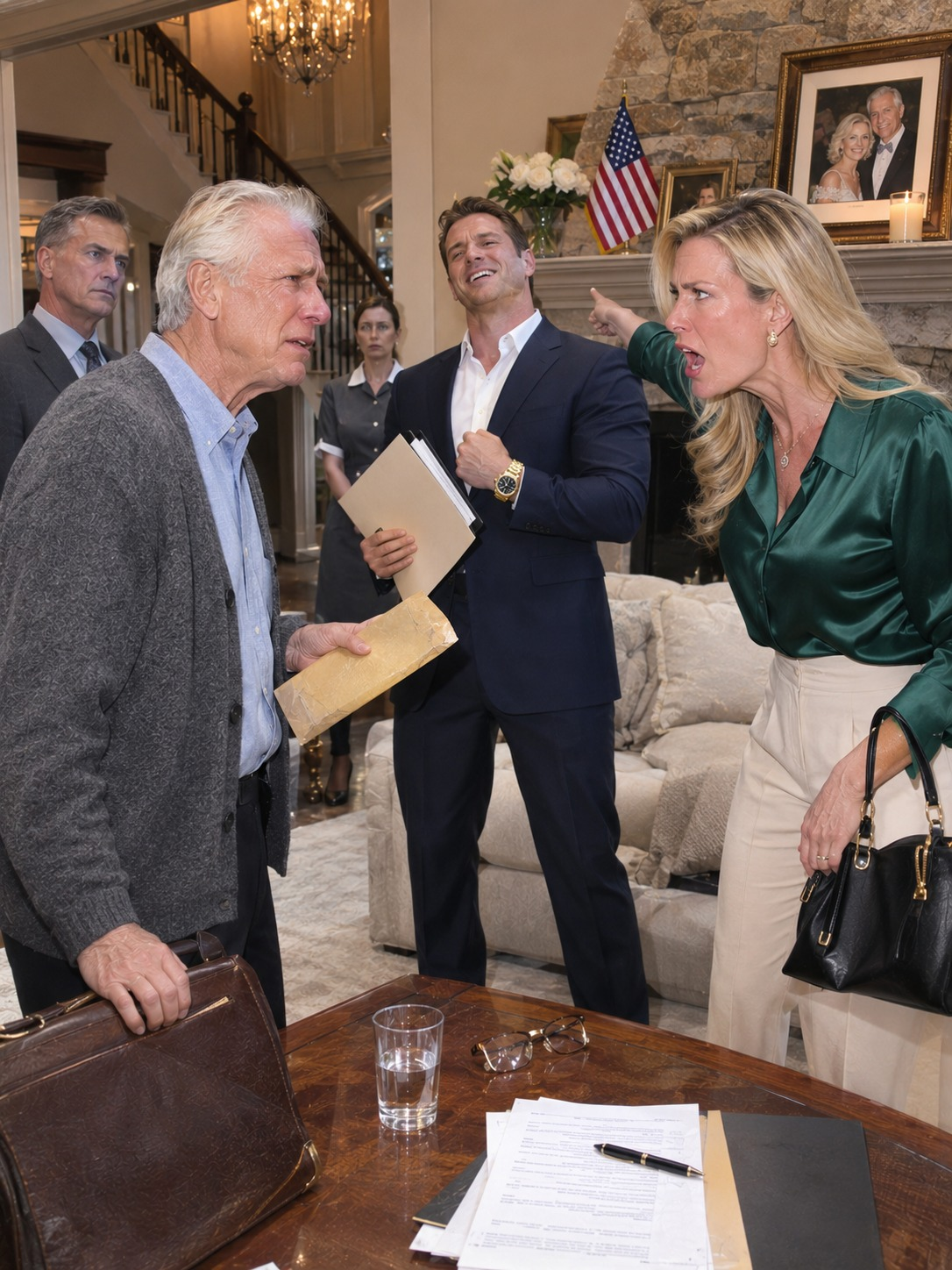
"DAD, DON'T LOOK AT THAT SIGNATURE!"
Michael lunged toward the document in Laura Whitcomb's hand.
Richard Collins stepped between them.
"Michael. Stop."
My son froze.
Laura stood just inside the front door, holding the original collateral authorization against her chest.
Rebecca was beside the coffee table, trembling.
And I was staring at the signature that someone had apparently used to place our family home at risk.
"Give me the document," I said.
Michael shook his head.
"Dad, please. You don't understand."
"Then help me understand."
He looked at Laura.
Then at Richard.
For the first time in my life, my son seemed unable to find an answer.
Laura approached me.
"Thomas, your wife wanted you to see this if anyone attempted to use the disputed authorization."
She placed the paper on the table.
I leaned forward.
At the bottom was a signature.
Not mine.
Not Eleanor's.
Rebecca Bennett.
My daughter's name.
I slowly raised my eyes.
Rebecca looked as though someone had struck her.
"That's impossible," she whispered.
Michael closed his eyes.
I stared at my daughter.
"Rebecca?"
She shook her head.
"Dad, I didn't sign that."
I looked back at the document.
The signature was unmistakably similar to hers.
I had seen Rebecca write her name thousands of times.
On birthday cards.
School forms.
Wedding invitations.
Checks.
But the fact that a signature looked familiar did not prove who had written it.
I had learned that much during the previous two days.
Still, my chest tightened.
"Rebecca, look at me."
She did.
"Did you authorize anyone to use our home as collateral for Michael's business?"
"No."
Her answer came immediately.
"Did you sign any document connected to the mansion in October 2022?"
She hesitated.
Michael opened his eyes.
"Rebecca," he said sharply.
I turned toward him.
"Don't answer for her."
He looked away.
Rebecca pressed a hand against her forehead.
"I signed some paperwork that year."
My heart sank.
"What paperwork?"
"I don't remember everything."
"Try."
She looked at Richard.
He remained silent.
Then she looked at me.
"Michael said we were reorganizing some family assets."
I felt a cold sensation spread through my chest.
"What family assets?"
She swallowed.
"Some investment accounts. Certain company interests. He said Mom wanted us to prepare for future estate planning."
I stared at her.
"And you signed?"
"Yes."
"Without reading the documents?"
Her eyes filled.
"I read some of them."
"Some?"
She looked down.
"Dad, Michael said everything had been reviewed."
I turned toward my son.
He stood near the fireplace.
His face was pale.
"Michael."
He did not answer.
"What did you ask your sister to sign?"
He rubbed his forehead.
"It was part of a refinancing package."
"Did it involve our home?"
He hesitated.
"Not the way you're thinking."
I stared at him.
"Then explain it."
He looked toward Laura.
"That document is being taken out of context."
Laura spoke calmly.
"Then the complete records should establish the context."
Michael gave her an angry look.
"You had no right to bring that here."
Laura did not move.
"Eleanor authorized me to preserve these records and provide them to Thomas under specified circumstances."
"Mom was sick."
The words came out sharply.
I turned toward him.
"What did you say?"
Michael looked at me.
"She was sick, Dad. She wasn't thinking clearly about everything."
For a moment, I could not speak.
Then I remembered Eleanor sitting in her hospital bed, carefully asking questions about financial records.
I remembered the way she corrected a nurse who had mixed up two appointment dates.
I remembered her discussing investment figures with William Prescott even when she was exhausted.
Her body had been failing.
Her mind had remained remarkably sharp during many of those conversations.
I looked at my son.
"Don't use your mother's illness to dismiss what she discovered."
He stared at me.
"Dad—"
"No."
My voice was quiet.
But it stopped him.
"You laughed at her envelope. You told me I had no place in this house. You asked me to sign a document without explaining what it meant."
I stepped closer.
"And now you're telling me your mother wasn't thinking clearly because she asked questions about your business?"
Michael's jaw tightened.
I looked at the authorization again.
"Enough. I want every document reviewed by independent professionals."
Richard nodded.
"That's appropriate."
Laura placed the original inside a protective sleeve.
"There's something important about this page," she said.
I turned toward her.
"What?"
"The signature isn't the only discrepancy."
She pointed toward a line near the top.
The document identified Bennett Residential Holdings as a party providing a purported authorization connected to the collateral.
Rebecca's company.
Not Michael's.
I frowned.
"Why would Rebecca's company be involved in a loan for Michael's manufacturing business?"
Laura answered carefully.
"That is one of the questions Eleanor wanted investigated."
Rebecca looked at Michael.
He stared at the floor.
Then she whispered, "You told me those documents were for my apartment properties."
Michael said nothing.
Rebecca took a step toward him.
"Michael."
He raised his eyes.
"What?"
"Did you use my company to support your loan?"
He hesitated.
Then he said, "We were all part of the same family business structure."
Rebecca's expression changed.
"That's not an answer."
I watched them.
For years, Michael and Rebecca had presented themselves as partners.
They attended charity events together.
Discussed investments together.
Defended each other's decisions.
And, only yesterday, they had stood together while telling me I needed to leave my home.
Now they were looking at each other as though they had suddenly become strangers.
Richard stepped forward.
"Before anyone makes accusations, these documents need to be authenticated and compared with the recorded instruments."
I nodded.
"Then that's what we'll do."
Michael turned toward me.
"Dad, please don't turn this into a legal war."
I looked at him.
"Then tell the truth."
He opened his mouth.
But no words came.
That night, I asked Laura and Richard to remain while I called Catherine Brooks.
Catherine answered immediately.
I explained what had happened.
She listened carefully.
Then she asked to speak with Richard.
They discussed the documents for several minutes.
I did not understand every legal term.
But I understood enough.
There were conflicting versions of a collateral authorization.
One appeared to carry my name.
Another carried Rebecca's.
The official title records had not yet established that the mansion had been validly pledged.
And no one was prepared to assume that any disputed signature was authentic.
Catherine advised that the original documents be preserved, that no one alter or remove records, and that an independent review begin immediately.
When Richard handed the phone back, she spoke directly to me.
"Thomas, I recommend that we hold a formal meeting tomorrow."
"With whom?"
"You, me, William Prescott, Richard, and your children. We can review the trust's financial position, explain the outstanding obligations, and establish what information is still missing."
I looked toward Michael.
He stood near the window.
Rebecca sat on the sofa, staring at her hands.
"All right," I said.
"One more thing."
"What?"
"Do not sign any releases, waivers, extensions, or acknowledgments before the meeting."
"I won't."
"And Thomas?"
"Yes?"
"Don't allow anyone to make you feel that asking questions is an act of betrayal."
I looked at Eleanor's photograph above the fireplace.
"Thank you, Catherine."
After the call, I turned toward my children.
"We're meeting tomorrow morning."
Michael looked at me.
"With lawyers?"
"Yes."
He laughed bitterly.
"Wonderful."
Rebecca did not speak.
I looked at both of them.
"You will have an opportunity to explain the documents. I will have an opportunity to understand them. And nobody will be asked to make decisions without proper information."
Michael shook his head.
"Dad, you don't know how much damage this could cause."
I studied him.
"Then perhaps you should have thought about that before asking people to sign documents they didn't understand."
He looked away.
I picked up my briefcase.
Then I turned toward Margaret, who stood quietly near the staircase.
"Would you please make sure the guest room is ready for Laura?"
Laura looked surprised.
"Thomas, that's not necessary."
I shook my head.
"It's late. You've come a long way."
She smiled faintly.
"Thank you."
I looked at Richard.
"You're welcome to stay too."
He declined, explaining that he needed to prepare for the meeting.
Before leaving, he approached me.
"Thomas, I want you to know something."
"What?"
"Eleanor believed you were capable of handling this."
I looked down.
"I'm not sure I am."
Richard smiled sadly.
"She was."
Then he left.
I did not sleep much.
Again.
I lay in bed staring at the ceiling, listening to the quiet sounds of a house that no longer felt like home.
Every room contained memories.
Eleanor laughing in the kitchen.
Michael running down the stairs on Christmas morning.
Rebecca practicing piano in the sitting room.
Family dinners.
Birthdays.
Anniversaries.
Arguments that ended with apologies.
I had spent decades believing those memories were proof that we had built something lasting.
Now I wondered how much of it had been real.
I turned toward Eleanor's empty side of the bed.
Her pillow was still there.
I reached across and touched it.
"I don't know what happened to them," I whispered.
For a moment, I remembered Michael at eight years old.
He had broken a neighbor's window while playing baseball.
He came home crying.
Not because he feared punishment.
Because he knew he had done something wrong.
I had taken him back to the neighbor's house.
He apologized.
Then he spent three weekends helping me with yard work to earn the money for the repair.
He was proud when he finally paid for the window.
I remembered Rebecca at twelve.
She had found a wallet in a grocery store parking lot.
Inside was more than two hundred dollars.
She insisted we take it to the customer service desk.
When the owner returned, he tried to reward her.
She refused.
"Dad says you don't get paid for doing the right thing," she told him.
I smiled through my tears.
Where had those children gone?
Had money changed them?
Had success made them careless?
Or had Eleanor and I protected them from too many consequences?
I did not know.
But I knew something else.
I could not help them by pretending their mistakes did not matter.
I had done that too often.
Perhaps Eleanor had understood it before I did.
At seven the next morning, I went downstairs.
Margaret was preparing breakfast.
She looked relieved to see me.
"Good morning, Mr. Bennett."
"Good morning."
"Would you like coffee?"
"Please."
She poured a cup.
Then she hesitated.
"Mr. Michael left early."
I looked at her.
"What time?"
"About six."
"Did he say where he was going?"
"No, sir."
I nodded.
Rebecca appeared a few minutes later.
She looked exhausted.
Her eyes were red.
She sat across from me.
For a long time, neither of us spoke.
Then she whispered, "Dad?"
I looked up.
"Yes?"
"I'm sorry."
The words surprised me.
I set down my coffee.
She stared at the table.
"For what I said after the will reading."
I waited.
She swallowed.
"I shouldn't have shouted at you."
"No."
"I shouldn't have told you to leave."
"No."
Her eyes filled.
"I don't know why I said those things."
I looked at my daughter.
I wanted to reach across the table and take her hand.
But something held me back.
Not anger.
Caution.
"Rebecca, you said them because you believed you had the power to make me leave."
She looked down.
"I know."
"You thought the inheritance made you more important than me."
A tear rolled down her cheek.
"I was angry."
"About what?"
She hesitated.
Then she whispered, "Mom."
I felt my chest tighten.
"What about her?"
Rebecca wiped her eyes.
"She never thought I was good enough."
I stared at her.
"That's not true."
"She always questioned my decisions."
"Because she wanted you to succeed."
"She questioned everything."
I leaned forward.
"Rebecca, your mother questioned herself more than anyone."
She looked at me.
"She did?"
"Every day."
I told her about the nights Eleanor sat at our kitchen table reviewing contracts.
About the times she worried she had made the wrong investment.
About the factory employees she felt responsible for.
About the decisions that kept her awake.
Rebecca listened silently.
Then she whispered, "She never told me any of that."
I smiled sadly.
"She wanted you to feel safe."
Rebecca lowered her head.
For several minutes, she cried quietly.
I moved beside her.
Then I placed my hand over hers.
"Sweetheart, your mother loved you."
She nodded.
"I know."
"But love doesn't mean approving every decision."
She looked at me.
"I know that now."
I wanted to believe her.
I truly did.
But the previous afternoon had taught me that words were not enough.
I needed to see what my children would do when telling the truth became difficult.
The meeting began at ten.
Catherine Brooks arrived first.
She carried a black leather briefcase and several neatly labeled folders.
William Prescott arrived shortly afterward.
Richard Collins came with copies of the relevant estate and property documents.
Laura joined us.
Michael returned five minutes before the meeting.
He looked tired.
His shirt was wrinkled.
His expression was guarded.
Rebecca sat beside him.
I took Eleanor's favorite chair.
The same chair I had occupied when the will was read.
The same chair from which I had watched my children celebrate their inheritance.
But this time, the atmosphere was different.
Nobody smiled.
Nobody joked.
Nobody asked when they could begin transferring properties.
Catherine placed a folder on the coffee table.
"Thank you for coming."
Michael leaned back.
"Let's get this over with."
She looked at him.
"Mr. Bennett, this meeting is intended to clarify the financial and legal issues. It is not a proceeding to determine wrongdoing."
He shrugged.
"Fine."
Catherine continued.
"We will discuss the trust's reported assets, the outstanding commercial loans, the disputed collateral documents, and the information required for further review."
I looked at my children.
Both remained silent.
William opened the first folder.
He turned a financial summary toward us.
"At the most recent reporting date, the trust's total reported value was approximately sixty-three million, four hundred thousand dollars."
Rebecca stared at the number.
Michael looked away.
William continued.
"The trust includes investments, financial assets, and ownership of a private lending entity."
He turned another page.
"That lending entity holds outstanding obligations associated with Bennett Advanced Manufacturing and Bennett Residential Holdings."
Michael shifted in his chair.
William looked at him.
"The aggregate balance is approximately eighteen million, six hundred thousand dollars."
Rebecca's eyes widened.
Michael remained silent.
I watched their faces.
The number had been explained to me the previous day.
But hearing it spoken aloud in the living room where they had laughed at me felt different.
This was the moment they finally understood that Eleanor had not left me a meaningless envelope.
She had left me financial security.
Authority.
And responsibilities that connected directly to the businesses they had inherited.
Catherine spoke.
"To be clear, these are obligations of the relevant borrowing entities. They are not automatically personal debts of Michael or Rebecca merely because they own interests in those businesses."
I nodded.
That distinction mattered.
Eleanor would have insisted on it.
Catherine continued.
"However, the obligations may affect the financial condition of the companies and the value of the interests inherited."
Rebecca looked at Michael.
"Did you know about this?"
He frowned.
"Of course I knew we had loans."
"Did you know the lender belonged to Mom's trust?"
He hesitated.
"I knew there were related entities."
Rebecca stared at him.
"That's not what I asked."
He looked away.
William turned another page.
"The manufacturing companies have approximately eleven million, two hundred thousand dollars outstanding."
Michael's jaw tightened.
"The residential entities have approximately seven million, four hundred thousand dollars outstanding."
Rebecca slowly lowered her head.
I watched her.
She had inherited valuable properties.
But those properties were not free from financial obligations.
The inheritance was real.
So were the debts.
William continued.
"One manufacturing loan has a significant payment approaching maturity."
Michael leaned forward.
"We've been negotiating an extension."
Catherine looked at him.
"With whom?"
"Our finance team."
"Has a formal request been submitted?"
Michael hesitated.
"Not yet."
William folded his hands.
"Any request will require updated financial statements and compliance information."
Michael gave a bitter laugh.
"Mom would have approved it."
I looked at him.
"Would she?"
He turned toward me.
"Yes."
I shook my head.
"William told me she specifically requested a review before any extension."
Michael stared.
Then he looked at William.
"She said that?"
William nodded.
"Her instructions are documented."
My son leaned back.
For a moment, he looked genuinely stunned.
Then he whispered, "She knew."
I frowned.
"Knew what?"
He did not answer.
Catherine continued.
"Before we discuss any extension, we need to address the discrepancies in the financial records."
Michael's expression hardened.
"What discrepancies?"
She opened another folder.
"Certain liabilities and collateral descriptions differ between document versions."
Richard placed copies on the table.
"Some of these differences may be explainable. Others require authentication and additional records."
Laura added, "Eleanor had asked for those differences to be reviewed before her death."
Michael looked at her.
"You keep saying that."
"Because it's true."
He shook his head.
"Mom was obsessed with paperwork."
I felt anger rise.
But I kept my voice calm.
"Your mother understood that paperwork could protect people."
Michael looked at me.
I continued.
"She understood that signatures mattered. That promises mattered. That borrowed money had to be repaid."
He looked away.
I leaned forward.
"And she understood that family relationships don't erase financial obligations."
Nobody spoke.
Then Catherine placed a copy of the disputed collateral authorization on the table.
"This document is one reason we cannot proceed casually."
Rebecca stared at it.
Her name appeared near the bottom.
Michael looked at the floor.
Catherine continued.
"We have conflicting copies. We need to establish which, if any, was validly executed and what authority existed to pledge the described assets."
She looked at Rebecca.
"Do you recall signing this specific authorization?"
Rebecca shook her head.
"No."
"Do you recall signing related documents in October 2022?"
"Yes."
"Did you understand that the family residence might be included in a collateral schedule?"
Rebecca's eyes filled.
"No."
Catherine nodded.
"Thank you."
She turned toward Michael.
"Do you have any information about how the collateral description was prepared?"
Michael stared at the paper.
Then he said, "Our finance department handled the documentation."
"Who supervised the process?"
He hesitated.
"I did."
The room became quiet.
I looked at my son.
He did not meet my eyes.
Catherine continued.
"Did you review the final collateral schedule?"
Michael rubbed his forehead.
"I reviewed the package."
"Did you notice the family residence listed?"
He hesitated.
Then he whispered, "Yes."
Rebecca turned sharply.
"What?"
Michael closed his eyes.
Catherine remained calm.
"Did you believe the company had authority to offer that property as collateral?"
He swallowed.
"I believed the necessary approvals had been obtained."
"From whom?"
He looked toward Richard.
Richard's expression changed.
"Michael, don't look at me for an answer. Tell us what you understood at the time."
Michael stared at the table.
Then he said, "I thought Mom had agreed."
My heart began pounding.
"Eleanor?"
He nodded.
I leaned forward.
"Did she tell you that?"
He hesitated.
"Not directly."
I stared at him.
"Then why did you believe it?"
He looked at Rebecca.
Then at me.
"Because someone told me she had approved the arrangement."
The room became very still.
Catherine spoke carefully.
"Who told you?"
Michael swallowed.
Then he said, "Someone who was handling the paperwork."
Richard leaned forward.
"Michael, this is important. Who?"
My son looked at the door.
Then back at us.
For several seconds, he seemed unable to speak.
Finally, he whispered, "I need to show you something."
He reached into his briefcase.
My heart began pounding.
He removed a thin black folder.
Then placed it on the table.
Catherine looked at it.
"What is that?"
Michael opened the folder.
Inside was a copy of an email.
He slid it toward her.
"This is what I received before the refinancing closed."
Catherine examined the page.
Her expression changed.
William leaned closer.
Richard stood.
I watched them.
"What does it say?" I asked.
Catherine looked up.
"Thomas, this appears to be an email claiming that Eleanor approved the collateral arrangement."
I felt my stomach tighten.
"Who sent it?"
Michael stared at me.
Then he said, "That's what I've been trying to explain."
I looked at him.
He swallowed.
"The email came from an address associated with Mom's office."
I stared at the paper.
"Then why didn't you ask her directly?"
He lowered his eyes.
"Because I was told she didn't want to discuss it."
I felt cold.
Catherine looked at the email again.
Then she frowned.
"Michael, this message has an attachment reference."
He nodded.
"I know."
"Where is the attachment?"
He hesitated.
"I don't have it."
"Why not?"
He looked at me.
"Because the person who sent it told me to delete it."
The room became silent.
I stared at my son.
"Who told you that?"
Michael opened his mouth.
Then stopped.
Catherine placed the email on the table.
"Michael, we need the original electronic records. A printed copy is not enough to establish authenticity."
He nodded slowly.
"I understand."
I looked at him.
"Then tell us who sent it."
He stared at the floor.
For a long moment, nobody spoke.
Then he whispered, "I thought I was protecting Mom."
My heart tightened.
"Protecting her from what?"
He looked up.
His eyes were wet.
"From something she discovered about the company."
I leaned forward.
"What did she discover?"
Michael shook his head.
"I didn't know how bad it was."
I stared at him.
"Michael."
He looked directly at me.
"Dad, the company was already in trouble before the refinancing."
I felt my stomach drop.
"How much trouble?"
He swallowed.
"More than anyone knew."
Rebecca stared at him.
"Michael, what are you talking about?"
He closed his eyes.
Then he whispered, "We were losing money."
I looked at him.
"How much?"
He opened his eyes.
"Millions."
The room became very quiet.
I looked toward Eleanor's photograph.
My wife had known.
She had tried to protect the businesses.
She had tried to protect me.
And now my son was finally beginning to tell the truth.
But before I could ask another question, William's phone vibrated.
He glanced at the screen.
His expression changed.
He stood.
"Excuse me."
He walked toward the hallway and answered.
I watched him listen.
His face grew pale.
"What do you mean the account was accessed?"
A pause.
"When?"
Another pause.
"Who authorized it?"
He turned toward the living room.
His eyes moved directly to Michael.
Then he said, "Freeze any pending instructions until the records are verified. I'm coming in."
He ended the call.
Catherine stood.
"William?"
He looked at her.
"There's been an attempted transaction involving one of the trust's lending accounts."
My heart began pounding.
"What transaction?"
William looked at me.
"Someone submitted instructions that appear to authorize a substantial transfer."
I stared at him.
"How substantial?"
He swallowed.
"Nearly four million dollars."
Rebecca gasped.
Michael went completely still.
Catherine stepped forward.
"Was the transfer completed?"
"Not according to the initial report. It's been flagged for review."
I looked at William.
"Who submitted it?"
He hesitated.
"The instructions appear to have been submitted using credentials associated with an authorized business contact."
I felt cold.
"Whose credentials?"
William looked toward Michael.
Then toward Richard.
Finally, he turned to me.
"Thomas, the authorization contains a digital signature attributed to someone connected to Eleanor's trust."
My heart began pounding.
"Who?"
Before he could answer, the front doorbell rang.
Margaret appeared in the hallway.
She looked frightened.
"Mr. Bennett, there's a man outside asking for you."
I turned.
"What man?"
She swallowed.
"He says he's from the bank's security department."
William's expression changed immediately.
"Did he identify himself?"
Margaret nodded.
"Yes."
"What did he say?"
She looked at me.
Then at William.
"He said someone used Mrs. Bennett's old credentials to access the trust records."
I felt my blood turn cold.
Eleanor had been dead for three weeks.
William moved toward the door.
Catherine followed.
Richard stood beside the coffee table.
Michael stared at the floor.
Rebecca looked at her brother.
Then the doorbell rang again.
This time, louder.
Margaret opened the door.
A man in a dark suit stood outside holding a sealed envelope.
He looked directly at me.
"Mr. Thomas Bennett?"
"Yes."
"I'm here regarding an urgent security matter involving your late wife's trust."
I stepped forward.
"What happened?"
He glanced toward Michael.
Then back at me.
"Sir, the attempted transfer was submitted using credentials that should have been inactive."
My heart pounded.
"Who used them?"
The man opened the envelope.
Inside was a printed security report.
He looked down.
Then his expression changed.
"Mr. Bennett, there's something you need to see."
He turned the report toward me.
At the top was a timestamp.
Below it was an access location.
And beneath that was the name of the person whose identity had been used to approve the transaction.
I leaned closer.
My hands began trembling.
Because the name on the report belonged to someone who had been standing in this room when the will was read.
Someone who had watched my children laugh at me.
Someone who had known about Eleanor's trust long before I did.
I looked up.
And the security officer said quietly, "Mr. Bennett, before I show you the surveillance photograph, you need to know that the person who entered the authorization code was..."






Comments 0