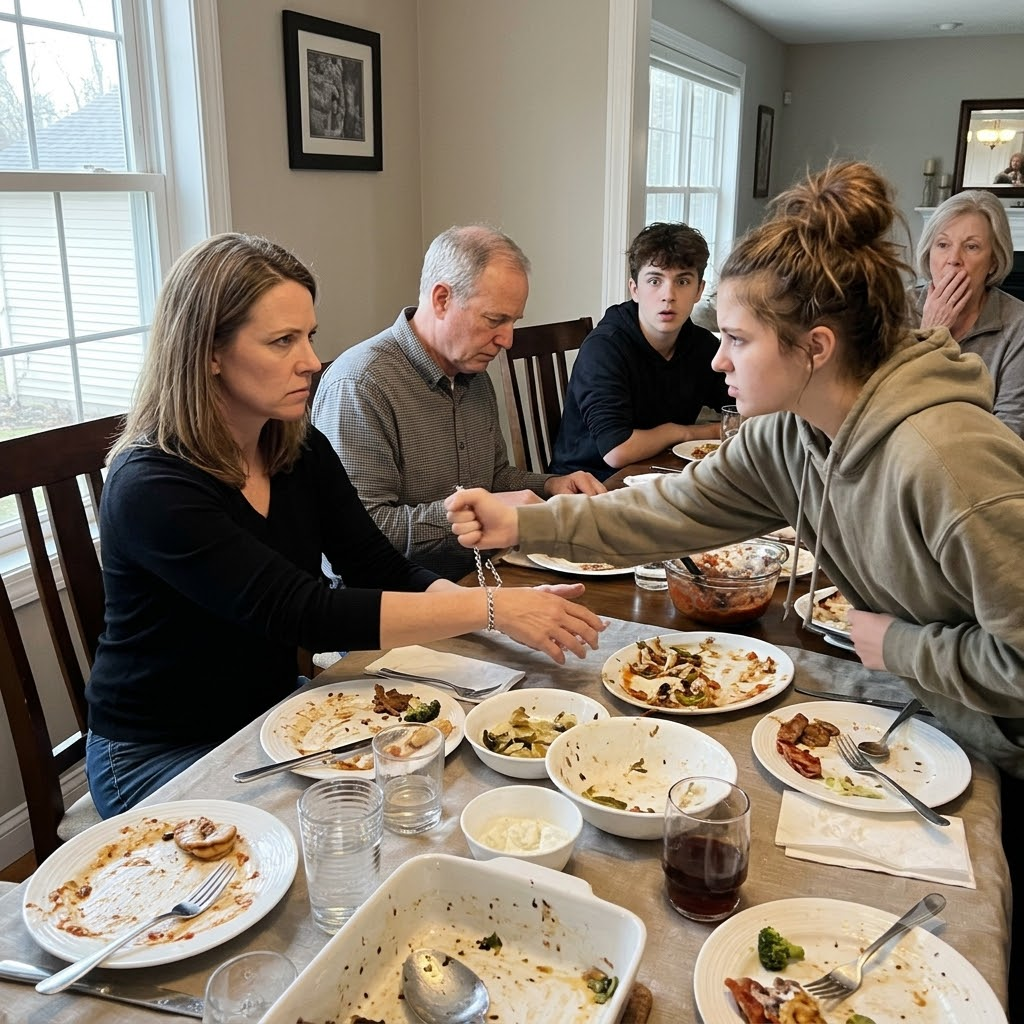
Sophie yanked the silver bracelet off my wrist and held it above the dinner table.
"Look at this thing! Mom says you bought it at a flea market!"
My nineteen-year-old niece laughed as she pulled the delicate chain between her fingers.
Then the clasp snapped.
My bracelet landed beside my dinner plate.
I stared at it.
Nobody moved.
My sister Rachel continued holding her wineglass. My father wasn't there to defend the gift he had given me years ago. Across the table, our uncle lowered his eyes, while my twenty-two-year-old cousin suddenly became very interested in his half-empty plate.
And Sophie?
She was still laughing.
I was forty-six years old. I had spent two decades building a small accounting firm in Columbus, Ohio. I had handled difficult clients, complicated business disputes, demanding employees, and financial emergencies that would have made most people lose sleep.
Yet somehow, sitting at my sister's dining table, I felt as though I had been reduced to a child who needed permission to be respected.
"Mom says you bought it at a flea market," Sophie repeated. "No wonder it looks cheap."
I slowly looked at her.
The bracelet was silver. Nothing particularly expensive. The chain was thin, and the clasp had been repaired once before.
It probably wasn't worth more than twenty dollars.
But its value had never been the point.
My father had given it to me when I turned eighteen.
He had purchased it at a flea market during one of the hardest periods of his life. He had recently lost his job, and money was so tight that even small purchases required careful consideration.
I remembered that birthday clearly.
He had walked into my bedroom holding a tiny gift box wrapped in inexpensive blue paper.
"I know it's not much," he'd said, looking slightly embarrassed. "But I saw it and thought of you."
I had opened the box.
Inside was the silver bracelet.
I had hugged him so tightly that he laughed.
"It's beautiful, Dad."
He smiled.
"Then that's all that matters."
He died the following year.
For almost three decades, I had kept that bracelet close.
I wore it during my first job interview, when I started my accounting firm, when my business nearly failed, and during the years when I wondered whether I had made the right decisions in life.
It had become a quiet reminder that someone had believed in me before I had anything worth showing the world.
And now my niece was holding it like a joke.
"Give it back, Sophie," I said.
My voice was calm.
She looked at me, surprised that I hadn't laughed along.
"What?"
"The bracelet. Give it back."
She rolled her eyes.
"Relax. I'm just looking at it."
"You've already had a look. Give it back."
Instead of returning it, she pulled the chain again.
The clasp broke completely.
A tiny metallic snap sounded against the dining table.
The bracelet fell beside my plate.
For a moment, I couldn't hear anything except the sound of my own breathing.
Rachel finally looked up.
"Honestly, Meredith. It's just a bracelet. Don't be dramatic."
I turned toward her.
"She just broke something that belonged to me."
Rachel shrugged.
"It's old. You can buy another one."
Sophie smiled.
"Exactly. You can buy another one for five dollars."
The words stung more than I wanted to admit.
Not because Sophie had insulted the bracelet.
Because Rachel knew exactly what it meant.
She had been there when our father gave it to me. She remembered the birthday. She knew how much he had struggled financially that year.
She knew.
And she still chose to laugh.
I reached down and picked up the broken chain.
"Apologize," I said.
Sophie folded her arms.
"For what? Telling the truth?"
Rachel poured herself more wine.
"Meredith, she's under enough pressure at the conservatory. You know how demanding that program is. Stop making everything about you."
I looked at my sister.
There were moments when a person's words revealed more than they intended.
That was one of them.
For two years, I had been helping pay for Sophie's education at a private music conservatory in Boston.
Two years.
Twenty-four months of tuition payments, administrative emails, billing notices, and financial arrangements.
I had never demanded recognition for it.
I had never asked Rachel to repay me.
I had never expected Sophie to stand up at dinner and announce that her aunt had helped make her education possible.
I simply wanted her to have an opportunity.
But apparently, helping someone had become an obligation in their minds.
Sophie pushed the broken bracelet toward me with one finger.
"Relax, Aunt Meredith. You're rich."
The way she said it made something inside me go quiet.
Rich.
That was what they saw when they looked at me.
Not the girl whose father had bought her a flea-market bracelet because he couldn't afford anything else.
Not the woman who had worked late nights, missed holidays, and taken risks to build a business.
Not the sister who had quietly helped Rachel when she couldn't afford her daughter's tuition.
Just a bank account.
I placed the broken bracelet inside my purse.
Then I picked up my napkin and folded it neatly.
"Thank you for dinner," I said.
Rachel looked almost relieved.
"See? That's all I'm saying. It doesn't have to become a whole thing."
I stood.
Sophie was already reaching for another piece of food.
Nobody asked me to stay.
Nobody apologized.
Nobody even looked particularly concerned when I walked toward the front door.
I put on my coat, picked up my purse, and stepped outside.
The door closed behind me.
Only then did I allow myself to look down at my wrist.
The pale indentation where the bracelet had rested was still visible.
I rubbed it with my thumb.
I didn't cry.
I didn't call Rachel.
I didn't send Sophie an angry message.
I simply got into my car and drove home.
The drive back to Columbus felt longer than usual.
I kept thinking about the bracelet.
My father had never been wealthy. When I was growing up, he worked whatever jobs he could find. Some years were comfortable. Others were not.
But he never allowed our financial circumstances to determine how much love we received.
He remembered birthdays.
He showed up for school events.
He taught me how to balance a checkbook before I understood why it mattered.
When I turned eighteen, he had taken me to the flea market because he wanted to buy me something special.
He had spent most of the afternoon looking at jewelry stands.
I remembered him comparing two bracelets, asking the seller whether the silver would tarnish, and checking his wallet before making the purchase.
He had been so proud when he gave it to me.
I could still hear his voice.
"One day, you'll have everything you want, Meredith. Just don't forget the people who loved you when you had nothing."
For years, I had believed I understood that sentence.
That evening, I wondered whether I had misunderstood something else.
Perhaps remembering the people who loved you did not mean allowing people to mistreat you.
Perhaps generosity without boundaries could eventually become another person's entitlement.
When I arrived home, I placed my purse on the desk in my home office.
I carefully removed the bracelet.
The broken clasp lay beside the chain.
I opened a small drawer and found the jewelry box I had kept since my father's death.
For a few seconds, I considered putting the bracelet away until I could have it repaired.
Then my eyes moved toward my laptop.
I remembered the conversation I had received from the conservatory's billing office earlier that week.
The remaining tuition.
The payment schedule.
The authorization I had personally approved.
Sixty thousand dollars.
I sat down.
My computer screen illuminated the room.
I opened my banking account and signed in.
The scheduled payment was still listed as pending.
Monday morning.
A little less than thirty-six hours away.
I stared at the number.
$60,000.
For two years, I had treated that money as an investment in Sophie's future.
I had imagined her graduating, finding work as a professional musician, and building a life she could be proud of.
I had imagined attending her performances.
I had even pictured my father sitting somewhere in the audience if he had lived long enough to see her succeed.
That was what the money represented to me.
Not control.
Not influence.
Not a way to make someone owe me affection.
An opportunity.
I opened the payment details.
My finger rested on the mouse.
Then I stopped.
I wanted to be absolutely certain that I wasn't acting out of anger.
I thought about Sophie's expression when the clasp broke.
I thought about Rachel's laughter.
I thought about the silence around the table.
And I asked myself one question.
If Sophie had apologized immediately, would I still have wanted to pay?
The answer was yes.
If Rachel had defended her daughter but acknowledged that the bracelet mattered to me, would I still have wanted to help?
Yes.
But neither of them had done that.
They had treated the incident as though I had no right to object.
Worse, they had treated my generosity as something they were entitled to receive regardless of how they treated me.
I moved the cursor toward the payment controls.
Then my phone vibrated.
A message from Rachel appeared.
Rachel: Hope you're home. Sophie was only joking. You know how teenagers are.
I read it twice.
Sophie was nineteen.
She was old enough to attend a private music conservatory in another state. Old enough to sign academic documents. Old enough to travel independently.
But apparently, according to Rachel, she was still too young to understand that deliberately breaking someone else's property was wrong.
I typed a response.
Deleted it.
Typed another.
Deleted that too.
Finally, I put the phone face down.
I didn't need to argue.
I didn't need to explain why my father's bracelet mattered.
And I certainly didn't need to convince Rachel that respect should not depend on the price of an object.
I returned to the banking screen.
The payment was still pending.
My eyes moved from the amount to the confirmation button.
Then I clicked.
A notification appeared.
SCHEDULED PAYMENT CANCELED.
I sat perfectly still.
The first installment was gone.
But that wasn't all.
There was another authorization for the later installment.
I opened it.
The remaining amount was listed clearly.
$60,000.
I removed the authorization.
The bank requested confirmation.
I confirmed.
Another notification appeared.
RECURRING PAYMENT AUTHORIZATION REMOVED.
I leaned back in my chair.
My decision was made.
I hadn't taken back a single dollar that had already been paid. I wasn't asking for reimbursement for the previous two years.
I was simply refusing to fund the next two.
I looked at the clock.
10:46 P.M.
One more thing remained.
I opened my email.
The conservatory's billing office had previously provided a contact address for tuition sponsorship arrangements.
I started a new message.
My fingers moved slowly across the keyboard.
I wrote that I would no longer be sponsoring Sophie's remaining tuition and that the scheduled payment and future authorization had been canceled.
I kept the message professional.
No accusations.
No emotional explanation.
No mention of the bracelet.
I read it once.
Then I pressed Send.
The timestamp appeared.
10:47 P.M.
I closed my laptop.
For the first time that evening, my shoulders relaxed.
I thought the hardest part was over.
I was wrong.
Because when I picked up my phone, I saw that Rachel had sent another message.
This time, it contained a photograph.
It was a screenshot of Sophie's conservatory tuition statement.
Under the amount due, Rachel had written three words.
YOU PROMISED HER.
I stared at the screen.
Then another notification appeared.
Sophie had joined the conversation.
Her message was only six words long.
Aunt Meredith, you can't be serious.
I placed the phone beside my father's broken bracelet.
And before I could decide whether to respond, the screen lit up again.
An incoming call.
Rachel.
I watched it ring.
Once.
Twice.
Three times.
Then I answered.
"Meredith!" she shouted. "What did you just do?"
I said nothing.
Her breathing was sharp and uneven.
Then she said something that made me realize she had already spoken to someone at the conservatory.
"Tell me you didn't actually cancel the payment."
I looked at the broken clasp beside my hand.
And quietly replied:
"I did."
Rachel went completely silent.
Then, in the background, I heard another voice.
It was Sophie.
And she was crying.
But the next sentence Rachel said changed everything.






Comments 0