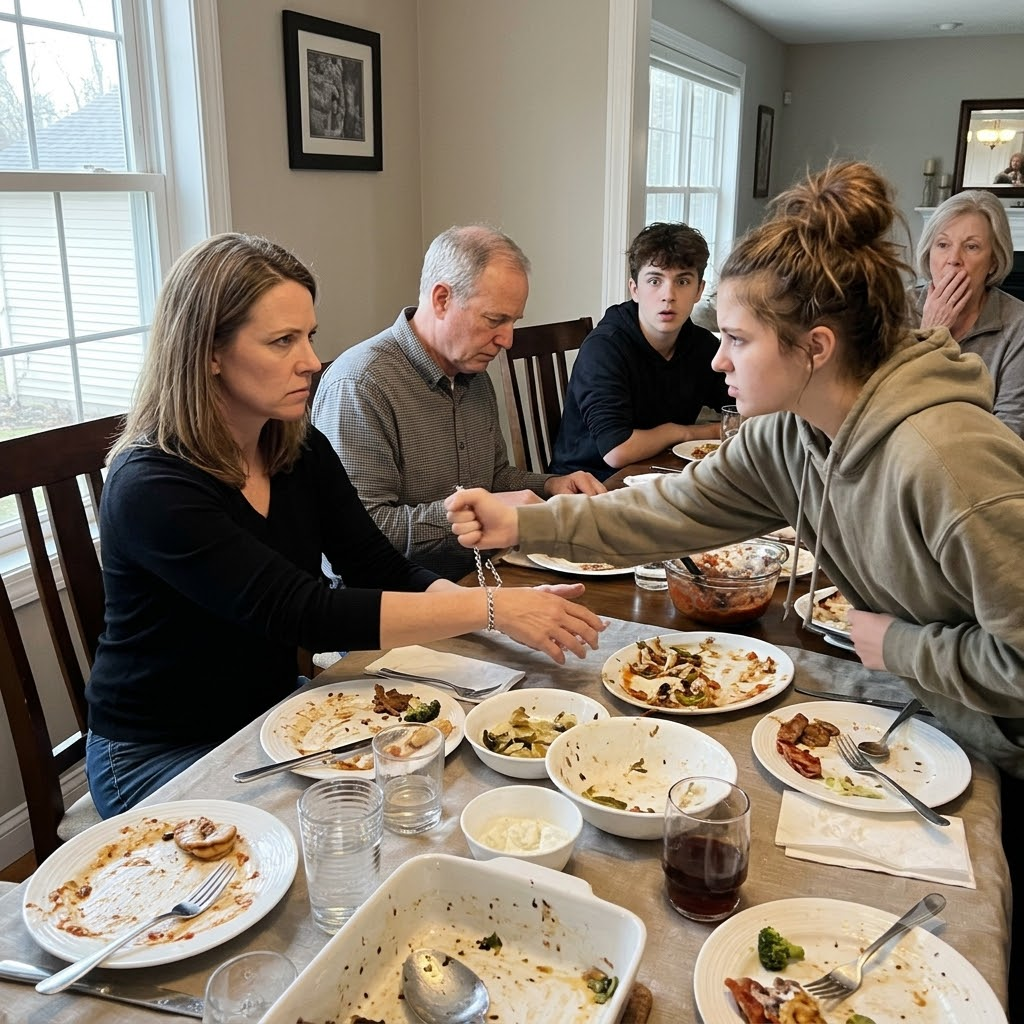
The property record was still open on my laptop when Rachel called again.
I stared at the three names listed in the financial history.
My mother's name.
Rachel's name.
And mine.
For several seconds, I couldn't move.
The house my mother had purchased after my father's death had supposedly been bought with her personal savings. Rachel had repeated that explanation for years. I had never questioned it.
Now the records suggested that money from an account bearing my name had helped finance the purchase.
I answered the phone.
"Rachel, I need you to explain this."
She sounded exhausted.
"I already told you. Mom needed somewhere to live."
"That's not what I asked."
"Meredith, please."
"Why was my account used to purchase the house?"
There was a long silence.
Then she said something that made my stomach tighten.
"Because Mom believed the house would eventually belong to both of us."
I looked at the property record.
"Did she tell you that?"
"Yes."
"Did she tell me?"
"No."
I closed my eyes.
"Did you know my money was being used?"
Rachel began crying.
"Not at first."
"When did you find out?"
"Years later."
"How many years?"
"Almost ten."
I leaned back.
"Rachel, you knew for ten years that my father's investment account had been used to help purchase that house?"
"I knew Mom had used some of the money."
"Some?"
"I don't remember the exact amount."
I looked at the document.
The amount was printed clearly.
I read it aloud.
Rachel didn't respond.
Then I asked:
"Did you ever intend to tell me?"
She whispered:
"I thought Mom would."
I stared at the photograph of my father.
He had written that the money was meant to help me build my future.
Instead, it had become part of a property purchase I hadn't known about.
And now my sister was telling me she had known for years.
The following morning, I met with my attorney.
I brought the property record, the investment statements, my father's letters, and the note written by my mother.
He examined the documents carefully.
Then he asked me to explain how I had obtained them.
I told him about Linda's storage box.
He nodded.
"These are useful records, but we need to establish the complete transaction history."
"Can we find out exactly how much came from my account?"
"Possibly. We need the original statements and the property closing records."
I showed him the date of the transfer.
He compared it with the date of the house purchase.
"They are close enough to warrant further review."
I looked at him.
"Does that mean the house was purchased with my money?"
"It means the available records suggest your account contributed to the purchase. We need to verify the full transaction before reaching that conclusion."
I understood.
He continued.
"There is another question. Was the money transferred as a gift, a loan, or under some other arrangement?"
I shook my head.
"I never authorized a transfer."
He made a note.
"Then we should determine what authority was used."
I thought about the old account.
I had been nineteen when my father died.
My mother had handled many of the financial arrangements.
I hadn't understood every document she asked me to sign.
I remembered visiting the bank with her once.
She had said she needed my signature to update some family records.
I hadn't questioned her.
I had trusted her.
"Could she have had authority to manage the account?" I asked.
"That's something we need to establish."
He reviewed the papers again.
Then he pointed to a line on the property record.
"Do you recognize this reference?"
I leaned closer.
It was a transaction code.
I shook my head.
He wrote it down.
"If the closing company still has the original records, this may help us identify the source of the funds."
I nodded.
Before I left, he gave me one instruction.
"Don't confront your sister with conclusions yet. Ask for the documents, preserve what you have, and let the records establish what happened."
I agreed.
But as I walked to my car, I couldn't stop thinking about one thing.
My mother had known.
Rachel had known.
And I had spent years believing there was nothing left to explain.
At lunchtime, Linda called.
"Did you receive the property document?"
"Yes."
"Have you spoken to Rachel?"
"Yes."
Linda sighed.
"I was afraid this would happen."
I frowned.
"What do you mean?"
"Your mother was very protective of Rachel after your father died."
"I know."
"But I don't think she ever explained all the financial arrangements to either of you."
I looked out the office window.
"Did you know about my account?"
"No."
"Did Mom ever tell you she used money from it?"
Linda hesitated.
"She once told me she had borrowed money from an account she managed for you."
I sat upright.
"When?"
"Several years after your father's death."
"Did she say how much?"
"No. She said she would replace it."
I closed my eyes.
"Did she?"
"I don't know."
I thought about the handwritten note.
Transferred to Rachel temporarily. To be restored when her circumstances improve.
I asked Linda whether she remembered anything else.
She thought for a moment.
Then she said:
"Your mother was worried about the mortgage. Rachel was going through a difficult time, and there were discussions about whether she could keep the house."
"Was Rachel living there?"
"Yes. She and Sophie were."
I looked down.
"Why was Mom's house being used as Rachel's home?"
"Your mother wanted to help her."
I remained quiet.
Linda continued.
"She thought it would give Sophie stability. Your mother was very attached to that house."
I understood.
My mother had wanted to protect her granddaughter.
She had wanted Rachel to have somewhere safe to live.
But if she had used money from my account without my permission, then that decision had affected me too.
"Linda, did Mom ever say she intended to return the money?"
"Yes."
I closed my eyes.
"Did she explain how?"
"No. She only said it was temporary."
I thanked her.
Before ending the call, Linda added:
"Meredith, there is something I have never told you about that house."
I waited.
"Your mother didn't want Rachel to sell it."
"Why?"
"She said the house was supposed to stay in the family."
I looked at the property record.
"Did she say who would inherit it?"
Linda paused.
"She said both girls."
That evening, I searched through my old emails.
I wanted to find anything relating to the account.
I found a message from my mother dated several months after my father's death.
It contained a scanned form.
The subject line read:
A FEW FAMILY BANKING DOCUMENTS.
I opened the attachment.
There were several pages.
Most were routine.
But one page contained a section about account management.
My mother's name appeared beside the word authorized representative.
My name appeared beside the word beneficiary.
I read it twice.
Then I noticed another page.
It contained a transfer authorization.
The amount matched the original investment balance.
I enlarged the signature.
My name appeared at the bottom.
I stared at it.
It looked like mine.
But I didn't remember signing that document.
I downloaded the file and forwarded it to my attorney.
Then I searched for the original email.
The message had been sent to me when I was twenty-three.
I remembered the period.
I had just started building my accounting firm.
I was working long hours and trying to manage my own expenses.
My mother had asked me to sign several documents.
I had trusted her.
I couldn't remember whether I had signed the transfer authorization.
I needed to know.
The next morning, Rachel arrived at my office.
She didn't call first.
Laura informed me that my sister was waiting in reception.
I asked her to bring Rachel into the conference room.
Rachel walked in carrying a handbag and a folder.
She looked tired.
Her eyes were swollen.
"Hi," she said.
I closed the door.
"Sit down."
She placed the folder on the table.
"I brought some documents."
I looked at it.
"What documents?"
"Everything I could find about the house."
I opened the folder.
There were mortgage statements, insurance papers, tax records, and a few old bank letters.
I began reviewing them.
Rachel sat opposite me.
"Mom wanted to keep the house for Sophie."
I looked up.
"Why?"
"Because she wanted Sophie to have a stable home."
"That doesn't explain why my account was used."
Rachel sighed.
"Mom said she would replace the money."
"Did she?"
"I don't know."
"Rachel, you lived in that house."
"Yes."
"Did you pay rent?"
"No."
"Did you pay the mortgage?"
"Mom handled most of it."
I looked at the statements.
There were several payments made from an account belonging to my mother.
Others came from Rachel.
I pointed to one.
"What was this payment?"
Rachel leaned forward.
"That was when Mom paid off part of the mortgage."
"With what money?"
"Her savings."
I looked at the amount.
It was almost identical to the transfer from my old investment account.
I turned the document toward her.
"Rachel, this payment was made three weeks after the money was withdrawn from my account."
She stared at the page.
Then she looked away.
"I didn't know the dates."
"Did you know the money was being used to pay the mortgage?"
She nodded slowly.
"Yes."
I sat back.
"Why didn't you tell me?"
"Because Mom said she would make everything right."
"How?"
Rachel wiped her eyes.
"She said the house would eventually be yours and mine."
I looked at her.
"Then why did you tell Sophie I had already received my inheritance?"
Rachel didn't answer.
I continued.
"Why did you tell her I was hiding money?"
"Because I believed you had been given something."
"But I hadn't."
Rachel lowered her head.
"I know that now."
I looked at the documents.
"Did Mom ever show you a will?"
"No."
"Did she show you a deed naming both of us?"
"No."
"Then what exactly did she promise?"
Rachel looked up.
"She said the house would belong to the family."
I closed the folder.
"That isn't the same as a legal agreement."
"I know."
For a moment, she looked genuinely ashamed.
Then she said something I hadn't expected.
"Meredith, I never thought you would care about the money."
I stared at her.
"Why?"
"Because you were successful. You had your business. You had your own apartment. You didn't need it the way we did."
I felt a familiar heaviness.
"Rachel, I was twenty-three. I was building everything from nothing."
She looked down.
"I know."
"And even if I had been wealthy, it wouldn't have made it acceptable to use my account without telling me."
She nodded.
I waited for her to respond.
Instead, she opened her handbag and removed a small envelope.
"I found this in Mom's old desk."
I looked at it.
My name was written across the front.
The handwriting belonged to my mother.
"What is it?"
"I don't know. I didn't open it."
I picked it up.
The envelope was sealed.
I looked at Rachel.
"Where did you find it?"
"Inside a folder with the house papers."
I turned it over.
There was a date.
It was from two months before my mother died.
I felt my stomach tighten.
"Why didn't you give it to me earlier?"
Rachel looked embarrassed.
"I didn't know what it was."
I placed the envelope in my folder.
Then I looked at her.
"Thank you."
Rachel nodded.
She stood.
Before leaving, she turned around.
"Meredith?"
"Yes?"
"I really did think Mom had made everything fair."
I looked at her.
"Fairness isn't something you decide for another person."
She lowered her eyes.
Then she left.
That evening, I opened the envelope.
Inside was a handwritten letter from my mother.
The paper was folded twice.
Her writing was shaky.
I recognized the first sentence.
My dear Meredith, if you are reading this, I hope I have found the courage to explain something I should have told you years ago.
I sat down.
The letter was dated several months before her death.
She wrote about my father.
About Rachel.
About the house.
Then she mentioned the money.
Your father wanted you to have something to help you start your business. I believed I was protecting you when I moved the money into an account I could manage.
I stopped.
I read the sentence again.
My mother had admitted it.
She had moved the money.
I continued.
Rachel was struggling, and I wanted Sophie to have a stable home. I told myself the arrangement was temporary. I believed the house would eventually become something both of you could share.
I felt my eyes burn.
Then I reached the next paragraph.
I should have told you. I should have asked. Instead, I made a decision because I thought I knew what was best for everyone.
I put the letter down.
For several minutes, I couldn't continue.
I had spent years remembering my mother as someone who always tried to keep the family together.
Now I was seeing how that desire had affected the people she loved.
She had wanted to protect Rachel.
She had wanted to protect Sophie.
And she had assumed I would understand.
But the letter wasn't finished.
I unfolded the final page.
The last paragraph was short.
There is one more thing you must know. The money I moved was not the only money used to purchase the house. I borrowed additional funds against the property, and Rachel knows about the arrangement. I hoped to settle everything before I died, but I ran out of time.
I stopped breathing.
Additional funds.
Against the property.
I looked at the old mortgage statements Rachel had brought to my office.
There had been payments I couldn't explain.
I opened the letter again.
At the bottom, my mother had written a name.
A bank.
And a reference number.
I called my attorney immediately.
He asked me to send him the letter.
I did.
He reviewed it and said we would need to obtain the relevant property and lending records.
I agreed.
Then I looked at the final line.
It was written separately, almost as an afterthought.
If the house is ever sold, the first payment must go to the person who provided the original funds.
I stared at the sentence.
My name appeared beneath it.
The next morning, my attorney called.
He had reviewed the property record and found an additional filing.
There was a loan secured against the house.
It had been registered years earlier.
The amount was substantial.
I asked whether the loan was still active.
He said we needed the latest records to confirm that.
Then he asked whether I knew who had signed the agreement.
I shook my head, even though he couldn't see me.
"No."
He paused.
"Meredith, I think we need to look at the original authorization."
I opened the old banking document.
The one with my signature.
"Why?"
"Because the property records suggest that your old account may have been referenced when the loan was arranged."
My stomach tightened.
"What does that mean?"
"It means we need to establish whether your identity or financial information was used in connection with the borrowing."
I looked at the letter.
My mother had written that she borrowed against the property.
But I had never agreed to guarantee a loan.
I forwarded the document again.
Then I asked Rachel to meet me.
She arrived that afternoon.
I showed her my mother's letter.
She read it silently.
Then she sat down.
"Did you know about the loan?" I asked.
She nodded.
"Yes."
"How much?"
She looked at the table.
"I don't know the exact balance."
"Why was it taken out?"
"Mom needed money."
"For what?"
Rachel began crying.
"To cover the mortgage and some other expenses."
"Did she use it to pay for the house?"
"Partly."
"Did she tell you my name was connected to it?"
Rachel shook her head.
"She said everything was in her name."
I looked at the letter.
"Then why does the property record refer to my old account?"
Rachel stared at the document.
"I don't know."
I placed another page in front of her.
It was the original loan authorization.
My name appeared at the bottom.
Rachel covered her mouth.
"Meredith..."
I looked at her.
"Have you ever seen this?"
She shook her head.
"No."
I studied the signature.
It looked almost exactly like mine.
But there was one detail I couldn't ignore.
The signature had been copied from the same old authorization form used in the conservatory sponsorship agreement.
The same signature that had appeared on the disputed tuition document.
I slowly raised my eyes.
"Rachel, did you know someone had used my signature on this loan?"
She began shaking her head.
"No."
I looked at the date.
Then at the bank's name.
It was the same institution my mother had mentioned in her letter.
My phone rang.
It was my attorney.
I answered.
He spoke immediately.
"Meredith, we've received an initial response from the lender."
I stood.
"What did they find?"
There was a pause.
Then he said:
"They have an original authorization bearing your signature."
I looked at Rachel.
My attorney continued.
"And according to their records, you were listed as a financial guarantor on the loan."
My mouth went dry.
I looked at the document in front of me.
The loan had been taken out years before.
The balance was still outstanding.
And the person who had signed the guarantee appeared to be me.
Then my attorney said the words that changed everything.
"Meredith, the lender is preparing to take legal action against the guarantor if the remaining balance isn't resolved."
Meet the requested 2000-word length Strengthen the legal-financial mystery






Comments 0