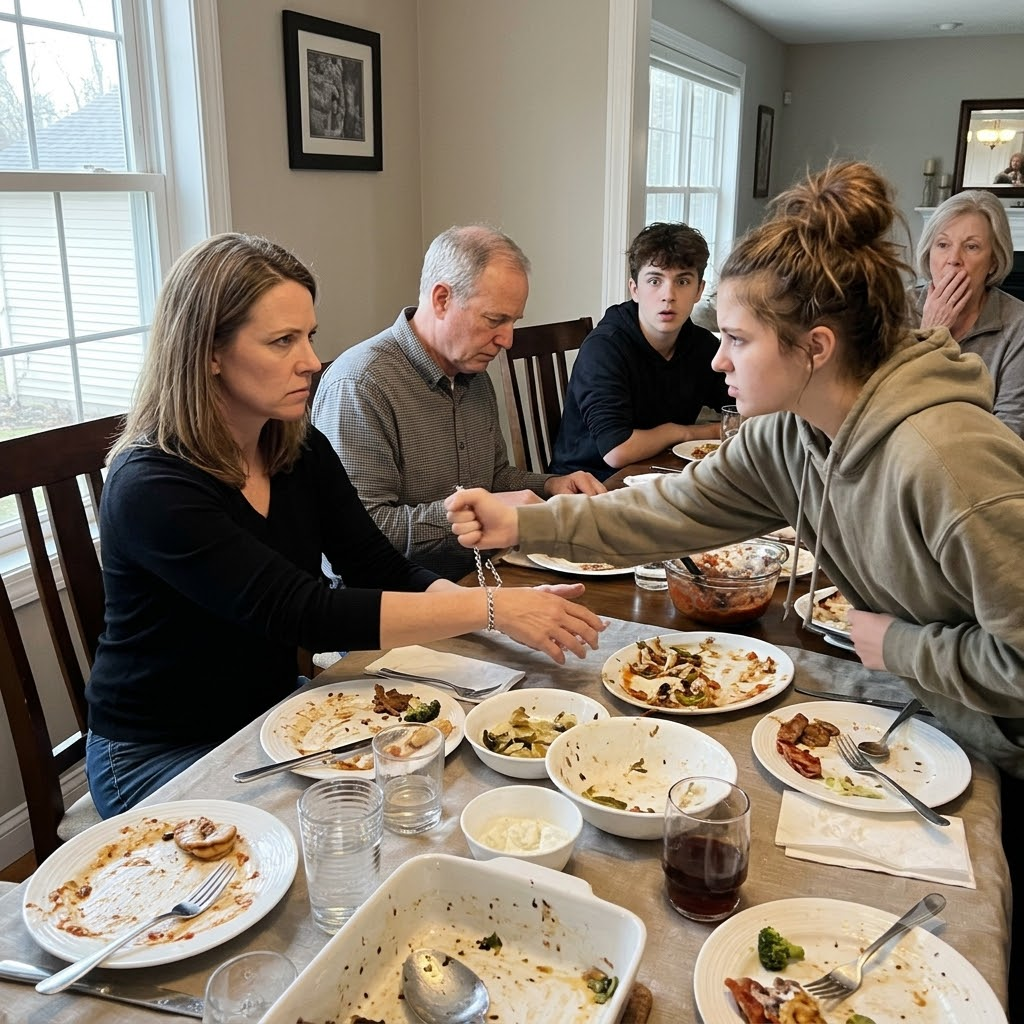
I stared at the photograph.
Sophie stood beside Andrew outside the conservatory entrance. Rachel was visible behind them, partially obscured by the glass doors.
The date printed beneath the image was almost a month before Sophie's acceptance letter.
I enlarged the photograph.
Andrew was holding a folder.
Sophie was smiling.
Rachel appeared to be looking directly at the camera.
I checked the date again.
It was impossible to confuse it.
The photograph had been taken before Sophie officially became a student.
I read the anonymous message again.
"If you want to know who actually created the agreement, ask your niece what happened after her audition."
My first instinct was to call Sophie.
I stopped myself.
I had learned something during the past few days.
Every time I reacted immediately, someone else seemed to control the conversation.
This time, I wanted facts.
I saved the photograph, downloaded the message, and forwarded both to my attorney.
Then I called David.
"Have you ever seen this photograph?"
I sent it to him.
A few seconds later, he answered.
"Yes."
My stomach tightened.
"When?"
"At Rachel's house. She showed it to me after Sophie received her acceptance letter."
"Why?"
"She said Andrew had been helping Sophie prepare for the audition."
I looked at the photograph.
"Did you know it was taken before the acceptance letter?"
"No. I never checked the date."
"Did Rachel tell you anything about the meeting?"
David hesitated.
"She said Andrew wanted to discuss Sophie's future."
"Her academic future?"
"That's what I assumed."
I closed my eyes.
"David, was there any discussion about money?"
"Not that I remember."
I looked at the folder in Andrew's hand.
"All right. Thank you."
Before ending the call, he said something that caught my attention.
"Meredith, there's something I should tell you about Andrew."
I waited.
"He wasn't just Sophie's piano instructor."
"What do you mean?"
"He had connections with the conservatory. He knew people in admissions and had helped students prepare their applications."
I frowned.
"Was he employed by the school?"
"No. He was an independent instructor. But he knew several faculty members."
I looked at the photograph again.
"Did he help Sophie with her application?"
"Yes."
"How much?"
David sighed.
"I don't know. Rachel might."
I ended the call.
Then I searched my old emails for Andrew's name.
I found several messages from Rachel thanking him for helping Sophie prepare.
One mentioned audition recordings.
Another mentioned a recommendation.
A third referred to an application review.
Nothing appeared unusual.
But now I was wondering whether there had been conversations I had never been told about.
The next morning, I called my attorney.
I explained the anonymous message and sent him the photograph.
He reviewed the material.
"Don't contact the anonymous sender yet," he advised. "We don't know who it is or whether the photograph has been altered."
"I understand."
"Have you asked the conservatory about the admission process?"
"Not yet."
"That may be worth doing. Keep the financial dispute separate from the academic decision. You don't want anyone assuming you're trying to interfere with her enrollment."
I agreed.
After the call, I contacted Patricia.
I explained that I had received information suggesting Andrew had been involved in Sophie's application before her acceptance.
I didn't accuse him of anything.
I simply asked whether the school could confirm what role, if any, he had played in the admissions process.
Patricia said she would refer the question to the appropriate department.
Then she added:
"Ms. Collins, I want to make sure you understand something. Sophie's admission and your sponsorship arrangement are separate matters."
"I understand."
"We will not make assumptions about her academic eligibility based on the financial disagreement."
"Thank you."
It was important to me that Sophie receive a fair academic review.
Whatever had happened between us, I didn't want her education evaluated through a family argument.
I wanted the truth.
Nothing more.
At 11:40 A.M., Rachel called.
I answered.
"Hello?"
"Why are you asking the conservatory about Andrew?"
I looked at my computer.
"Because his name appears in the correspondence concerning the disputed agreement."
"He's not responsible for any of this."
"I haven't said he was."
"Then why are you investigating him?"
"I'm asking the school to clarify his involvement."
Rachel sighed.
"Meredith, he was trying to help Sophie."
"That's what everyone keeps saying."
"Because it's true."
I paused.
"Rachel, why was Andrew meeting you and Sophie before she received her acceptance letter?"
She went quiet.
"How do you know about that?"
"I received a photograph."
"What photograph?"
"One showing the three of you outside the conservatory."
Rachel's breathing changed.
"Who sent it?"
"I don't know."
"Did you ask David?"
I didn't answer.
She continued.
"Meredith, that meeting had nothing to do with you."
I felt my jaw tighten.
"Then explain it."
"It was about Sophie's application."
"Why did you need Andrew there?"
"He was helping her."
"With what?"
"Her audition."
"She had already completed the audition."
Rachel sighed.
"You're making something suspicious out of an ordinary meeting."
"Then it should be easy to explain."
There was silence.
Finally, Rachel said:
"Andrew thought Sophie had a real chance of getting accepted. He wanted to make sure everything was ready."
"Ready for what?"
"For her future."
I looked at the photograph.
"Did you discuss tuition that day?"
Rachel didn't answer.
"Rachel?"
"Yes."
"Did you discuss me?"
Another silence.
Then she said:
"Yes."
I sat back.
"What did you say?"
Rachel sounded frustrated.
"I told him you were willing to help."
"Did I say that to him?"
"No."
"Then why did you tell him?"
"Because you had offered to help Sophie!"
"That isn't the same as promising to pay every future expense."
Rachel's voice rose.
"Meredith, we were trying to make sure she had a chance."
I took a slow breath.
"Did Andrew tell you that the school would be more likely to accept Sophie if she had a financial sponsor?"
Rachel didn't answer.
That silence was enough to make me ask another question.
"Was the sponsorship discussed before the audition?"
"Yes."
I closed my eyes.
"How long before?"
"I don't remember."
"Was it before the photograph?"
Rachel sounded irritated.
"Yes."
I stared at the screen.
The pieces were beginning to fit together.
Andrew had been involved before Sophie was accepted.
Rachel had been discussing my financial support before the acceptance letter arrived.
And someone had eventually created a document making that support look guaranteed.
"Rachel, did you tell Andrew I had agreed to cover the entire program?"
"I told him you were helping."
"Did he ask whether you had written confirmation?"
"I don't remember."
"Did he suggest preparing an agreement?"
She became silent again.
Then she whispered:
"Yes."
I felt a cold sensation move through my chest.
"What exactly did he say?"
Rachel exhaled.
"He said the conservatory might want financial reassurance. He suggested that we prepare something showing that Sophie had a sponsor."
"And you agreed?"
"I thought it was reasonable."
"Even though I hadn't signed anything?"
"I thought you'd sign it later."
I stared at the wall.
That was the first time Rachel had admitted that the document had been prepared before I authorized anything.
"Did Sophie know?"
Rachel didn't answer.
I ended the call.
At lunchtime, I received a message from Sophie.
Sophie: Mom told me you're asking questions about my audition.
I read it.
Then another message arrived.
Sophie: I don't understand why you're involving the school in everything.
I replied.
Me: I'm trying to understand why a financial guarantee with my signature was created before you were even accepted.
She responded almost immediately.
Sophie: Andrew was helping me.
Me: I understand that. What did he help you prepare?
There was no answer for several minutes.
Then:
Sophie: My application.
I waited.
Me: Did he also help prepare the sponsorship agreement?
The typing indicator appeared.
Disappeared.
Appeared again.
Finally, she wrote:
Sophie: I don't know what you're talking about.
I stared at the message.
I didn't want to accuse her without hearing her explanation.
So I wrote:
Me: The school has the original file and submission history. If you created or edited anything, the best thing you can do is explain exactly what happened.
She didn't reply.
That afternoon, Patricia called.
"Ms. Collins, I have an update regarding your inquiry."
I sat down.
"Go ahead."
"The admissions department confirmed that Andrew Bennett provided Sophie with private audition preparation."
"Was he involved in evaluating her application?"
"No. He was not an admissions officer."
"Did he communicate with anyone at the conservatory?"
"Yes. He contacted a faculty member regarding Sophie's preparation and performance background."
I listened.
Patricia continued.
"The school has also confirmed that the admissions decision was made through its normal process."
"Thank you."
There was a pause.
Then she said:
"However, we discovered something else while reviewing the sponsorship documentation."
I felt my stomach tighten.
"What?"
"The original application included a financial support statement that was not part of your original correspondence."
I leaned forward.
"Who submitted it?"
"Sophie."
"When?"
"Shortly before the audition."
I closed my eyes.
"Was my name on it?"
"Yes."
"Was it signed?"
"An electronic signature was included."
I gripped the phone.
"Did the school accept it?"
"It was recorded as supporting information, but it was not treated as a legally binding financial guarantee."
I exhaled.
That explained why the school had continued accepting my voluntary payments without requiring a formal sponsorship contract.
But it raised another question.
"Did the document contain the same signature as the later agreement?"
Patricia paused.
"Yes."
I looked toward my desk.
The original sponsorship statement had been submitted before Sophie was accepted.
The later agreement had been prepared before the family dinner.
The signature was identical.
"Can you send me a copy?"
"We can provide the records through the appropriate review process. I'll explain the next steps in writing."
I thanked her.
Then I ended the call.
At 3:20 P.M., I received a message from my attorney.
He had reviewed the new information and wanted me to preserve everything.
He also advised me to avoid making further payments or signing new documents until the review was complete.
I agreed.
Then he asked me to check whether I had ever sent Rachel a scanned signature page.
I searched my old emails again.
I found a message from two years earlier.
It contained a PDF of my identity verification and an authorization form allowing the conservatory to process the payments I voluntarily made.
I opened the document.
My signature appeared on the last page.
It was the same signature used in the disputed agreement.
I felt my heart beating faster.
Someone had copied it.
There was no longer any reasonable doubt about that.
I sent the file to my attorney.
He replied that he would review the original electronic documents and advise me on the appropriate next steps.
I closed my laptop.
Then I looked at the repaired bracelet.
The silver caught the afternoon light.
I turned it around.
The clasp was secure.
I thought about my father again.
He had never been wealthy.
He had never owned an expensive car or a large house.
But he had understood the importance of keeping his word.
I wondered what he would have thought about the people who had used his daughter's generosity to manufacture a promise.
At 6:10 P.M., David called.
"Meredith, I found something."
I sat down.
"What?"
"An old message from Andrew."
"Send it."
"I already did."
I opened my email.
The message was addressed to Rachel.
It was dated two days before the audition.
Andrew had written that he believed Sophie had the ability to succeed, but that the family needed to demonstrate financial stability.
Rachel had replied that I was willing to cover the expenses.
Andrew then suggested that the school might be reassured by a signed statement.
I read the next line.
If Meredith is comfortable supporting Sophie, the paperwork should reflect the arrangement clearly.
Rachel's response was:
She hasn't signed anything yet, but she won't let Sophie down.
I stared at the sentence.
Then I scrolled further.
Andrew had written:
In that case, do not submit anything that claims to be a formal guarantee until she confirms it.
I stopped.
That was important.
It suggested Andrew had initially warned Rachel not to present the support as guaranteed without my confirmation.
But there was another message, sent several days later.
Rachel had written:
Meredith is difficult to reach. Can we use the signature from the original payment authorization? The school needs something before the application review.
Andrew's response was short.
I cannot advise you to do that.
I read it again.
He had refused.
At least initially.
I leaned back.
Perhaps Andrew had been trying to help without crossing a line.
Perhaps Rachel and Sophie had ignored his warning.
But the later email from Andrew suggesting electronic sponsorship paperwork still troubled me.
I called David.
"Did you find any more messages after this?"
"Not yet."
"Keep looking."
"I will."
At 8:35 P.M., Sophie finally called.
I answered.
"Aunt Meredith?"
"Yes."
She sounded nervous.
"Can I come over tomorrow?"
I considered it.
"Why?"
"I want to talk."
"About the document?"
"About everything."
I looked at the photograph of my father.
"All right."
There was a pause.
Then she said:
"Can Mom come too?"
I hesitated.
"Not this time."
"But—"
"Sophie, I want to hear from you directly. We can speak with your mother separately."
She was quiet.
Then she said:
"Okay."
Before hanging up, she asked something unexpected.
"Do you still have Grandpa's letter?"
I looked at the envelope on my desk.
"Yes."
"Did you read it?"
"Yes."
Another pause.
"Did it say anything about me?"
I was surprised by the question.
"No. It was written before you were born."
She breathed out.
"Right."
I waited.
Then she said:
"Mom told me Grandpa wanted us to take care of each other."
"He did."
"She said that's why you helped me."
I looked down at the letter.
"Your grandfather wanted us to love each other. He didn't want anyone to turn that love into an obligation."
Sophie didn't respond.
Then she whispered:
"I think I need to tell you something."
I sat upright.
"What?"
She took a breath.
"About the audition."
I waited.
She continued.
"Andrew wasn't the only person who helped me prepare the financial documents."
My fingers tightened around the phone.
"Who else helped you?"
She didn't answer immediately.
Then I heard her crying.
And when she finally spoke, she said something I hadn't expected.
"Mom didn't just give me your old signature."
I stared at the photograph.
"What do you mean?"
Sophie took another shaky breath.
"She gave me something else."
"What?"
There was a long silence.
Then Sophie whispered:
"A copy of the letter Grandpa had written before he died."
I stood up.
"How did your mother get that?"
Sophie began crying harder.
"Because she had already read it."
And then she said the words that changed everything.
"Aunt Meredith, Mom told me Grandpa had left money for both of us. She said you were hiding your share."






Comments 0