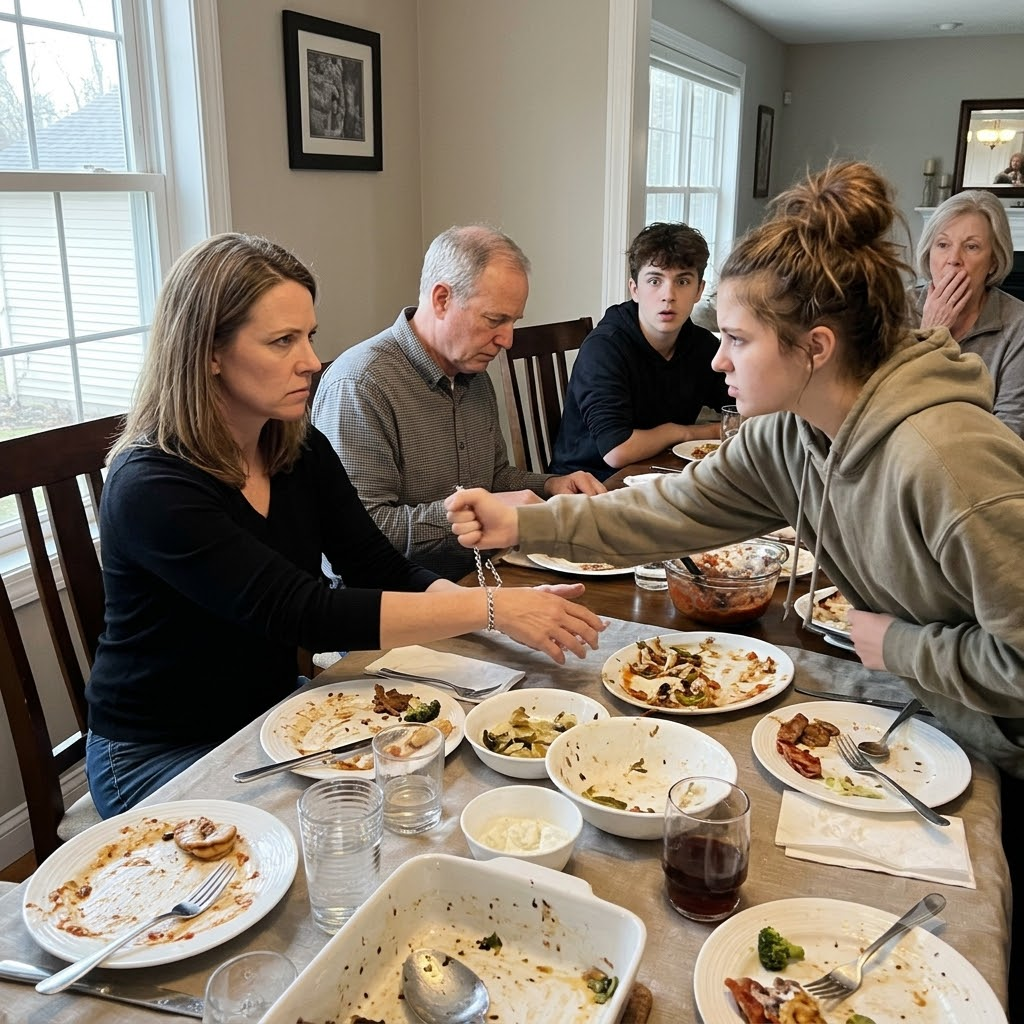
The message on my phone contained one sentence.
"Andrew wasn't just a witness. He was the person who brought the paperwork to your mother."
I read it several times.
Then I forwarded the photograph to my attorney.
For months, my family had treated my financial support as an obligation. My signature had appeared on documents I had never knowingly authorized. My father's money had been moved without my knowledge. And now the same man who had helped Sophie with her conservatory application was connected to a loan secured against my mother's house.
I was done guessing.
I wanted the truth.
My attorney called less than twenty minutes later.
"Meredith, don't respond to the sender. We'll preserve the message and investigate the source."
"Can you contact Andrew?"
"We can request a formal written explanation through the appropriate channels."
I looked at the photograph.
"There's something else. His name appears on both the tuition documents and the loan guarantee."
"I've noticed."
"Do you think these matters are connected?"
"Possibly. But we need evidence before drawing that conclusion."
I agreed.
That afternoon, my attorney contacted the lender and requested the original loan file, including the application, authorization, witness declaration, payment history, and delivery records.
He also asked the conservatory to preserve all correspondence concerning the disputed sponsorship agreement.
For the first time, I wasn't reacting to another family accusation.
I was establishing a record.
And that made all the difference.
Three days later, Andrew agreed to attend a meeting with my attorney.
Rachel came too.
I sat at the conference table with my documents arranged in front of me.
Andrew entered first.
He looked uncomfortable.
Rachel followed him, avoiding my eyes.
Nobody spoke until my attorney began.
"Thank you for coming. We need clarification regarding two financial documents bearing Ms. Collins's signature."
Andrew nodded.
"I understand."
My attorney placed the loan guarantee on the table.
"Mr. Bennett, your name appears as a witness."
Andrew examined the document.
"Yes."
"Do you remember witnessing Ms. Collins sign this?"
He hesitated.
"No."
"Did you see her sign it?"
"No."
I looked at him.
"Then why is your signature here?"
Andrew shifted in his chair.
"Your mother asked me to help organize some paperwork. I was under the impression that everything had already been discussed within the family."
"With whom?"
"With your mother and Rachel."
"Not with me?"
He looked down.
"I don't remember speaking with you about the loan."
My attorney placed another document beside the first.
The conservatory sponsorship agreement.
Andrew's expression changed.
"And this?" my attorney asked.
Andrew examined it.
"I helped Rachel understand what the school required."
"Did you advise Sophie to use Ms. Collins's previous signature?"
"No."
"Did you know that her signature had been copied into the document?"
Andrew hesitated.
"I knew an electronic signature had been included."
I felt my stomach tighten.
"Did you know I hadn't authorized it?"
He looked at me.
"Rachel told me you had agreed to provide support."
"Did you ask me?"
"No."
"Did you see written permission from me?"
"No."
I leaned forward.
"Then why did you allow your name to appear on the paperwork?"
Andrew rubbed his forehead.
"I thought I was helping Sophie."
My attorney continued.
"Did you receive any payment for arranging the financial documents?"
Andrew immediately shook his head.
"No."
He paused.
Then he added:
"I did receive money from Rachel for administrative help with Sophie's application."
I looked at Rachel.
She lowered her eyes.
"How much?" my attorney asked.
"Three thousand dollars."
I felt a strange emptiness.
Andrew had been paid to help with an application that eventually included financial documents bearing my name.
He had also witnessed a loan authorization he hadn't actually seen me sign.
"Did you receive any money from the loan proceeds?" my attorney asked.
Andrew shook his head.
"No."
"Did you benefit financially from the conservatory sponsorship arrangement?"
"No."
My attorney made a note.
Then he asked Andrew to provide every original email and document connected to the transactions.
Andrew agreed.
Before the meeting ended, I asked him one final question.
"Did you ever tell Sophie that her education depended on my continuing to pay?"
He looked at me.
"I told her that financial stability was important."
"That's not what I asked."
He lowered his eyes.
"Yes. I told her that losing the sponsorship could put her enrollment at risk."
I nodded slowly.
"Then you should have made sure the sponsorship was real before telling her that."
Andrew said nothing.
The investigation took several weeks.
During that time, I continued running my accounting firm.
I attended meetings.
I handled client accounts.
I reviewed payroll.
I did everything I had always done.
But something had changed.
I no longer allowed family emergencies to interrupt my work simply because someone expected me to respond immediately.
My attorney kept me informed.
The lender eventually provided the original loan file.
An independent document examiner reviewed the signature on the guarantee and compared it with my genuine signatures.
The report was clear.
The signature had been reproduced from an earlier document.
It was not a naturally executed signature on the loan agreement.
The witness declaration was also problematic.
Andrew had signed it without witnessing me sign the document.
The lender suspended its collection action against me while the matter was reviewed.
My attorney formally disputed the guarantee.
The institution eventually acknowledged that it could not establish my authorization and removed me as a guarantor.
I remember the day he called.
"Meredith, your name has been removed from the disputed liability."
I sat quietly.
"Are you certain?"
"Yes. The lender has confirmed it in writing."
I closed my eyes.
For months, I had feared that my father's final financial decisions would somehow destroy the business I had spent decades building.
Now that fear was gone.
I thanked my attorney.
Then I took the bracelet off my wrist and placed it on my desk.
My father had given it to me when I turned eighteen.
It had survived everything.
And I had finally stopped allowing other people's decisions to define what it meant.
The truth about the house emerged through the financial records.
My mother had transferred money from the investment account intended to help me establish my business.
She had used part of it toward the purchase and maintenance of the property.
Later, she had arranged additional borrowing secured against the house.
Rachel had received several transfers from those funds.
Some were used for household expenses.
Some supported Sophie's education.
Others covered personal debts.
The records also established that my mother had intended the arrangement to be temporary.
She had hoped to restore the money and eventually leave the property to both daughters.
But she had died before completing that plan.
There was no valid agreement making me responsible for the loan.
There was no evidence that I had received an equivalent inheritance.
And there was no legal document requiring me to pay Rachel back for the decisions our mother had made.
My attorney explained the distinction carefully.
The fact that my mother had intended to help Rachel did not automatically create a debt between the sisters.
The property itself still had an outstanding mortgage.
Rachel had been living there without fully understanding the long-term financial consequences.
Once the disputed guarantee was removed, the lender negotiated directly with the actual borrower and the estate representatives.
Rachel had two choices.
She could sell the house and use the proceeds to settle the outstanding obligations, or she could arrange financing based on her own financial circumstances.
She couldn't continue treating my income as the missing piece.
For the first time, she had to make a decision without assuming I would rescue her.
Rachel called me one evening.
"I've decided to sell the house."
I was sitting at my kitchen table.
"Are you sure?"
"Yes."
She sounded tired but calmer.
"I can't afford to keep it."
I remained silent.
She continued.
"I've spoken with a financial adviser. There are smaller places I can afford."
"What about Sophie?"
"She'll finish the semester in Boston. After that, we'll work out where she wants to live."
I nodded.
"That sounds reasonable."
Rachel was quiet.
Then she said:
"I'm sorry."
I looked at the bracelet.
"For what?"
"For using your money without asking. For letting Sophie believe you owed us something. For laughing when she broke Dad's bracelet."
I didn't answer immediately.
Rachel continued.
"I was jealous of you."
That surprised me.
"Why?"
"Because you built a life for yourself. You had your business, your own home, and your independence. I kept telling myself that you had everything because things had been easier for you."
I listened.
"They weren't easier," I said.
"I know that now."
"I worked for years to build what I have."
"I know."
"And helping you was something I chose to do. It wasn't something you were entitled to."
Rachel began crying.
"I understand."
I looked out the window.
For years, I had wanted my sister to understand that distinction.
Now, hearing her say it, I felt no desire to argue.
I simply said:
"I hope we can have a better relationship from now on."
"So do I."
Sophie also had to face the consequences of her decisions.
The conservatory completed its review of the disputed sponsorship documents.
The school determined that the false financial statements had to be formally corrected.
Because Sophie admitted her role, cooperated with the review, and provided the original communications, the school allowed her to remain enrolled under a disciplinary warning.
Her financial aid application was reassessed.
The school offered a revised payment plan, and Sophie was required to arrange her remaining expenses independently.
I did not sponsor the remaining sixty thousand dollars.
That decision remained final.
But I did not want her education to end because of a financial arrangement that had never been properly understood.
I agreed to provide one thing.
I offered to help her find an independent financial adviser who could explain scholarships, grants, student employment, and realistic education costs.
The adviser was not connected to our family.
The decisions would be Sophie's.
She accepted.
A few weeks later, she called me.
"Aunt Meredith?"
"Yes?"
"I got a part-time position in the music department."
I smiled slightly.
"That's good."
"They're letting me assist with student performances and instrument preparation."
"Congratulations."
She hesitated.
"I also applied for a scholarship."
"Have you heard anything?"
"Not yet."
I told her I hoped it worked out.
Then she said:
"I've been thinking about Grandpa."
I looked at the bracelet.
"So have I."
"I remember when you used to tell me how he bought that bracelet at a flea market."
"He did."
"I called it cheap."
I remained silent.
"I'm sorry I said that."
"Thank you."
She took a breath.
"I didn't understand what it meant."
I looked down at my wrist.
"Now you do."
Several weeks later, Sophie came to visit.
She arrived with a small package.
I opened the door.
"Hello, Aunt Meredith."
"Come in."
She looked nervous.
We sat in the living room.
She placed the package on the table.
"I made something for you."
I opened it.
Inside was a small silver jewelry box.
It wasn't expensive.
But it was beautifully made.
On the inside of the lid, there was a short engraving.
For the memories that matter.
I looked at her.
"Did you make this?"
"With help from someone at the conservatory."
I ran my fingers over the engraving.
"It's lovely."
Sophie looked down.
"I know it can't replace your bracelet."
"It doesn't have to."
She nodded.
Then she reached into her bag and removed a folded piece of paper.
It was a handwritten apology.
She had written about the dinner.
About the bracelet.
About the financial documents.
And about how she had allowed fear to become an excuse for dishonesty.
She didn't ask me to forgive her.
She didn't mention tuition.
She didn't ask whether I would pay for anything in the future.
She simply admitted what she had done.
When she finished, I folded the letter carefully.
"Thank you for writing this."
She nodded.
"Do you think we can start over?"
I looked at her.
"Yes. But starting over means doing things differently."
"I understand."
I reached across the table and took her hand.
"I hope you become a wonderful musician, Sophie."
Her eyes filled.
"Thank you."
By the beginning of the following year, Rachel had sold the house.
After the mortgage and legitimate property expenses were settled, she moved into a smaller apartment in Columbus.
She found a full-time administrative position and began rebuilding her savings.
She also started attending financial counseling sessions.
For the first time, she was learning to manage her money without assuming another person would cover the difference.
Sophie continued her studies in Boston.
She received a partial scholarship and worked part-time.
Her progress wasn't easy.
There were difficult months.
There were moments when she considered taking a break.
But she continued.
And she began earning recognition for her performances.
Andrew was no longer involved in her financial arrangements.
His role in the disputed documents was reviewed separately, and he lost several professional opportunities after the conservatory determined that his conduct had fallen below its standards.
He eventually sent me a written apology.
I read it.
Then I filed it with the other documents.
I didn't need to maintain a relationship with him.
I didn't need to punish him either.
The truth had been established.
That was enough.
One Sunday afternoon, Rachel invited me to lunch.
It was the first time we had spent time together without discussing money.
She prepared a simple meal.
There were no expensive dishes.
No wine.
No elaborate family gathering.
Just the two of us.
After lunch, she brought out an old photograph.
It showed our father standing beside us when we were children.
I looked at his face.
He was smiling.
Rachel sat beside me.
"Do you think Dad would be disappointed in us?"
I studied the photograph.
"I think he would have wanted us to tell the truth sooner."
She nodded.
"Yes."
I placed the photograph back on the table.
"He wanted us to help each other. He never wanted us to use each other."
Rachel wiped her eyes.
"I wish I had understood that."
"Me too."
We sat quietly.
Then she reached across the table and touched my bracelet.
"Does the clasp still work?"
I smiled faintly.
"Perfectly."
She nodded.
"Good."
For the first time in a long while, there was no argument waiting beneath the conversation.
On the anniversary of my father's birthday, Sophie returned to Columbus for a short visit.
She brought her music portfolio and showed me several recordings.
One was a piano piece she had written herself.
She explained that it was about family, memory, and the feeling of losing something valuable.
I listened without interrupting.
When the final notes faded, I realized my eyes were wet.
"That was beautiful," I said.
She smiled.
"Thank you."
She looked at my bracelet.
"Do you still wear it every day?"
"Almost."
"Grandpa would have liked that."
I nodded.
Then Sophie handed me a small envelope.
Inside was a photograph of her standing beside a piano at the conservatory.
On the back, she had written:
I got here because people believed in me. I'm learning that I have to earn the rest myself.
I read the sentence twice.
Then I hugged her.
It wasn't a promise to pay her tuition.
It wasn't a guarantee of future financial support.
It was simply an aunt embracing her niece.
And that was enough.
Later that evening, I returned home and placed my father's letter beside the repaired bracelet.
I had kept every important document from the investigation.
The original account records.
The disputed loan authorization.
The lender's confirmation removing my liability.
The conservatory's final decision.
And the letters that had helped explain what happened.
I no longer needed to look at them every day.
The questions had been answered.
My father's money had been traced.
My signature had been cleared.
The house had been sold.
The loan had been settled through the proper arrangements.
The tuition dispute had ended.
And the family had finally begun rebuilding its relationships without pretending that love meant unlimited financial support.
I opened my father's letter one last time.
I found the sentence I had read so many times.
Never make love a debt.
I touched the paper gently.
Then I placed it inside the jewelry box Sophie had given me.
The silver bracelet rested beside it.
I thought about the young woman I had been when my father first gave it to me.
I thought about the years I had spent building my business.
The family I had tried to support.
The decisions I had made.
And the person I had become.
I had not lost my family.
I had lost the illusion that loving them meant accepting every burden they placed on me.
There was a difference.
A very important one.
The following Monday, I returned to my accounting firm.
My employees were waiting for me.
There were reports to review, clients to meet, and another busy week ahead.
I walked into my office, placed my purse beside the desk, and looked at the bracelet on my wrist.
The repaired clasp caught the morning light.
For the first time in months, I felt completely at peace.
My father had given me something inexpensive.
My family had nearly turned it into a symbol of everything they believed I owed them.
But the bracelet had never represented money.
It represented love.
And I had finally learned that I could keep the love without carrying the debt.
I smiled softly, picked up the first file of the day, and got to work.
My future belonged to me.
And this time, I was going to live it without apology.
Tăng cao trào khi Andrew bị vạch trần Làm rõ cách khoản vay được giải quyết






Comments 0