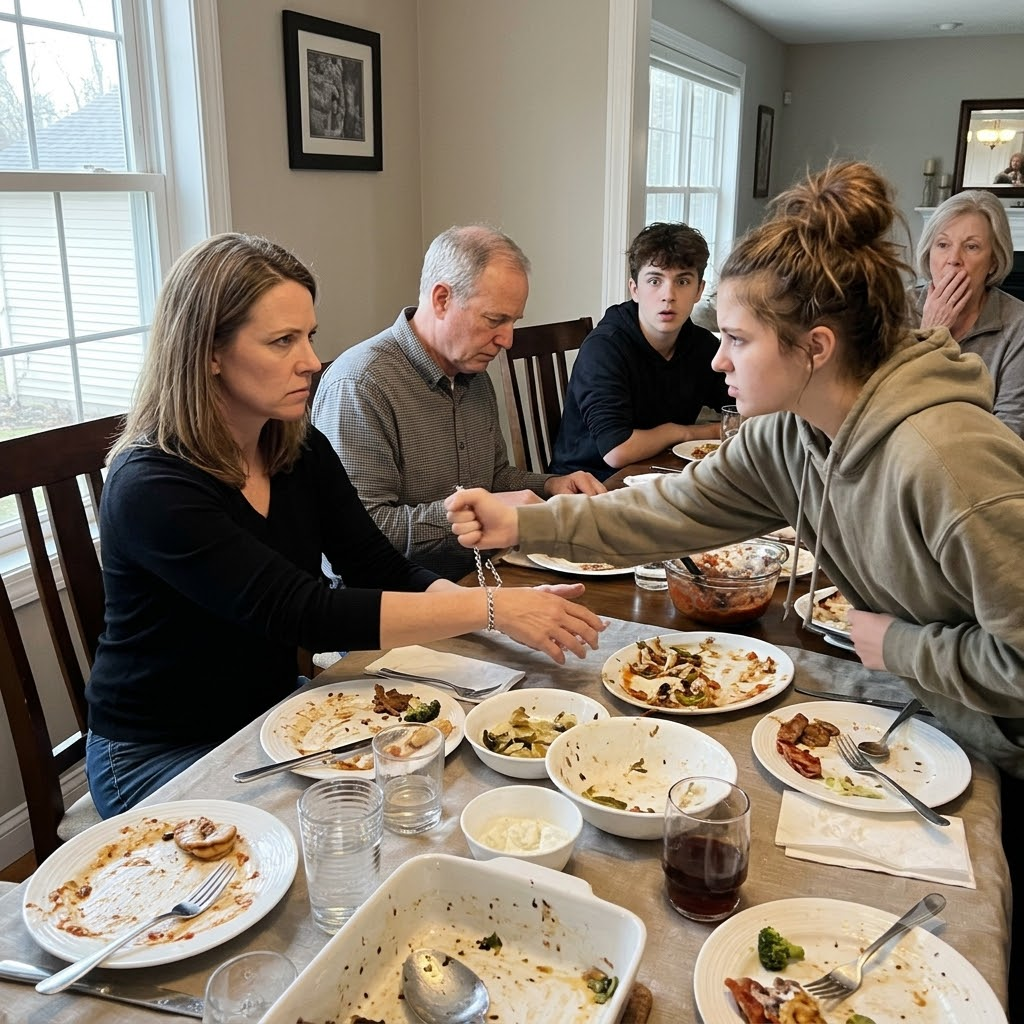
"Meredith, I think it's time you heard my side of the story."
I froze.
I knew that voice.
It belonged to David, our uncle, the man who had sat quietly at Rachel's Sunday dinner while Sophie broke my bracelet.
He had watched the entire incident.
He had heard Rachel dismiss me.
And he hadn't said a word.
Now he was standing somewhere beside my sister, telling me there was another side to the story.
I tightened my grip on the phone.
"What side, David?"
Rachel interrupted.
"Meredith, please. Let him explain."
I ignored her.
"David, why were you involved in the tuition agreement?"
He took a breath.
"I wasn't involved in the agreement itself."
"Then why were you there?"
"Because Rachel asked me to help her understand some paperwork."
I closed my eyes.
"What paperwork?"
There was a pause.
Then he answered.
"The document with your signature."
I sat down slowly.
"So you knew about it?"
"I knew something was being prepared."
"Did you know it contained a financial guarantee I never signed?"
"I didn't know the final version said that."
I looked at the disputed document on my laptop.
"Did you see my signature?"
"Yes."
"And you didn't question it?"
David hesitated.
"I thought Rachel had obtained your permission."
"From whom?"
"From you."
I laughed once, without humor.
"Nobody obtained permission from me."
"I understand that now."
I stood and walked toward the window.
"David, I need you to answer one question. Who added the statement saying I had verbally reconfirmed the payments?"
He didn't respond immediately.
Then he said:
"Sophie."
I stopped walking.
"Are you sure?"
"That's what Rachel told me."
I looked toward my desk.
The document's revision date had been the night before the family dinner.
Sophie had created it.
Rachel's account had submitted it.
And now David was telling me that Sophie had added a statement claiming I had confirmed something I had never said.
I felt my stomach tighten.
"Why?"
David sighed.
"Because she was afraid the school would question the sponsorship."
"Why would they question it?"
"Because the original arrangement was temporary."
I looked at the letter from my father.
"Then everyone knew it wasn't permanent."
There was silence.
Finally, David said:
"Yes."
That one word hurt more than I expected.
I had been the only person in the family treating the arrangement as voluntary.
Everyone else had apparently been planning around money that didn't belong to them.
"Meredith," David continued, "I know you're angry."
"Angry isn't the word."
"I understand."
"No, I don't think you do."
He remained quiet.
I continued.
"You watched Sophie take something from my wrist. You watched her break it. You heard her insult me. You watched Rachel laugh."
"I know."
"And now I'm learning that a financial document with my signature was prepared before that dinner."
"I didn't know the document would be used that way."
"But you knew something was happening."
He sighed.
"Yes."
I sat down again.
"Why didn't you tell me?"
David took several seconds to answer.
"Because Rachel told me you had already agreed to continue helping Sophie. She said the family had discussed it."
"There was no family discussion."
"I know that now."
"Why did you believe her?"
"Because I wanted to believe there was a way to keep Sophie in school."
I looked at the screen.
"That still doesn't explain why you stayed silent."
David's voice softened.
"Rachel was desperate. She'd been telling me for months that she couldn't manage the tuition. She was afraid Sophie would lose her place."
"And that made it acceptable to use my name?"
"No."
"Then what made you think it was acceptable to let me walk out of that dinner without telling me what was happening?"
He didn't answer.
I looked at the photograph of my father.
For years, David had been someone I trusted.
He had attended birthdays, holidays, family celebrations, and funerals.
He had been there when our father died.
He had helped our mother move.
He had watched Rachel and me grow up.
And now I was discovering that he had been quietly involved in something he knew I hadn't approved.
"David, I want you to send me everything you know about that document."
"I can do that."
"Every message. Every email. Every version."
"All right."
"And don't discuss this with anyone before you send it."
He paused.
"Meredith, there's something else."
I waited.
"Rachel isn't the only person who has been worried about the money."
I frowned.
"What does that mean?"
He lowered his voice.
"Sophie has been telling people that you agreed to cover more than just her tuition."
I felt a cold sensation move through my chest.
"More than tuition?"
"She told some people you were helping with her living expenses, travel, and other costs."
I stared at the wall.
"That isn't true."
"I know."
"Did Rachel know she was saying that?"
"I think so."
I pressed my fingers against my forehead.
The story was becoming more complicated with every conversation.
I had agreed to help with tuition.
I had never promised to fund an entire lifestyle.
I had never offered to become responsible for every expense Sophie might have during her education.
And yet, somehow, the family had turned my generosity into a permanent financial arrangement.
"David, did Sophie really believe all of that?"
"I think she did."
"Why?"
He hesitated.
"Because Rachel kept telling her you would always help."
I closed my eyes.
"Thank you for telling me."
"Meredith, I hope you know I never wanted to hurt you."
I didn't answer immediately.
Then I said:
"I believe you didn't want a confrontation. But choosing not to confront something doesn't mean nobody gets hurt."
I ended the call.
For the next hour, I couldn't concentrate.
I opened my father's letter again.
The words seemed different now.
Never make love a debt.
I read the sentence several times.
Then I looked at the photograph from my eighteenth birthday.
My father had been smiling.
He had bought me that bracelet because he wanted me to remember that love didn't need an expensive price tag.
Now my sister and niece had turned my financial help into a measure of my affection.
I thought about Sophie.
When she was younger, she had often stayed at my apartment during school holidays.
She loved music even then.
She would sit at my piano and play the same short melody over and over until she got it right.
I remembered how proud she had been when she finally learned a difficult piece.
I remembered taking her to a small music store to buy her first serious keyboard.
She had hugged me.
"You're the best aunt ever."
I had laughed.
"Don't say that until you've heard me sing."
She had laughed too.
Those memories were real.
The affection was real.
And that was what made everything so painful.
I hadn't stopped caring about Sophie.
I had stopped believing that my care entitled her to treat me however she wanted.
At 2:16 P.M., David sent me an email.
There were four attachments.
The first was a copy of an email from Rachel.
The second was a draft of the sponsorship agreement.
The third was a series of messages between Rachel and Sophie.
The fourth was a document titled:
FAMILY TUITION PLAN.
I opened the first attachment.
Rachel's email had been sent several weeks before the family dinner.
It was addressed to David.
The message was short.
She explained that Sophie was worried about the remaining tuition and that she wanted to find a way to ensure the payments continued.
She also wrote that she believed I would agree if the arrangement was presented correctly.
I read that sentence twice.
Presented correctly.
I opened the second attachment.
It was an early version of the disputed agreement.
The document stated that I had agreed to provide financial assistance.
The signature field was blank.
I checked the date.
It had been created before the final version.
I opened the third attachment.
It contained a conversation between Rachel and Sophie.
I read the messages slowly.
Rachel: Your aunt has always helped us. She won't let you lose your place.
Sophie: But what if she changes her mind?
Rachel: She won't. She knows how important this is.
Sophie: What if she gets upset?
Rachel: I'll talk to her. She always calms down eventually.
I felt my jaw tighten.
Then I saw another message.
Sophie: I don't want to ask her again.
Rachel: You don't have to. I'll handle it.
I scrolled further.
The next exchange was dated the evening before the Sunday dinner.
Sophie: The school wants proof that the remaining tuition is covered.
Rachel: Send them the agreement.
Sophie: It isn't signed.
Rachel: We'll deal with that.
Then Sophie wrote:
Sophie: What if Aunt Meredith says she never agreed?**
Rachel's response made me sit upright.
Rachel: She won't. Once everyone knows the arrangement, she'll be too embarrassed to back out.
I stopped reading.
For a moment, the room seemed completely silent.
This hadn't been a misunderstanding.
It hadn't been a careless assumption.
Rachel had anticipated that I might refuse.
And she had believed that making the arrangement appear official would pressure me into continuing.
I opened the fourth attachment.
The family tuition plan contained a list of expected expenses.
Tuition.
Accommodation.
Travel.
Books.
Instrument maintenance.
Performance clothing.
Summer programs.
Some items were marked as already covered.
Others were listed as future expenses.
At the bottom was a projected amount for the following academic year.
I stared at it.
Then I noticed a handwritten note in the margin.
Meredith can cover the difference if necessary.
I closed the document.
My hands were trembling.
Not from fear.
From the realization that people I had loved had been planning my money as though it were theirs.
At 4:30 P.M., Rachel called.
I answered.
"Did David send you the documents?" she asked.
"Yes."
There was a long silence.
Then she said:
"I can explain."
"Can you?"
"Yes."
I looked at the messages.
"Did you write that once everyone knew about the arrangement, I'd be too embarrassed to back out?"
Rachel didn't respond.
"Rachel?"
"Yes."
I felt something inside me go quiet.
"Why?"
"Because I thought you'd continue helping."
"Even if I didn't want to?"
"I didn't think you'd say no."
"That's not an answer."
She began crying.
"I was scared."
"Of what?"
"Of losing everything Sophie had worked for."
"Then you should have spoken to me honestly."
"I tried."
"No, Rachel. You assumed."
She sighed.
"You're right."
The admission surprised me.
I remained silent.
Rachel continued.
"I know I handled it badly."
"Badly?"
"Yes."
"You let someone prepare a document with my signature."
"I didn't sign it."
"You submitted it from your account."
"I thought it would help Sophie."
"You knew it contained a guarantee I had never made."
Rachel started crying harder.
"I didn't think it would go this far."
I leaned back.
"Where did you think it would go?"
She didn't answer.
I continued.
"Did you expect me to see the document and simply accept it?"
"No."
"Then what did you expect?"
"I thought you'd feel obligated."
I closed my eyes.
There it was again.
Obligation.
That was what my generosity had become.
I took a slow breath.
"Rachel, I need you to understand something. I am not responsible for the promises you made to Sophie."
"I know."
"And I am not responsible for the financial plans you made using money I never agreed to provide."
"I know."
"Then stop telling people I abandoned her."
Rachel went quiet.
Finally, she whispered:
"I'll tell them."
I looked at the broken bracelet's repair receipt.
"Thank you."
She sniffed.
"Can I ask you something?"
"Go ahead."
"Would you ever consider helping her again?"
I thought about it.
"I don't know what the future looks like. But I will not make financial promises under pressure."
Rachel nodded, although I couldn't see her.
"Okay."
We ended the call.
That evening, I received a message from Sophie.
It was the first direct message she had sent since the conservatory meeting.
Sophie: Mom told me you saw the documents.
I read it.
Then another message appeared.
Sophie: I didn't mean for things to get this bad.
I waited.
She continued.
Sophie: I was scared I'd lose my place.
I considered how to respond.
Finally, I wrote:
Me: I understand that you were scared. But fear doesn't make it acceptable to use someone else's name without permission.
A few seconds passed.
Then she replied.
Sophie: Mom said you would probably help anyway.
I stared at the message.
Me: That doesn't make it true.
She sent another.
Sophie: I know.
For a moment, I felt hopeful.
Then:
Sophie: Are you going to tell the school I'm a liar?
I put the phone down.
I couldn't keep having conversations in which every apology turned into another attempt to control the outcome.
I typed one final message.
Me: I will tell the school the truth about the documents and my financial agreement. What they decide about your enrollment is between you and them.
I sent it.
She didn't respond.
The following morning, I received a call from Patricia at the conservatory.
She explained that the school had completed its initial review.
The disputed agreement would not be accepted as proof of a guaranteed sponsorship.
My original correspondence would remain the valid record of the voluntary arrangement.
I thanked her.
Then she added:
"There is one more matter we need to discuss."
I sat down.
"What is it?"
"The financial aid department received another document yesterday."
I frowned.
"From whom?"
"It was submitted by the student."
"What kind of document?"
"A written explanation of the family's financial circumstances."
"All right."
Patricia paused.
"It includes a statement that you had previously agreed to provide additional financial support outside the tuition arrangement."
I closed my eyes.
"That's not true."
"We understand that. The statement is currently being reviewed."
I exhaled.
"Thank you for letting me know."
After the call, I forwarded the information to my attorney.
I thought that would be the end of it for the morning.
Then my phone rang again.
It was David.
"Meredith, have you seen the messages I sent last night?"
"Yes."
"There's something I didn't include."
I frowned.
"What?"
He lowered his voice.
"I found another email."
"From Rachel?"
"No."
"Then from whom?"
He hesitated.
"From Sophie."
I waited.
"It was sent to someone at the conservatory before the tuition agreement was created."
I sat upright.
"What did it say?"
David took a breath.
"She was asking whether the school would accept a sponsorship guarantee if the sponsor's signature was provided electronically."
I felt my stomach drop.
"Why would she ask that?"
"I don't know."
"Who did she send it to?"
David went quiet.
Then he said:
"Meredith, the person who replied wasn't from the billing office."
I gripped the phone.
"Who was it?"
David paused.
And when he finally gave me the name, I recognized it immediately.
It belonged to someone who had been helping Sophie with her music studies.
Someone who had visited our family home.
Someone who knew exactly how much I had been paying.
And that person had offered to help Sophie make the agreement look official.






Comments 0