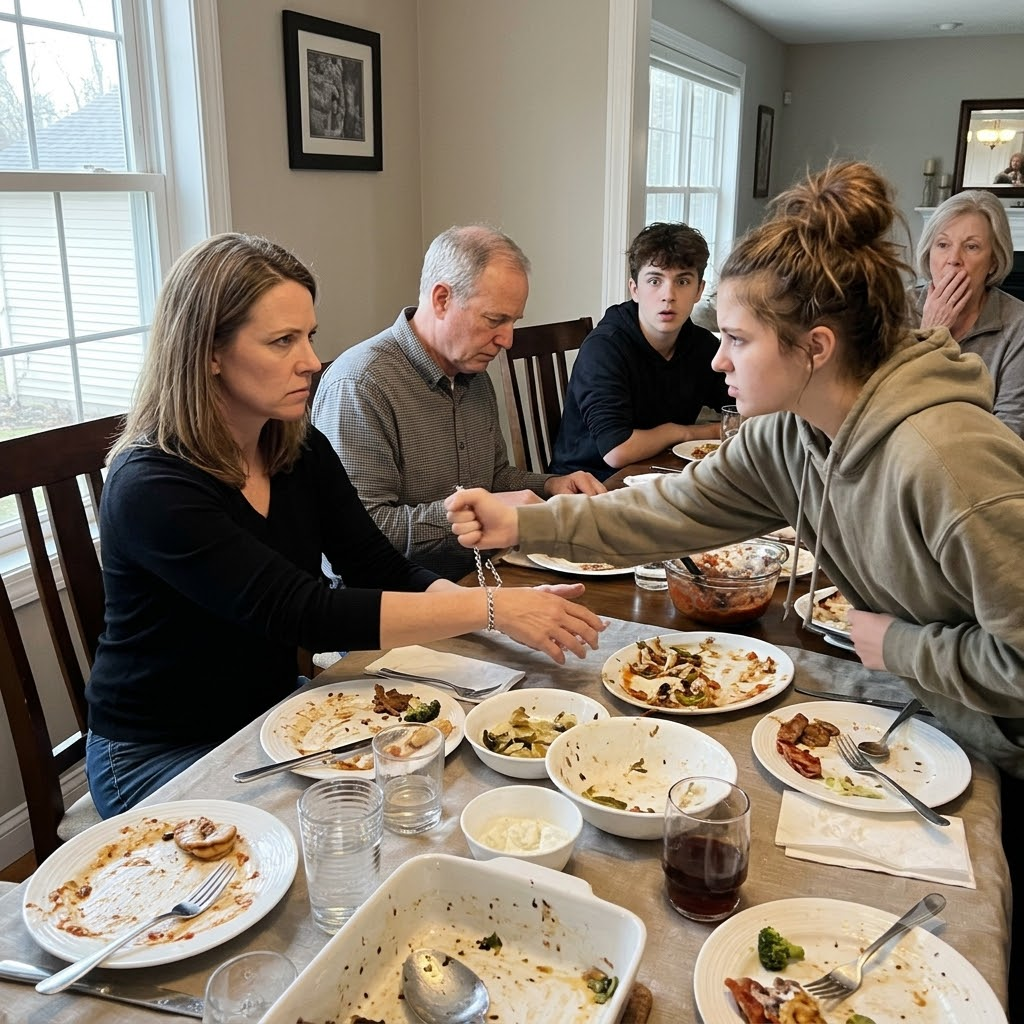
"Aunt Meredith, Mom told me Grandpa had left money for both of us. She said you were hiding your share."
I couldn't move.
For several seconds, I simply stood beside my desk, holding the phone against my ear.
My father's letter was lying open in front of me.
I looked at his handwriting.
Then I looked at the photograph from my eighteenth birthday.
"What money, Sophie?"
She sniffed.
"The money Grandpa left."
"How much?"
"I don't know exactly. Mom said there was supposed to be money for both of us. She said you got yours, but she never got hers."
I closed my eyes.
"Sophie, your grandfather died when you were nineteen. He didn't leave me a large inheritance."
"That's not what Mom said."
"Then I need you to tell me exactly what she told you."
Sophie hesitated.
"She said Grandpa had arranged something before he died. She said you were supposed to share it with her when she needed help."
I looked at the letter again.
There was nothing about an inheritance.
Nothing about a hidden account.
Nothing about money being divided between his daughters.
There was only a message about love, responsibility, and never making affection into a debt.
"Did your mother show you a bank statement?"
"No."
"An account?"
"No."
"An estate document?"
"I don't think so."
"Then how does she know this money exists?"
Sophie began crying again.
"She said she found a letter."
"What letter?"
"The one Grandpa wrote."
I stared at the envelope.
My father's original letter was sitting in front of me.
I had read every line.
There was no mention of a financial inheritance.
"Did she show you the original?"
"No. She showed me a photograph of one page."
"Which page?"
"I don't remember."
"Can you send me the photograph?"
Sophie hesitated.
"I think I still have it."
"Please send it."
A few seconds passed.
Then my phone vibrated.
An image appeared.
I opened it.
The photograph showed a handwritten page.
My father's handwriting.
I recognized it immediately.
But something was different.
The page was not part of the letter I had just read.
At the top was a date.
Three months before his death.
Beneath it were several paragraphs.
I enlarged the image.
The first paragraph mentioned a savings account.
The second mentioned Rachel.
The third mentioned me.
And the final paragraph contained a sentence that made my hands go cold.
Whatever remains should be divided fairly between my daughters, provided they understand that the money is meant to help them build independent lives.
I read it again.
Then I looked at the date.
My father had written this before the letter I had found in the storage unit.
I turned toward my desk drawer.
There were old documents inside.
I pulled out the family papers I had kept after his death.
Insurance records.
Tax documents.
A few photographs.
But nothing about an account being divided between Rachel and me.
I returned to the phone.
"Sophie, where did your mother get this photograph?"
"She said she found it among Grandpa's things."
"Did she tell you how much money was in the account?"
"No."
"Did she say when it was supposed to be divided?"
"She said you had received your part."
I felt my stomach tighten.
"That isn't true."
Sophie was quiet.
Then she asked:
"Are you sure?"
I looked directly at the photograph.
"Yes."
I heard her breathing.
"Then why would Mom say that?"
I didn't know.
But I was beginning to understand why Rachel had been so determined to make me continue paying Sophie's tuition.
She believed there was something I had received that she hadn't.
And she had somehow convinced Sophie that I was keeping it from her.
"Sophie, I want you to send me the entire photograph, not a cropped version."
"Okay."
"And don't delete any messages about this."
"Okay."
I paused.
"One more thing. Did your mother tell you this before the tuition problem started?"
Sophie hesitated.
Then she whispered:
"Yes."
I barely slept that night.
At 7:15 the next morning, I contacted my attorney.
I explained what Sophie had told me and sent him the photograph.
He asked me to bring every document I had relating to my father's estate.
I spent the next hour searching through old folders.
I found the paperwork from the year my father died.
There had been no substantial inheritance.
My mother had received the family home and the remaining household assets.
A small insurance payment had covered outstanding expenses.
There had also been a modest savings account.
I remembered it.
My father had been saving for years, although the amount was nowhere near enough to support two adult daughters.
I found the old account statement.
The balance was smaller than I remembered.
I checked the date.
The account had been closed shortly after his death.
There was a distribution record attached to the file.
I read it carefully.
The money had been used to cover funeral expenses, medical bills, and outstanding household obligations.
There was no separate payment to me.
There was no separate payment to Rachel.
And there was certainly no inheritance hidden in my name.
I placed the documents in a folder.
Then I found something unexpected.
A handwritten note from my mother.
It was dated several months after my father's death.
The note contained a list of household expenses and a short reference to the savings account.
At the bottom, my mother had written:
There wasn't enough left to divide. Your father would have wanted you girls to build your own lives.
I sat quietly.
That was what I remembered.
My mother had never told me there was money waiting for me.
She had never suggested Rachel was entitled to anything from me.
So where had this new story come from?
At 10:00 A.M., I met with my attorney.
He examined the photograph Sophie had sent.
Then he reviewed the estate records.
He was careful with his conclusions.
"The photograph may be genuine," he said. "But we need to establish whether this was a complete document, a draft, or part of a larger record."
I nodded.
"Can you determine whether the account existed?"
"We can start with the records you have. If necessary, we can request information through the appropriate estate channels."
I showed him the old account statement.
He reviewed the balance and the closing date.
Then he pointed to the distribution record.
"Based on this document, the remaining savings were used for estate and household obligations. There is no indication of a separate inheritance being distributed to you."
"That's what I remembered."
He nodded.
"Then don't accept anyone else's interpretation without documentation."
I agreed.
Before I left, he asked whether Rachel had ever made a formal claim against my father's estate.
I shook my head.
"Not that I know of."
"Has she ever asked you for money because of this alleged inheritance?"
I thought about it.
There had been occasional conversations about our father's wishes.
But nothing specific.
Not until the tuition arrangement began.
I explained that Rachel had recently told Sophie I was hiding money.
My attorney looked thoughtful.
"Then I would keep these issues separate. The estate records should establish what happened to your father's savings. The sponsorship dispute is another matter."
I thanked him.
As I walked to my car, I felt a strange mixture of relief and sadness.
The numbers were small.
The records were clear.
But the emotional damage was enormous.
My father had left behind very little money.
He had left behind something far more valuable.
And somehow, that had become another reason for my family to argue.
At noon, I called Rachel.
She answered immediately.
"Meredith?"
"We need to talk about Dad's savings."
There was a pause.
"What about them?"
"Sophie told me you said I received my inheritance."
Rachel exhaled.
"I knew she would tell you."
"Then you should have expected this conversation."
"I don't want to fight."
"Neither do I. I want to know where this information came from."
Rachel was silent.
I continued.
"Did Dad leave an account for both of us?"
"He said he wanted us to have something."
"That's not the same thing."
"He had savings."
"Yes. I found the records."
Rachel's voice changed.
"What records?"
"The estate documents. The account was used to cover his medical and household expenses."
She said nothing.
I continued.
"There was no inheritance divided between us. I never received money from Dad."
Rachel sounded confused.
"But Mom said—"
"Mom's note says there wasn't enough left to divide."
"Maybe she didn't know about everything."
I stared at the papers.
"Rachel, the account records are here. The distribution is documented."
She became defensive.
"Well, there was another letter."
"I know. Sophie sent me a photograph."
Rachel went quiet.
I waited.
Then I asked:
"Do you have the original?"
"Yes."
"Where?"
"At home."
"Can I see it?"
Rachel hesitated.
"Why?"
"Because I want to understand what Dad actually wrote."
She sighed.
"I'll find it."
"Thank you."
Then I asked the question that had been bothering me.
"Did you tell Sophie I was hiding money because you believed it, or because you wanted her to think I owed her something?"
Rachel immediately became upset.
"How can you say that?"
"Because it was a very specific thing to tell a nineteen-year-old."
"I was explaining what Dad wanted."
"No. You were telling her I had something that belonged to you."
Rachel started crying.
"I've had a difficult life, Meredith."
I closed my eyes.
"I know."
"You've always been better off financially."
"That doesn't mean I received Dad's money."
"You built a successful business. You have savings. You don't understand what it's like to worry about every bill."
I took a slow breath.
"Rachel, I've worked for everything I have."
"I know."
"And I have helped you."
"Yes."
"For years."
"Yes."
"Then why are you telling Sophie that I stole something from you?"
Rachel didn't answer.
Finally, she whispered:
"I never said you stole it."
"You told her I was hiding it."
She remained silent.
I ended the call after telling her I wanted to see the original letter.
That afternoon, Sophie arrived at my house.
She looked uncomfortable.
Her hair was pulled into a loose bun, and she wore a dark sweatshirt and jeans.
She stood in the doorway holding her phone.
"Hi, Aunt Meredith."
"Come in."
She walked into the living room.
Her eyes immediately went to the small jewelry box on my desk.
"Is that the bracelet?"
"Yes."
"Did you fix it?"
"I did."
She looked at it for a moment.
Then she lowered her eyes.
"I'm sorry."
I didn't respond immediately.
I gestured toward the sofa.
"Sit down."
She sat.
I brought her a glass of water.
For several minutes, neither of us spoke.
Then she said:
"Mom told me Grandpa had left money for us."
I sat opposite her.
"Did she tell you how much?"
"No."
"Did she tell you where it was?"
"No."
"Did she show you a bank statement?"
"No."
"Then what made you believe it?"
Sophie looked down.
"She said Grandpa wanted to make sure we both had a future."
I nodded.
"That sounds like something he would say."
"She said you had already received your part."
I looked at her.
"Sophie, I never received an inheritance from your grandfather."
She frowned.
"But Mom said—"
"I know what she said. I also have the records."
I placed the old account statement on the table.
She studied it.
I explained that my father had left a small amount of savings, but most of it had been used for medical bills and household expenses.
There had been no separate inheritance.
There had been no hidden money.
And there had never been an arrangement requiring me to divide my personal savings with Rachel.
Sophie read the papers quietly.
Then she looked up.
"So Mom was wrong?"
"That's what the documents indicate."
She seemed lost.
"Why would she tell me that?"
I considered my answer.
"I don't know."
Sophie wiped her eyes.
"She said you had everything. She said you had Dad's money and your business, and that you didn't understand what it was like to struggle."
I looked at her.
"Your mother and I have had very different lives. That doesn't mean I owe her my income."
Sophie nodded slowly.
Then she said something I hadn't expected.
"Mom told me you were the reason she couldn't afford the conservatory."
I felt my stomach tighten.
"What?"
"She said Grandpa had wanted you to help her family, but you always chose your business first."
I stared at her.
"Your grandfather died before you were born."
"I know."
"How could he have made a specific promise about your tuition?"
Sophie looked down.
"I don't know."
I leaned forward.
"Did your mother ever tell you that I was helping voluntarily?"
"She said you had offered."
"Then why did you believe it was guaranteed?"
"Because she kept saying it was part of the family arrangement."
I looked at her.
There it was again.
A family arrangement that nobody had ever actually agreed to.
I took a breath.
"Sophie, I want you to understand something. Your grandfather loved both his daughters. He wanted us to support each other when we could. But he never asked me to become responsible for another person's financial future."
She nodded.
I continued.
"And I never asked you to repay me for helping with your tuition. I wanted you to have an opportunity. But that doesn't mean you could take my belongings, break them, and then tell me I had no right to be upset."
Her eyes filled.
"I know."
For the first time, she sounded as though she meant it.
"I was horrible at dinner," she whispered.
I looked at her.
"Yes, you were."
She nodded.
"I thought you would just get over it."
I didn't answer.
"I thought because you had money, things like that didn't matter."
I looked at the bracelet.
"They mattered to me."
"I'm sorry."
This time, I believed she was trying to apologize without asking for anything.
I accepted her apology.
But I didn't promise to restore the tuition payments.
Before Sophie left, I asked her about Andrew.
She looked uncomfortable.
"Why?"
"Because I still need to understand how the sponsorship documents were created."
She stared at her phone.
Then she said:
"Andrew told Mom the school would be more comfortable if there was a written commitment."
"Did he tell you to use my signature?"
"No."
"Did he know you were using the signature from my old payment authorization?"
She shook her head.
"I don't know."
"Did you create the document?"
Sophie looked down.
"I helped."
I waited.
She continued.
"Mom sent me the old authorization form. I copied the signature into the new document."
My chest tightened.
"Did you understand that you were making it appear as though I had signed something I hadn't?"
She began crying.
"I thought Mom had already talked to you."
"Did you ask me?"
"No."
"Did you show me the document?"
"No."
I sat quietly.
Sophie wiped her cheeks.
"Andrew told us not to call it a guarantee unless you confirmed it. But Mom said it was just paperwork to get the school to stop asking questions."
I looked at her.
"Then why did you add the sentence saying I had verbally reconfirmed the payments?"
She looked away.
"Mom asked me to."
I felt my heart sink.
"Did you know that sentence wasn't true?"
Sophie nodded.
"Yes."
The room went quiet.
I didn't shout.
I didn't accuse her of being beyond forgiveness.
I simply looked at the young woman sitting across from me.
She had been given an opportunity.
She had received years of support.
And when she became afraid of losing that support, she had chosen to make a false statement using my name.
"Thank you for telling me the truth," I said.
Sophie nodded.
"Are you going to tell the school?"
"I have to provide accurate information."
She lowered her head.
"Will I get expelled?"
"I don't know. That decision belongs to the school."
She looked terrified.
I wanted to comfort her.
But I couldn't promise something I didn't control.
I walked her to the door.
Before she left, she turned around.
"Aunt Meredith?"
"Yes?"
"Can I ask you something?"
"Go ahead."
"Do you think Grandpa would be disappointed in me?"
I looked at her for a long moment.
"I think he would want you to tell the truth and take responsibility."
She nodded.
Then she left.
At 7:48 P.M., I received an email from Rachel.
The subject line read:
THE ORIGINAL LETTER.
I opened it.
There was one attachment.
A scanned copy of a handwritten document.
My father's signature appeared at the bottom.
I enlarged the first page.
Then the second.
Then the third.
The letter was longer than the one I had found in the storage unit.
It contained details about the savings account, our childhood, and the things he had hoped for both of us.
I read every word.
Then I reached a paragraph that made me sit upright.
If the savings are not enough to cover the household expenses, I want your mother to use them as she sees fit. I do not want either daughter to believe she has a claim against the other.
I continued.
Meredith has a strong sense of responsibility. Rachel sometimes needs more encouragement to trust herself. I hope neither of them mistakes the other's circumstances for a lack of love.
I read the paragraph again.
Then I noticed something unusual.
The final page contained an additional handwritten note.
It was not addressed to me.
It was addressed to Rachel.
And the last sentence read:
Rachel, there is one thing I need you to promise me. Do not let Meredith become the person who pays for every mistake you are afraid to face.
I stared at the screen.
My phone rang.
Rachel.
I answered.
For several seconds, neither of us spoke.
Then I asked:
"Did you know this paragraph was in the original letter?"
Rachel began crying.
"Yes."
"Then why did you tell Sophie I was hiding money?"
She didn't answer.
I looked at my father's handwriting.
Then Rachel finally whispered:
"Because I thought if Sophie believed you owed us something, you wouldn't stop helping."
I closed my eyes.
But before I could respond, she said something else.
Something that made me realize the tuition dispute wasn't the only thing she had been hiding.
"Meredith, there's another account. And Mom didn't use all of Dad's savings for the household expenses."
I sat perfectly still.
"What account?"
Rachel took a shaky breath.
"The one she put in my name."
And then she told me the amount.
It was far more than either of us had ever expected.
Verify the chapter reaches 2,000 words Tighten the repeated inheritance investigation






Comments 0