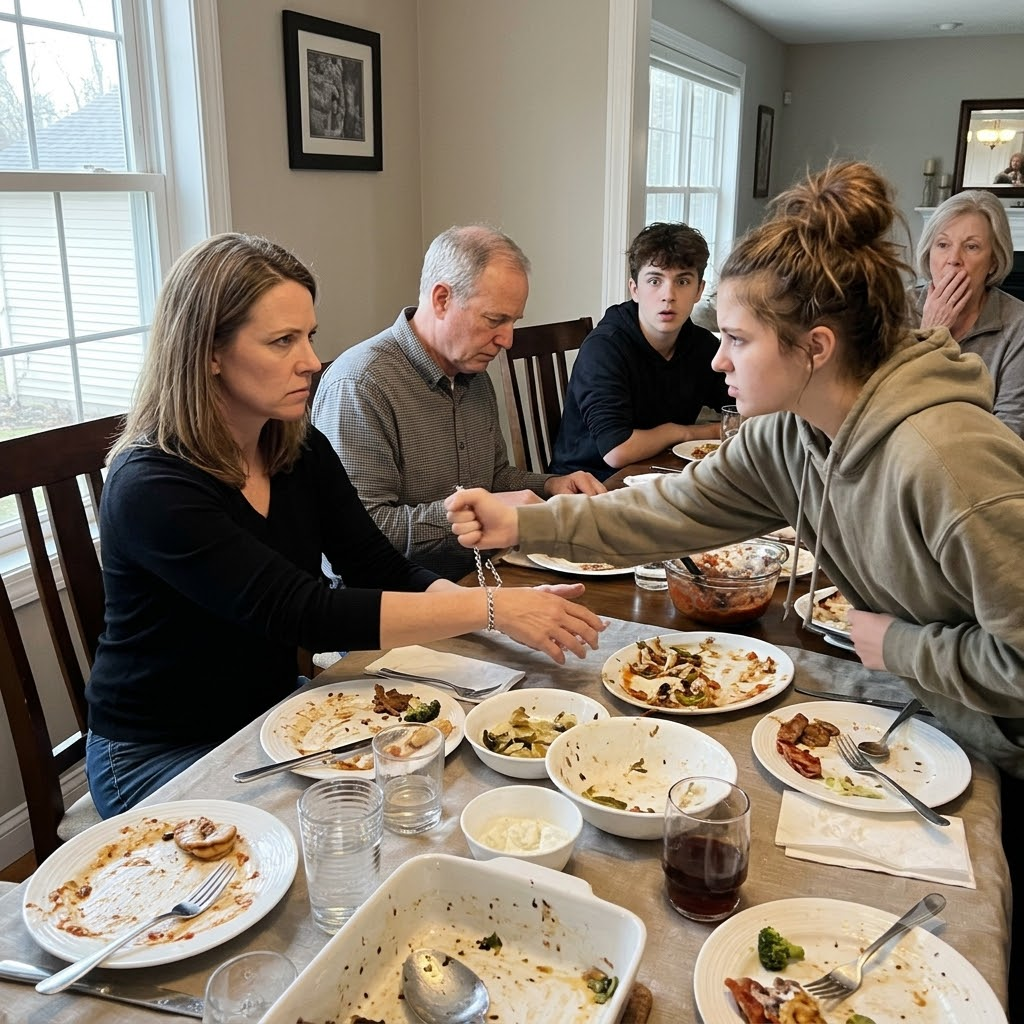
I stared at the document Rachel had placed on my desk.
For several seconds, I didn't touch it.
"What is this?"
Rachel pulled out the chair opposite me and sat down.
"It's the agreement you made when Sophie was accepted."
I looked at the first page.
It was a copy of an email exchange from two years earlier.
I recognized it immediately.
Rachel had forwarded me the conservatory's estimated tuition costs after Sophie received her acceptance letter. I had replied that I would help cover the expenses.
But there was no signed contract.
No formal guarantee.
No agreement requiring me to pay for the entire program.
I turned the page.
Rachel tapped a paragraph near the bottom.
"You said you would help her graduate."
"I said I would help with her education."
"What's the difference?"
"A significant one."
Rachel shook her head.
"Meredith, don't do this."
I looked at her.
"Don't do what?"
"Act like you don't understand what you promised."
I placed the paper on the desk.
"Rachel, I never signed a contract agreeing to pay sixty thousand dollars."
"You didn't need to. You're family."
I almost smiled.
There it was again.
Family.
The word seemed to appear whenever someone wanted something from me.
Family meant I should pay.
Family meant I should forgive.
Family meant I should remain silent when someone hurt me.
But somehow, family hadn't meant Sophie needed to respect my belongings.
It hadn't meant Rachel needed to defend me.
It hadn't meant anyone needed to apologize.
"Why did you bring this here?" I asked.
"Because I want you to understand the consequences of your decision."
"I understand them."
"No, you don't."
Rachel leaned forward.
"Her place at the conservatory is at risk. She has worked for this since she was a little girl. You can't just pull the rug out from under her."
"I didn't make Sophie break my bracelet."
"Stop talking about that bracelet!"
Her voice echoed through my office.
A moment later, she glanced toward the glass wall and lowered her volume.
"You're forty-six years old. You have a successful business. You have money. Sophie is nineteen. She made a stupid comment. Why can't you be the bigger person?"
I studied my sister.
I had heard versions of that argument my entire life.
Be patient.
Be understanding.
Be generous.
Be the bigger person.
But the bigger person was always expected to be me.
When Rachel needed help, I was the responsible sister.
When Sophie needed tuition, I was the generous aunt.
When the family had financial problems, I was the person who could solve them.
And when I finally objected, I was suddenly selfish.
"I want you to answer one question," I said.
Rachel sighed.
"What now?"
"If Sophie had broken someone else's bracelet at the conservatory, what would you tell her?"
"That's different."
"How?"
"That's not family."
I nodded slowly.
"So she can disrespect family because we're supposed to tolerate it?"
Rachel looked away.
I continued.
"Did you know Dad gave me that bracelet?"
"Of course I knew."
"Did you remember the birthday?"
"Meredith, I was there."
"Then why did you laugh?"
Rachel didn't answer.
I waited.
She picked up the tuition statement and straightened it.
"Because I didn't want dinner turning into another argument."
I felt something tighten in my chest.
"So you let Sophie humiliate me to keep dinner peaceful?"
"That's not what happened."
"Then explain it."
Rachel looked irritated.
"She was joking. I thought you'd understand."
"Understand what?"
"That she doesn't think about things the way adults do."
"She's nineteen."
"She's still young!"
I looked at the woman sitting across from me.
For years, I had thought Rachel was simply overwhelmed by raising a daughter.
Now I wondered whether she had spent too much time protecting Sophie from consequences.
Perhaps every time Sophie behaved badly, Rachel found an excuse.
Every time someone complained, Rachel changed the subject.
Every time Sophie hurt someone, Rachel reminded everyone how much pressure her daughter was under.
And I had helped create that arrangement by always making things easier.
I had paid the tuition.
I had covered expenses.
I had offered help before anyone asked.
I had never made Sophie confront what those opportunities cost.
Not because I believed she owed me anything.
Because I wanted her to focus on her education.
But somewhere along the way, my generosity had become invisible.
"Rachel," I said quietly, "I am not paying the remaining tuition."
She stared at me.
"You're really doing this."
"Yes."
"After everything I've told you?"
"Yes."
She stood abruptly.
"You know what? I hope you're happy."
I didn't respond.
Rachel collected the papers.
Then she paused at the door.
"Mom and Dad would be ashamed of you."
I looked directly at her.
"Don't bring Dad into this again."
She opened the door.
And left.
I remained seated for several minutes.
Then I called my assistant.
"Laura, could you come in?"
She appeared almost immediately.
"Everything okay?"
"Yes. I just need a favor."
I explained that Rachel had brought private family documents into my office and asked Laura to make sure no further personal visits interrupted business hours.
Laura nodded.
"Of course."
She hesitated.
"Can I ask something?"
"Sure."
"Is everything all right at home?"
I considered the question.
"Not particularly."
Laura gave me a sympathetic look.
"Sometimes people get so used to someone helping them that they forget it's a choice."
I looked up.
She shrugged.
"Sorry. I shouldn't have said that."
"No," I replied. "You were right."
After she left, I returned to work.
But I couldn't stop thinking about Rachel's last sentence.
Mom and Dad would be ashamed of you.
My mother had been gone for several years.
My father had died when I was nineteen.
Rachel knew how much I missed him.
She also knew I had spent years trying to preserve the things he left behind.
And now she had used that history as another weapon.
I opened the drawer and took out the birthday photograph.
My father was smiling.
I looked at the bracelet on my wrist in the photograph.
Then I noticed something I hadn't paid attention to before.
A tiny mark near the clasp.
I enlarged the photograph on my computer.
The mark was visible.
A small engraved initial.
M.
My father had told me it was the only bracelet in the flea market stall with that engraving.
He had joked that the seller must have known it was meant for me.
I smiled faintly.
Then I put the photograph away.
That evening, I drove home later than usual.
There were three missed calls from Rachel.
Two from Sophie.
And one voicemail from an unknown number.
I listened to the voicemail.
A woman from the conservatory explained that the school had received my withdrawal notice and would be contacting the student regarding the outstanding balance.
She also mentioned that the student had requested an urgent review of the financial arrangement.
I deleted the voicemail after saving the relevant contact information.
Then I opened my messages.
Sophie had sent another text.
Sophie: Mom said you came to her office and embarrassed her.
I stared at the screen.
She continued.
Sophie: You don't understand what this means for me.
Then:
Sophie: Everyone at school knows my aunt is helping me. What am I supposed to tell them?
I read that last sentence twice.
Not:
I shouldn't have broken your bracelet.
Not:
I'm sorry I embarrassed you.
Not even:
Can we talk?
What am I supposed to tell them?
I typed a response.
Me: You can tell them the truth. I was helping with your tuition, but I decided to stop after what happened at dinner. I hope you take this opportunity to think about how you treat people.
I sent it.
She didn't respond.
At 8:20 P.M., I received an email from the conservatory.
The subject line read:
URGENT: STUDENT FINANCIAL ARRANGEMENT REVIEW.
I opened it.
The message was professional and brief.
The school confirmed that the sponsorship withdrawal had been recorded.
It also explained that Sophie would need to speak with the billing office to discuss her options.
There was no accusation.
No pressure.
No demand that I reverse the decision.
I appreciated that.
Then I noticed an attachment.
It was a copy of the original sponsorship correspondence.
I opened it.
My own email was there.
I read the first paragraph.
Then the second.
And finally, the sentence I had written two years earlier:
I am happy to help Sophie pursue her education while the family evaluates its financial situation.
I stopped.
While the family evaluates its financial situation.
That had been the understanding.
I had never agreed to take over every financial responsibility.
I had offered help during a difficult period.
The arrangement had always been voluntary.
I forwarded the email to my personal records.
Then I closed the laptop.
For a moment, I felt lighter.
The facts were clear.
I hadn't broken a promise.
I had withdrawn a gift.
There was a difference.
At 9:06 P.M., someone knocked on my front door.
I looked through the glass.
It was my cousin.
He stood outside with his hands in his jacket pockets.
I opened the door.
"Hey," he said.
"Everything okay?"
He nodded, although he looked uncomfortable.
"Can I come in?"
I stepped aside.
He walked into the living room and glanced around.
Then his eyes settled on the small jewelry box sitting on the coffee table.
"Is that the bracelet?"
I nodded.
He looked down.
"I heard what happened."
I didn't answer immediately.
He sat on the edge of the sofa.
"I was there. I should have said something."
I appreciated the honesty.
"Why didn't you?"
He rubbed his hands together.
"Honestly? I didn't know what to do. Rachel was laughing, and Sophie was acting like it was funny. I thought if I said something, it would become a bigger fight."
I sat across from him.
"It was already a fight. I was just the only person who hadn't agreed to participate."
He looked down.
"Yeah."
For a while, neither of us spoke.
Then he asked the question I had been expecting.
"Are you really stopping the tuition payments?"
"Yes."
He nodded slowly.
"I figured."
I looked at him.
"Do you think I'm wrong?"
He shook his head.
"No. I think Sophie needs to understand that people aren't obligated to keep helping her when she treats them badly."
His answer surprised me.
Not because it was particularly complicated.
Because it was the first time someone in the family had said it plainly.
He stood after a few minutes.
Before leaving, he turned toward me.
"For what it's worth, I remember your dad giving you that bracelet."
My throat tightened.
"You do?"
He nodded.
"I was younger, but I remember. He was really proud of it."
I looked at the jewelry box.
"Thank you."
He walked toward the door.
Then stopped.
"There's something else."
I waited.
"Rachel has been telling people that you promised to cover Sophie's entire degree."
I frowned.
"What people?"
He hesitated.
"Some relatives. And I think she's already called your mother-in-law—"
He stopped himself.
I stared at him.
"Rachel has been telling people what?"
He looked uncomfortable.
"That you made a permanent commitment. That the family had planned around your payments."
I slowly stood.
My sister hadn't simply misunderstood my offer.
She had been presenting it to other people as though it were guaranteed.
And suddenly, the document she had brought to my office made sense.
She wanted me to feel trapped by a promise I had never made.
"Did she tell them about the dinner?" I asked.
He shook his head.
"Not really."
I looked at him.
"Then what exactly did she tell them?"
He took out his phone.
"I think you should see this."
He opened a family group chat.
There were several messages from Rachel.
The most recent one had been sent less than an hour earlier.
I read it.
Then I read it again.
My sister had written:
Meredith has decided that her niece's future is worth less than an old piece of jewelry.
I felt my stomach tighten.
Underneath it were several replies.
And one of them came from someone I hadn't heard from in months.
My aunt Linda.
Her message was short.
I think there's something Meredith hasn't told us.
I looked at my cousin.
"What does she mean?"
He shook his head.
"I don't know."
Then another message appeared.
Linda was typing again.
This time, she sent a photograph.
It was a picture of my father.
And beneath it were the words:
Before everyone judges Meredith, I think we should remember what happened when your father bought that bracelet.
I stared at the photograph.
My cousin looked at me.
And suddenly, I realized the family dinner might have exposed something much bigger than Sophie's behavior.
Because my aunt knew a story about that bracelet that Rachel had never told me.






Comments 0