I stared at the document on my laptop screen.
My name was printed at the bottom.
Meredith Collins.
Beneath it was a date from two years earlier, followed by a statement claiming that I had agreed to cover Sophie's entire music conservatory education until graduation.
I read it again.
Then I enlarged the document.
There was a signature.
It looked similar to mine.
Similar, but not mine.
I leaned back in my chair.
For a moment, I couldn't understand what I was looking at. I had never signed an agreement promising to pay for Sophie's entire degree. I had never authorized Rachel to sign anything on my behalf. And I certainly hadn't agreed to become permanently responsible for sixty thousand dollars or any other amount.
I opened the original email exchange from two years earlier.
There it was.
My actual message.
I had offered to help Sophie pursue her education while the family evaluated its financial situation.
That was all.
No guarantee.
No contract.
No permanent commitment.
I placed the two documents side by side.
The difference was obvious.
The email was mine.
The agreement was not.
My phone was on the desk.
I picked it up and called the conservatory's billing office.
It was late, but the office had an after-hours contact number for urgent account issues. I left a message requesting clarification about the document Sophie had submitted.
Then I forwarded the attachment to my personal email.
I didn't want to lose it.
I wasn't interested in threatening anyone or making accusations without understanding exactly what had happened.
But I knew one thing.
Someone had used my name to create an agreement I had never approved.
And I wanted to know who.
The following morning, I arrived at my office earlier than usual.
I had barely slept.
I made coffee, opened my laptop, and reviewed the document again.
The signature bothered me.
It wasn't an exact copy of my handwriting, but it contained several familiar features.
The capital M.
The way I crossed the final letter.
The slight curve beneath my surname.
Someone had clearly tried to reproduce my signature.
I opened a folder containing scanned copies of documents I had signed during the previous two years.
There were tax forms, business agreements, and personal financial records.
I found a signature from the same month as the supposed tuition agreement.
The difference was unmistakable.
My real signature was slightly uneven.
The one on the new document was unusually smooth.
It looked like someone had copied it from another source.
I enlarged both images.
Then I noticed something else.
The signature on the alleged agreement had a faint gray border around it.
I had seen that effect before when images were inserted into electronic documents.
I wasn't a handwriting expert, and I wasn't going to pretend that I could establish how the document had been created just by looking at it.
But I knew I hadn't signed it.
That was enough to make the situation serious.
I printed both documents and placed them in separate folders.
One was labeled ORIGINAL CORRESPONDENCE.
The other was labeled UNAUTHORIZED AGREEMENT.
At 9:18 A.M., my phone rang.
The caller ID displayed an unfamiliar Boston number.
I answered.
"Hello, this is Meredith Collins."
"Good morning, Ms. Collins. My name is Patricia. I'm calling from the conservatory's student accounts department."
I recognized the name from the previous emails.
"Good morning."
"We received your request for clarification regarding a document submitted by Sophie."
"Yes."
Patricia paused.
"I wanted to speak with you directly because there appears to be some confusion about the sponsorship arrangement."
I looked at the printed agreement.
"That's putting it mildly."
She remained professional.
"Before we discuss the document, could you confirm whether you personally signed a financial sponsorship agreement guaranteeing Sophie's remaining tuition?"
"No. I did not."
"Did you authorize anyone to sign on your behalf?"
"No."
"Did you ever provide written confirmation that you would cover the entire cost of her program until graduation?"
"No. I offered financial assistance for a period of time. That assistance was voluntary."
Patricia typed something.
"Thank you. We will note that distinction."
I waited.
Then she asked me to describe the original arrangement.
I explained that I had agreed to help Sophie after she received her acceptance letter. Rachel had told me the family couldn't afford the program, and I had offered to contribute toward the tuition.
I had made payments directly through the conservatory.
I had never signed a long-term guarantee.
I had never promised to pay regardless of circumstances.
And I had never agreed to an arrangement that would prevent me from withdrawing future financial support.
Patricia listened carefully.
"Do you still have the original correspondence?"
"Yes. I can provide it."
"That would be helpful."
I forwarded the emails while we were still speaking.
A few moments later, she confirmed receipt.
Then she said something that made me sit upright.
"Ms. Collins, I want to be transparent. The document Sophie submitted was included in her request for an emergency financial review."
I looked at the agreement again.
"Was it presented as a contract?"
"It was presented as evidence of an existing sponsorship commitment."
"And you accepted it?"
"We haven't made any final determination. That's why we're contacting you."
I exhaled.
"Good."
Patricia continued.
"Because the student account currently shows that previous payments were made by you, the school needs to establish whether the remaining balance was covered by a separate guarantee."
"It wasn't."
"Understood."
There was a pause.
Then she asked whether I would be willing to participate in a meeting with the student and the financial aid office.
I considered it.
"Yes. But I want to be clear that I am not reconsidering the cancellation."
"Of course. The purpose would be to clarify the records."
"That's fine."
She gave me an available appointment time for the following afternoon.
I accepted.
Before ending the call, Patricia thanked me for responding quickly.
I thanked her as well.
Then I sat quietly at my desk.
The situation had become much more serious than a family disagreement.
At 10:05 A.M., Rachel called.
I let it ring once before answering.
"What?"
"Why is the conservatory calling Sophie?"
I looked at the documents in front of me.
"Because she contacted them."
"They're questioning her financial arrangement."
"They contacted me to verify a document."
Rachel went silent.
Then she asked:
"What document?"
I felt a chill move through me.
"The agreement with my name on it."
She didn't answer immediately.
"Meredith, I don't know what you're talking about."
"The document Sophie submitted claiming I had guaranteed her entire tuition."
Rachel sighed.
"That's what you said you would do."
"No, it isn't."
"You offered to pay for her education."
"I offered to help."
"What's the difference?"
I looked down at my printed email.
"The difference is that I never signed a contract."
Rachel's voice became defensive.
"Nobody said you signed a contract."
"The document has my signature."
"Well, I didn't create it."
I paused.
"Then who did?"
"I don't know. Sophie probably got it from the school records."
"School records?"
"Don't twist my words."
I remained silent.
Rachel continued.
"You're making this into something ugly. Sophie was trying to explain that she depended on your help."
"Then she could have told the truth."
"She was scared."
"That doesn't explain the signature."
Rachel exhaled sharply.
"Meredith, please. She has enough problems right now."
I stared at the agreement.
"Rachel, did you know this document existed?"
"I've already told you. I don't know anything about it."
"Did you give it to Sophie?"
"No."
Her answer came too quickly.
I didn't accuse her.
I simply said, "The conservatory has the original file. They're reviewing it."
Rachel's voice changed.
"Why would you involve the school in a family issue?"
"Because the school received a document claiming I made a financial commitment. That's not just a family issue."
"You could have handled this privately."
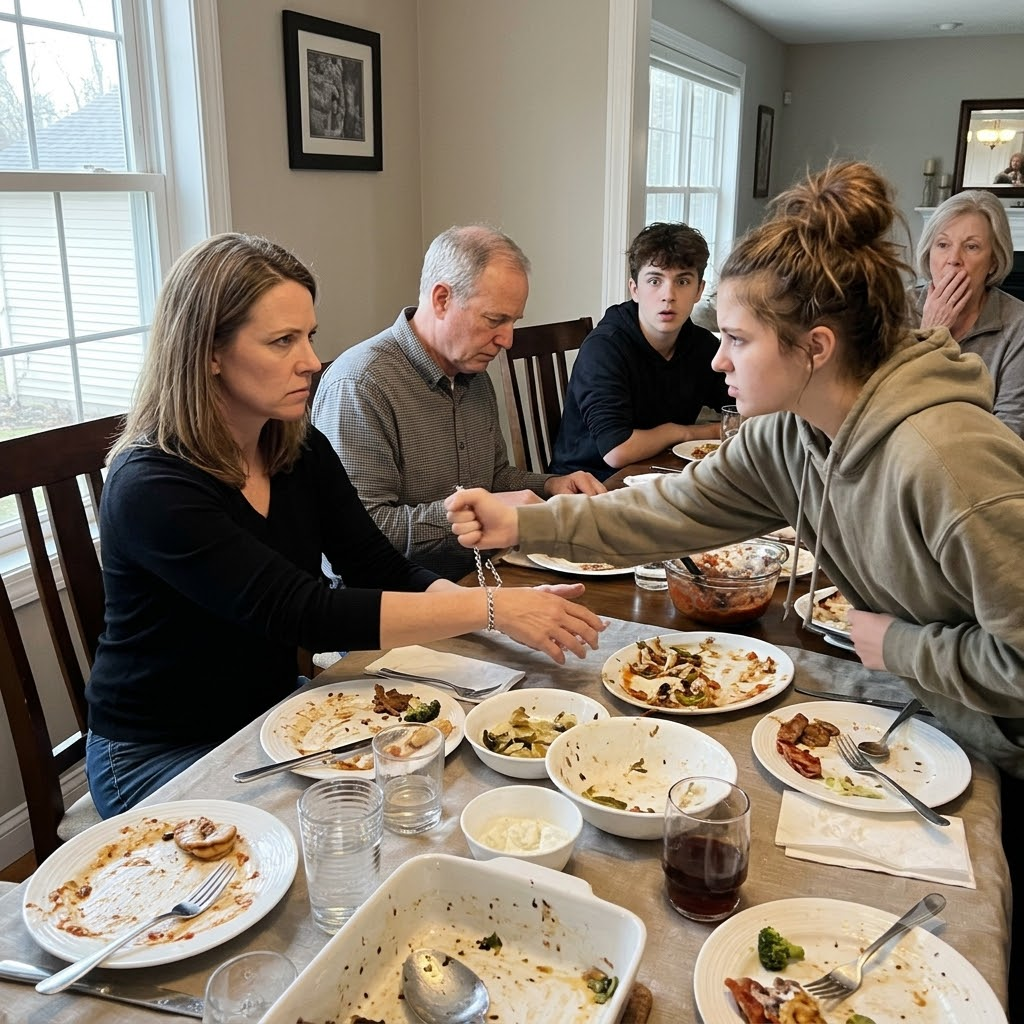
"I tried handling things privately when Sophie broke my bracelet."
Rachel made an irritated noise.
"Oh, for heaven's sake. We're still talking about that?"
I felt the familiar exhaustion returning.
"Goodbye, Rachel."
"Meredith!"
I ended the call.
For several seconds, I watched the phone.
Then I wrote down the time of the conversation.
I wanted everything documented.
Not because I wanted to destroy my sister.
Because I no longer trusted that a simple conversation would remain a simple conversation.
At noon, I went to a jeweler near my office.
The shop was small and quiet.
An older man stood behind the counter examining a watch.
When I approached, he looked up.
"How can I help you?"
I placed the bracelet on the counter.
"The clasp broke. I'd like to have it repaired."
He picked it up carefully.
"Silver?"
"Yes."
He examined the chain.
"Nice piece. Old?"
"Almost thirty years."
He turned it over.
"Family heirloom?"
"My father gave it to me."
The man nodded.
"Then we'd better be careful with it."
He examined the broken clasp under a small magnifying lens.
"The chain itself is in good condition. The clasp can be replaced, but I can preserve the original decorative pieces."
"Please do."
He wrote down the details.
"It may take a few days."
"That's fine."
He placed the bracelet in a small padded envelope and gave me a receipt.
I put it in my purse.
Walking back to my car, I thought about the previous evening.
Sophie had held that bracelet as though its only purpose was to entertain her.
She had never understood why I had treasured it.
But perhaps I had made the same mistake in another way.
I had assumed that because I loved Sophie, she would eventually understand what my help meant.
I had confused the opportunity I wanted to give her with the gratitude I hoped she would feel.
I couldn't control what she understood.
I could only control what I chose to give.
At 2:30 P.M., I received another email from the conservatory.
Patricia confirmed our meeting for the following afternoon.
The email also contained a request.
They wanted me to provide any available records showing the original sponsorship arrangement.
I gathered the correspondence, payment confirmations, and my bank records.
I saved everything in one folder.
Then I reviewed the alleged agreement one more time.
The document listed a total amount.
It also contained a sentence stating that I would remain responsible for all outstanding tuition expenses until Sophie's graduation.
At the bottom was my name.
The date was two years old.
I checked my business calendar for that day.
I had been in Columbus attending a client meeting.
That didn't prove anything by itself, but I knew I hadn't signed the agreement.
I saved the calendar entry.
Then I sent a brief message to my attorney asking for a consultation regarding the unauthorized use of my signature on a financial document.
I didn't want to make assumptions about legal consequences.
I wanted professional advice.
An hour later, his office confirmed an appointment for the following morning.
That evening, Sophie called.
I was preparing dinner when her name appeared on my phone.
I answered.
"Hello?"
"Aunt Meredith?"
"Yes."
She sounded tired.
"Can we talk?"
"We're talking."
She hesitated.
"Why did you tell the school I didn't have an agreement?"
I stopped what I was doing.
"I told them I didn't sign the document they received."
"But I thought you said you would pay."
"I said I would help."
"What's the difference?"
I put down the knife.
"Sophie, I need you to understand something. I offered to contribute toward your education because I wanted to help you. I never signed a guarantee promising to pay every remaining bill."
She sighed.
"Mom said you agreed."
"Then your mother misunderstood."
"She said you wanted me to finish."
"I did."
"Then why are you doing this?"
I took a breath.
"Because I don't want to continue funding an arrangement in which my generosity is treated as an obligation."
There was a long silence.
Then Sophie said:
"You know everyone thinks you're being cruel."
I looked at the kitchen counter.
"Who is everyone?"
"My friends. Mom's friends. Some of the family."
"Have they heard what happened at dinner?"
She didn't answer.
I continued.
"Did you tell them that you took my bracelet and broke it?"
"It was an accident."
"You told me it was cheap."
"I was joking."
"And when I asked you to apologize?"
She sighed.
"Can we stop talking about the bracelet?"
I felt a familiar disappointment.
"You keep asking me to forget what happened without acknowledging it."
"I said I was sorry!"
I paused.
"When?"
"Well, I'm saying it now."
I waited.
She continued.
"Look, I'm sorry about the bracelet. I didn't think it would break."
Her words were rushed.
There was no real pause to consider what she had done.
But at least it was something.
"Thank you for saying that," I replied.
"So you'll pay?"
I closed my eyes.
There it was.
The apology had lasted only a few seconds before becoming another request.
"No, Sophie. My decision hasn't changed."
Her breathing became louder.
"Then what's the point of apologizing?"
I looked toward the window.
"An apology isn't supposed to be a payment method."
She said nothing.
Then the call ended.
At 8:15 P.M., Rachel sent me a message.
Rachel: Sophie told me you refused to help even after she apologized.
I didn't respond.
Another message appeared.
Rachel: You're making her feel like she's worthless.
I read it twice.
Then I typed:
Me: Her worth has nothing to do with whether I pay her tuition.
I sent it.
Rachel replied almost immediately.
Rachel: You have no idea what you're doing to this family.
I turned off the screen.
The following morning, I met with my attorney.
He reviewed the document, the original correspondence, and the payment history.
He asked several questions.
Had I ever authorized anyone to sign for me?
No.
Had I provided Rachel or Sophie with a signed blank document?
No.
Had I sent a formal letter guaranteeing future tuition?
No.
He studied the signature.
"I can't determine its authenticity just by looking at this copy," he said. "But you should preserve the original file and all related correspondence. Don't alter anything. Don't make public accusations. Let the institution complete its review."
I nodded.
He explained that if the document had been submitted electronically, its source information and submission history might help establish how it had been created.
I thanked him.
Before I left, he asked whether I wanted to send Rachel a formal notice.
I considered it.
"Not yet," I said. "I want to see what the school finds first."
He nodded.
"That's sensible."
At 1:00 P.M., I joined the conservatory meeting through a video call.
Patricia was present, along with a financial aid administrator and another staff member.
Sophie appeared on the screen a few minutes later.
She was sitting in a small office.
Her platinum-blonde hair was tied back.
She looked pale.
When she saw me, she immediately looked away.
Patricia began by explaining that the meeting was intended to clarify the sponsorship records.
She asked Sophie to describe the document she had submitted.
Sophie shifted in her chair.
"Mom gave it to me."
I looked at her.
Patricia continued.
"Did your aunt personally sign it?"
Sophie hesitated.
"I thought she had."
"Did you witness her signing it?"
"No."
"Did you receive it directly from her?"
"No."
Patricia nodded.
Then she turned toward me.
"Ms. Collins, do you recognize the document?"
"No. I have never seen it before."
Sophie looked up.
"But Mom said—"
Patricia gently interrupted.
"We need to establish the source of the document before making any assumptions."
She explained that the school would retain the file and review its submission history.
She also confirmed that my original email correspondence supported a voluntary sponsorship arrangement rather than a formal guarantee.
Then came the question I had been expecting.
"Ms. Collins, do you intend to reinstate your financial sponsorship?"
"No."
Sophie lowered her head.
Patricia nodded.
"Thank you for clarifying."
The administrator explained that the school would now work directly with Sophie to explore available financial options.
Sophie asked whether she could remain enrolled.
The answer was careful.
Her academic standing was separate from the outstanding financial balance, but her enrollment status would depend on resolving the account under the school's policies.
They would provide her with the available options.
The meeting was almost over when Sophie suddenly spoke.
"Can I ask my aunt something?"
Patricia nodded.
Sophie looked directly into the camera.
"Did you ever actually want me to succeed?"
The question hit harder than I expected.
I took a moment.
"Yes, Sophie. I did."
"Then why did you stop helping?"
"Because helping you succeed doesn't mean I have to accept being treated badly."
She looked down.
I continued.
"I never wanted you to feel that you owed me your future. But I also never agreed that my money was yours regardless of how you treated me."
Sophie wiped her eyes.
Then Patricia said they would follow up after completing their review.
The meeting ended.
I closed my laptop.
For a moment, I simply sat there.
I had expected the school to question my decision.
Instead, they had confirmed the distinction between a voluntary gift and a guaranteed obligation.
But the document remained unexplained.
And I still didn't know who had created it.
At 4:42 P.M., Patricia called again.
I answered immediately.
"Hello?"
"Ms. Collins, we have an update regarding the document."
I sat down.
"Go ahead."
"We reviewed the file submitted with Sophie's financial aid request."
"And?"
"There is a discrepancy between the document and the original correspondence."
I closed my eyes briefly.
"I see."
Patricia continued.
"We also reviewed the submission information. The document was uploaded from an email account associated with the student's family."
My fingers tightened around the phone.
"Which account?"
There was a pause.
Then Patricia gave me the address.
It wasn't Sophie's.
It was Rachel's.
I stared at the wall.
Patricia added that the school wasn't making any accusation about who had prepared the document, but they needed clarification about its origin.
I thanked her.
We ended the call.
I remained still for several minutes.
Rachel had told me she knew nothing about the document.
She had denied giving it to Sophie.
But the conservatory had now confirmed that it had been submitted from an account associated with my sister.
I opened my phone.
I found Rachel's number.
I pressed Call.
She answered after one ring.
"Meredith?"
I didn't greet her.
I asked one question.
"Why did you upload a financial agreement with my signature on it?"
Silence.
A long silence.
Then Rachel whispered:
"Who told you that?"
I looked at the broken bracelet's repair receipt beside my laptop.
And before I could answer, Rachel said something that made my entire body go cold.
"Because Meredith, you don't know what Sophie and I were trying to protect you from."
Then I heard another voice in the background.
It was Sophie.
And she was saying my father's name.






Comments 0