"Meredith, the lender is preparing to take legal action against the guarantor if the remaining balance isn't resolved."
I gripped the edge of my desk.
For several seconds, I couldn't speak.
My attorney continued explaining the situation, but my attention was fixed on the document Rachel had brought to my office.
My name appeared beneath the word GUARANTOR.
The signature looked like mine.
The loan had been secured against my mother's house.
And according to the lender, I was responsible for the outstanding balance.
"How much?" I finally asked.
My attorney gave me the figure.
Nearly sixty-eight thousand dollars.
I closed my eyes.
Sixty-eight thousand.
The same amount that had been weighing on my mind since I canceled Sophie's remaining tuition payments.
The irony was almost unbearable.
I had withdrawn sixty thousand dollars I had never legally promised.
Now I was facing a potential liability of sixty-eight thousand dollars attached to a loan I had never knowingly agreed to guarantee.
"Has the lender confirmed that the signature is authentic?" I asked.
"They have confirmed that the document contains a signature matching the one on file. That is not the same as confirming that you personally signed it."
I exhaled.
"What happens now?"
"We formally dispute your authorization and request the original loan documentation. We also need to determine who submitted the paperwork."
I looked at the date.
My mother had been alive when the loan was arranged.
Rachel had known about it.
And I had never received a single letter from the lender.
"Why wasn't I contacted earlier?"
"That is one of the questions we need answered."
I thanked him.
Before ending the call, he gave me one final instruction.
"Do not acknowledge responsibility for this loan. Do not make a payment. Let us handle communication with the lender."
"I understand."
I hung up.
Then I looked at my father's photograph.
For the first time, I wondered whether the financial problems my mother had tried to solve had become something much larger than anyone in the family wanted to admit.
Rachel arrived at my house that evening.
She looked frightened.
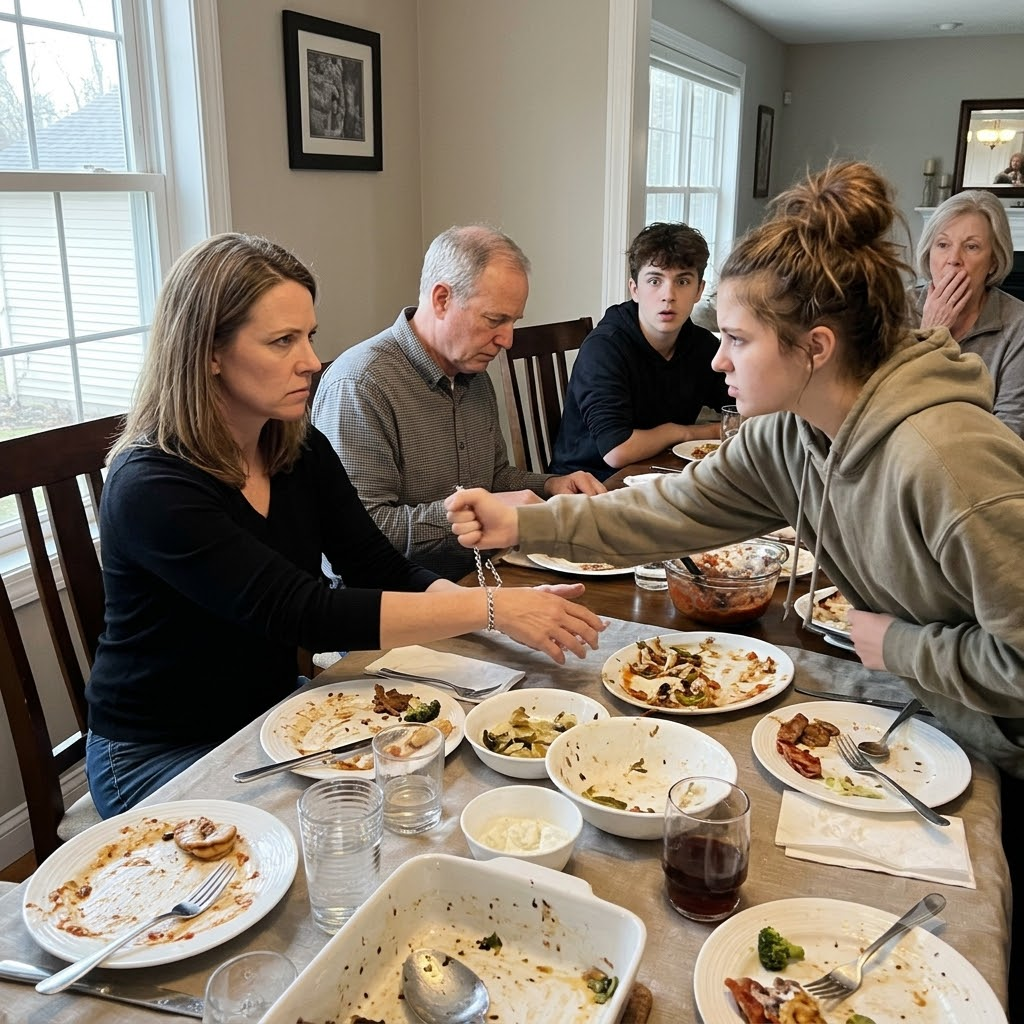
I had placed copies of the loan documents on the dining table.
The repaired silver bracelet was on my wrist.
Rachel noticed it immediately.
"You got it fixed."
"Yes."
She looked down.
"I'm glad."
I didn't respond.
She sat across from me.
"Did the bank contact you?"
"My attorney spoke with them."
Her face tightened.
"What did he say?"
"Apparently, I'm listed as a guarantor on the loan."
Rachel lowered her eyes.
"I didn't know that."
I looked at her.
"You knew about the loan."
"Yes."
"You knew my mother used money from my account."
"Yes."
"You knew the house was financed partly with that money."
She nodded.
"Then how could you not know my name was on the guarantee?"
"I thought Mom had handled everything."
I pushed the document toward her.
"Look at the signature."
Rachel examined it.
Her expression changed.
"That's yours."
"It looks like mine."
"Meredith, it is your signature."
I leaned forward.
"Did you see me sign this?"
She shook her head.
"Did you ever hear me agree to guarantee the loan?"
"No."
"Then don't tell me it's my signature as though that settles the matter."
Rachel covered her face.
"I don't know what Mom did."
I sat back.
For years, I had trusted my mother to handle family matters.
Now I was discovering that her decisions might have created financial obligations I had never accepted.
"Rachel, I need you to tell me everything you know."
She lowered her hands.
"Mom said she needed the loan to keep the house."
"Why?"
"She had fallen behind on some expenses."
"What expenses?"
Rachel hesitated.
"Mortgage payments. Property taxes. Some medical bills."
"How much did she borrow?"
"I don't know."
"How long was the loan supposed to last?"
"I don't know."
"Did you make payments?"
"Sometimes."
"From your own account?"
"Yes."
I studied her.
"Then why is the balance still sixty-eight thousand dollars?"
Rachel looked down.
"Because Mom stopped making payments."
"When?"
"Before she died."
I stared at her.
"And nobody told me?"
Rachel began crying.
"Mom thought she would have time to sort it out."
I felt a deep heaviness in my chest.
My mother had died believing she could resolve everything later.
But later had arrived.
And now I was the person being asked to carry the consequences.
The following morning, my attorney arranged a meeting with the lender's representative.
I attended with him.
The representative was polite and professional.
She explained that the institution had inherited the loan records after a merger.
According to the available documents, my name appeared as a guarantor.
The loan had been issued against the property.
Payments had become irregular several years earlier.
The account was now in arrears.
I listened carefully.
Then I asked:
"Can you show me the original authorization?"
She placed a document on the table.
I examined it.
My name appeared beneath the guarantee section.
The signature was familiar.
But the spacing between the letters was slightly different.
I pointed to it.
"This doesn't look like the way I normally sign."
The representative nodded.
"We can provide a copy for independent examination."
"Who submitted the document?"
She reviewed her notes.
"The application was submitted through a branch office."
"By whom?"
She hesitated.
"The record lists your mother as the primary applicant."
I looked at my attorney.
He made a note.
The representative continued.
"Your sister was also listed as an occupant of the property."
I frowned.
"Was she listed as a borrower?"
"No. She was listed as a resident."
I looked down at the paperwork.
"Did I ever receive confirmation that I was a guarantor?"
"We have an address associated with your name."
"Was anything delivered?"
"The historical records are incomplete."
My attorney asked for the original delivery documentation.
The representative agreed to investigate.
Before the meeting ended, I asked one more question.
"Was the loan used entirely for the property?"
She reviewed the available account history.
"Most of the funds were used for property-related expenses. However, there were several transfers to another account."
I sat upright.
"What account?"
She turned the page.
"The destination account was held in your sister's name."
I looked at Rachel's empty chair beside me.
She hadn't attended the meeting.
I asked for the transfer dates.
The representative provided them.
There were four.
I recognized one immediately.
It was the same month Sophie had started her first year at the conservatory.
I stared at the page.
My mother's loan had apparently helped fund more than the house.
Some of the money had gone into Rachel's account.
And I was being treated as a guarantor.
That afternoon, I called Rachel.
She answered on the third ring.
"Did you speak to the bank?" she asked.
"Yes."
"What happened?"
I looked at the transaction list.
"Some of the loan money was transferred into your account."
She became silent.
Then she said:
"I can explain."
I closed my eyes.
"Please do."
"Mom sent me money when things got difficult."
"How much?"
"I don't remember."
"Rachel, there are four separate transfers."
She sighed.
"She was helping me."
"With what?"
"Household expenses."
"All four?"
"Yes."
I looked at the dates.
One transfer was made shortly before Sophie's tuition deposit.
Another was made shortly after.
"Did any of that money go toward Sophie's education?"
Rachel hesitated.
"Some of it."
I felt my jaw tighten.
"How much?"
"I don't know."
"Did you tell Mom you couldn't afford the conservatory?"
"Yes."
"Did she use the loan to help pay for it?"
Rachel started crying.
"Meredith, Sophie was accepted. I couldn't let her lose that opportunity."
I looked at the transaction list.
"So my name was placed on a loan, and some of the money was used to support your daughter's education."
"I didn't ask Mom to put your name on anything."
"But you knew about the loan."
"Yes."
"And you accepted the money."
Rachel didn't answer.
I continued.
"Did you ever ask whether I had agreed to guarantee it?"
She whispered:
"No."
I leaned back.
"Rachel, you have spent years telling Sophie that I had a financial obligation to your family. Now I'm discovering that my name was attached to a loan I never agreed to."
"I didn't know it would become this serious."
"That doesn't change what happened."
She began crying harder.
I ended the call.
For the next several days, my attorney worked with the lender to obtain the original records.
He also recommended that an independent document examiner review the disputed signature.
I provided several genuine examples of my signature from the same period.
Old tax returns.
Business contracts.
Banking documents.
The examiner would compare them with the loan authorization.
Meanwhile, I contacted the conservatory.
I wanted to make sure the school understood that my financial dispute with Rachel had nothing to do with its academic evaluation of Sophie.
Patricia confirmed that the review was still underway.
She also told me that Sophie had submitted a written explanation.
I asked whether the school could share it.
Patricia said that certain details could only be disclosed through the appropriate process.
I understood.
I didn't want to interfere with the investigation.
I simply wanted the truth recorded accurately.
On Thursday evening, Sophie called.
"Aunt Meredith?"
"Hello, Sophie."
"Can I talk to you?"
"Of course."
She sounded nervous.
"I heard about the loan."
I sat down.
"Who told you?"
"Mom."
I waited.
She continued.
"She said Grandpa's money was used to keep the house."
"Some of it was."
"She said you were listed on the loan because you had agreed to help."
I closed my eyes.
"That's not true."
Sophie was silent.
"Did Mom tell you that I had signed the guarantee?"
"She said you knew about it."
"I didn't."
"She said Grandpa wanted you to help the family."
I looked at my father's letter.
"Your grandfather wanted us to care for each other. He didn't ask me to guarantee debts without my knowledge."
Sophie took a breath.
"Mom says the bank might take the house."
I considered my response.
"That's something your mother needs to discuss with the lender."
"But where would we go?"
I felt sympathy for her.
She was nineteen.
She had grown up believing the house was secure.
Now she was discovering that the adults around her had made financial decisions without explaining the consequences.
"I don't want you to lose your home, Sophie."
"Then why won't you help?"
I closed my eyes.
There it was again.
The assumption that my compassion should automatically become financial responsibility.
"I have already helped your family for years. I cannot accept responsibility for a loan I never authorized."
She began crying.
"I'm sorry about the bracelet."
I looked down at my wrist.
"Thank you."
"I really am."
I believed her.
But I still needed her to understand that an apology didn't erase the financial problem.
"I hope you continue your education, Sophie. But you and your mother need to work with the school to find a realistic plan."
She nodded.
Then she asked:
"Would Grandpa have wanted us to lose the house?"
I looked at his photograph.
"I think he would have wanted everyone to be honest about how it was financed."
She didn't answer.
We ended the call.
That weekend, Rachel came to my office.
She carried a thick folder.
"I found something."
I looked up.
"What?"
"Mom's old paperwork."
She placed the folder on my desk.
I opened it.
There were mortgage statements, insurance documents, tax records, and several handwritten notes.
Then I found a letter from my mother.
It was addressed to Rachel.
The date was from the year the loan had been arranged.
I began reading.
My mother explained that she had used part of the money from my old account to help secure the property.
She also mentioned that she had borrowed additional funds.
The letter stated that Rachel would be responsible for making the monthly payments whenever she could.
I turned the page.
There was a second paragraph.
It mentioned my name.
Meredith has already agreed to help with the financial arrangement. I will explain everything to her when the time is right.
I stopped.
I looked at Rachel.
"Did you know Mom had written this?"
"No."
"Did you believe I had agreed?"
Rachel nodded slowly.
"Mom told me she had spoken to you."
"She never did."
Rachel lowered her head.
I continued reading.
The next paragraph contained something even more troubling.
My mother had written that if the house was eventually sold, the proceeds should be divided between her daughters after the loan was repaid.
That was the arrangement Linda had mentioned.
The house was supposed to remain in the family.
But the letter did not establish that I had accepted responsibility for the loan.
I placed it on the desk.
"Rachel, did Mom ever show you this?"
"No."
"Then how did you know about the arrangement?"
"She told me."
I studied her.
"Did she ever say I had personally agreed?"
Rachel nodded.
"Yes."
I looked at the letter again.
My mother had written that she would explain everything later.
That was not proof of my consent.
But it explained why Rachel had believed the family arrangement was legitimate.
I closed the folder.
"Rachel, I need you to understand that I cannot simply accept this."
She wiped her cheeks.
"I know."
"Even if Mom intended to help you, she couldn't make me responsible for a loan without my authorization."
"I know."
For once, Rachel didn't argue.
Then she took another paper from the folder.
"This was with the letter."
I looked at it.
It was a copy of an old bank form.
The top section contained my personal information.
The bottom section contained a signature.
I recognized the document.
It was the same form my mother had emailed me years earlier.
The one I had never remembered signing.
I examined the date.
It was three days before the loan application.
Then I noticed a small handwritten note beside the signature.
Original received from Meredith.
My hands went cold.
I looked at Rachel.
"Where did you get this?"
"It was in Mom's folder."
I stared at the note.
Someone had recorded that the original signature came directly from me.
But I had never knowingly authorized a loan.
I photographed the document and sent it to my attorney.
On Monday morning, the document examiner contacted my attorney.
He called me immediately afterward.
"The preliminary findings are ready."
I sat down.
"What did they find?"
He explained that the signature on the loan guarantee contained several similarities to my genuine signature.
However, there were also differences in pressure, spacing, and letter formation.
The examiner wanted the original document before making a final determination.
I exhaled.
"So they can't confirm I signed it?"
"Not from the copy alone."
I nodded.
He continued.
"There is another development."
"What?"
"The lender located a second authorization document."
I felt my stomach tighten.
"Another one?"
"Yes."
"What does it say?"
He paused.
"It appears to be a separate acknowledgment that you understood the financial risk associated with the guarantee."
I closed my eyes.
"Was that signed by me?"
"Your name is on it."
I stared at the wall.
My attorney continued.
"Meredith, this second document is particularly important because it includes a witness signature."
I gripped the phone.
"Who witnessed it?"
He gave me the name.
I recognized it immediately.
It was not my mother.
It was not Rachel.
It was someone who had been present at our family home when the original loan paperwork was discussed.
Someone who had also been involved in Sophie's conservatory sponsorship arrangements.
I felt my breathing change.
"Are you certain?"
"The name is clearly printed."
I looked at the family photograph on my desk.
Then I asked:
"Who was the witness?"
My attorney answered.
"Andrew Bennett."
I stood up.
The piano instructor.
The man who had helped Sophie prepare her audition.
The man who had advised Rachel about the sponsorship agreement.
The man who had insisted he had never created the disputed document.
He had now appeared on a second financial document connected to my name.
I looked at the old loan authorization.
Then I looked at the photograph of Andrew outside the conservatory.
Suddenly, the different pieces of the story seemed to be connected.
My attorney spoke again.
"Meredith, there's one more thing. Andrew's signature is dated the same day as the original loan application."
I stared at the document.
Then my phone vibrated.
A message from an unknown number appeared.
It contained a photograph of a handwritten note.
Beneath it was a single sentence:
"Andrew wasn't just a witness. He was the person who brought the paperwork to your mother."






Comments 0