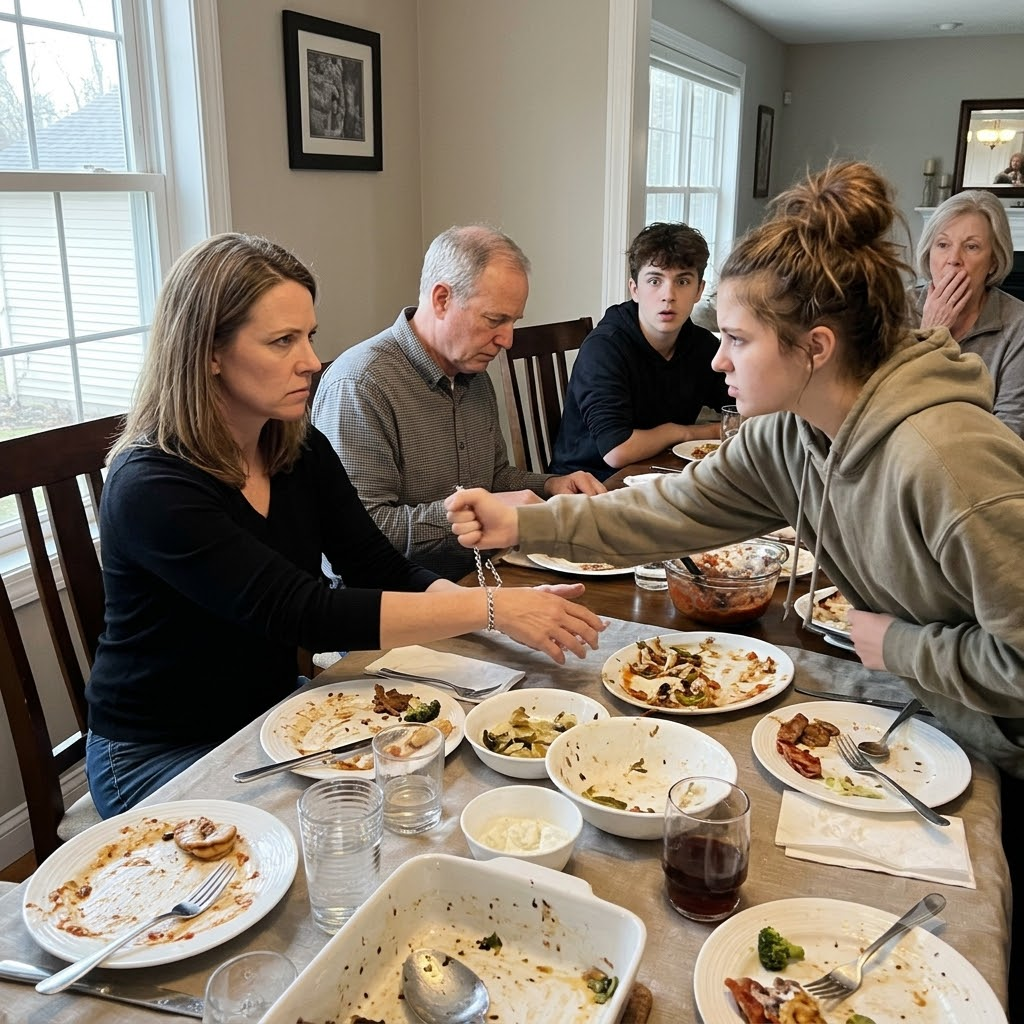
"Meredith, you need to fix this right now."
Rachel's voice came through the phone so loudly that I instinctively moved it away from my ear.
I remained seated at my desk.
The broken bracelet was still beside my laptop.
"Fix what?" I asked.
"Don't play games with me. The conservatory just contacted Sophie. They said the payment isn't going through."
"I canceled it."
There was another silence.
Then Rachel laughed.
Not because anything was funny.
It was the kind of laugh people used when they believed someone had made a mistake so ridiculous that it couldn't possibly be intentional.
"You canceled her tuition?"
"Yes."
"All of it?"
"The remaining payments, Rachel."
"Meredith, are you out of your mind?"
I looked at the clock.
10:49 P.M.
Two minutes had passed since I sent the email.
"No," I answered. "I'm perfectly clear."
Rachel started talking faster.
"You cannot do this to her. She's nineteen. She's studying music. She has worked her entire life for this opportunity."
"I know."
"Then why would you destroy everything over a stupid bracelet?"
I closed my eyes briefly.
There it was.
The same argument.
The same dismissal.
The same assumption that the bracelet was the problem.
"It wasn't about the bracelet," I said.
"Then what was it about?"
"How you both treated me."
Rachel exhaled sharply.
"Oh, here we go."
I waited.
She continued.
"You're always so sensitive about everything. Sophie made a joke. That's what young people do. She didn't mean anything by it."
"She deliberately broke it."
"Accidentally."
"I watched her pull the chain until the clasp snapped."
"Well, she didn't know it was that important!"
"You knew."
Rachel stopped.
For a moment, neither of us spoke.
I could almost picture her standing in her kitchen, holding her phone, searching for an argument that would make me feel guilty.
Then she found one.
"Your father wouldn't have wanted this."
My hand tightened around the phone.
I looked at the bracelet.
There were very few things Rachel could have said that would have hurt more.
She knew our father had given it to me.
She knew why I treasured it.
And now she was using his memory to pressure me into continuing to pay for her daughter's education.
"Don't use Dad to defend what happened tonight," I said.
Rachel made an irritated sound.
"I'm just saying he loved Sophie."
"So did I."
"Then prove it."
I stared at the wall.
That sentence told me everything.
In Rachel's mind, love was something that could be measured through financial contributions.
If I paid, I loved Sophie.
If I stopped paying, I was abandoning her.
There was no room for the possibility that I could care about someone and still refuse to finance their choices.
"I've already paid for two years of her education," I said. "I'm not asking for any of that money back."
"That's not the point!"
"Then what is the point?"
"The point is that she needs the money tomorrow!"
I glanced at the email confirmation.
The school had received my message.
My decision was no longer theoretical.
"Rachel, I didn't promise to pay for Sophie's entire life."
"You promised to help her finish!"
"I promised to help when I believed this was something we were doing together with mutual respect."
"Oh, so now we're supposed to bow down to you because you have money?"
I almost laughed.
Not because she was funny.
Because the irony was extraordinary.
I had never asked Rachel to bow down to me.
I had never asked Sophie to call me every week.
I had never demanded that they praise me in front of other people.
All I had asked was for a broken bracelet to be acknowledged.
And even that had apparently been too much.
"I think we should stop this conversation tonight," I said.
"Meredith, don't you dare hang up on me!"
"I've made my decision."
"You're ruining her future!"
"No. I'm changing my financial involvement in it."
Then I ended the call.
My phone immediately began vibrating again.
I didn't answer.
A message appeared.
Rachel: You have no idea what you've done.
Another followed.
Rachel: Sophie has an important assessment coming up. She can't concentrate when you do things like this.
Then a third.
Rachel: Call me back.
I placed the phone on silent.
For several minutes, I sat without moving.
I had expected Rachel to be angry.
What I hadn't expected was how quickly she had transformed the situation into something entirely different.
The broken bracelet had disappeared from the conversation.
So had Sophie's behavior.
Now the only issue was the money.
I made myself a cup of tea.
The house was quiet.
I carried the cup back to my office and opened the small drawer where I kept important personal documents.
Inside were old photographs, insurance papers, a few letters, and several things I had never found a reason to throw away.
I found a photograph from my eighteenth birthday.
My father stood behind me with one hand resting on my shoulder.
I was wearing a simple white dress.
On my wrist was the silver bracelet.
He looked younger than I remembered him.
His hair was darker. His face was thinner. His smile was enormous.
I sat down and studied the picture.
I could almost remember the smell of the old flea market.
The crowded stalls.
The wooden tables.
The smell of coffee from a nearby stand.
My father had taken his time choosing that bracelet.
He hadn't bought it because it was valuable.
He had bought it because he wanted me to have something beautiful.
I turned the photograph over.
On the back, in my father's handwriting, were three words.
Always remember love.
I ran my thumb over the writing.
Then I placed the photograph beside the broken bracelet.
For the first time that evening, I allowed myself to feel sad.
Not angry.
Sad.
Because I had spent two years helping Sophie build a future, and I had genuinely believed she understood what that support meant.
I remembered the day she received her acceptance letter.
She had called me before calling anyone else.
"Aunt Meredith! I got in!"
She was crying.
I could hear Rachel shouting in the background.
Sophie had been accepted into a prestigious private music conservatory in Boston.
She had spent years practicing piano and studying music theory.
The acceptance had been a major achievement.
Then Rachel had called me.
She explained that the family couldn't afford the tuition.
She said Sophie might have to turn down the offer.
I remembered the desperation in her voice.
"She's worked so hard, Meredith. I don't know how to tell her."
I had listened.
Then I had asked for the financial details.
The numbers were substantial.
Much larger than anything I had planned to contribute.
But I had the resources.
My business was doing well, and I had saved carefully for years.
I offered to help.
Rachel cried.
Sophie cried.
Everyone thanked me.
At the time, it had felt like one of the best decisions I had ever made.
I hadn't expected anything in return.
I simply wanted to give Sophie a chance.
Now, sitting alone with the broken bracelet, I wondered when the gratitude had disappeared.
Or whether I had mistaken gratitude for something else.
At 11:18 P.M., my phone vibrated again.
This time, the message came from Sophie.
Sophie: I can't believe you did that.
I read it.
Another message appeared.
Sophie: You know how important this school is to me.
I waited.
She sent another.
Sophie: Mom says you got offended because I made a joke.
Then:
Sophie: You're seriously going to destroy my future because of a stupid bracelet?
I put the phone down.
For a few seconds, I considered explaining everything.
I wanted to tell her about the birthday when my father had given me that bracelet.
I wanted to explain that it had survived almost thirty years because I had treasured it.
I wanted to remind her that she had been wearing clothes, playing instruments, and attending lessons partly because I had chosen to help her.
But something stopped me.
Sophie wasn't asking what had happened.
She wasn't asking why I was hurt.
She was asking why I had stopped paying.
There was a difference.
I picked up the phone and typed a short response.
Me: I hope you understand that this decision is about my boundaries, not the value of your education. I wish you well, but I will not be funding the remaining tuition.
I sent it.
Her response came almost immediately.
Sophie: So that's it?
I didn't answer.
Sophie: After everything?
I turned off the screen.
The following morning, I woke earlier than usual.
I had slept poorly.
Not because I regretted canceling the payments.
Because I knew the day would bring more arguments.
I showered, dressed, and drove to my accounting office.
My employees greeted me as they always did.
There were client meetings, reports to review, and several financial statements waiting for approval.
For a few hours, work gave me something useful to concentrate on.
At 9:15 A.M., my assistant, Laura, knocked on my office door.
"Meredith? Your sister is calling."
I looked at the phone.
Rachel.
Again.
"Tell her I'm unavailable."
Laura nodded.
A few minutes later, she returned.
"She called the main office number this time."
I frowned.
"What did she say?"
"She said it's a family emergency."
I leaned back.
"Did she say what kind?"
Laura hesitated.
"She said her daughter's education is at risk."
I closed my eyes.
"Please tell her that personal matters cannot be handled through the business."
"Of course."
Laura left.
I returned to the spreadsheet in front of me.
But my attention was gone.
At 10:02 A.M., Rachel sent an email.
The subject line was:
YOU NEED TO THINK ABOUT WHAT YOU'RE DOING.
I opened it.
The message was longer than I expected.
She explained that Sophie had been devastated since the previous evening.
She said the conservatory had strict financial policies.
She claimed Sophie might lose her place if the payment wasn't received.
Then came the accusations.
Rachel wrote that I had always been fortunate financially.
She said I didn't understand what it meant to struggle.
She suggested that I was punishing a young woman for a harmless mistake.
At the bottom, she added something that made me sit upright.
You know Sophie has always considered you her second mother. How could you abandon her now?
I read that sentence several times.
Her second mother.
I remembered the school supplies I had bought.
The emergency travel arrangements.
The tuition payments.
The phone calls when Sophie was nervous before performances.
The countless times I had listened to Rachel complain about how difficult it was to raise a teenager.
I had helped because I loved them.
But I had never agreed to become financially responsible for another household indefinitely.
I opened a reply.
I wrote three sentences.
I stated that the canceled payments were final.
I clarified that the school had already been notified.
And I asked Rachel not to contact my employees about private family matters again.
Then I closed the email.
At lunchtime, I received an unexpected call.
The number was unfamiliar.
I answered.
"Hello, this is Meredith."
A woman introduced herself as a representative from the conservatory's billing office.
She spoke politely.
She confirmed that she had received my email the previous evening.
Then she asked whether I intended to withdraw from the sponsorship arrangement permanently.
"Yes," I said.
"I understand. We just need to clarify that the student will now be responsible for arranging an alternative payment method."
"That's correct."
There was a short pause.
"Would you like us to discuss the account with the student directly?"
"Please do."
"Thank you, Ms. Meredith. We'll update the account."
I thanked her and ended the call.
For a moment, I felt relieved.
The administrative side was settled.
But I hadn't anticipated what would happen next.
At 1:37 P.M., my office receptionist called.
"Meredith, there's someone here asking for you."
"Who?"
"Your sister."
I looked at the clock.
Then toward the glass wall of my office.
Rachel was standing in the reception area.
She was wearing the same emerald-green blouse from the previous evening.
Her arms were crossed.
And she was holding a printed document.
I slowly stood.
"Send her in."
The door opened.
Rachel walked inside without greeting me.
She placed the document on my desk.
It was a printed copy of the conservatory's tuition statement.
At the top, someone had highlighted the outstanding balance.
$60,000.
Rachel tapped the paper with one finger.
"Explain how you're going to fix this."
I looked at her.
Then at the document.
Then back at her.
And for the first time since the dinner, I realized Rachel had come to my office for a reason that had nothing to do with apologizing.
She had brought something else.
Something she believed would force me to change my mind.
She reached into her handbag.
Pulled out a second sheet of paper.
And placed it directly in front of me.
It was a copy of an agreement I had never signed.
And my sister was already pointing to my name.






Comments 0