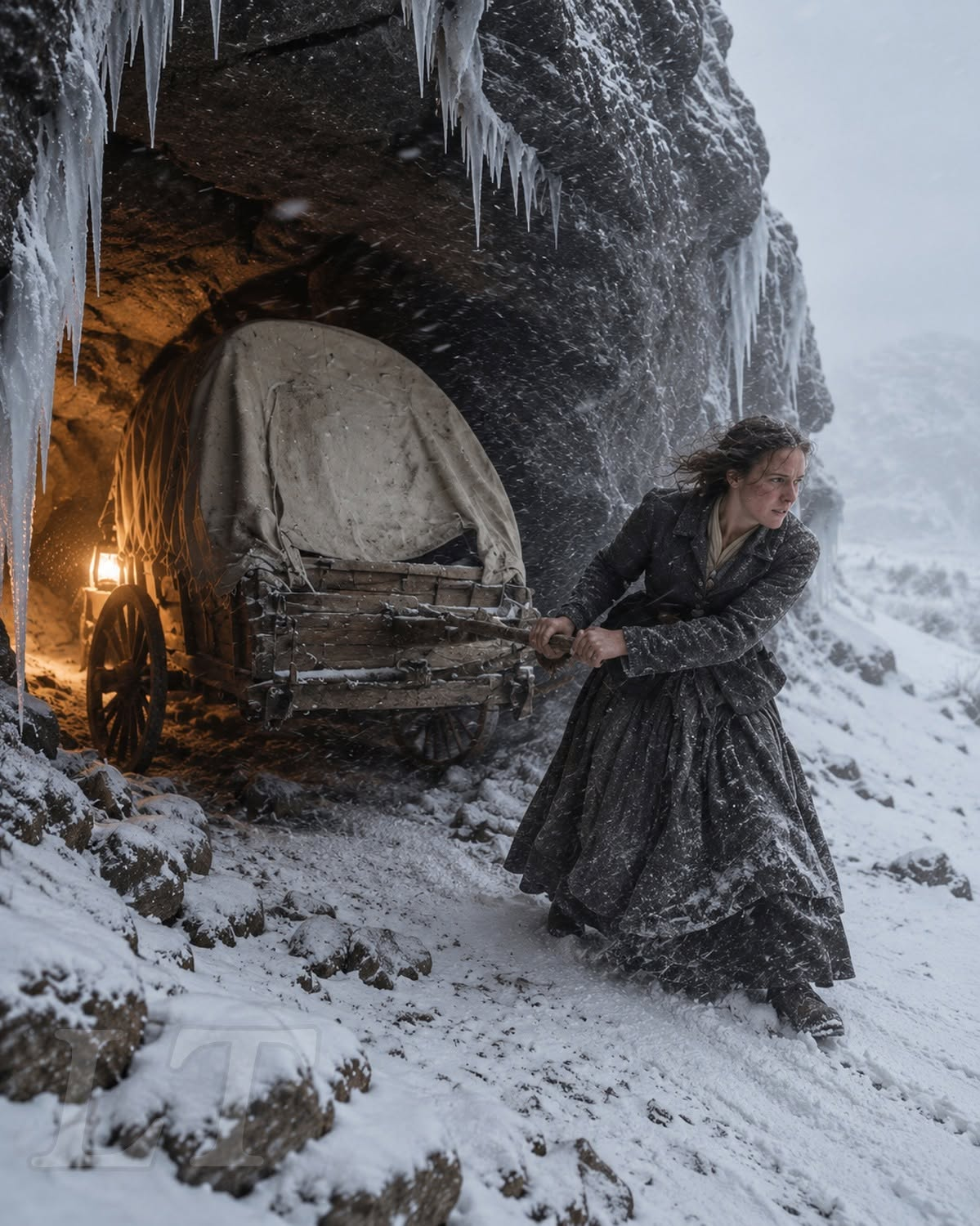
The sandstone wall moved.
Elsa stumbled backward, raising the lantern.
A small section of rock collapsed near the floor, scattering fragments across the ground.
The mule pulled against its lead rope and let out a frightened cry.
Elsa grabbed the hammer.
Something was moving behind the sandstone.
She could hear it.
A faint scratching.
Then a heavier scraping noise.
She crouched near the opening, keeping her distance from the unstable stones.
The gap was no longer completely sealed.
A thin stream of cold air entered through the fracture.
Elsa raised the lantern.
The light revealed a narrow passage extending into the darkness.
She could not see where it led.
Perhaps the sandstone contained a natural cavity.
Perhaps the pressure from the blizzard had opened a previously hidden fracture.
But the sound suggested something else.
Something was moving inside.
Elsa backed away.
She had already encountered a bear outside the wooden barrier. She could not afford another animal entering through the rear wall.
She looked toward the mule.
The animal was standing rigidly, its ears pointed toward the opening.
Elsa moved closer and placed a hand against its neck.
"Stay behind me."
She did not know whether the words meant anything to the frightened animal.
But speaking helped her remain calm.
Another stone shifted.
This time, a larger fragment fell.
It struck the ground and broke into several pieces.
Elsa stepped backward.
The opening had widened.
She examined the surrounding sandstone.
The fracture extended upward and toward the rear of the hollow. Some sections appeared stable, while others had loose edges.
She could not simply pack the entire opening with soil.
If the stone continued moving, the material would fall away.
She needed a more substantial barrier.
Elsa looked toward the wagon remains.
A short wooden board lay beside the central support.
She picked it up and carried it toward the opening.
Then she positioned it across the lower section of the fracture.
The fit was awkward.
The rock surface was irregular, and the board did not sit evenly.
She adjusted it several times.
Finally, she found a position where the timber rested against two solid sandstone projections.
She pressed against it.
The board held.
Elsa tied a rope around the timber and secured the other end to a nearby rock projection.
Then she placed several smaller stones beneath the board.
The arrangement created a temporary barrier.
She examined the opening.
The scratching had stopped.
For a few seconds, she heard nothing except the wind.
Elsa lowered the lantern.
Then a low rumbling sound came from deeper inside the sandstone.
She froze.
The noise was not coming from the entrance.
It was coming from behind the rear wall.
She looked at the narrow opening.
A small amount of dust drifted outward.
Elsa moved away.
The sound continued.
Then something struck the other side of the rock.
A single heavy impact.
The wooden board vibrated.
Elsa raised the hammer.
She waited.
Another impact followed.
This time, several small stones fell from the upper edge.
She realized that the fracture was connected to a larger section of loose sandstone.
The wall was not simply developing a crack.
It might be separating along an existing natural passage.
She needed to get the mule away from it.
Elsa moved toward the animal.
The mule resisted as she pulled the lead rope.
Its hooves scraped against the frozen ground.
"Come on."
She guided it toward the center of the hollow.
There was little room to move, but she managed to position the animal near the strongest section of the rear wall, away from the fracture.
Then she secured the rope.
She returned to the wooden box.
Her father's tools lay inside.
Elsa opened the lid and examined them.
The hammer.
The chisel.
The wrench.
The small iron fittings.
She had used nearly all of them to construct the shelter.
Now she needed to determine whether any remaining tool could help her stabilize the sandstone.
Her eyes settled on the chisel.
She picked it up.
The metal edge was damaged, but still usable.
She approached the fracture and examined the surrounding stone.
The opening was wider near the bottom.
Above it, the sandstone formed a narrow natural arch.
Some of the stone beneath that arch appeared loose.
Elsa considered removing the unstable fragments before they fell.
But she could not know how much of the surrounding structure depended on them.
If she struck the wrong section, she might cause a larger collapse.
She remembered her father's advice.
When repairing a damaged ship, he had never removed timber simply because it looked weak.
He first examined how the surrounding structure carried the load.
Elsa looked at the sandstone again.
She needed to understand what was supporting what.
She raised the lantern.
The light revealed a horizontal fracture extending toward the left side.
A smaller crack crossed it.
The two lines formed an uneven shape.
Elsa touched the surface.
A small fragment came away.
She withdrew her hand.
The stone was deteriorating.
She stepped backward and examined the floor.
Several loose rocks lay near the opening.
She could use them to block the lower gap, but she would need something stronger to hold them in position.
The wagon's remaining sideboard might work.
It was still lying beside the wooden barrier.
Elsa dragged it toward the rear wall.
The timber scraped across the ground.
She positioned it horizontally against the opening.
Then she used the chisel to remove a small protruding section of wood.
The board fitted more closely against the sandstone.
She pushed it into position.
It held.
Elsa placed a flat stone beneath the lower edge.
Then another beside it.
The barrier became more stable.
She tightened the rope.
For several seconds, nothing moved.
Elsa examined the repair.
It would not withstand a direct impact from a large animal.
But it might prevent loose stones from falling into the shelter.
She returned to the mule.
The animal was still trembling.
Elsa adjusted the blanket across its back.
Then she checked the lead rope.
The knot was secure.
She stroked its face.
"Just a little longer."
The mule lowered its head.
Elsa looked at the entrance.
The bear had not returned to the narrow opening, but she could still hear occasional movements outside.
The storm continued burying the wooden barrier.
She was now facing two separate threats.
The bear outside.
And the unstable sandstone behind her.
There was no way to leave the hollow without exposing herself to the blizzard.
She needed to make the shelter stronger.
Elsa returned to the rear wall and examined the remaining timber.
The wooden board was holding.
The stones beneath it remained in place.
But she noticed a narrow opening above the support.
A draft was entering through it.
She reached for a strip of canvas.
There was barely enough material left.
She folded it several times and pushed it into the gap.
Then she packed soil around the fabric.
The draft weakened.
Elsa pressed the material firmly into place.
She tested it with her hand.
The air movement had almost disappeared.
Satisfied, she stepped backward.
The lantern flame flickered.
She looked at the light.
The oil was running dangerously low.
She could no longer afford to keep the flame burning continuously.
But darkness would make repairing the shelter almost impossible.
She needed to conserve it for emergencies.
Elsa lowered the wick until the flame became small.
Then she placed the lantern on a flat stone.
She sat beside the wooden box.
Her shoulder throbbed.
Her palms were raw.
Her legs felt weak.
She had been fighting the storm for hours, and the physical effort was beginning to affect her judgment.
She needed to rest.
But she could not sleep while the rear wall remained unstable.
She looked at the tools.
The hammer reminded her of her father.
She remembered the small workshop beside the Norwegian harbor.
It had always smelled of sawdust, tar, and damp rope.
Her father had worked there from early morning until evening.
Sometimes she had sat on an overturned wooden bucket, watching him repair fishing boats.
He had never hurried.
Even when the weather was bad and a boat needed to return to the water before the next tide, he worked with remarkable patience.
Elsa remembered one winter afternoon when she had asked him why he spent so much time examining damaged timber.
He had held up a piece of wood.
"Because the outside can lie."
She had laughed.
He had smiled.
"Something may look strong until pressure reaches the weak place. Then you discover what was hiding underneath."
He had turned the timber in his hands.
"Never repair only what you can see, Elsa. Understand what is holding everything together."
Those words had followed her across an ocean.
Now they were guiding her through a Wyoming blizzard.
Elsa looked toward the rear wall.
She realized that she had been treating the fracture as an isolated problem.
But perhaps it was connected to the larger collapse near the entrance.
The sandstone formation had been under pressure for hours.
The first section had broken away.
The remaining rock might be shifting as well.
She stood.
She needed to inspect the entire rear wall.
Carefully.
She moved the lantern along the sandstone, examining every visible crack.
The first section appeared stable.
The second contained several small fractures.
The third was partly hidden behind the wooden box.
Elsa moved the box.
A long vertical crack appeared beneath it.
She raised the lantern.
The fracture extended upward almost to the ceiling.
She stepped closer.
A small amount of dust fell.
Elsa immediately stepped back.
The crack was larger than she had expected.
She examined the ground beneath it.
A narrow line of loose soil had appeared along the base.
The sandstone was separating from the surrounding rock.
She pressed her palm against the wall.
It felt solid.
But she remembered her father's warning.
The outside could lie.
She tapped the sandstone gently with the wooden handle of the hammer.
The sound was different from the surrounding rock.
It was hollow.
Elsa tapped another section.
A deeper sound answered.
She moved back to the first area.
The difference was unmistakable.
Part of the rear wall was no longer firmly attached to the surrounding formation.
It might be concealing a cavity.
Or a natural passage.
Elsa looked toward the opening she had blocked.
The scratching sound returned.
This time, it came from farther inside the wall.
She raised the lantern.
A faint movement appeared behind the wooden board.
Something was passing through the narrow darkness.
Elsa stepped backward.
She looked toward the mule.
The animal had raised its head again.
Its ears were pointed toward the wall.
Elsa picked up the hammer.
She did not want to strike the sandstone.
But she needed to know whether the opening was expanding.
She approached the fracture and placed the wooden handle against the lower section.
Then she applied gentle pressure.
The stone did not move.
She tried again.
A small fragment fell away.
Elsa stopped.
The fracture was unstable.
She could not risk forcing it.
She examined the wooden barrier she had constructed.
The board rested against two solid projections.
If the wall shifted, the timber might prevent some of the debris from entering the shelter.
But it could also become trapped beneath falling stone.
She needed to move the mule farther away.
Elsa approached the animal and loosened the lead rope.
She guided it toward the center of the hollow.
The mule followed reluctantly.
She secured it beside the strongest section of sandstone.
Then she returned to the rear wall.
The scratching sound had stopped.
She lowered the lantern and examined the floor.
There were several small marks in the loose soil.
At first, they appeared to be irregular impressions left by falling stones.
Then Elsa noticed something unusual.
The marks continued beneath the wooden board.
They formed a narrow trail leading toward the dark opening.
She crouched.
The soil had been disturbed recently.
Elsa touched one of the impressions.
It was damp.
She looked at her fingers.
Then she raised the lantern.
A faint odor came from the opening.
Not the smell of ordinary wet sandstone.
Something stronger.
Something animal.
Elsa's expression changed.
The bear outside had been searching for a way into the hollow.
But the marks beneath the rear wall suggested that another creature might have been moving through the rock passage.
She slowly stood.
The lantern flame flickered.
Then a sudden gust struck the wooden entrance.
The barrier shook.
Elsa turned toward the sound.
A heavy impact followed.
The bear had returned.
She looked between the entrance and the rear wall.
There was no safe direction.
Another impact struck the entrance.
The central support groaned.
Elsa grabbed the hammer.
Then the rear wall made a deep cracking sound.
She turned.
The wooden board began moving away from the sandstone.
A narrow line of darkness appeared behind it.
Elsa stepped backward.
The mule pulled against its rope.
She raised the lantern.
Something was moving inside the opening.
A shadow.
Then another.
The stones beneath the board began falling away.
Elsa watched in horror as the rear wall slowly separated.
And from the darkness came a sound she recognized from stories told by Norwegian hunters when she was a child.
A low, heavy growl.
There was something else inside the rock.
And it was coming out.






Comments 0