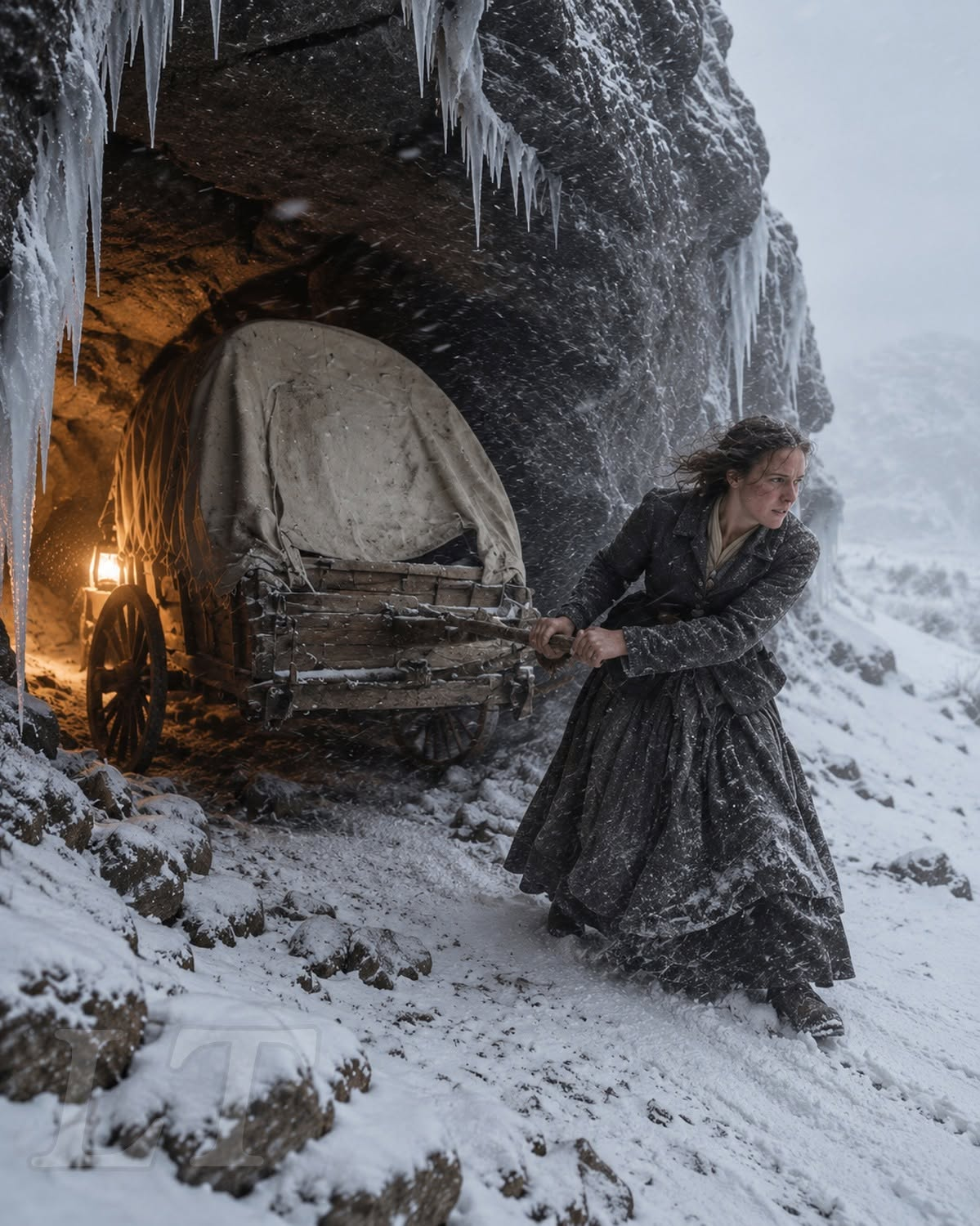
The wooden section began separating from the frame.
Elsa dropped the hammer and grabbed the nearest support.
A sharp crack echoed through the hollow.
The left sideboard shifted inward, pushing against the diagonal brace.
Elsa threw her weight against the timber.
"Hold together!"
Another violent gust struck the buried entrance.
The board moved again.
She felt the pressure through her arms and shoulders. The structure was no longer resisting the storm evenly. The accumulated snow was pushing against one section, forcing the entire barrier toward the interior.
Elsa looked at the damaged connection.
The rope had slipped.
A wooden wedge had fallen from beneath the frame.
Without that support, the left sideboard was carrying more weight than it could safely withstand.
She needed to restore the connection before the next gust.
She released one hand and reached for the hammer.
The tool lay several feet away.
She could not leave the board unsupported.
Instead, she pressed her shoulder against the timber and stretched her arm toward the ground.
Her fingertips brushed the hammer handle.
She pulled it closer.
Then she searched for the fallen wedge.
It had disappeared beneath the snow that had entered through the damaged section.
Elsa could not see it.
She moved her free hand across the ground.
Snow.
Loose soil.
A broken piece of canvas.
Then her fingers touched wood.
She grabbed it.
The wedge was smaller than she remembered, but still usable.
She placed it beneath the sideboard.
The board remained unstable.
Elsa struck the wedge with the hammer.
Once.
Twice.
The wood moved into position.
She struck it again.
The wedge tightened beneath the frame.
For a moment, the sideboard stopped moving.
Elsa kept her shoulder against the timber.
She listened.
The wind continued roaring outside.
Then another gust arrived.
The barrier shuddered.
The wedge held.
Elsa slowly stepped backward.
She examined the damaged section.
A long split had appeared along the lower edge of the board. The crack extended toward the central support.
The timber was close to failing.
She could not simply replace it.
There were no full-length boards remaining.
She had already used the strongest pieces of the wagon to construct the barrier.
What remained were short fragments, damaged spokes, and a few sections of broken frame.
Elsa looked at the split.
Then she remembered the iron bracket in her father's wooden box.
She hurried toward it.
The box was beside the rear wall.
She opened the lid and searched through the tools.
The bracket was still there.
She picked it up and returned to the entrance.
The metal piece was heavy.
Its shape was simple, with two narrow ends and a central section designed to reinforce a wooden connection.
Elsa positioned it across the split.
The fit was not perfect.
But it covered the weakest part.
She used the hammer to drive an existing metal fastening through the bracket and into the timber.
The first strike made little difference.
She adjusted the angle.
The second strike pushed the metal deeper.
Then the third.
The bracket tightened against the board.
Elsa tested the connection.
The split remained visible, but the two sections no longer moved independently.
She stepped away.
The repair might hold for a while.
She returned to the central support and examined the ropes.
The diagonal brace was still secure.
The central axle had shifted slightly but remained in position.
She tightened its lower connection.
Then she checked the right side.
The rope was stretched, but not broken.
Elsa pulled it tighter and secured the knot.
She looked at the barrier again.
It was holding.
But she knew the snow outside was continuing to accumulate.
She needed to reduce the pressure before another section failed.
She approached the narrow opening near the upper right corner.
The lantern illuminated a small patch of white beyond the wooden boards.
Snow had almost completely covered the entrance.
Elsa could barely see anything outside.
She pressed her hand against the opening.
The air felt unusually still.
That worried her.
The wind had been forcing snow against the barrier for hours.
If the entrance was becoming completely buried, the airflow might be severely restricted.
She remembered her father's lessons about enclosed shelters.
Blocking the wind was important.
But a person and an animal still needed fresh air.
She examined the opening carefully.
A narrow space remained between the canvas and the wooden frame.
It was small, but air could still move through it.
She decided not to disturb it.
Instead, she focused on the damaged lower section.
The snow had entered through several gaps and accumulated along the floor.
Elsa used a broken board to push it toward the entrance.
She worked slowly.
Each movement revealed more of the wooden frame.
She removed the loose snow and pressed the remaining grass packing back into place.
Then she added soil.
The lower edge became more secure.
She moved to the left corner.
A small opening remained beneath the fallen sandstone.
She packed it with cloth and grass.
Then she secured the material with a wooden wedge.
The draft weakened.
Elsa straightened.
Her back hurt.
Her shoulders burned.
Her hands were trembling.
She looked toward the mule.
The animal was standing quietly, but its head remained raised.
Elsa approached and checked the blanket.
It had slipped again.
She adjusted it and examined the animal's legs.
There was snow around its hooves.
She brushed it away with her hands.
The mule shifted.
Elsa placed her forehead briefly against its neck.
"You have to stay strong."
The animal breathed against her coat.
She remained beside it for several seconds.
Then a low sound came from the entrance.
Elsa lifted her head.
Something was scraping against the outer side of the wooden wall.
The sound moved from left to right.
Then stopped.
She approached the barrier.
The scraping returned.
This time, it was louder.
Elsa listened carefully.
The noise seemed to come from beneath the accumulated snow.
It was not the sound of wind passing over the canvas.
It was something dragging across the outer boards.
She pressed her ear against the timber.
A deep grinding noise followed.
Then silence.
She stepped backward.
The lantern flickered.
The mule moved nervously.
Elsa looked at the opening.
Nothing was visible.
She picked up the hammer.
Another scraping sound came from outside.
It traveled along the lower edge.
Then something struck the wooden wall.
The impact was heavy enough to shake the lantern.
Elsa froze.
The barrier vibrated.
A small amount of snow fell from the upper canvas.
She approached cautiously.
The sound came again.
Three distinct impacts.
Thump.
Thump.
Thump.
Elsa stared at the wood.
For a moment, she wondered whether another section of the sandstone overhang had collapsed.
But the impacts were too regular.
They came from the same position.
She crouched near the damaged sideboard.
A narrow crack had opened between two wooden boards.
She raised the lantern.
The opening revealed only darkness and snow.
Then a thin line of white moved across the gap.
Elsa leaned closer.
The snow outside was shifting.
Something was pushing against the other side.
She moved backward.
The mule suddenly pulled against its lead rope.
Elsa turned.
"Easy!"
The animal raised its head and gave a frightened cry.
Elsa returned to the entrance.
She placed one hand against the central board.
The timber was vibrating again.
The pressure seemed to increase.
She could hear the wind rushing through the accumulated snow outside.
But beneath that sound was something else.
A deeper rumble.
It seemed to travel through the ground.
Elsa lowered herself and examined the lower opening.
Snow was pressing through the gap.
She pushed it back with a wooden board.
The movement stopped.
Then something struck the other side again.
This time, the impact was followed by a long scraping sound.
Elsa stood.
She could not understand what was happening outside.
But she knew the barrier was being tested by something heavier than loose snow.
She retrieved a length of rope and tied it around the central support.
Then she secured the other end to the rear sandstone projection.
The connection would not stop the entire wall from collapsing.
But it might prevent the central section from moving too far inward.
She tightened the knot.
Then she checked the diagonal brace.
Everything appeared secure.
The next gust struck.
The wooden wall shook.
The rope tightened.
Elsa felt the force travel through the timber.
But the barrier remained standing.
She exhaled slowly.
Then she heard another sound.
A faint metallic scrape.
It came from the lower left corner.
Elsa turned toward it.
The damaged wheel rim was still attached to the wooden barrier.
She had used it to reinforce the opening after the rockfall.
Now the metal was vibrating against the timber.
She approached and examined the connection.
The rope around the rim had become loose.
She tightened it.
Then she placed a small piece of cloth between the iron and the wood to prevent further movement.
The metallic sound stopped.
Elsa returned to the center.
For several minutes, nothing happened.
The storm continued outside.
The lantern burned quietly.
The mule lowered its head.
Elsa began to believe the barrier might survive another hour.
She looked toward the food box.
Only a small amount remained.
She took a piece of hardtack and broke it in half.
She ate one portion and saved the other.
Then she drank a little water.
Her throat was dry from the dust and cold air.
She sat against the rear wall.
The stone felt unforgiving beneath her back.
She pulled the blanket around her shoulders and tried to rest.
But the sounds outside continued.
The wind.
The shifting snow.
The occasional groan of the wooden frame.
She closed her eyes.
Then she heard a sound that made her open them immediately.
A knock.
Not an impact from the storm.
A distinct, hollow knock.
It came from the other side of the wooden barrier.
Elsa remained still.
She listened.
Nothing.
Then it came again.
Three knocks.
Slow.
Heavy.
Separated by several seconds.
She rose carefully.
The mule lifted its head.
Elsa picked up the lantern.
She approached the barrier.
Her heart began beating faster.
The sound had come from the lower section, near the damaged sideboard.
She crouched.
Another knock.
This time, it was followed by a short scrape.
Elsa held the lantern closer.
The wooden boards were covered with frost.
A narrow gap remained between the lower pieces of timber.
She leaned toward it.
There was nothing visible.
Only darkness.
She listened again.
The wind weakened for several seconds.
And in that brief silence, she heard something that made her blood run cold.
A faint, irregular tapping.
It was coming from beneath the snow.
Elsa pulled back.
She looked toward the ceiling.
Then toward the mule.
She considered whether the sound might be caused by shifting timber or loose stones.
But the rhythm was different.
It seemed deliberate.
She approached the wall again.
The tapping stopped.
Elsa waited.
A few seconds passed.
Then something brushed against the wood.
A long, slow movement.
She placed the lantern on the ground and reached for the hammer.
Her father's old lessons returned to her.
Never assume a structure is safe because it has survived the previous impact.
Always inspect the damage.
Always understand what is applying the pressure.
Elsa examined the lower board.
A small piece of timber had broken away, creating an opening barely wide enough for her fingers.
She touched the edge.
The wood was wet.
Snow had melted against it.
She pressed gently.
Something moved on the other side.
Elsa pulled her hand away.
The mule gave another nervous cry.
She looked toward the animal.
Then back at the wall.
The tapping returned.
One knock.
Then another.
Then a long scrape.
Elsa raised the lantern.
A thin shadow appeared beneath the wooden board.
It moved across the narrow opening.
She leaned closer.
For one terrible second, she thought she saw a hand.
She blinked.
The shadow disappeared.
She moved the lantern closer to the gap.
Nothing.
Only blowing snow.
She waited.
The wind rose again.
The wooden barrier vibrated.
Elsa stepped backward.
She needed to understand what was happening before the wall failed.
She reached for the broken piece of timber and carefully widened the opening by a fraction.
A small amount of snow fell inward.
Cold air entered.
Elsa held the lantern near the gap.
Then she heard a sound from outside.
Not a knock.
Not a scrape.
A low, unmistakable growl.
Elsa froze.
The mule suddenly reared against its rope.
The lantern shook.
A second growl came from the other side of the wooden wall.
It was closer.
Much closer.
Elsa stared into the narrow opening.
Something moved behind the snow.
A dark shape appeared.
Then two pale reflections caught the lantern light.
Eyes.
Elsa stumbled backward.
The animal outside struck the barrier with tremendous force.
The wooden boards shook.
The central support groaned.
And before Elsa could reach the hammer, a powerful claw appeared through the widening gap.






Comments 0