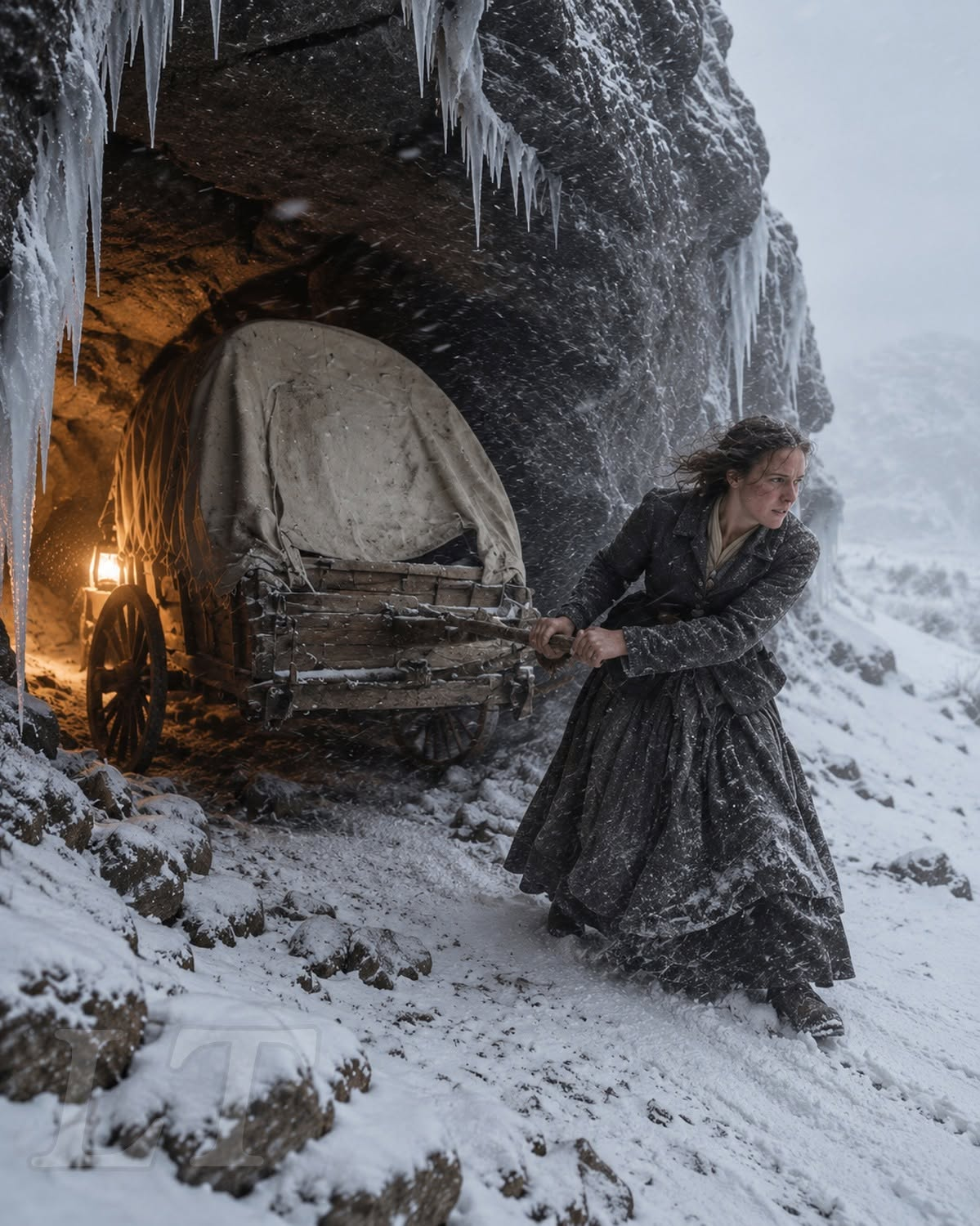
The handle turned again.
Elsa stood motionless beside the wooden table, staring toward the inner door.
The warning on the old paper seemed to burn in her mind.
DO NOT OPEN THE INNER DOOR DURING A STORM.
Another metallic click echoed through the chamber.
The handle stopped.
Then slowly returned to its original position.
Elsa looked toward the mother mountain lion.
The animal had moved in front of its young.
Its ears were flattened, and its body was rigid.
Even the injured mountain lion near the outer entrance had become unusually still.
Something behind the inner door was frightening them.
Elsa tightened her grip on the lantern.
She looked at the old map again.
The eastern passage was marked clearly.
If she could reach it, she might find a way out of the hollow.
But the inner door stood directly between her and the corridor.
She needed to understand what was behind it.
A heavy thump struck the other side.
The wooden door vibrated.
Elsa stepped backward.
Dust fell from the ceiling.
Then came another sound.
A long scraping noise traveled across the other side of the door.
It sounded as though something heavy was being dragged along the floor.
Elsa looked toward the documents.
The warning had been written in 1872.
Whatever had happened here, someone had considered the inner door dangerous enough to leave an explicit instruction.
She examined the remaining papers.
Most described the construction of the shelter.
One document contained a list of supplies.
Another showed the location of an old drainage channel.
Then she discovered a folded sheet hidden beneath the map.
The paper was brittle.
She opened it carefully.
The handwriting belonged to someone named Thomas Whitaker.
The first lines described a terrible winter storm that had trapped several travelers inside the mountain.
Elsa moved the lantern closer.
She read slowly.
The chamber had originally been designed as a winter refuge for travelers crossing the ridge.
The inner passage had been built to connect the shelter with a lower exit on the eastern side.
But during an earlier storm, part of the passage had collapsed.
Water and snow had entered through the upper section.
The builders had reinforced the inner door to prevent debris from entering the main chamber.
Elsa continued reading.
Then she reached a paragraph that made her stop.
Whitaker described hearing movement behind the inner door after the collapse.
At first, he believed it was another traveler.
But no one answered when he called.
The sounds continued for several nights.
Scratching.
Dragging.
Occasional impacts.
He had eventually sealed the door.
The final lines were difficult to read.
Elsa leaned closer.
A sentence appeared beneath the last paragraph.
Whatever is beyond that door must remain there until the mountain is completely still.
She lowered the paper.
The storm was still raging.
She looked toward the inner door.
The handle moved again.
This time, it turned farther.
A dull wooden creak followed.
Elsa backed away.
The mother mountain lion gave a low growl.
The smaller animal pressed against her body.
Elsa understood that she could not remain in the chamber indefinitely.
The front entrance was buried.
The rear opening was occupied by the mountain lions.
And the inner passage was the only route shown on the map.
She needed to reach the eastern exit.
But first, she had to determine whether the door could be opened safely.
She examined the wooden frame.
It was much heavier than the outer door.
Thick iron straps reinforced its surface.
A horizontal wooden bar had been installed across the interior.
The bar was secured by two metal brackets.
Elsa approached carefully.
She did not touch the handle.
Instead, she examined the lower edge.
A narrow gap remained beneath the door.
Cold air moved through it.
She crouched.
The air smelled of damp earth and wet stone.
Then she heard something.
A faint rushing sound.
Water.
Elsa looked toward the floor.
A thin line of moisture had appeared beneath the door.
She touched it.
The water was cold.
She looked at the old document again.
The drainage channel.
The warning.
The storm.
The pieces began connecting.
Perhaps the inner door had been designed to hold back water and debris from the eastern passage.
If the storm had caused flooding, opening it could release everything trapped behind it.
Elsa stepped away.
She examined the floor around the chamber.
A shallow groove ran along the sandstone toward one corner.
It was almost completely covered by dust.
She brushed the surface with her hand.
The groove continued beneath the wooden table and disappeared behind a pile of old debris.
Elsa moved the debris aside.
A narrow drainage channel appeared.
She examined its direction.
It seemed to lead away from the inner door and toward the eastern wall.
Perhaps the chamber had been built with a drainage system to prevent flooding.
She looked at the water beneath the door again.
The amount was small.
But the pressure behind it might be increasing.
She needed to understand how the drainage system worked.
Elsa retrieved the map.
A small symbol appeared beside the inner door.
She had overlooked it earlier.
It resembled a square with a line extending downward.
Beneath it was a handwritten word.
Release.
Elsa examined the walls.
Near the floor, she discovered a metal handle hidden behind a wooden shelf.
She moved the shelf aside.
The handle was attached to a narrow iron rod that disappeared into the sandstone.
It was old and rusted.
Elsa touched it.
The metal felt cold.
She pulled gently.
Nothing happened.
She tried again.
The handle moved slightly.
A metallic groan came from beneath the floor.
Then a faint rush of water followed.
Elsa froze.
The drainage channel had opened.
A small amount of water began flowing along the groove.
She watched it move toward the eastern corner.
The system was still functional.
Perhaps the builders had designed it to relieve pressure behind the inner door.
Elsa pulled the handle again.
This time, it moved farther.
The water flow increased.
A deep rumble traveled through the chamber.
The inner door shook.
Elsa immediately released the handle.
The rumbling stopped.
She stared at the door.
The mechanism had affected the pressure behind it.
She realized that opening the drainage channel might be necessary before anyone attempted to move the door.
She looked at the old papers.
There was another document beneath the first.
It contained a rough drawing of the drainage system.
Elsa unfolded it.
The drawing showed three channels.
One ran beneath the chamber.
Another extended toward the eastern passage.
The third connected to a small reservoir beyond the inner door.
The reservoir had been designed to collect water during heavy storms.
But the document contained a warning.
If the reservoir filled completely, pressure would build against the inner door.
Elsa looked toward the moisture beneath the wood.
The water was spreading.
The reservoir might already be full.
She stepped backward.
A sudden impact struck the inner door.
The entire frame shook.
The mother mountain lion growled.
Elsa turned.
The smaller animal had moved behind the old table.
Its mother was watching the door.
Another impact followed.
This time, the wooden bar shifted.
Elsa stared.
The metal brackets were beginning to pull away from the frame.
She approached the door cautiously.
The handle remained still.
But the lower section was visibly vibrating.
The water beneath it had become a narrow stream.
Elsa looked at the drainage handle.
She needed to release more water.
But the mechanism might be stuck.
She returned to it and pulled.
The metal resisted.
She used both hands.
The handle moved a fraction.
A sudden rush of water traveled beneath the floor.
The channel began filling.
Elsa watched the flow.
It was moving toward the eastern wall.
For several seconds, she felt hopeful.
Then a loud cracking noise came from beneath the chamber.
The floor trembled.
A small section of sandstone collapsed beside the drainage channel.
Elsa jumped backward.
Water surged through the opening.
It spread across the floor.
She looked at the inner door.
The wooden bar was still in place.
But one of the iron brackets had separated from the frame.
The reservoir was releasing pressure.
Or perhaps something was breaking.
She could not tell.
Elsa returned to the table and examined the remaining papers.
One sheet contained a drawing of a second release mechanism.
It appeared to be positioned on the opposite side of the inner door.
She studied the illustration.
The mechanism was connected to the eastern passage.
If the first release was not enough, the second might open a larger drainage channel.
But reaching it would require opening the inner door.
Elsa lowered the paper.
The handle turned again.
This time, it did not return.
It remained angled downward.
Then the wooden bar began sliding sideways.
Elsa stared.
The bar was moving without anyone touching it.
She stepped backward.
The mother mountain lion growled louder.
The smaller animal disappeared beneath the table.
Elsa grabbed the hammer.
The bar moved another inch.
A metal bracket snapped.
The door opened slightly.
A powerful stream of cold air rushed into the chamber.
The lantern flame nearly went out.
Elsa raised one arm to shield it.
Then she heard a sound from beyond the door.
Not scratching.
Not growling.
A deep rushing roar.
Water.
A great volume of water was moving through the passage.
Elsa looked at the floor.
The drainage channel was overflowing.
The water spread around her boots.
She moved toward the table.
The mother mountain lion retreated with her young.
Elsa looked at the door.
The gap was widening.
She could see darkness beyond it.
And beneath the darkness, something was moving.
She grabbed the old map.
Then the wooden bar slipped completely out of its brackets.
The inner door swung inward.
A wall of freezing water began rushing into the chamber.
Elsa barely had time to pull the mule's rope closer before the first wave struck her legs.
She fell against the table.
The lantern dropped.
The flame disappeared.
In the darkness, she heard the mother mountain lion cry out.
Then a tremendous crash shook the chamber.
The water was rising.
Elsa reached for the table and pulled herself upright.
She could no longer see the eastern passage.
She could barely distinguish the animals.
She called for the mule.
A frightened movement answered from somewhere behind her.
Then her fingers touched something on the floor.
A small metal object.
She picked it up.
It was a key.
Attached to it was a narrow brass tag.
Even in the darkness, she could feel engraved letters beneath her thumb.
She brought it closer.
A faint glow from the opening illuminated the inscription.
EASTERN EXIT — EMERGENCY RELEASE.
Elsa looked toward the flooded doorway.
The water was still pouring through.
But beyond it, she could now see a narrow stone staircase.
At the top was another wooden door.
And something was moving on the other side.
Extend my chapter to 2,000 words Strengthen my final cliffhanger






Comments 0