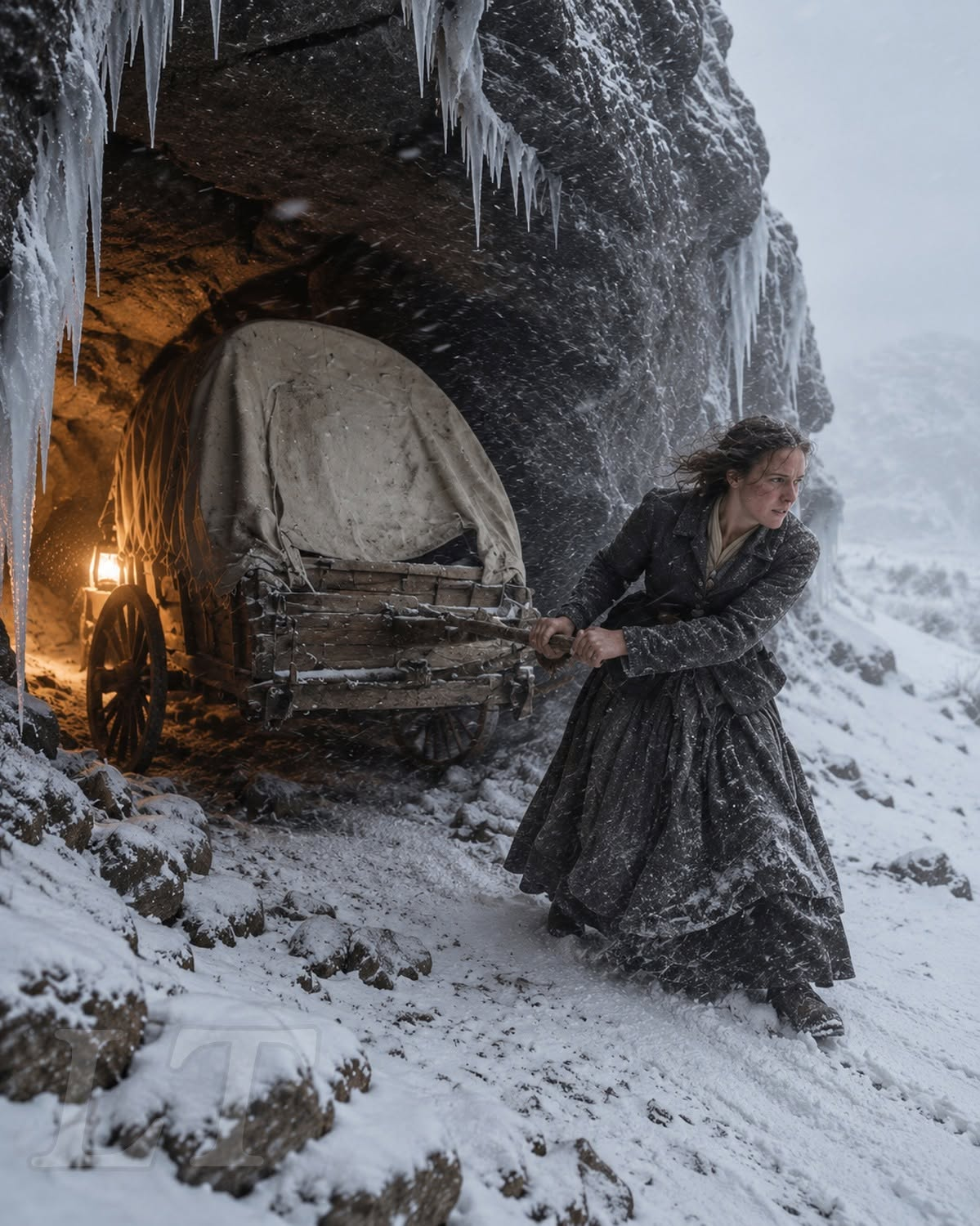
The final fastening refused to move.
Elsa pressed the wrench against the metal fitting and pulled with both hands.
Nothing.
She changed her position, placed one boot against the wagon frame, and tried again.
The bolt groaned.
Then it turned.
"Thank God," she whispered.
The metal fitting finally came loose.
Elsa lowered the wrench and examined the damaged wagon.
Its structure looked worse without the wheels attached. The wooden frame leaned awkwardly, and the broken axle rested against the frozen earth.
She had never imagined dismantling her only means of transportation.
Yet she knew there was no other choice.
The sandstone hollow was the only natural shelter she had found for miles. If she abandoned the wagon entirely, she would lose the strongest material available to construct a protective barrier.
She could not afford that mistake.
She walked around the wooden frame, inspecting each remaining connection.
The rear wheel was still attached.
Its iron rim was damaged, and several wooden spokes had begun separating from the central hub.
Elsa knelt beside it.
She placed the wrench against the fastening.
The metal was painfully cold.
Her gloves were worn, and the rough surface of the tool slipped against her fingers.
She tightened her grip.
Then she heard the mule.
The animal gave a short, nervous cry.
Elsa looked toward the sandstone ridge.
The sky had become darker.
Snow was beginning to travel across the ground in long, narrow streams.
The storm was no longer something distant.
It was approaching.
"Easy," she called to the mule.
The animal shifted its weight.
Elsa returned to the wheel.
She loosened the fastening and pulled the damaged wheel away from the frame.
It dropped against the snow with a heavy thud.
She remained kneeling for several seconds, catching her breath.
One wheel.
One axle.
One wooden bed.
That was all she needed to move.
But the wooden structure weighed hundreds of pounds.
She looked toward the hollow again.
Sixty feet.
The distance seemed insignificant.
Under ordinary circumstances, she could have walked it in less than a minute.
Dragging the wagon bed across frozen, uneven ground was another matter.
She wiped her hands against her coat and stood.
The second wheel came away more easily.
Elsa placed it beside the first.
She then returned to the axle.
The front section was badly damaged, but the iron connections still held.
She positioned the hammer against one of the wooden joints.
The first strike produced a dull sound.
The second loosened the fitting.
She worked carefully, trying not to damage the surrounding boards.
Her father had always warned her against confusing force with progress.
A shipwright who destroyed the timber while repairing a ship was not much of a shipwright.
Elsa remembered that lesson as she worked.
She struck the joint again.
The axle finally separated.
She lowered it to the ground.
The wagon bed now rested on its wooden underside.
For the first time, Elsa could see what remained of the structure without the damaged running gear.
The sideboards were weathered, but much of the timber was solid.
The front panel was particularly strong.
It would make a useful barrier.
She walked around the wagon bed, testing the boards with her gloved fingers.
One section near the rear had loosened.
She pressed against it.
The board moved slightly.
Elsa picked up her hammer and secured it with an iron fitting from the damaged axle.
The repair was crude.
But it held.
She examined the upper edge.
There were gaps between several boards.
Those would have to be covered with canvas and packed with grass.
She could not make the barrier completely airtight. In fact, she knew that ventilation would remain important, particularly with the mule inside.
But she needed to prevent the full force of the wind from entering.
She needed to reduce drafts.
She needed to keep the snow outside.
And above everything else, she needed to keep the wooden structure standing.
A sudden gust brushed across the ridge.
Elsa turned.
A thin layer of snow swept past her boots.
The clouds had grown so dark that the distant landscape appeared almost colorless.
She looked at the wagon bed.
Then at the rope.
She had approximately sixty feet of strong hemp rope.
It was the same rope she had used throughout the journey to secure supplies, repair the wagon, and fasten the mule's equipment.
Now it would become the most important tool she possessed.
Elsa dragged the rope toward the wooden bed.
She looped it around the strongest section of the frame.
Then she pulled the end through itself and tightened the knot.
Her father had taught her several methods for securing heavy timber.
She selected one that would distribute the pulling force across the structure rather than concentrate it on a single board.
She tested the knot.
It held.
Next, she examined the ground between the wagon and the hollow.
The route sloped gently downward.
That was fortunate.
If the ground had risen, she might not have been able to move the wooden bed at all.
She cleared a few loose stones with her boots.
Then she returned to the wagon.
The rope was long enough to pass over her shoulder.
She placed it across her upper body, adjusted the tension, and positioned herself in front of the wooden structure.
Her boots sank into the snow.
She leaned forward.
Pulled.
Nothing happened.
The wagon bed remained motionless.
Elsa tightened her jaw.
She adjusted the rope.
Then she tried again.
The wooden frame shifted slightly.
A few inches.
She stopped.
Her heart was beating rapidly.
She looked behind her.
The hollow seemed farther away than before.
The mule watched from beside the rocks.
"Come on," Elsa whispered.
She pulled again.
The wooden structure scraped across the frozen ground.
This time it moved several inches.
Elsa continued.
One step.
Another.
Her boots slipped.
The rope tightened against her coat.
The weight of the wagon pulled backward, threatening to drag her down.
She planted her feet and leaned forward.
The wooden bed moved again.
It was not much.
But it was progress.
She had learned something important.
The wagon did not need to be lifted.
It only needed to slide.
She remembered her father moving heavy timber along the Norwegian shoreline.
He had taught her that the direction of force mattered as much as the amount of strength a person possessed.
"Don't fight the whole weight," he had said. "Find the direction where it wants to move."
Elsa looked at the downward slope.
Then she adjusted the rope.
She positioned her boots more carefully and leaned her body forward.
The next pull moved the wagon several inches.
A small piece of frozen earth broke beneath its wooden edge.
Elsa exhaled.
For the first time, she believed the task might actually be possible.
She continued.
The first ten feet took an exhausting amount of effort.
Her shoulders burned.
The rope rubbed against her coat.
Her breathing became increasingly irregular.
Twice, she stopped to rest.
The second time, she dropped to one knee.
She pressed her hand against the snow and lowered her head.
Her body was telling her to stop.
She could feel the exhaustion spreading through her legs.
But when she raised her eyes, she saw the dark clouds.
They were closer.
Much closer.
She forced herself upright.
There was no time to recover completely.
She needed to reach the hollow.
She needed to secure the entrance.
And she needed to bring the mule inside before the worst of the storm arrived.
Elsa returned to the rope.
She tightened the knot and resumed pulling.
The wooden bed scraped forward.
A rough wooden sound echoed against the rocks.
She pulled.
Stopped.
Adjusted her footing.
Pulled again.
Several times, she felt the rope slipping against her shoulder.
She repositioned it.
Her gloves were becoming damp from melting snow.
The cold was beginning to reach her fingers.
She could no longer feel the tips of her hands properly.
Yet she continued.
At one point, the wagon bed became caught against a buried stone.
The entire structure stopped.
Elsa pulled harder.
The rope stretched.
The wooden boards groaned.
Nothing moved.
She stepped backward and examined the obstruction.
A large rock had caught beneath the front edge.
She could not lift the wagon bed high enough to clear it.
Instead, she retrieved her father's chisel.
She knelt beside the stone and worked the metal tool into the frozen soil around it.
The ground resisted.
She struck the chisel with the hammer.
Again.
And again.
Small pieces of frozen earth broke away.
Eventually, the stone shifted.
Elsa pushed it aside with both hands.
She returned to the rope.
The wagon bed moved.
This time, it slid freely.
A faint expression of relief crossed her face.
She had passed the halfway point.
The sandstone hollow was now close enough for her to see the dark interior beneath its overhanging roof.
The lantern she had placed inside provided a small circle of amber light.
It was the only warm-looking thing in the entire landscape.
Elsa focused on it.
She pulled again.
Her legs trembled.
The rope burned against her shoulder.
The wooden bed scraped over another patch of frozen ground.
Then it stopped.
Elsa lowered herself to one knee.
She could barely catch her breath.
Her body was exhausted.
She looked at her hands.
The leather gloves had split near the fingers.
A small amount of blood had appeared along one palm.
She stared at it for a moment.
Then she closed her hand.
There would be time to deal with the injury later.
If there was a later.
She looked toward the northwest.
The sky had turned an unnatural yellow-gray.
Snow was moving across the plains in increasingly thick bands.
The storm was almost upon her.
Elsa stood.
She took hold of the rope.
And she pulled with everything she had left.
The wagon bed moved several more feet.
Its front edge reached the uneven ground near the sandstone hollow.
Elsa adjusted the rope and guided the structure toward the entrance.
The wooden frame scraped against the rocks.
She released the rope and pushed one sideboard with both hands.
It shifted slightly.
She pushed again.
The wagon bed finally came to rest across the sheltered area.
Elsa stepped backward.
For several seconds, she simply stared at it.
She had done it.
The broken wagon was no longer stranded in the open wilderness.
It had reached the one place where it might serve a purpose greater than transportation.
But the shelter was not ready.
Not even close.
She walked around the wooden structure.
The ten-foot barrier blocked the center of the entrance.
However, large gaps remained on both sides.
Above the wagon, the opening between the wooden boards and the sandstone overhang was dangerously wide.
Beneath the structure, snow could still blow through several spaces.
Elsa examined each opening.
She needed to close them.
Quickly.
She retrieved the torn canvas.
There was not enough material to cover the entire entrance, but she could stretch it across the upper gap.
The remaining pieces could be folded into smaller strips and used to block narrow openings.
She would need the dry grass scattered around the edge of the ridge.
She would also need loose soil and stones.
Everything had to be secured before the wind became too strong.
Elsa turned toward the mule.
The animal was standing near the hollow, its head raised.
She approached slowly and placed one hand against its neck.
"Easy, old friend."
The mule moved its ears.
Elsa looked into its eyes.
She had no intention of leaving it outside.
The animal had carried her supplies across six days of difficult travel.
It had endured the same cold, the same exhaustion, and the same uncertain road.
Now it would have to trust her one more time.
She took the lead rope.
The mule hesitated.
Elsa gently guided it toward the wooden barrier.
The opening was narrow, and the animal seemed uncomfortable entering the cramped space.
She stroked its face.
"Come on. I'm not leaving you out there."
The mule finally stepped forward.
Its hooves touched the sheltered ground.
Elsa guided it deeper inside.
Then she turned toward the entrance.
The lantern flickered.
Outside, the first powerful gust of wind struck the sandstone ridge.
Elsa looked at the canvas.
It lifted violently from the ground.
She rushed toward it.
The storm had arrived earlier than she had expected.
And she still had one enormous gap left to close.
Hết Chapter 2. Chapter 3 tiếp nối trực tiếp cảnh Elsa bắt đầu dựng bức tường cuối cùng cho nơi trú ẩn, không quay lại kể lại những sự kiện đã xảy ra.






Comments 0