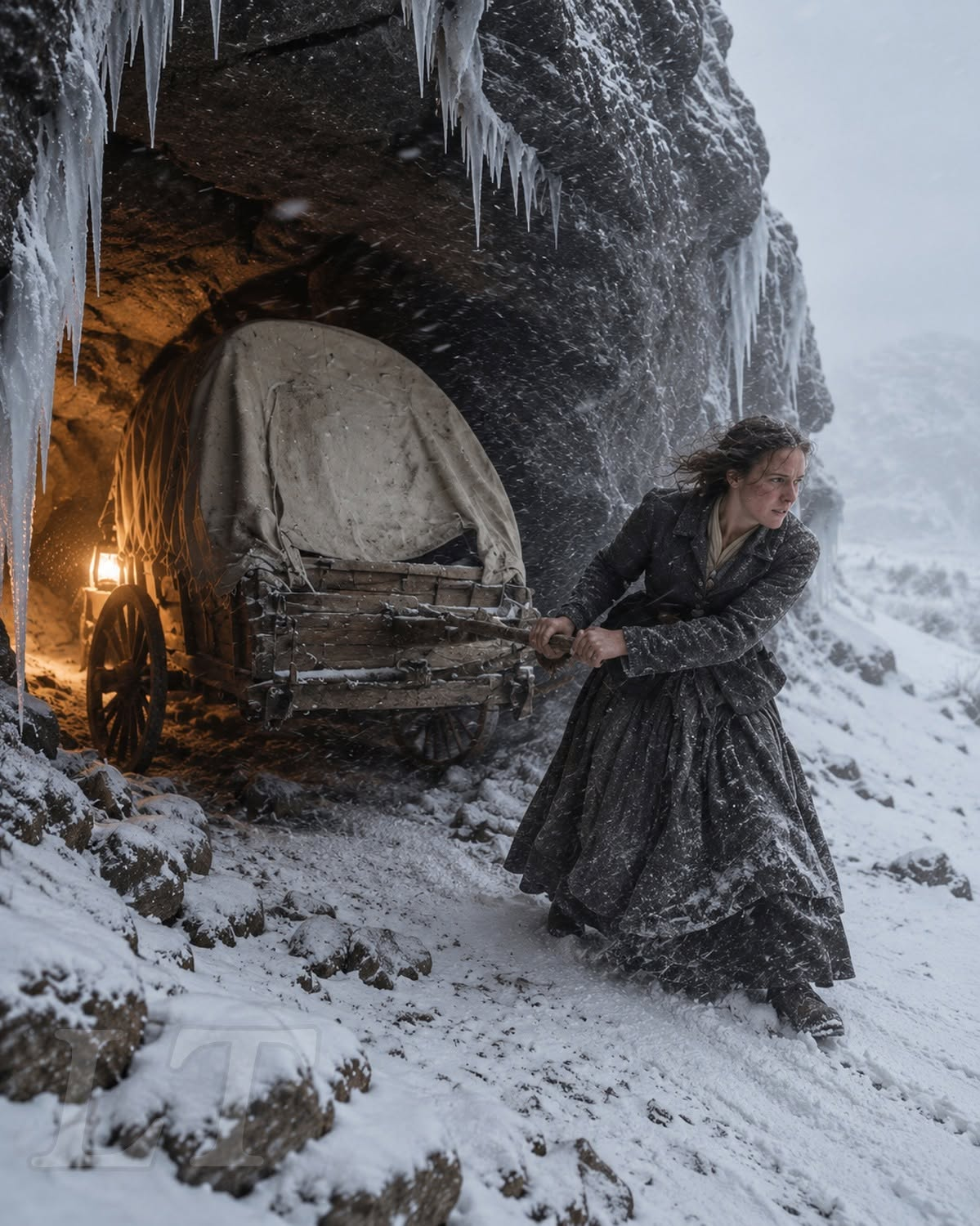
The sandstone began to fall.
Elsa threw herself toward the rear wall.
A tremendous crash shook the hollow.
The mule screamed and pulled violently against its lead rope. Dust exploded through the air, swallowing the lantern light and turning the shelter into a choking darkness.
Elsa covered her head with both arms.
Something heavy struck the ground behind her.
Then came another impact.
And another.
For several seconds, the entire rock formation seemed to tremble.
Elsa remained crouched against the sandstone, unable to see anything.
Her ears rang.
Her mouth tasted of dust.
She reached forward, searching for the wooden box containing her father's tools.
Her fingers found the edge of it.
She pulled it closer and used it to shield her face as smaller fragments of stone continued falling.
"Easy!" she shouted toward the mule. "Stay where you are!"
The animal answered with another frightened cry.
Elsa waited.
The crashing gradually stopped.
But the wind continued roaring outside.
She lifted her head.
The lantern was still burning, although its flame had become very small. Its light revealed a thick layer of dust across the floor.
Elsa blinked repeatedly.
Then she saw the damage.
A large section of the sandstone overhang had broken away.
The fallen rock lay across the outer part of the hollow, partially covering the left side of the entrance.
The wooden wagon barrier had caught some of the falling fragments.
Several boards were damaged.
One of the upper supports had shifted.
The canvas covering was hanging at an awkward angle.
Elsa stared at the destruction.
Her shelter had survived.
But barely.
She pushed herself upright and immediately felt pain in her left shoulder.
A small piece of sandstone had struck it.
She moved her arm carefully.
It hurt, but she could still use it.
She examined her coat.
The fabric had been torn near the shoulder, exposing a small patch of skin.
There was no serious bleeding.
She looked toward the mule.
The animal was standing near the rear wall.
Its lead rope had become tangled around one of the sandstone projections, but it appeared unharmed.
Elsa hurried toward it.
"You're all right."
She placed both hands against its face.
The mule was trembling.
She checked its legs, then its neck and shoulders.
No visible injuries.
Elsa released a breath she had not realized she was holding.
Then she examined the entrance.
The fallen sandstone had created a new problem.
The opening was now partly blocked by a heavy rock formation.
At first glance, that seemed fortunate.
The collapsed section had reduced the amount of space exposed to the storm.
But the debris had also damaged the wagon barrier.
A wide gap remained near the upper left corner.
Wind was forcing snow through it.
Elsa approached carefully.
She could hear the storm outside.
It sounded enormous now.
Not like ordinary wind.
Not even like the strongest winter weather she had experienced in Norway.
It was a continuous roar that seemed to consume everything beyond the rock walls.
The sky had finally turned black.
Elsa could no longer see the horizon.
She could barely distinguish the outline of the ridge.
The blizzard had arrived.
And the shelter she had spent hours constructing was already under attack.
She reached for the lantern and adjusted its wick.
The flame grew slightly.
Then she examined the fallen rocks.
One large fragment rested near the left side of the wagon bed.
It had struck the wooden barrier and broken part of the upper frame.
Another section had fallen directly in front of the entrance.
The largest piece was too heavy for her to move.
She tried pushing it with both hands.
Nothing happened.
She tried again.
The stone did not shift.
Elsa stepped backward.
She could not waste her remaining strength trying to move something that was beyond her ability.
Instead, she needed to determine whether the fallen rock could become part of the shelter.
She examined the space between the debris and the wagon bed.
A narrow opening remained.
The wind entered through it with considerable force.
Elsa crouched and placed her hand near the gap.
The cold air struck her fingers.
She withdrew her hand.
The opening had to be sealed.
She looked toward the remaining pieces of canvas.
There was barely enough material to cover the damaged section.
She would have to use the fallen rock itself as a partial barrier.
Elsa retrieved a small piece of timber and placed it against the lower edge of the broken frame.
Then she secured it with rope.
She tightened the knot around a wooden projection.
The timber did not move.
She added another piece beside it.
The arrangement was uneven, but it reduced the opening.
She reached for the remaining grass.
Most of it had been scattered by the falling debris.
She gathered what she could find and pressed it into the narrow gaps.
Then she packed loose soil around the lower edge.
The wind weakened slightly.
Elsa tested the repair.
A small draft remained.
She added a strip of the wool blanket she had previously cut apart.
The opening finally became smaller.
She sat back.
Her hands were shaking.
The fallen rock had changed the shape of the shelter completely.
The entrance was narrower now.
The wooden barrier leaned slightly toward the interior.
The central axle support remained in place, but the left side brace had been damaged.
She needed to repair it before another gust struck.
Elsa moved toward the broken support.
A length of timber had split near the middle.
The damage was severe.
She could not use it in its current condition.
She examined the remaining wagon parts.
There were only a few short pieces left.
One of the wheel spokes was still usable.
Another was cracked.
The old side rail had been cut and used as an additional brace.
The damaged axle was now supporting the central section.
She looked at the broken support again.
Then she noticed something.
The fallen sandstone fragment had created a natural ledge beneath the left side of the wagon bed.
It was not perfectly positioned, but it might help support the damaged section.
Elsa moved closer.
She placed a small wooden wedge between the stone and the wagon frame.
Then she used her hammer to drive it into place.
The wedge tightened.
She added a second piece beside it.
The wooden barrier became more stable.
She pushed against the sideboard.
It moved slightly.
She tightened the rope.
Then she pushed again.
The movement stopped.
Elsa examined the repair.
It would have to hold.
She had no more timber long enough to create another full brace.
She could not rebuild the entire structure.
All she could do was strengthen the remaining connections.
She moved to the upper canvas.
The fabric had torn along one edge.
She pulled it downward and examined the damage.
A section approximately the length of her forearm had separated from the main covering.
She could not sew it.
Instead, she folded the torn edge over itself and secured it with rope.
Then she used a small strip of cloth to reinforce the weakest section.
The repair was crude.
But it reduced the opening.
She stepped back and watched the fabric.
A gust struck.
The canvas moved violently.
The ropes tightened.
The wooden supports groaned.
But the covering remained attached.
Elsa looked toward the rear of the hollow.
The mule had lowered its head.
Its breathing was still quick, but it appeared less frightened.
She approached and adjusted the blanket across its back.
The animal shifted.
Elsa stroked its neck.
"I know. I know."
She wanted to comfort it.
But she also needed to keep moving.
The temperature inside the hollow was dropping.
The broken section of the entrance had allowed cold air to circulate through the shelter.
Elsa needed to reduce the drafts before the mule began losing too much warmth.
She returned to the barrier.
The lantern revealed several narrow openings between the fallen stone and the wagon bed.
She examined them one by one.
The first was small enough to close with grass.
The second required a piece of cloth.
The third was larger.
Elsa looked at it for several seconds.
She could not cover it with the remaining canvas without leaving another opening elsewhere.
She considered using the damaged wheel rim.
The iron ring was still outside, partly buried in snow.
It would be difficult to retrieve, and it would not seal the opening by itself.
But perhaps she could use it as a frame.
She looked toward the wagon parts.
A short length of wooden board remained beside the rear wall.
She picked it up.
Then she dragged the wheel rim toward the entrance.
The iron scraped against the stone.
Elsa positioned it across the largest gap.
The shape was awkward, but it created a boundary.
She tied the rim to the wooden frame with rope.
Then she pressed the remaining pieces of cloth and grass into the openings around it.
The arrangement looked strange.
But it reduced the amount of air entering the shelter.
Elsa tested the repair.
The draft became weaker.
She stepped back.
For the first time since the rockfall, the entrance seemed reasonably secure.
Then the wind struck again.
The entire barrier shook.
Elsa instinctively reached for the central support.
The axle vibrated.
The upper rope tightened.
A deep wooden groan echoed through the hollow.
She waited.
The structure remained standing.
Another gust arrived.
The wooden boards shook again.
But the additional braces held.
Elsa lowered her hand.
She was beginning to understand the real danger.
The blizzard would not destroy the shelter through one single impact.
It would test every connection repeatedly.
Every knot.
Every wedge.
Every wooden brace.
Every weak section of canvas.
She would have to keep inspecting the structure until the storm passed.
If she became careless, the smallest failure could become catastrophic.
Elsa moved toward the wooden box.
She opened it and examined the remaining tools.
The hammer was still usable.
The chisel had become slightly damaged along one edge.
The saw remained intact.
She placed the tools in a position where she could reach them quickly.
Then she looked at the food.
The dried meat was running low.
The hardtack supply was still sufficient for several small meals, but she could not afford to eat freely.
She counted the pieces.
Then she wrapped them in cloth.
The water container was nearly empty.
She looked toward the entrance.
Snow had accumulated near the fallen rocks.
She could collect clean snow from the sheltered edge and melt it in the Dutch oven.
But she would have to be careful.
The lantern was not a proper cooking fire.
She had no chimney.
And creating too much smoke inside the hollow could be dangerous.
She would need to use the lantern only for light and preserve the small amount of oil.
Elsa gathered a little snow from the cleanest section near the entrance.
She placed it in the Dutch oven and waited for it to melt.
The process was slow.
She added more snow.
Then she covered the pot with a piece of cloth to keep dust from falling inside.
While she waited, she checked the shelter again.
The fallen rock had created a second concern.
Part of the ceiling now appeared exposed.
The broken section had removed some of the natural protection provided by the overhang.
Snow was collecting along the outer edge.
If the wind continued driving it toward the hollow, more debris might fall.
Elsa examined the remaining ceiling.
She could not reach the damaged section.
Nor could she safely stand beneath it.
She decided that the rear section of the hollow was the safest place to remain.
She moved the blanket again.
Then she shifted the wooden box.
She placed the Dutch oven beside it.
The lantern was positioned on a low sandstone ledge.
Everything important was now away from the entrance.
She looked at the mule.
The animal stood close to the rear wall.
Its ears moved whenever the wind struck the barrier.
Elsa approached and checked the lead rope.
It was still secure.
She loosened it slightly so the mule could lower its head comfortably.
Then she rubbed its forehead.
The animal breathed against her coat.
For a brief moment, Elsa felt less alone.
She returned to the Dutch oven.
The snow had melted.
She poured the water into the container and added another small quantity.
It would not be enough for the entire night.
But it was something.
She drank a small amount.
Then she placed the container beside the blanket.
Her body was beginning to feel heavy.
She had not rested properly since the previous morning.
The journey had exhausted her.
The wagon had failed.
The storm had arrived.
And the shelter had nearly collapsed before she had even settled inside it.
She lowered herself onto the blanket.
The sandstone wall felt cold against her back.
She pulled her coat tightly around her body.
For a few minutes, she simply listened.
The blizzard roared outside.
The mule shifted.
The lantern hissed faintly.
And somewhere above the hollow, the damaged rock continued making occasional cracking noises.
Elsa closed her eyes.
She wanted to sleep.
Even a few minutes would help.
But every time she began drifting away, another gust struck the barrier.
The wooden boards vibrated.
The canvas snapped.
She opened her eyes again.
She could not afford to sleep deeply.
Not while the shelter remained vulnerable.
She reached for her father's tools.
The old wooden box was worn smooth along its edges.
Her father had carried it aboard fishing boats for decades.
It had traveled across the Atlantic with her when she came to America.
She had never imagined that the tools inside would one day become her only defense against a Wyoming blizzard.
Elsa opened the lid.
The hammer lay on top.
Beneath it were several small metal fittings.
She picked up one of them.
It was a heavy iron bracket her father had once used to repair a wooden hull.
She examined its shape.
Then she looked toward the damaged side brace.
The bracket might help secure the split timber.
Elsa rose.
She carried the bracket toward the entrance and placed it against the damaged support.
The fit was not perfect.
But it could reinforce the connection.
She positioned the bracket and used the hammer to drive the existing metal fastener through the timber.
The first strike missed slightly.
She adjusted her hand.
The second strike connected.
The metal began entering the wood.
Elsa continued.
One strike.
Then another.
The bracket tightened against the brace.
She tested the support.
It held.
She examined the next connection.
The rope had loosened slightly.
She pulled it tight.
Then she secured the knot with a smaller line.
The repair was complete.
Elsa stood and looked at the entrance.
The wooden wall was still damaged.
The canvas was torn.
The fallen sandstone had narrowed the opening.
But the structure was holding.
She moved toward the center and placed both hands against the main board.
Another gust struck.
The board vibrated beneath her palms.
Elsa waited.
The pressure increased.
The central axle support groaned.
Then the wind weakened.
The barrier remained upright.
She slowly removed her hands.
For the first time, she felt that the shelter might survive the next few hours.
But she knew the storm was not finished.
The wind had been growing stronger for nearly an hour.
The snow was accumulating faster than she could clear it.
And the damaged sandstone overhang remained unpredictable.
Elsa returned to the rear wall.
She sat beside the mule and pulled the blanket around her shoulders.
The animal lowered its head near her arm.
She rested one hand against its neck.
"Just until morning," she whispered.
Outside, the wind continued.
Then something struck the wooden barrier.
A sharp impact.
Elsa immediately raised her head.
The sound came from the left side.
She listened.
Nothing.
She waited several seconds.
Another impact followed.
This one was heavier.
The wooden boards shuddered.
Elsa stood and picked up the lantern.
She approached the entrance.
A thin line of snow had begun appearing beneath the lower edge.
She crouched and examined the opening.
The grass packing was still in place.
The wooden wedge had not moved.
But something was pushing against the barrier from outside.
Elsa raised the lantern.
Through a narrow opening between the canvas and the fallen rock, she saw a dark mass moving across the entrance.
At first, she thought it was another section of snow.
Then it moved again.
It was too large.
Too heavy.
And it was pressing directly against the wooden wall.
Elsa stepped backward.
The mule gave a frightened cry.
She looked at the central support.
It was beginning to bend.
The dark mass shifted.
A deep scraping noise filled the hollow.
Then the entire wooden barrier lurched inward.
Elsa grabbed the nearest brace.
And something enormous struck the other side of the wall.
Meet the requested chapter length precisely Strengthen the chapter’s escalating danger






Comments 0