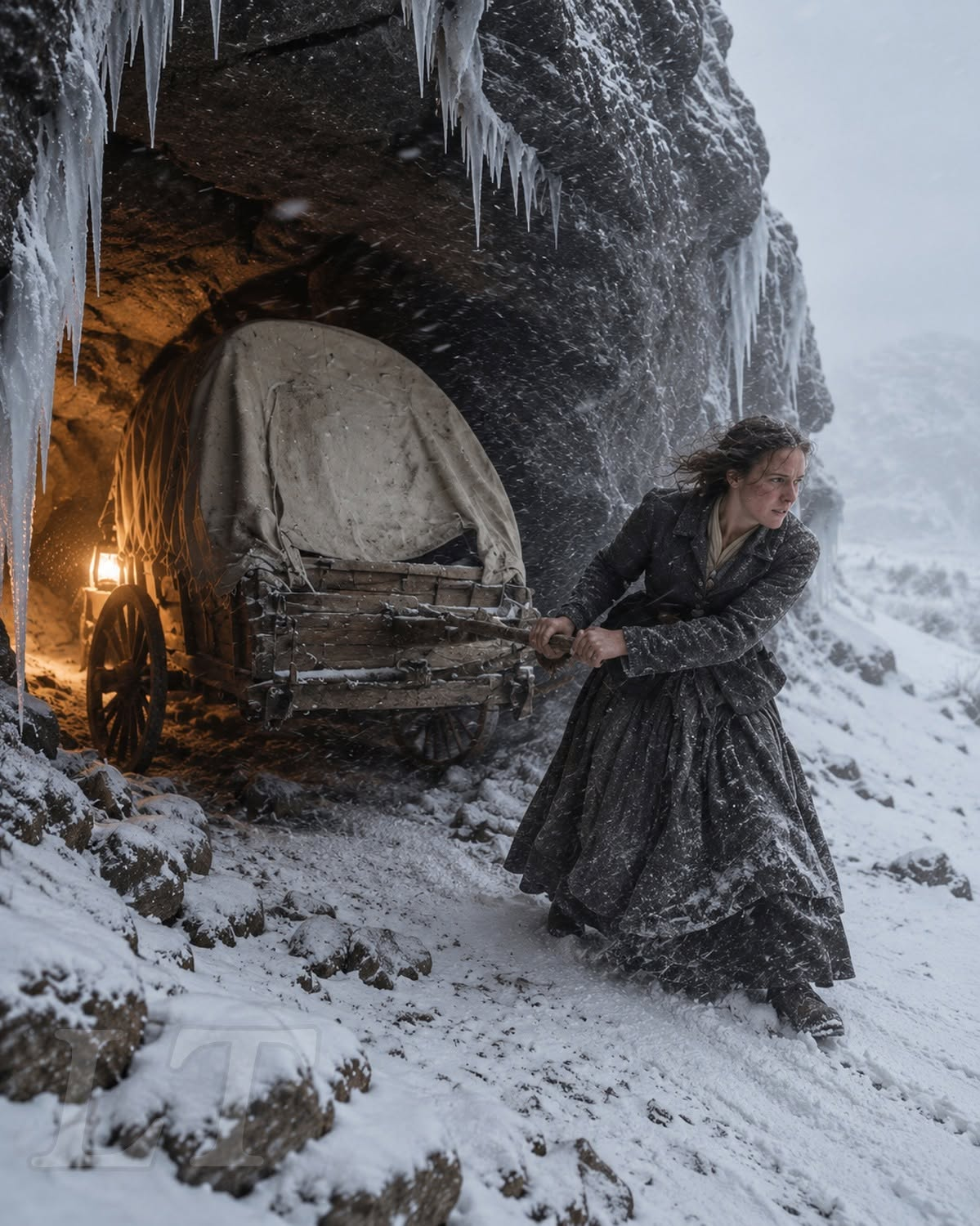
The impact threw Elsa against the sandstone wall.
She struck the rock with her shoulder and dropped to one knee.
The lantern nearly fell from her hand.
For a moment, she could not understand what had happened.
The wooden barrier had lurched inward, and the central support was bending under the pressure.
Something enormous was pressing against the other side.
Elsa grabbed the nearest wooden brace.
"Hold!"
Another impact shook the entire entrance.
The mule cried out.
Elsa turned toward the animal.
"Stay back!"
She placed the lantern on the ground and rushed toward the central support.
The timber had shifted almost two inches.
The upper rope was stretched tightly, and one of the wooden wedges had begun slipping from its position.
Elsa pushed against the barrier with both hands.
It moved again.
She could feel the storm forcing the structure inward.
Outside, the wind roared with such intensity that she could barely hear her own breathing.
She looked through the narrow opening beside the canvas.
A mass of snow and ice was moving across the entrance.
It was not a person.
It was not an animal.
The blizzard had driven a large accumulation of snow against the shelter, and the weight was pressing directly against the wooden wall.
Elsa understood the danger immediately.
The snow was not simply blowing through the opening.
It was piling up.
Every additional layer increased the pressure against the barrier.
If the snow continued accumulating, the wooden wall might eventually collapse.
She needed to prevent that from happening.
But she could not move the entire mass.
She needed to create a way for the snow to pass around the entrance rather than collect directly against it.
Elsa stepped backward and examined the structure.
The fallen sandstone had narrowed the opening on the left.
The right side remained more exposed.
The wooden barrier stood between them, reinforced by the central axle and the remaining side braces.
She looked at the damaged wheel rim.
It was still tied against the lower section.
Perhaps she could use it to reinforce the weakest area.
She reached for the rope.
Before she could secure it, another impact struck.
The barrier moved inward.
A loud cracking sound came from the central board.
Elsa froze.
The crack extended several inches along the weathered timber.
She immediately understood that the board was beginning to split.
She could not leave it unsupported.
She dropped the rope and grabbed the remaining long piece of wood.
It had been part of the wagon's side rail.
She dragged it toward the center and positioned it diagonally between the wagon bed and the sandstone floor.
Then she searched for a suitable anchor.
The rear wall contained a solid natural projection.
She wrapped the rope around it and tightened the connection.
The arrangement created an additional support behind the central board.
Elsa pushed against the timber.
It held.
She tightened the rope again.
Then another gust struck.
The barrier shook violently.
The diagonal brace absorbed some of the movement.
But the pressure remained.
Elsa stepped back and looked at the entrance.
The storm was now completely surrounding the hollow.
Snow swept across the ground in thick waves.
The sandstone ridge had disappeared behind the whiteout.
She could no longer distinguish the direction of the trail.
The world beyond the shelter had vanished.
Elsa had experienced severe winter weather before.
She remembered storms along the Norwegian coast, where snow could cover narrow roads and strong winds could make ordinary walking dangerous.
But this was different.
There was no village nearby.
No harbor.
No neighboring house.
No experienced fisherman who might discover her missing from the road.
There was only the hollow, the broken wagon, and the frightened mule.
She returned to the central support.
The rope had loosened slightly.
She tightened it.
Then she checked the lower wedges.
One had slipped.
She replaced it with a thicker piece of timber.
She struck it with the hammer until it settled firmly beneath the wagon bed.
The structure became more stable.
Elsa pushed against it.
It held.
Then she noticed that snow was beginning to enter beneath the lower edge.
The grass packing had been disturbed by the repeated impacts.
She crouched and pulled away the loose material.
Cold air rushed against her hands.
She gathered more dry grass from the remaining pile.
There was very little left.
She pressed it into the opening and packed loose soil around it.
Then she used a flat stone to secure the lower edge.
The draft weakened.
Elsa tested it with her hand.
Better.
She moved along the entire bottom section, repeating the process wherever she found an opening.
The work was becoming increasingly difficult.
Her fingers had lost much of their sensitivity.
The gloves were wet, and her wrists ached.
She had to stop several times to warm her hands beneath her arms.
Each pause made her feel as though she were wasting precious time.
But working with numb fingers was dangerous.
One mistake could leave the shelter exposed.
She finished the lower edge and stood.
The mule had moved closer.
Its ears were pointed toward the entrance.
Elsa approached it.
The animal was breathing rapidly.
Its blanket had shifted, exposing part of its back.
She adjusted the fabric and secured it again.
Then she examined the animal's hooves.
They were wet from the snow that had blown inside.
Elsa wiped them as best she could with a piece of cloth.
The mule moved its head.
"I know you're frightened," she whispered. "So am I."
She stroked its neck.
For a moment, the animal stood quietly.
Then another violent gust struck the barrier.
The mule jerked backward.
Elsa caught the lead rope.
She prevented it from tangling around the wooden support.
The animal settled after several seconds.
Elsa secured the rope again.
This time, she positioned it so the mule could move farther into the rear section without approaching the unstable entrance.
Then she returned to the wall.
A deep rumble traveled through the sandstone.
Elsa looked upward.
The damaged ceiling remained in place, but small fragments continued falling from the fractured edge.
She could not safely inspect it.
She needed to keep her attention on the entrance.
The snow was accumulating faster now.
A thick white layer had formed outside the wooden barrier.
The pressure was no longer coming only from individual gusts.
The snow itself was beginning to press against the structure.
Elsa examined the space near the fallen rock.
There was a narrow passage along the right side where the snow might be able to move past the barrier.
She needed to keep that passage open.
She picked up a broken piece of timber and used it to scrape away the snow entering through the gap.
The task was difficult because every time she cleared a section, another gust pushed more snow inside.
She worked in short bursts.
Scrape.
Push.
Clear.
Then move backward.
The passage slowly became visible.
But she could not reach the outer side.
She had no way of knowing whether the snow was building into a solid mound beyond the opening.
She could only keep the interior passage clear.
Elsa looked toward the lantern.
The flame was small.
She needed to conserve the oil.
She lowered the wick slightly.
The hollow became darker.
The shadows along the sandstone walls grew longer.
She returned to the rear section and retrieved the remaining food.
A small piece of dried meat remained.
She ate slowly.
Then she drank a little water.
Her body needed energy.
The next few hours would be difficult.
She wrapped the remaining food and placed it beside the wooden box.
Then she checked the tools.
The hammer.
The chisel.
The wrench.
The saw.
Everything was still there.
She placed the hammer beside her.
It was not a weapon.
It was simply a tool she might need to repair the shelter.
But having it within reach gave her a small sense of security.
Elsa moved toward the entrance again.
The wind was making an unusual sound.
It rose and fell in powerful waves.
Sometimes it became so loud that the entire hollow seemed to vibrate.
At other times, it weakened for several seconds.
During those brief intervals, Elsa could hear the snow hitting the rocks.
She waited for another lull.
Then she inspected the upper canvas.
The fabric was still attached, but the central rope had stretched.
She tightened it.
The canvas settled.
She checked the knots along the left side.
One had begun slipping.
She secured it with another loop.
Then she moved to the right.
The rope there was still tight.
Elsa pressed the canvas against the timber.
It did not move.
She was about to step away when she noticed something beneath the fabric.
A small stream of snow was entering through a narrow opening.
She raised the canvas slightly.
A section of the wooden frame had separated from the sandstone.
The gap was wider than it appeared from below.
Elsa examined it.
She could not reach the opening directly.
It was above shoulder height, and the fallen rock had made the surrounding ground uneven.
She looked toward the remaining wooden pieces.
There was a short board beside the axle support.
She dragged it toward the gap.
Then she placed one end against the lower frame and used the other to press the canvas upward.
The board was too short.
Elsa searched again.
She found a broken spoke.
It was long enough to extend the support.
She tied the spoke to the board with a short rope and positioned the combined piece beneath the canvas.
The arrangement held the fabric against the wooden frame.
She tightened the upper knot.
The opening became smaller.
Elsa stepped back.
The repair was not permanent.
But it would prevent the snow from pouring through.
She returned to the center of the hollow.
Her legs were trembling.
She lowered herself beside the rear wall.
The mule stood quietly nearby.
For several minutes, she listened to the storm.
The wind continued.
The wooden barrier continued vibrating.
But the structure remained upright.
Elsa looked at the lantern.
The flame was almost motionless now.
She placed one hand against the sandstone.
The rock was cold, but the air near the rear wall was relatively still.
That mattered.
Her father had always emphasized the importance of blocking moving air.
Still air would not make the shelter warm by itself.
But it would give her a chance to preserve whatever warmth remained.
Elsa pulled the blanket around her shoulders.
She leaned against the rock and closed her eyes.
She did not intend to sleep.
Only to rest.
A few minutes passed.
Then she heard something different.
A low, rhythmic sound.
At first, she thought it was another gust.
But the noise continued even when the wind weakened.
Thump.
Scrape.
Thump.
Scrape.
Elsa opened her eyes.
She looked toward the entrance.
The sound came from outside the wooden barrier.
Something was moving against it.
She rose carefully and approached the wall.
The sound became clearer.
Snow was sliding across the outer surface.
A large accumulation had begun shifting.
Elsa listened.
The snow moved in heavy waves.
Sometimes it struck the wooden boards.
Sometimes it scraped against the fallen sandstone.
She looked through the narrow gap near the right side.
A thick mound of snow had formed outside.
It reached almost halfway up the wagon bed.
Elsa's stomach tightened.
If the snow continued piling up, it could bury the entrance.
The shelter might remain protected from the wind, but she could become trapped inside.
She needed to keep some part of the opening clear.
But going outside was becoming increasingly dangerous.
The visibility was almost zero.
The wind could knock her down before she had taken three steps.
She looked at the mule.
The animal was standing near the rear wall.
Elsa considered leaving it inside while she cleared the snow.
But if something happened outside, she might not be able to return.
She could not risk separating from the animal.
Instead, she examined the opening from inside.
A small section near the right side remained accessible.
If she used the broken board to push the loose snow outward, she might prevent it from accumulating directly against the entrance.
She retrieved the board.
Then she positioned herself beside the opening.
The first push moved some snow.
The second moved more.
She continued.
The effort was exhausting.
Her arms began aching.
But the passage became slightly wider.
She pushed again.
A heavy mass of snow shifted outside and slid down the side of the fallen rock.
Elsa stepped backward.
For a moment, she thought the problem had been solved.
Then the snow above the entrance began moving.
She heard a deep rushing sound.
It grew louder.
Elsa dropped the board.
She grabbed the mule's lead rope and pulled it toward the rear wall.
"Back! Move back!"
The animal resisted for a moment.
Then it stepped away from the entrance.
Elsa followed.
A massive wave of snow slid down from the ridge and struck the outer barrier.
The impact shook the entire hollow.
The lantern went out.
Darkness swallowed the shelter.
Elsa fell to the ground.
The mule cried out.
A heavy scraping sound continued beyond the wooden wall.
Then silence.
Not complete silence.
The wind was still roaring.
But the movement of the snow had stopped.
Elsa remained on the ground for several seconds.
She could not see anything.
She reached forward and found the sandstone wall.
Then she felt along the ground until her fingers touched the hammer.
She pulled it closer.
The mule was breathing rapidly.
Elsa called to it.
"Stay there. I'm coming."
She crawled toward the animal and found its neck.
It was trembling, but still standing.
She stroked its face.
Then she returned toward the lantern.
Her hands moved across the floor until she found the metal body.
She checked the wick.
The flame had gone out, but the lantern was intact.
Elsa searched for the matches.
They were inside a small cloth pouch in the wooden box.
She opened it.
Her fingers were clumsy.
She struck the first match.
It broke.
She tried another.
A small flame appeared.
Elsa used it to relight the lantern.
The warm light slowly returned.
She looked toward the entrance.
The wooden barrier was still standing.
But the opening was almost completely covered by snow.
Only a narrow section near the upper right corner remained visible.
Elsa approached carefully.
She pressed her hand against the central board.
The timber was vibrating.
She examined the supports.
The diagonal brace had shifted.
The central axle remained in place.
The left side was buried beneath the accumulated snow.
She looked through the narrow opening.
The world outside had disappeared.
There was only white.
She could no longer see the fallen rock, the ridge, or the trail.
The snow had formed a thick wall against the entrance.
Elsa stepped backward.
The shelter had survived the first major attack.
But the storm had changed the situation completely.
She was now trapped behind a wooden barrier with a growing mass of snow pressing against it.
And the next gust might be stronger than the last.
She moved toward the central support and began tightening the rope.
The knot resisted.
She pulled harder.
Then she heard a sudden cracking sound from the buried left side.
Elsa stopped.
Another crack followed.
The sound was coming from beneath the snow.
She turned toward the barrier.
The wooden boards began moving inward.
One inch.
Then another.
Elsa reached for the hammer.
But before she could strike the support, the entire left side of the wagon wall gave a violent jerk.
And a long section of timber began separating from the frame.






Comments 0