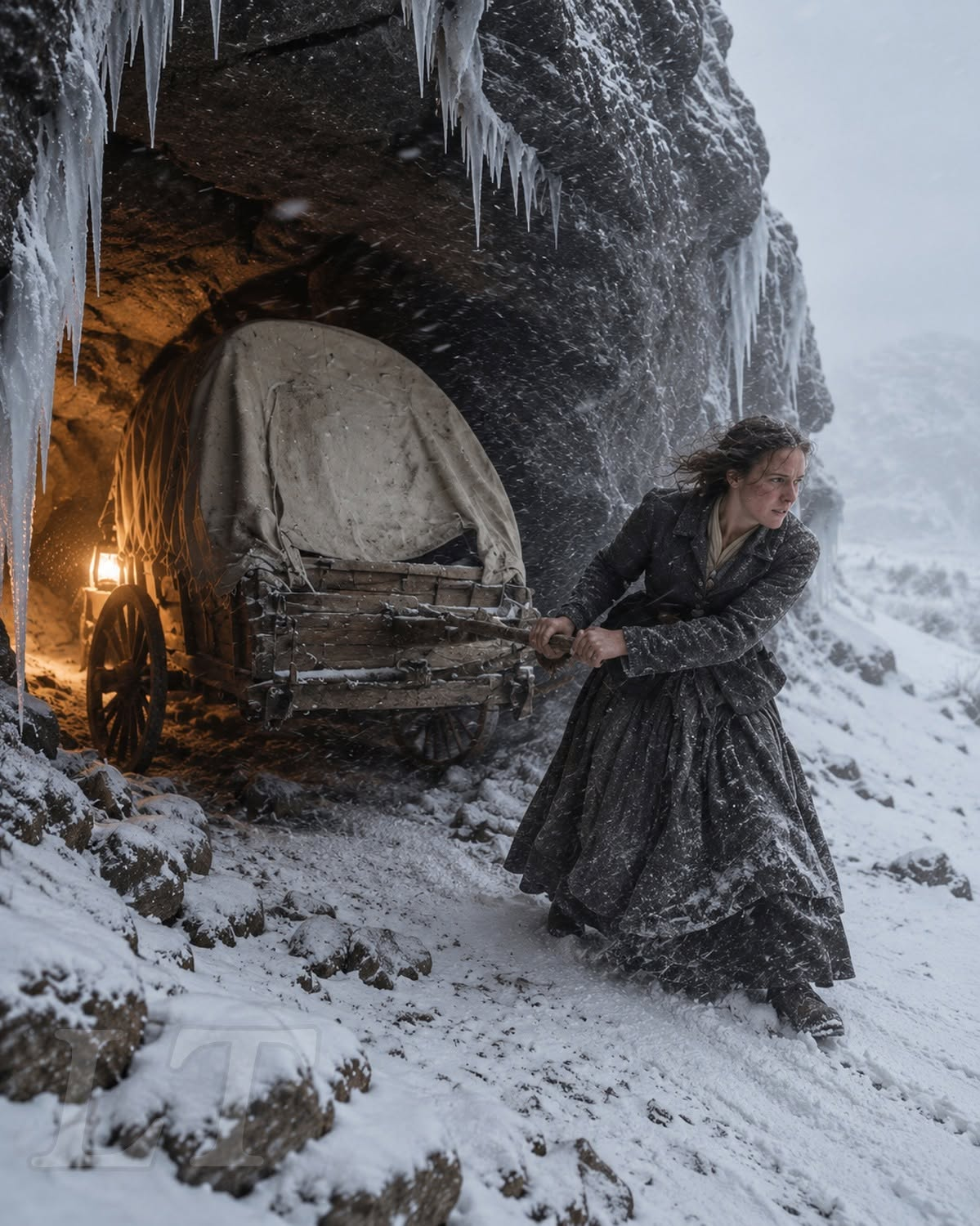
Elsa Doll pulled the hemp rope with both hands and shouted:
"Come on! Just a little farther!"
Behind her, the broken wagon's wooden bed scraped across the frozen ground.
One of its sideboards carried a long crack.
The wagon was no longer going to carry her to safety.
It would have to become her safety.
Elsa stopped pulling.
Her lungs burned.
Her shoulders throbbed beneath her heavy winter coat, and her fingers felt as though someone had driven small needles through them. She bent forward, resting both hands against her knees, trying to recover enough strength to take another step.
The wagon had moved perhaps six inches.
Six miserable inches.
She looked toward the sandstone ridge.
The natural hollow was still several dozen feet away.
Behind her, the wilderness stretched into an endless white landscape. There were no houses, no trees large enough to provide shelter, and no distant smoke rising from a chimney.
There was nowhere to run.
Elsa slowly straightened.
She turned toward the northwest.
The sky had changed.
Only an hour earlier, the horizon had been pale gray. Now, enormous dark clouds stretched across the distant plains, their lower edges almost black.
A strange yellowish light had settled over the snow.
Elsa recognized it.
She had seen skies like this before, long ago, when she was a child in Norway.
It was the kind of sky that made experienced travelers stop whatever they were doing and find shelter.
But Elsa had no shelter.
Not yet.
She looked down at the rope cutting across her shoulder.
Then she looked at the wagon.
For six exhausting days, that damaged vehicle had been both her transportation and her home. She had slept beneath its torn canvas, cooked beside its wooden wheels, and protected her few possessions inside its battered bed.
Now she was preparing to destroy what remained of it.
The decision had not come easily.
But the storm was coming.
And Elsa had learned that desperation was sometimes the only thing capable of revealing a solution.
Six days earlier, she had left a failed trading post outside Billings, Montana.
She had departed with almost nothing.
Two wool blankets.
A small quantity of dried meat.
Hardtack wrapped in cloth.
A cast-iron Dutch oven.
A coil of hemp rope.
And a wooden box containing the tools her father had left her.
Everything else had disappeared beneath the weight of her husband's debts.
The possessions she and her husband had spent years acquiring had been sold, surrendered, or taken by creditors.
The home she had once believed would provide security was gone.
The trading business had failed.
And Elsa had reached a point where remaining in Montana meant watching the last of her independence disappear.
She had one possible destination.
Her brother Henrik's homestead near Buffalo, Wyoming.
He had established a small property there, and Elsa hoped he might allow her to stay until she could rebuild her life.
The journey was approximately sixty miles from where she now stood.
Sixty miles.
Under ordinary conditions, she might have covered that distance in several days.
But ordinary conditions had vanished.
Her wagon had become increasingly unreliable.
The front axle was cracked, one rear wheel wobbled dangerously, and the canvas covering had been torn apart by earlier winds.
She had repaired what she could.
She had tightened the wheel fittings, reinforced the damaged boards, and used rope to secure the canvas.
Yet the wagon had continued deteriorating.
Elsa had known that something would eventually fail.
She had simply hoped it would happen after she reached Henrik's property.
Instead, the wilderness had chosen that afternoon.
The mule raised its head.
Elsa turned.
The animal stood several yards away, its brown coat dusted with snow. Its breath formed pale clouds in the freezing air.
It had stopped eating.
Its ears pointed toward the northwest.
"What's wrong, old friend?" Elsa whispered.
The mule shifted its front hooves.
It had been restless for several minutes.
Elsa followed its gaze.
The clouds were moving closer.
But something else bothered her.
The wind had stopped.
Not weakened.
Not gradually disappeared.
Stopped.
The silence was so complete that Elsa could hear the faint movement of the leather harness against the mule's neck.
She looked at the surrounding grass.
The frozen stalks stood motionless.
A loose piece of canvas hanging from the wagon did not move.
Even the snow seemed suspended in the air.
Elsa felt a tightening sensation in her chest.
She remembered her father's voice.
Kristian Dahl had been a Norwegian shipwright. He had spent most of his life working with timber, rope, and the unforgiving forces of the sea.
He had understood weather in a way Elsa had never forgotten.
When she was nine years old, he had taken her outside during a winter storm and shown her how fishermen protected themselves against the wind.
They had no comfortable houses.
Sometimes they had no fires.
They survived by finding natural protection and sealing every opening through which the cold could enter.
He had pointed toward a rocky cliff and explained that the stone could protect them from the worst of the wind.
But only if they understood how the wind moved.
"Elsa," he had told her, "the cold is dangerous, but the wind is what steals your warmth. Stop the wind, and you give yourself a chance."
She had listened carefully.
Her father had never been a man who wasted words.
He had taught her how to recognize weak timber, how to distribute weight across a wooden frame, and how to use rope to move objects that seemed too heavy to lift.
He had also taught her something about survival.
"Three walls are a beginning," he had said. "But the wind will search for every opening. You must close the gaps."
At the time, Elsa had considered those lessons ordinary.
Now, standing alone in the Wyoming wilderness, she realized they might be the only inheritance that could save her.
She turned toward the sandstone bluffs rising along the western side of the ridge.
The rocks formed a broken line against the pale sky.
She remembered noticing them earlier that afternoon.
At the time, they had seemed like nothing more than another obstacle along the trail.
Now they looked different.
Elsa tied the mule's lead rope to the wagon and walked toward the ridge.
She moved quickly, but carefully.
The frozen ground was uneven, and her boots slipped against patches of ice hidden beneath the snow.
She examined the first rock formation.
It contained a shallow depression, barely deep enough to protect a person from the wind.
She rejected it.
The second hollow was even smaller.
Its entrance was narrow, and its ceiling was too low.
She continued.
Her breathing became heavier as she climbed over a collection of snow-covered rocks.
Then she saw something that made her stop.
The third hollow was different.
It was carved naturally into the sandstone, forming a broad curved opening beneath a massive overhanging ledge.
Elsa stood at its entrance.
She slowly examined the structure.
The hollow was approximately eighteen feet across and six feet deep.
Solid sandstone surrounded three sides.
The overhang provided a natural roof.
She stepped inside.
The air felt different.
The opening faced east, away from the approaching northwestern storm.
The rock walls blocked the wind from three directions.
Elsa raised her hand.
For the first time that afternoon, she felt no direct movement of air against her fingers.
She turned toward the entrance.
It was wide.
Too wide to provide protection by itself.
But the surrounding stone was strong.
She walked to the back wall and examined the ceiling.
There were no obvious openings large enough to expose her to the full force of the storm.
The ground was uneven, but mostly sheltered.
She crouched and pressed her palm against the sandstone.
Cold.
Hard.
Solid.
For several seconds, she did not move.
Then an idea entered her mind.
It was so simple that she almost dismissed it.
Her wagon.
Elsa slowly turned her head toward the ridge.
The broken wagon stood in the open, its torn canvas hanging loosely from the wooden frame.
She pictured its heavy bed.
The sideboards.
The thick wooden front panel.
The structure was already damaged, but much of the timber remained usable.
If she could remove the wheels and running gear, the wagon bed would become a large wooden barrier.
She could drag it across the hollow's entrance.
The sandstone would provide three walls and a roof.
The wagon could provide the fourth.
It would not be a comfortable shelter.
It would not be perfect.
But it might block enough wind to keep her and the mule alive.
Elsa stood slowly.
She looked at the sky again.
The dark clouds had advanced considerably.
Snow was beginning to move across the distant ground in thin white streams.
She had less time than she thought.
The shelter needed to be built before the blizzard arrived.
She returned to the wagon.
The mule watched her approach.
Elsa stroked its neck.
"We're going to make it," she whispered.
She did not know whether she believed the words.
But she needed to hear them.
She untied the harness and led the animal toward the sandstone hollow.
The mule resisted.
Its hooves scraped against the frozen ground, and its head turned repeatedly toward the wagon.
Elsa gently pulled the lead rope.
"Come on. Just a little farther."
Eventually, the animal followed.
She tied it beside the entrance, where the rock formation provided some protection.
Then she returned to the wagon.
The wooden box containing her father's tools sat beneath the remaining canvas.
Elsa lifted it carefully and placed it on the ground.
She opened the lid.
Inside were several old tools, their handles darkened by years of use.
A hammer.
A small saw.
A heavy iron wrench.
A wooden-handled chisel.
And a collection of smaller metal implements her father had used when repairing ships.
Elsa touched the hammer.
For a moment, she remembered watching her father work beside the Norwegian harbor.
He had been patient.
He had never struck a piece of timber without first understanding where the force needed to go.
She swallowed.
"I could use your help now," she whispered.
A gust of cold air brushed across her face.
The silence was ending.
Elsa looked toward the wagon.
There was no more time for hesitation.
She needed to dismantle it.
She examined the front axle.
The crack had widened during the journey. The wood was no longer reliable enough to support the wagon's weight.
The rear wheel was worse.
Its wobbling had become dangerous, and the metal fittings were beginning to loosen.
She could no longer depend on the vehicle to carry her to Wyoming.
But its wooden bed remained strong enough to serve another purpose.
Elsa picked up the wrench.
She placed it against the first metal fitting and began working.
The bolt resisted.
She adjusted the tool.
Tried again.
Nothing.
She wiped her forehead with the back of her sleeve, then examined the fitting more carefully.
Her father had once shown her how to loosen stubborn metal fasteners by changing the angle of pressure rather than forcing them straight.
She repositioned the wrench.
This time, the bolt moved.
A small sound escaped her.
Not quite a laugh.
Not quite a sigh.
But something close to hope.
She continued working.
One fitting.
Then another.
The wagon's damaged structure began to come apart.
The wheels would have to be removed.
The axle would have to be detached.
The wooden bed would need to be lowered onto the frozen ground.
Only then could she begin the difficult work of moving it.
Elsa paused and looked at the clouds.
They were no longer distant.
The dark wall now stretched across much of the horizon.
The mule stamped its hoof.
A thin line of snow swept across the ridge.
Elsa returned to the wrench.
Her hands were beginning to stiffen.
Her body was exhausted.
But she had discovered something more valuable than a road, a house, or a replacement wagon.
She had discovered a chance.
And she was determined to use it.
She loosened the next fitting.
Then another.
The first wheel finally shifted away from the wooden frame.
Elsa looked toward the sandstone hollow.
The shelter was waiting.
The storm was coming.
And her father's old tools were about to determine whether his daughter would survive the night.
She reached for the final metal fastening.
It refused to move.
Then the first snowflakes began falling sideways.






Comments 0