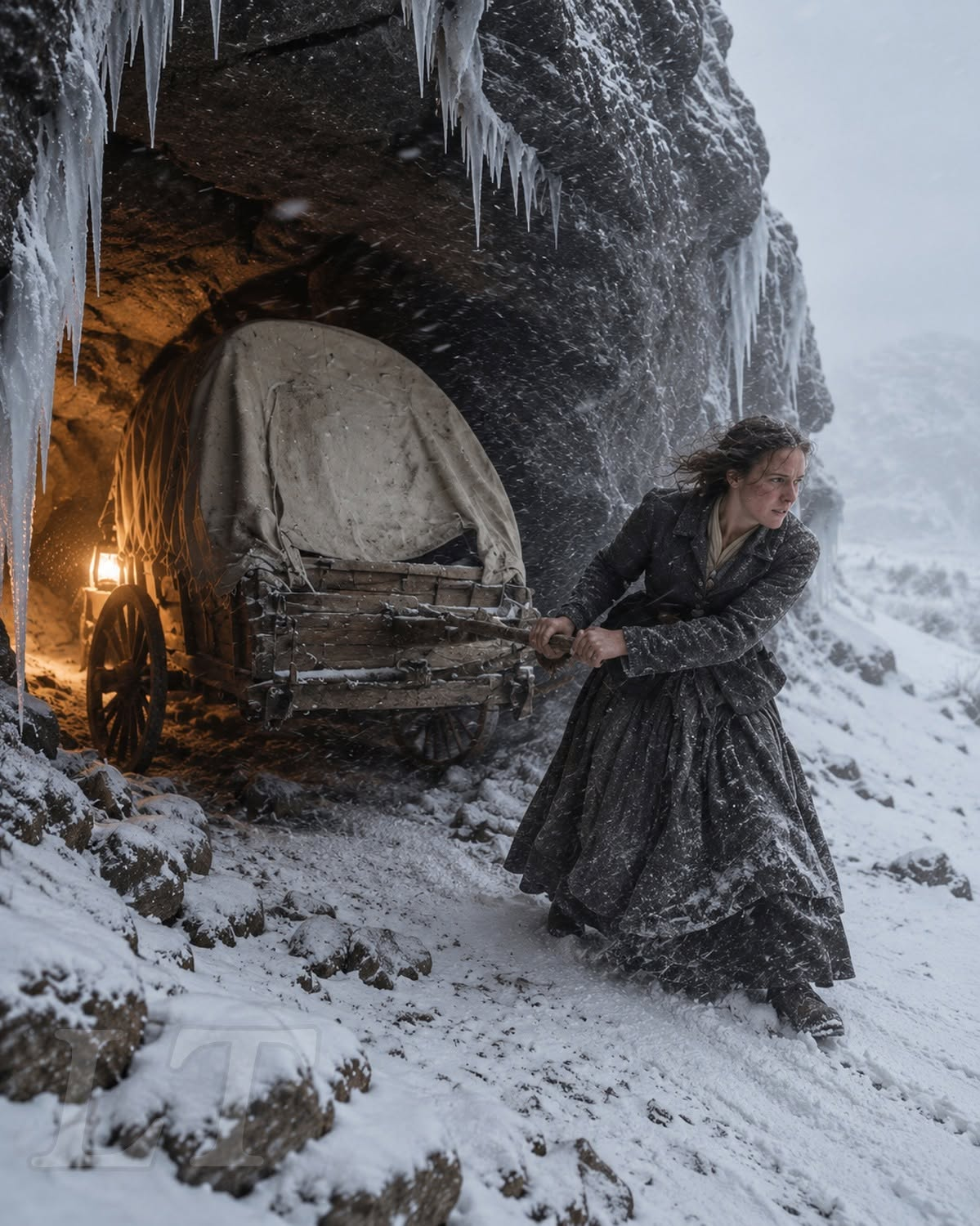
The canvas lifted again.
Elsa lunged forward and caught its edge just before the wind dragged it across the frozen ground.
"Not now," she muttered. "You are not taking this from me."
She pulled the heavy fabric against the wooden wagon bed and held it there with both hands. A gust struck the sandstone hollow, sending loose snow swirling through the entrance. The canvas snapped against her gloves, and a sharp corner whipped across her cheek.
Elsa barely noticed.
She needed to secure the material before another gust arrived.
The wooden wagon bed stood across the center of the hollow, blocking much of the entrance. Its weathered sideboards looked solid enough, but the structure had never been designed to withstand the force of a mountain blizzard. The gaps between the boards were uneven, and the upper opening remained dangerously exposed.
The sandstone overhang provided a natural roof, but it could not protect her from wind entering through the unfinished entrance.
Elsa looked at the canvas.
Then at the rope.
She had enough material to cover the upper gap, but she needed something to hold it in place.
She could not simply tie the fabric to the wooden boards. The wind would pull against it, gradually loosening the knots until the entire covering tore away.
She needed to distribute the pressure.
Her father had explained this principle many times when she was growing up.
A sail was not secured by one rope.
A ship's rigging depended on several connections working together. If one failed, the remaining lines carried the load.
Elsa looked toward the wagon's remaining wooden supports.
Several narrow pieces of timber lay beside the entrance. They had been removed during the dismantling process.
She hurried toward them.
The first piece was approximately four feet long. It had once supported part of the wagon's upper frame.
She lifted it and examined the ends.
The wood was weathered, but still usable.
She found another piece and carried both toward the canvas.
The first support would hold the fabric against the sandstone overhang.
The second would secure the lower edge.
Elsa placed the canvas across the opening.
She stretched it as tightly as possible, then positioned the first timber along its upper edge.
The arrangement was awkward.
She had no proper nails long enough to fasten the support directly into the sandstone.
Instead, she would need to use rope and the natural shape of the rock.
She examined the overhang.
A narrow projection extended along its underside.
It was not large, but it provided enough surface to anchor a rope.
Elsa threaded the hemp line around the timber, passed it over the stone projection, and brought it back toward the wagon bed.
She pulled until the fabric tightened.
Then she tied the rope around a thick wooden crosspiece.
The canvas stopped moving.
For a moment, Elsa thought she had solved the problem.
Then another gust struck.
The entire covering bowed inward.
The timber shifted.
A knot began sliding along the wet rope.
Elsa grabbed the support before it fell.
She pressed her shoulder against the wood and forced it back into position.
The wind screamed outside.
The canvas stretched so tightly that she could hear the fibers straining.
Elsa's eyes moved rapidly between the rope, the timber, and the rock.
The arrangement was not strong enough.
She needed another anchor point.
She released one hand and reached for the smaller rope coil hanging from her belt.
Her fingers struggled to work the knot.
The leather gloves were wet, and the cold had made them stiff.
She pulled one glove off with her teeth.
The exposed skin immediately began burning in the freezing air.
She ignored it.
She passed the smaller rope around a protruding section of sandstone and tied it to the lower support.
Then she repeated the process on the opposite side.
The canvas became tighter.
The wooden supports settled into place.
The next gust struck.
The fabric moved, but it held.
Elsa slowly released her shoulder from the timber.
She stepped backward and examined the covering.
It was not beautiful.
It was not particularly strong.
But it had survived the first serious test.
She reached for her glove and pulled it back onto her hand.
Then she turned toward the ground beneath the wagon bed.
A narrow opening remained between the wooden structure and the frozen earth.
It was almost impossible to see from a distance.
But Elsa knew that the wind would find it.
Her father had been right.
The smallest opening could become the greatest danger.
She crouched and pushed her hand beneath the lowest board.
Cold air brushed against her fingers.
She withdrew her hand.
The draft was stronger than she expected.
Snow had already begun collecting inside the hollow.
She needed to close the opening.
Elsa looked around for suitable material.
The broken wagon had left behind several pieces of canvas, but they were too valuable to waste beneath the structure.
She needed something that could be packed tightly into the ground.
Her eyes settled on a patch of dry grass growing between two rocks near the entrance.
Most of the surrounding vegetation was frozen, but several clumps remained upright.
She hurried outside.
The wind caught her coat immediately.
She bent low and pulled at the grass with both hands.
The roots resisted.
She used her father's small chisel to loosen the frozen soil.
A clump finally came free.
Elsa gathered it against her coat.
Then she returned to the hollow.
She placed the grass along the bottom edge of the wagon bed and pushed it into the opening.
The dry stems compressed beneath her hands.
She added another handful.
Then another.
She pressed the material firmly into place, making sure it filled the spaces between the uneven ground and the wooden boards.
The process was slow.
Her fingers were already stiff, and the grass scratched against her skin.
But gradually, the draft weakened.
Elsa reached for the loose soil she had collected earlier.
She poured it along the outer edge of the grass and pressed it down with the flat side of her hand.
The combination created a crude seal.
She tested it again.
The wind was no longer entering with the same force.
She felt a small surge of satisfaction.
Then she noticed another problem.
The right side of the wagon bed was not resting evenly against the ground.
One corner stood higher than the other.
A narrow gap extended between the wooden sideboard and the sandstone wall.
Elsa crawled toward it.
The opening was large enough for snow to blow through.
She pressed a piece of torn cloth into the space.
It disappeared almost immediately.
The gap was deeper than she had realized.
She needed something more substantial.
Elsa looked toward the wagon's dismantled wheels.
They remained outside the hollow, lying against the snow.
One of them was badly damaged, but its wooden rim was still intact.
She considered it for several seconds.
The wheel could be broken apart and used for firewood later.
But she needed its wood now.
She stepped outside and dragged the damaged wheel toward the shelter.
It was heavier than she expected.
The iron rim scraped against the frozen ground.
She pulled it inside and positioned it beneath the right side of the wagon bed.
Then she used her hammer to separate several wooden sections.
The spokes came loose one at a time.
She examined their lengths.
Most were too short to fill the entire gap, but they could be arranged together.
She placed two spokes horizontally between the wagon and the rock wall.
Then she inserted another piece vertically.
The arrangement created a crude brace.
Elsa pushed against the wagon bed.
It moved slightly.
She added another spoke.
Then she tightened the rope around the wooden pieces, securing them against the sandstone.
She pushed again.
This time, the barrier remained in place.
Elsa released a breath.
The damaged wagon had given her another useful component.
Its wheels had once carried her through the wilderness.
Now their broken spokes were helping keep the shelter standing.
She looked toward the remaining wheel.
There were several usable pieces of timber left.
She would keep them.
She might need them before morning.
A sudden movement caught her attention.
The mule had stepped closer to the rear wall of the hollow.
Its ears were raised, and its head turned toward the entrance.
Elsa approached.
"What is it?"
The animal shifted nervously.
She placed a hand against its neck.
Its coat felt cold and damp beneath her glove.
The mule had been standing for too long, and the stress of the approaching storm was making it restless.
Elsa checked the lead rope.
It was secured to a solid sandstone projection, away from the wagon barrier.
She did not want the animal tied directly to the wooden structure.
If the wall shifted, the mule could be injured.
She loosened the rope slightly and allowed it more room to move.
Then she examined the ground beneath its hooves.
Snow had blown into the hollow.
The surface was uneven, and several stones protruded from the frozen earth.
Elsa moved a few of the larger rocks aside.
She gathered some dry grass and spread it across a small section of the floor.
It would not provide much warmth, but it would help keep the mule from standing directly on the cold stone.
The animal lowered its head.
Elsa stroked its muzzle.
"Just a little longer."
She wished she could explain that she was doing everything possible.
Instead, she returned to the entrance.
The lantern flickered beside the sandstone wall.
Its warm light illuminated the rough wooden boards, the stretched canvas, and the scattered tools.
Elsa examined the shelter from the inside.
The arrangement was beginning to make sense.
The rock formation provided the natural structure.
The wagon bed blocked the central entrance.
The canvas covered the upper gap.
Grass and soil filled the lower openings.
The broken wheel spokes reinforced the side.
It was an improvised construction, but every piece served a purpose.
She had not wasted anything.
That realization gave her a small measure of confidence.
She retrieved her father's wooden box and placed it against the rear wall.
Then she removed the cast-iron Dutch oven from the wagon supplies.
The heavy pot had been wrapped in cloth to protect it during the journey.
Elsa unwrapped it and placed it beside the lantern.
She examined her remaining food.
A small quantity of dried meat.
Several pieces of hardtack.
Not enough for a long winter.
But perhaps enough to survive a night.
She counted the portions carefully.
Then she wrapped everything again and placed it inside the wooden box.
She would not eat until she was certain the shelter could withstand the storm.
The wind struck the canvas.
Elsa looked up.
The covering moved slightly.
The ropes remained tight.
She approached the entrance and pressed her palm against the wagon bed.
The wooden boards vibrated faintly.
But they held.
She leaned closer and listened.
The wind was making a deep, continuous sound beyond the barrier.
It reminded her of the ocean during the worst winter storms.
She remembered the small fishing village where she had grown up.
The narrow harbor.
The wooden boats.
The smell of tar and salt.
Her father working late beneath a lantern.
She remembered how he would inspect every rope before a storm arrived.
Sometimes she had complained that he checked the same knots repeatedly.
He would simply smile and tell her that the sea did not care how tired a person was.
"Wood remembers every weakness," he had once said. "And the wind knows where to look."
Elsa stared at the wagon bed.
The old words returned with uncomfortable clarity.
She moved toward the left side and inspected the brace.
The rope was tight.
The wooden spokes remained secure.
She pressed against the upper support.
It did not move.
Then she checked the opposite side.
The canvas was still stretched.
The lower grass packing had not shifted.
She returned to the center.
For the first time since discovering the hollow, she allowed herself to sit.
Her back rested against the sandstone wall.
Her legs trembled from exhaustion.
She removed her gloves and examined her palms.
The skin was red and irritated.
A shallow cut crossed one hand.
She wrapped it with a strip of cloth.
The lantern light flickered across her fingers.
Outside, the storm continued gathering strength.
Elsa listened to the wind.
It was no longer the distant sound she had heard earlier.
It was a constant roar.
The air beyond the shelter was filled with moving snow.
She could hear it striking the sandstone.
She could hear small pieces of ice hitting the wooden barrier.
And occasionally, she heard something heavy moving across the ridge.
She tried not to imagine what it might be.
The mule shifted behind her.
Elsa turned.
The animal had lowered its head, but its ears remained alert.
She rose and checked the water container.
There was enough water for the moment, but she would need to melt additional snow if the storm continued for several hours.
The Dutch oven could be used for that purpose.
She placed a small quantity of clean snow inside it and set it near the sheltered side of the lantern.
Then she returned to the entrance.
A thin line of snow was beginning to appear beneath the wagon bed.
Elsa crouched.
She pressed her hand against the lower packing.
The grass had shifted.
Not much.
But enough to create a narrow opening.
She added another handful and packed more soil against it.
Then she placed a small flat stone along the outside edge.
The opening disappeared.
She tested it.
A faint draft remained.
Elsa adjusted the stone.
Better.
She moved along the entire bottom edge, checking each section.
The process was repetitive and exhausting.
Yet she knew that every minute spent inspecting the shelter now might save hours of danger later.
She reached the far corner.
There, the wooden bed met the sandstone wall.
A narrow triangular opening remained.
She pressed a piece of canvas into it.
The fabric held.
She packed dry grass around it.
Then she secured the material with a small wooden wedge.
She pushed the wedge into place with her hammer.
The gap finally closed.
Elsa leaned back.
Her breathing was uneven.
She had almost finished.
Only the final inspection remained.
She stood in the center of the hollow and looked toward the entrance.
The wagon bed formed a rough wooden wall.
The canvas stretched across its upper section.
The rope connections were tight.
The broken wheel spokes reinforced the sides.
The dry grass and soil sealed the lower openings.
She had turned a ruined wagon into something that might protect two living creatures from the worst of the storm.
For a moment, she felt proud.
Then the wind changed.
The sound outside deepened.
It was no longer a simple roar.
It was a heavy, rising pressure that seemed to press against the entire rock formation.
The lantern flame leaned sharply toward the rear wall.
Elsa frowned.
She looked toward the entrance.
The canvas moved inward.
Then outward.
The wooden barrier gave a low groan.
She walked toward it and placed her hand against the central board.
The vibration was stronger now.
She examined the upper support.
One rope had become slightly loose.
Elsa reached for it and pulled.
The knot tightened.
The canvas settled.
But the wooden structure continued vibrating.
She listened carefully.
Another gust swept over the ridge.
This one struck harder.
A small shower of sandstone dust fell from the ceiling.
Elsa looked upward.
The rock remained solid.
But she knew the storm was only beginning.
She returned to the wooden wall.
The barrier had to hold.
There was no alternative.
She pressed her shoulder against the center board and listened to the wind.
For several seconds, nothing changed.
Then came a sound she had not heard before.
A deep wooden creak.
It came from somewhere beneath the left side of the wagon bed.
Elsa straightened.
She moved toward the sound.
The left support appeared normal.
The rope remained tight.
The wooden spokes were still in position.
She crouched and examined the bottom edge.
At first, she saw nothing.
Then the lantern flickered again.
A thin line appeared beneath the wooden frame.
It was moving.
Elsa leaned closer.
The frozen ground beneath the barrier was beginning to crumble.
The weight of the wagon bed was pressing against a section of loose earth.
She reached for a flat stone and tried to push it beneath the structure.
Before she could position it, another gust struck.
The wagon bed shifted.
Only slightly.
But the movement was unmistakable.
Elsa froze.
The wooden barrier was no longer resting securely against the ground.
Something beneath it had begun to give way.
She grabbed the nearest support.
The mule suddenly raised its head.
A loud cracking sound echoed through the hollow.
Elsa turned toward the left corner.
The wooden brace began sliding out of position.
Then, from beneath the wagon bed, came a second crack.
Much louder than the first.
Elsa reached for the hammer.
But before she could move, the entire left side of the wooden barrier lurched inward.
And a massive shadow appeared through the widening gap.
Reach the requested word count Reduce repeated survival beats






Comments 0