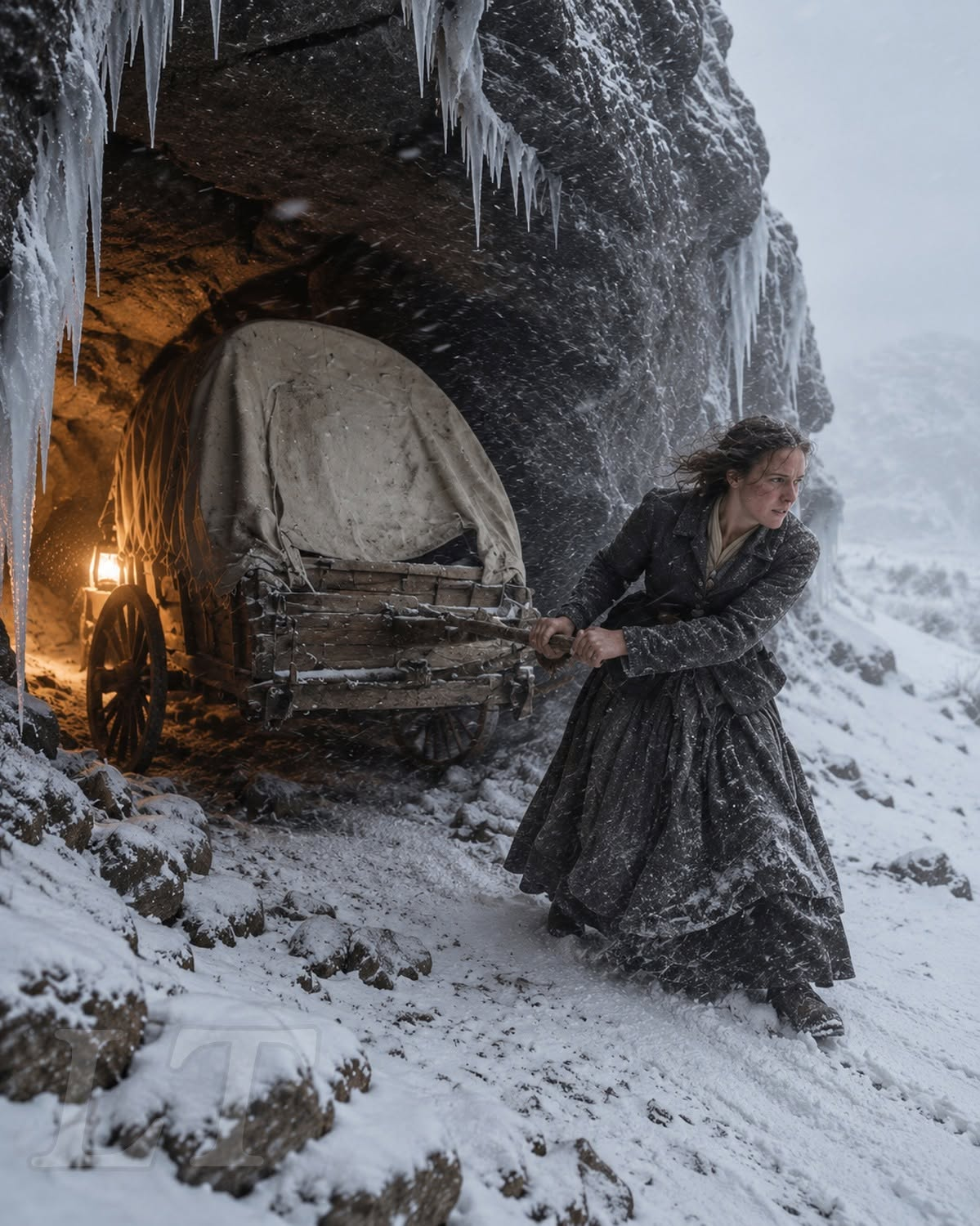
The freezing water reached Elsa's waist.
She struggled to keep her balance as another surge rushed through the inner doorway.
The old wooden table shifted across the chamber.
Somewhere behind her, the mule cried out.
Elsa tightened her grip on the lead rope.
"Stay with me!"
She could barely see through the darkness.
The lantern had gone out, and the water had extinguished the small flame in the metal container.
Only a faint gray light entered from the passage.
Elsa held the brass key in one hand.
The tag attached to it carried three words.
EASTERN EXIT — EMERGENCY RELEASE.
Beyond the flooded chamber, a narrow stone staircase rose toward another wooden door.
It was their only chance.
She looked toward the mother mountain lion.
The animal had moved its young onto a raised section of stone.
Its injured leg was stretched awkwardly beneath its body.
The smaller animal pressed against its mother.
Elsa could not leave them in the rising water.
But she could not rescue them either.
She had to move the mule first.
She pulled the lead rope toward the staircase.
The animal resisted.
Its hooves slipped against the submerged stone floor.
Elsa moved closer and placed her hand against its face.
"Come on, old friend. We're going home."
The mule raised its head.
Then, slowly, it followed.
Elsa guided it toward the staircase.
The water continued rising behind them.
When they reached the first step, she stopped.
The staircase was narrow and steep.
The mule could climb it, but the flooded passage made every movement dangerous.
Elsa climbed one step and pulled gently.
The animal placed its front hooves on the stone.
Then it climbed another.
Behind them, a tremendous crash echoed through the chamber.
Elsa turned.
The old inner door had broken away from its frame.
Water rushed through the opening with increasing force.
The mountain lions retreated farther onto the raised ledge.
Elsa looked at them.
The mother was watching her.
For a brief moment, their eyes met.
Then Elsa continued upward.
She reached the top of the staircase and found the second wooden door.
The brass key fitted into an old iron lock.
She inserted it.
The mechanism resisted.
Elsa turned the key with both hands.
A metallic click sounded.
The lock opened.
She pushed against the door.
It did not move.
Something heavy was blocking it from the other side.
Elsa examined the frame.
A horizontal wooden beam had been installed across the exterior.
The emergency release mechanism mentioned in the old documents was probably designed to remove it.
She searched the surrounding stone.
Near the right side of the frame, she found a small metal handle.
It was almost completely hidden beneath dirt.
She pulled.
Nothing happened.
She pulled again.
A heavy mechanical sound traveled through the wall.
Then the wooden beam shifted.
Elsa pushed against the door.
This time, it moved.
A narrow opening appeared.
Cold air rushed inside.
Elsa widened the gap and looked through.
The passage beyond was dark, but she could see the outline of snow-covered rocks.
She had found the eastern exit.
For the first time in hours, hope became something more than a desperate thought.
She turned toward the mule.
"Almost there."
The animal climbed the remaining steps.
Elsa guided it through the doorway.
They emerged onto a narrow ledge beneath the eastern side of the ridge.
The blizzard was still raging.
Snow swept across the rocks.
But the opening was protected by a natural overhang.
Elsa looked toward the horizon.
She could not see much.
The entire landscape was white.
However, she noticed a shallow depression leading downward from the ledge.
The old map had shown this route.
It connected the hidden shelter to the lower eastern slope.
She had found the escape passage.
But the storm was still dangerous.
She could not travel far in the darkness.
She secured the mule beside the rock wall and checked its condition.
The animal was exhausted.
Its legs trembled.
Elsa removed the wet blanket and replaced it with the driest remaining section of wool.
Then she examined her own clothing.
Her coat was soaked.
Her shoulder hurt.
Her left knee had become swollen.
Her hands were badly scraped.
She needed warmth.
She needed food.
And she needed to survive until the storm weakened.
Elsa looked back toward the opening.
The mother mountain lion was still visible inside the chamber.
The animal had moved closer to the staircase.
Its young followed.
Elsa watched them for several seconds.
She could not bring them outside safely.
But the eastern doorway remained open.
Perhaps the animals could eventually find their own way through the passage.
She decided not to close it.
Instead, she pulled the door partly across the frame, leaving enough space for movement.
Then she sat beside the mule.
The storm continued throughout the night.
Elsa did not sleep deeply.
She kept the animal close and used the rock overhang as protection.
Whenever the wind became stronger, she moved farther beneath the stone.
She collected small amounts of clean snow and placed them in the Dutch oven.
The water melted slowly.
She drank only what she needed.
The remaining hardtack provided little nourishment, but it kept her from becoming completely exhausted.
Hours passed.
The sky remained dark.
Then, sometime before dawn, the wind began changing.
The strongest gusts became less frequent.
The snow still fell, but it no longer struck the rocks with the same violence.
Elsa lifted her head.
She listened.
The terrible roar that had surrounded the mountain for hours was beginning to fade.
She looked toward the eastern slope.
A faint line of gray appeared beyond the ridge.
Morning was approaching.
Elsa stood carefully.
Her legs were stiff.
She checked the mule.
The animal raised its head.
She stroked its neck.
"One more day."
She did not know whether the storm had ended.
But she knew she had survived the night.
That was enough.
As the first daylight reached the rocks, Elsa examined the slope below the eastern exit.
The snow was deep.
But the terrain was not completely impassable.
She recognized several formations from the old map.
A narrow ridge extended toward the southeast.
Beyond it lay a shallow valley.
If she could reach the valley, she might find protection from the wind.
She prepared to move.
Before leaving, she returned to the hidden doorway.
She wanted to retrieve the old documents.
They might contain information about the shelter that could help future travelers.
She entered carefully.
The water inside the chamber had begun receding through the drainage channel.
The wooden table lay overturned.
Several papers floated near the wall.
Elsa retrieved the map and the documents bearing Thomas Whitaker's name.
She wrapped them in the remaining dry cloth.
Then she examined the rear passage.
The mountain lions were gone.
Only several tracks remained in the wet soil.
She followed them with her eyes.
They appeared to lead toward a narrow opening farther inside the chamber.
The animals had found another route.
Elsa felt relieved.
She had not wanted them trapped behind the fallen sandstone.
She returned to the eastern exit.
Then she noticed something beside the wooden doorway.
A small leather pouch had been wedged beneath the lower frame.
It had probably been hidden there for decades.
Elsa picked it up.
Inside were several old coins, a folded letter, and a small metal badge.
The letter was addressed to a man named Henrik Whitaker.
Elsa stared at the surname.
Her brother had the same first name.
But that did not necessarily mean anything.
She opened the letter.
The writing was faded, but readable.
It described the construction of the shelter and the travelers who had used it during the winter of 1872.
The final paragraph contained a family name.
Whitaker.
The letter explained that Thomas Whitaker had left the shelter to his younger brother's family, hoping it would remain available to anyone caught in dangerous weather.
Elsa folded the paper carefully.
She had discovered an important piece of local history.
But she could not remain there.
She placed the letter inside the pouch and secured it in her coat.
Then she prepared the mule.
The descent was slow.
Elsa walked ahead, testing the snow with a wooden stick.
The mule followed carefully.
Several times, the animal slipped.
Each time, Elsa stopped and waited until it regained its balance.
The eastern slope eventually led into a narrow valley.
The wind was weaker there.
Large sandstone formations provided protection from the worst of the weather.
Elsa found a small depression between two rocks and rested.
She examined the mule's legs.
One hoof had developed a small cut.
She cleaned it with water and wrapped it with a strip of cloth.
Then she rested beside the animal.
The sun appeared briefly through the clouds.
Its light illuminated the snow-covered valley.
For the first time since the storm began, Elsa could see beyond a few feet.
The landscape was enormous.
The ridge stretched across the horizon.
Snow covered the grasslands.
No buildings were visible.
But the weather was changing.
The clouds were beginning to break apart.
Elsa looked toward the southeast.
She knew the general direction of Henrik's homestead.
If the storm continued weakening, she might be able to reach it within a day or two.
She gathered her strength and continued.
The journey was difficult.
Her knee hurt.
Her shoulder had stiffened.
The mule moved slowly.
But they kept going.
By late afternoon, the clouds had lifted enough for Elsa to recognize distant landmarks.
She found a narrow trail beneath the snow.
It followed the valley toward the south.
She remembered seeing a similar route on the old map.
It eventually connected with the main trail.
Elsa followed it.
As evening approached, she spotted something in the distance.
A dark shape.
At first, she thought it was another rock formation.
Then she noticed a thin column of smoke rising into the sky.
A chimney.
Someone was living nearby.
Elsa stopped.
She could hardly believe what she was seeing.
She guided the mule toward the smoke.
The path became easier as the valley opened.
Several minutes later, she saw a small wooden building.
Then another.
A cluster of structures stood beside a frozen creek.
It was an abandoned-looking ranch.
But smoke was rising from one chimney.
Elsa approached cautiously.
A dog began barking.
A man stepped out of a wooden doorway.
He was middle-aged, wearing a heavy coat and a wool hat.
He stared at her.
Then his expression changed.
"Good Lord! Are you alive?"
Elsa tried to answer.
Her voice was weak.
"I need help."
The man hurried toward her.
He took the mule's lead rope and guided them toward the barn.
His wife appeared behind him.
She brought a blanket and helped Elsa inside.
They gave her warm water and a small bowl of soup.
Elsa sat beside the stove.
For several minutes, she could barely speak.
Her hands shook as the warmth returned to them.
The rancher's wife examined her shoulder and knee.
She cleaned the wounds and wrapped them with fresh bandages.
The rancher introduced himself as Samuel Carter.
His wife was named Margaret.
They had been living at the ranch for nearly twelve years.
Samuel listened carefully as Elsa explained where she had come from and what had happened.
When she mentioned the sandstone hollow, his expression became serious.
"You found the old Whitaker shelter?"
Elsa nodded.
Samuel looked at Margaret.
Neither spoke for several seconds.
Then Samuel explained that the shelter had been known to local ranchers for generations.
Most people believed its entrance had collapsed decades earlier.
A few travelers had claimed to hear animals moving inside the rocks.
But nobody had been able to investigate.
Elsa reached into her coat and removed the old documents.
Samuel examined the handwriting.
His expression changed when he saw the name Thomas Whitaker.
"My grandfather used to tell stories about that man."
He explained that Thomas had helped travelers survive several terrible winters.
He had built shelters along the ridge and stored food for anyone who needed protection.
The hidden chamber was one of his projects.
Samuel looked at Elsa.
"You found something important."
Elsa placed the brass key on the table.
Samuel examined it carefully.
Then he smiled.
"You didn't just survive that storm. You found a piece of history."
The next morning, Samuel helped Elsa arrange transportation toward Buffalo.
The rancher had a supply wagon traveling in that direction.
He offered to take her and the mule as far as the main trail.
Elsa accepted gratefully.
Before leaving, she asked whether Samuel knew anything about a homestead belonging to a man named Henrik Doll.
Samuel thought for a moment.
Then he nodded.
"There's a Norwegian family living near the southern creek. The man's name is Henrik."
Elsa felt her eyes fill with tears.
For the first time in many days, she allowed herself to smile faintly.
She was close.
Very close.
The journey continued for several hours.
The weather remained cold, but the sky was clear.
The mule rested in the supply wagon.
Elsa sat beside Samuel, holding the old leather pouch.
When they reached the southern creek, Samuel pointed toward a small homestead beyond a line of cottonwood trees.
A wooden house stood beside a barn.
Smoke rose from its chimney.
Elsa recognized the shape of the property from the description her brother had sent months earlier.
She climbed down from the wagon.
Her legs were weak.
She walked toward the house.
The front door opened.
A tall man stepped outside.
He stared at her.
Then he dropped the piece of firewood in his hands.
"Elsa?"
She stopped.
"Henrik."
Her brother hurried toward her.
He wrapped his arms around her and held her tightly.
For several moments, neither spoke.
Then Henrik stepped back and examined her face.
"What happened?"
Elsa looked at him.
"I got caught in the blizzard."
He looked toward the wagon.
Then at the mule.
Then back at his sister.
He understood that the story was much larger than those few words.
He helped her inside.
The house was warm.
A fire burned in the stove.
A pot of food simmered on the table.
Henrik's wife, Anna, hurried forward and wrapped Elsa in a blanket.
They gave her warm soup.
They cleaned her injuries again.
Then Henrik sat beside her and listened.
Elsa told him everything.
The broken wagon.
The approaching storm.
The sandstone hollow.
The wooden barrier.
The falling rocks.
The bear.
The mountain lions.
The hidden chamber.
And the eastern exit.
Henrik listened without interrupting.
When she finished, he remained silent.
Then he looked at her hands.
They were bruised and covered with small cuts.
He gently took one of them.
"Father would have been proud."
Elsa lowered her eyes.
For the first time since the storm began, tears came.
Not from fear.
Not from pain.
But from the relief of finally being somewhere safe.
Henrik placed another log on the fire.
Anna prepared a warm bath.
The mule was given food, fresh water, and a dry stall.
For the next several days, Elsa rested.
Her injuries slowly improved.
Her strength returned.
The swelling in her knee decreased.
Her shoulder healed.
And the terrible exhaustion that had followed her through the storm gradually disappeared.
During those quiet days, she showed Henrik the old documents.
He recognized several family names.
One belonged to a Norwegian carpenter who had settled in the region decades earlier.
Another appeared in the records of an early trading post.
The discovery fascinated him.
Together, they began organizing the papers.
Samuel Carter later sent word that the old shelter should be inspected when the weather improved.
Henrik agreed to help.
When spring arrived, the brothers and sisters of the surrounding ranching community organized a small expedition to the sandstone ridge.
Elsa returned with Henrik and Samuel.
They found the hollow partially covered by fallen snow and rock.
The wooden wagon barrier was damaged beyond repair.
But the hidden chamber remained accessible through the eastern entrance.
The drainage system had survived.
The old documents were preserved.
The mountain lions had left several tracks near the rear passage, but no animals remained inside.
The group carefully cleared the eastern route and repaired the entrance.
They also built a simple wooden sign near the ridge.
It carried a message:
WHITAKER WINTER SHELTER
OPEN TO ANY TRAVELER IN NEED.
Henrik suggested that they restore the chamber with supplies.
They brought blankets, dried food, tools, and a small emergency lantern.
Samuel arranged for nearby ranchers to check the shelter regularly.
Elsa insisted that the drainage system be inspected before the next winter.
She knew how close she had come to losing everything.
The community agreed.
By the following autumn, the shelter had become a reliable refuge again.
Travelers crossing the ridge could find protection there during dangerous weather.
And Elsa's experience became part of the story told around the ranching community.
Some people remembered her as the woman who dragged a broken wagon into a rock hollow.
Others remembered how she survived a blizzard that had buried the eastern trail.
But Elsa never described herself as brave.
Whenever someone asked how she had managed to survive, she gave the same answer.
"I remembered what my father taught me."
Years later, she kept his old wooden tool box beside the fireplace in her home.
The hammer remained inside.
So did the chisel and the iron fittings.
The tools were worn.
Some were damaged.
But she never replaced them.
They reminded her of the night when everything seemed lost.
The night when a broken wagon became a wall.
When a hidden chamber became a lifeline.
And when patience, determination, and the lessons of a loving father gave one woman a chance to see another morning.
Elsa eventually built a peaceful life near Henrik's homestead.
She found work repairing wagons and maintaining wooden structures for neighboring ranchers.
Her practical skills became well known.
She helped families prepare their homes for winter.
She taught younger women how to repair equipment, secure supplies, and recognize dangerous weather.
She also made certain that the Whitaker shelter remained stocked and accessible.
The mule recovered completely.
It lived many more years at the homestead, spending its days in a comfortable pasture.
Whenever Elsa walked through the barn, the old animal would lift its head and approach her.
She always brought it a piece of apple.
Sometimes she would rest her forehead against its neck, remembering the journey that had nearly ended in the mountains.
She never forgot the bear.
She never forgot the mountain lions.
And she never forgot the sound of sandstone collapsing above her.
But those memories no longer controlled her.
They had become part of a story about survival.
One spring morning, Elsa stood outside her home and looked toward the distant ridge.
The snow had disappeared.
Wild grass covered the valley.
The creek ran freely beneath the cottonwood trees.
Henrik approached carrying two cups of coffee.
He handed one to his sister.
"Thinking about that terrible winter again?"
Elsa looked at the mountains.
"Sometimes."
"Does it still frighten you?"
She considered the question.
Then she shook her head.
"No. Not anymore."
She looked at the wooden tool box visible through the open doorway.
"Now it reminds me how much can be saved when you refuse to give up."
Henrik smiled.
They stood together in the morning sunlight.
Behind them was a warm home.
Beside them was family.
And beyond the ridge stood a shelter that would give other travelers the same chance Elsa had once fought so desperately to find.
The woman who had entered the Wyoming wilderness with a broken wagon and almost nothing left had finally found what she had been searching for all along.
Not merely a place to survive.
But a place to belong.
And every winter, when the first snow covered the plains, a lantern was placed inside the old Whitaker shelter.
Its light remained visible through the darkness.
A quiet promise to anyone still traveling through the frozen wilderness:
There was somewhere to go.
There was warmth waiting.
And no traveler would have to face the storm alone.






Comments 0